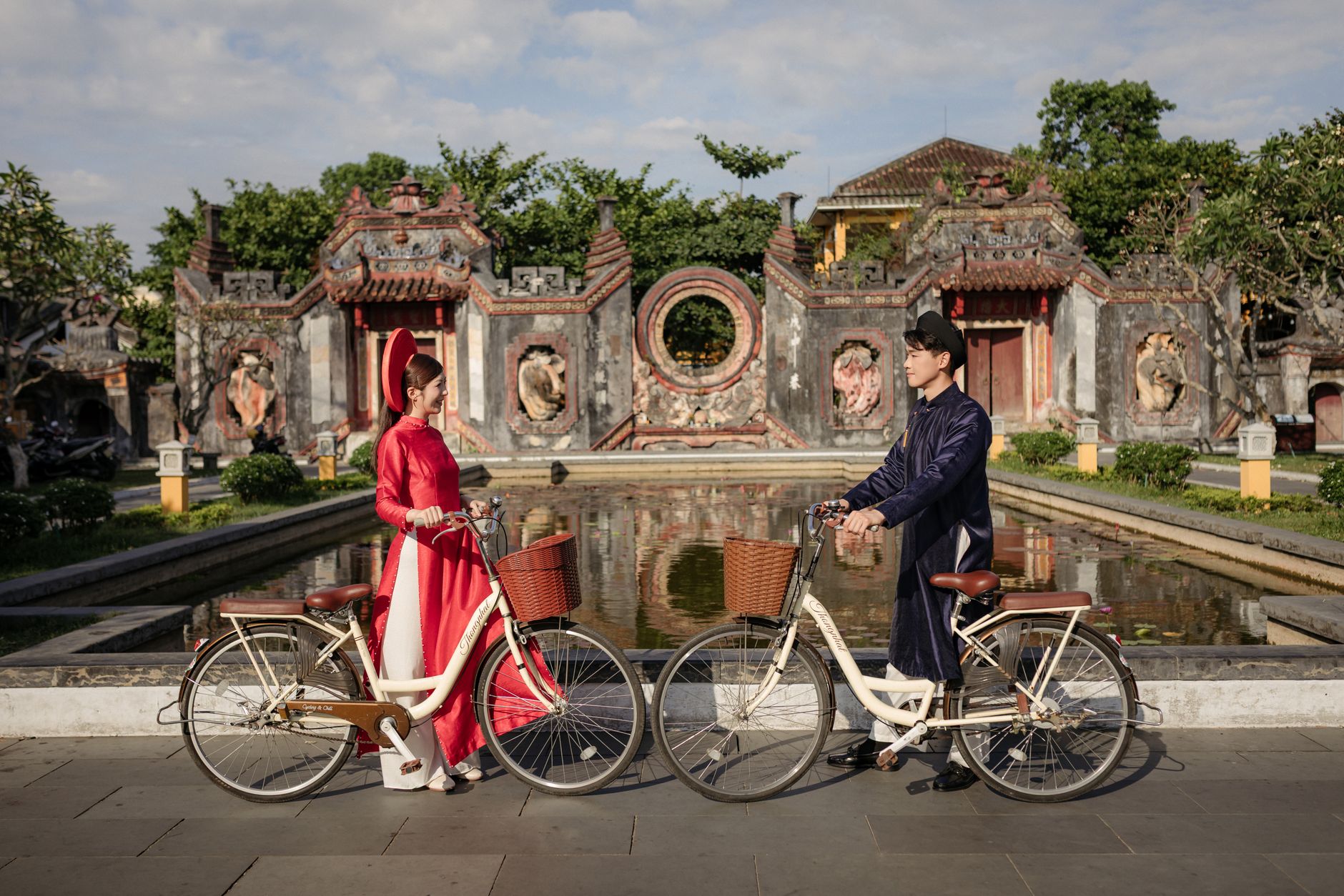
The good news is that Vietnam is forgiving. Unlike some destinations where a wardrobe misstep gets you barred from entry, Vietnam's dress code is mostly common sense. Covered shoulders and knees at temples. Clean, modest clothing in villages. Nothing too revealing in rural areas. Beyond that, you have room to breathe.
This guide breaks down what to wear for temples, cities, and everything in between. It also covers the cultural logic behind the rules, so you understand why you are dressing a certain way, not just what to pack.
Temple dress code: the non-negotiable basics
Vietnam has tens of thousands of pagodas and temples. From the Perfume Pagoda near Hanoi to the Cao Dai Holy See in Tay Ninh, these are active religious sites, not museum pieces. Locals come to pray, burn incense, and seek guidance. Your clothing should reflect that.
The rules are simple:
- Cover your shoulders. No tank tops, no strapless dresses, no sleeveless shirts.
- Cover your knees. Shorts and skirts must reach at least to the knee. Mini skirts and short shorts are not acceptable.
- Remove your shoes. You will take off footwear before entering the main sanctuary hall. This applies at most temples and all pagodas.
- Avoid sheer or tight clothing. Modesty is the goal. Anything see-through or body-hugging reads as disrespectful.
Men are not exempt. A shirt with sleeves and long trousers or knee-length shorts work fine. Women have more flexibility. Loose trousers, maxi skirts, and long dresses are all good choices.
What happens if you show up in a tank top and short shorts? At major tourist sites like the Temple of Literature in Hanoi or the Marble Mountains in Da Nang, staff will often lend you a robe or sarong to cover up. At smaller local temples, you might get a stern look or be asked to leave. Neither experience is pleasant.
The practical solution is to carry a lightweight scarf or sarong in your day bag. It weighs almost nothing and turns any outfit into temple-appropriate attire in seconds. This is especially useful if you are visiting temples spontaneously, which happens often in Vietnam. A pagoda might appear around the corner of a busy street, and you will want to step inside.
For a deeper breakdown of the rules, see our guide to temple etiquette in Vietnam: what to wear, do and avoid. It covers everything from incense handling to proper bowing posture.
Why the dress code exists
Vietnamese temple dress codes come from Buddhist and Confucian traditions. The idea is that physical modesty supports mental focus. When you cover your body, you signal that you are there for spiritual reasons, not to attract attention.
The same logic applies to behavior. Loud voices, public affection, and pointing at statues are all discouraged inside temple grounds. Dress is just the most visible part of a broader code of respect.
If you want to understand the religious context better, read Buddhism and pagodas in Vietnam: a traveler's guide to temples and rituals. It explains the difference between a temple, a pagoda, and a communal house, and why each has its own rules.
City dress code: casual but covered
Vietnamese cities are more relaxed than temples, but they are not beach towns. Locals in Hanoi and Ho Chi Minh City dress neatly, even for casual errands. You will rarely see Vietnamese women in crop tops or men shirtless outside of swimming pools. Tourists get some leeway, but dressing closer to local norms makes interactions smoother.
The everyday uniform for Vietnamese women is often a T-shirt or blouse with trousers or a long skirt. Men wear collared shirts or plain T-shirts with jeans or chinos. Sneakers and sandals are fine. Flip-flops are common for quick errands but less so for nicer restaurants.
For travelers, the practical approach is:
- Lightweight long trousers for evenings and temples
- Breathable tops with sleeves, short or long
- A light jacket or cardigan for air-conditioned spaces
- Comfortable walking shoes for exploring
- Sandals for markets and beach towns
The heat is the main challenge. Vietnam is hot and humid for most of the year. The solution is not to wear less, but to wear the right fabrics. Linen, cotton, and bamboo viscose breathe well and dry quickly. Synthetic fabrics like polyester trap sweat and smell bad by midday.
How to dress for Hanoi
Hanoi has four distinct seasons, though summer dominates from May to September. Winters can drop to 10°C (50°F), which catches many travelers off guard. If you are visiting between November and February, pack a warm jacket and layers. The cold in Hanoi is damp, so it feels colder than the thermometer suggests.
In summer, Hanoi is hot and prone to sudden downpours. A compact umbrella or packable rain jacket is essential. Locals wear everything from ao dai to business suits, but tourists can get away with smart casual. For a full guide to the capital, see visiting Hanoi: the complete travel guide to Vietnam's capital.
How to dress for Ho Chi Minh City
Saigon is warm year-round, with temperatures rarely dropping below 25°C (77°F). The dress code is more relaxed than Hanoi. Shorts are acceptable in most settings, though not at temples or upscale restaurants. Lightweight trousers and cotton tops work best.
The city is also a motorbike city. If you plan to ride, consider long trousers and closed shoes. They protect against sunburn and road rash in case of a fall. For more on the two-wheeled culture, see motorbike culture in Vietnam: why 45 million scooters rule the streets.
What to wear in Hoi An
Hoi An is the tailoring capital of Vietnam. Many visitors arrive with a half-empty suitcase and leave with custom-made clothes. The town's style is breezy and romantic. Linen shirts, flowing dresses, and tailored trousers fit right in.
If you are planning to get clothes made, bring reference photos and allow at least two days for fittings. A custom ao dai, Vietnam's national dress, is a popular souvenir. Learn more about its history and where to see it in our piece on ao dai: the story of Vietnam's national dress and where to see it today.
Regional differences in dress
Vietnam stretches over 1,600 kilometers from north to south. The climate and culture shift dramatically along the way. What works in Hanoi might not suit the Mekong Delta, and vice versa.
| Region | Climate | Key clothing considerations | Best fabrics |
|---|---|---|---|
| North (Hanoi, Sapa, Ha Giang) | Four seasons; cold winters, hot humid summers | Layers for winter; rain gear for summer; warm jacket for mountain towns | Wool, fleece, linen, cotton |
| Central (Hue, Da Nang, Hoi An) | Hot year-round; rainy season Sept-Dec | Lightweight everything; rain jacket essential in autumn | Linen, cotton, quick-dry |
| South (Saigon, Mekong Delta) | Hot and humid year-round; rainy season May-Oct | Breathable fabrics; rain poncho; sun protection | Cotton, bamboo, quick-dry |
| Highlands (Da Lat, Buon Ma Thuot) | Cool year-round; evenings can be cold | Jacket or sweater for evenings; comfortable walking shoes | Fleece, cotton, denim |
For a month-by-month breakdown of weather across the country, see Vietnam weather by month: the best time to visit each region.
The north: Sapa and the mountains
Sapa and the northern highlands are a different world. Temperatures drop sharply at altitude. Even in summer, evenings can be cool. In winter, it can drop near freezing. Pack a proper jacket, thermal layers, and sturdy shoes for trekking.
The ethnic minority communities in Sapa, Ha Giang, and Mai Chau have their own dress traditions. The H'Mong are known for their indigo-dyed hemp clothing and intricate embroidery. The Red Dao wear bright red headscarves and silver jewelry. If you visit their villages, dress modestly and ask before taking photos. Our guide to H'Mong culture in Vietnam: markets, textiles and homestays in the northern mountains covers what to expect.
The central coast: Hue and Da Nang
Hue is the former imperial capital, and its dress code leans conservative. When visiting the Imperial City and royal tombs, wear long trousers and covered shoulders. The same rules as temples apply.
Da Nang is more relaxed. It is a beach city, so swimwear is fine at the coast. But cover up when you leave the sand. Walking through the city in a bikini will draw stares and is considered disrespectful.
Hoi An sits between the two, both geographically and culturally. The Ancient Town is a UNESCO site and feels like an open-air museum. Modest, elegant clothing fits the vibe. For more on choosing between the two cities, see Hoi An vs. Hue: which ancient city suits your travel style in 2026.
Practical packing advice for 2026
The key to packing for Vietnam is versatility. You will move between climates, settings, and activities. A capsule wardrobe works best.
Here is a suggested packing list for a two-week trip:
- 5-7 tops (T-shirts, blouses, light shirts)
- 2-3 pairs of trousers (lightweight, breathable)
- 1-2 pairs of shorts (for beach towns and hot days)
- 1 long skirt or dress (for temples and nicer dinners)
- 1 light jacket or cardigan (for air conditioning and cool evenings)
- 1 warm layer (fleece or sweater, essential for the north)
- 1 rain jacket or compact poncho
- 3-4 pairs of socks (quick-dry material)
- Comfortable walking shoes (broken in before you arrive)
- Sandals or flip-flops (for beaches and hostel showers)
- 1 sarong or large scarf (doubles as temple cover-up and beach towel)
- Sun hat and sunglasses
This list covers most itineraries. If you are doing a longer trip, you can do laundry along the way. Most hotels and homestays offer laundry services for VND 20,000-50,000 (USD 0.80-2) per item. Budget guesthouses often wash by hand, so quick-dry fabrics help.
For a complete two-week route, see two weeks in Vietnam 2026: the only first-timer itinerary you need.
What not to pack
Some items are better left at home:
- Heavy jeans. They take forever to dry and are uncomfortable in heat. If you must bring them, save them for the north in winter.
- Formal wear. Vietnam is not a suit-and-tie destination. Even upscale restaurants accept smart casual.
- White shoes. The streets are dusty, and rainy season turns sidewalks into mud. White sneakers will not stay white.
- Too many shoes. Stick to two pairs maximum. You will walk a lot, and your feet will thank you.
Buying clothes in Vietnam
Vietnam is a great place to buy clothes, especially if you forget something or want to dress more locally. Markets sell cheap T-shirts, trousers, and accessories. Hoi An is the tailoring capital, but Hanoi and Saigon also have skilled tailors.
Prices at markets are negotiable. A decent T-shirt costs VND 100,000-200,000 (USD 4-8). Linen trousers run VND 200,000-400,000 (USD 8-16). For bargaining tips, see bargaining in Vietnam: complete guide to negotiating like a local in 2026.
The non la, Vietnam's conical hat, is both practical and iconic. It keeps sun and rain off your face. A genuine one costs VND 30,000-80,000 (USD 1.20-3.20) at local markets. Learn how to spot a real one in our guide to the non la: Vietnam's conical hat, where it is made and how to buy a real one.
Cultural etiquette beyond clothing
Dressing appropriately is part of a larger code of respect. Understanding a few basics will help you navigate social situations with confidence.
The concept of face
In Vietnam, "face" refers to social standing and reputation. Causing someone to lose face is a serious breach of etiquette. This affects everything from bargaining to giving feedback. If a shopkeeper quotes a high price, walk away rather than argue. If a restaurant serves something you dislike, eat what you can and move on. Public confrontation is always counterproductive.
For a deeper explanation, read the concept of face in Vietnam: why saving face shapes every interaction.
Greetings and body language
A slight bow with a smile is the standard greeting. Handshakes are common in business settings, but not universal. Use both hands when giving or receiving anything, from money to business cards. Avoid touching someone's head, as it is considered sacred in Buddhist culture.
More tips are available in our guide to Vietnamese greetings and social etiquette: a practical guide for travelers.
Photography etiquette
Taking photos at temples and markets is generally fine, but always ask before photographing people, especially ethnic minority communities. Some hill tribe women will expect a small payment for photos. It is customary to pay VND 10,000-20,000 (USD 0.40-0.80) if you take a portrait.
For more on this topic, see photography etiquette in Vietnam: when to ask, when to pay and where not to shoot.
Shoes and feet
Shoes come off at temples, pagodas, and many private homes. Pay attention to where locals remove their shoes and follow suit. Your feet are considered the lowest part of the body, both literally and symbolically. Never point your feet at someone or at a religious statue. When sitting on the floor, tuck your feet underneath you.
Special occasions and festivals
Vietnam's festival calendar offers chances to see traditional dress in action. The Tet Nguyen Dan, or Lunar New Year, is the biggest celebration. During Tet, many people wear new clothes, often in red or bright colors, to symbolize a fresh start. If you are in Vietnam during Tet, dress festively. Avoid black or dark colors, which are associated with mourning.
The Hung Kings Festival and Mid-Autumn Festival also have their own dress traditions. For a broader look at the lunar calendar and its superstitions, see the lunar calendar and Vietnamese superstitions: what travelers should know.
Rainy season dressing
Vietnam's rainy season varies by region. The north gets heavy rain from May to October. The central coast sees its wet season from September to December. The south has afternoon downpours from May to November.
Rain changes your clothing strategy. A compact umbrella is useful, but a poncho is better for motorbike rides. Locals wear full-length plastic ponchos that cover both rider and bike. You can buy one for VND 20,000-50,000 (USD 0.80-2) at any market.
Quick-dry fabrics become essential in rainy season. Cotton takes hours to dry; synthetic blends dry in minutes. For more on planning around the monsoon, see visiting Vietnam in the rainy season: how to plan around the monsoon.
What to wear for specific activities
Trekking and outdoor adventures
If you are trekking in Sapa, Ha Giang, or Pu Luong, invest in proper gear. Waterproof hiking boots, moisture-wicking socks, and a daypack are non-negotiable. The trails can be slippery, especially after rain. Our trekking in Vietnam: a two-week itinerary through Sapa, Ha Giang and Pu Luong covers the best routes.
Beach time
Vietnam's beaches range from party central in Nha Trang to quiet escapes in Con Dao. Swimwear is fine on the sand and in the water. Cover up when you leave the beach. A kaftan, sarong, or oversized shirt works well.
For island hopping, see island hopping in southern Vietnam: Phu Quoc, Con Dao and Nam Du.
Nightlife
Vietnamese nightlife is casual. A nice shirt and clean trousers for men, a dress or blouse for women, and you fit in anywhere. Upscale rooftop bars in Saigon may enforce a smart-casual dress code, but nothing stricter.
Markets and street food
Markets are casual, but practical. Wear closed-toe shoes to protect against dropped skewers and spilled broth. Bring a reusable bag for purchases. For tips on navigating the chaos, see Vietnam's food markets: how to visit, eat and shop like a local.
Frequently asked questions
Q: Can I wear shorts in Vietnam? Yes, shorts are fine in beach towns, markets, and casual restaurants. Avoid them at temples, pagodas, and when visiting rural villages. In Hanoi and Saigon, knee-length shorts are acceptable in most settings.
Q: Do I need to cover my head at temples? No. Unlike some religions, Buddhism does not require head coverings. Hats are fine outdoors, but remove them when entering the main sanctuary hall as a sign of respect.
Q: What should women wear to a pagoda in Vietnam? Covered shoulders and knees are the minimum. Loose trousers, a long skirt, or a maxi dress all work. Avoid tight, sheer, or low-cut clothing. Carry a scarf or sarong as a backup.
Q: Are there dress codes for restaurants in Vietnam? Most restaurants are casual. Upscale establishments in Hanoi and Saigon may expect smart casual, but you will rarely need formal wear. When in doubt, dress one step above the venue's apparent vibe.
Q: What is the best fabric to wear in Vietnam's heat? Linen, cotton, and bamboo viscose are the best choices. They breathe well and wick moisture. Avoid polyester and other synthetics, which trap sweat and cause discomfort.
Q: Should I buy clothes in Vietnam or bring everything from home? Bring a basic capsule wardrobe and buy extras in Vietnam if needed. Hoi An is excellent for tailored clothing. Markets sell affordable T-shirts and trousers. Just remember to bargain.
Q: Is it okay to wear ao dai as a foreigner? Yes, wearing the ao dai is generally appreciated as a sign of respect for Vietnamese culture. It is appropriate for festivals, formal events, and photo shoots. Avoid wearing it for everyday activities like market shopping.
Final practical notes
The golden rule for dressing in Vietnam is simple: when in doubt, cover up. A little extra fabric costs nothing and avoids awkward situations. A sleeveless shirt becomes acceptable with a light overshirt. Short shorts become fine with a long skirt over them.
Carry a day bag with a scarf, a compact umbrella, and a reusable water bottle. These three items solve most wardrobe emergencies. The scarf covers shoulders at temples and serves as a light blanket on air-conditioned buses. The umbrella handles both sun and rain. The water bottle keeps you hydrated in the heat.
Vietnam rewards travelers who adapt. Dress for the place you are in, not the place you left. The result is smoother interactions, better photos, and a deeper connection to the culture. For more on navigating daily life, see nod, smile, and swipe: how to survive Vietnam without speaking Vietnamese.