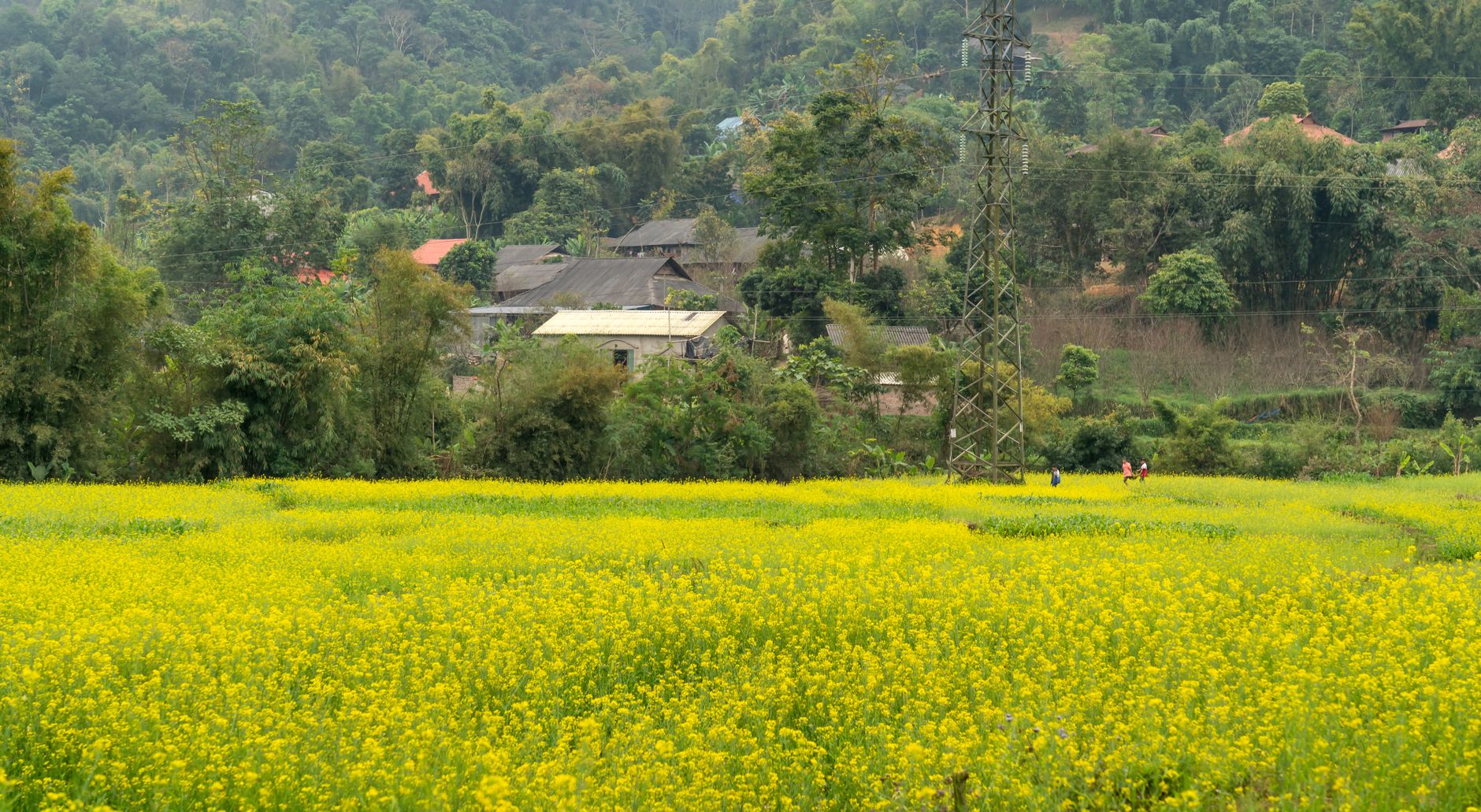
Vietnam is home to 54 official ethnic groups. The H'Mong are the eighth largest, with over one million people. They arrived from southern China over 300 years ago, pushed south by conflict and land pressure. Today they live primarily in the provinces of Ha Giang, Lao Cai (home to Sapa), Lai Chau, and Cao Bang.
This guide covers who the H'Mong are, their subgroups, where to meet them respectfully, how to understand their textiles, and how to behave as a guest in their homes.
Who are the H'Mong? Understanding the subgroups
The H'Mong divide themselves into groups based on traditional clothing colors and patterns. These are not rigid ethnic divisions. They reflect regional styles and historical migration patterns.
Black H'Mong (H'Mong Den) are the largest subgroup in Vietnam. They live mostly around Sapa and in parts of Ha Giang. Women wear deep indigo-dyed hemp clothing, almost black. Their jackets are trimmed with small embroidered collars and silver buttons. Men wear simpler versions of the same dark indigo.
Flower H'Mong (H'Mong Hoa) wear the most colorful clothing. Their homes are concentrated in Ha Giang province, particularly around Dong Van and Meo Vac. Women's skirts and headscarves explode with bright red, green, yellow, and pink embroidery. The name "Flower H'Mong" comes from this vibrant dress.
White H'Mong (H'Mong Trang) traditionally wore undyed hemp clothing. Today they incorporate indigo and some embroidery, but their style remains more subdued. They live mainly in Ha Giang and parts of Lai Chau.
Red H'Mong (H'Mong Do) are a smaller subgroup found in Lao Cai and Ha Giang. Their clothing features red accents, particularly on headscarves and collars.
Pro tip: Do not ask H'Mong people to change their clothing for photographs. The traditional dress they wear daily is authentic. Requesting "traditional costume" for photos reduces their culture to a prop.
Where to meet H'Mong communities respectfully
Three main regions offer access to H'Mong villages without turning them into tourist spectacles.
Sapa: The most accessible but busiest option
Sapa town sits at 1,600 meters in Lao Cai province. It is the most developed base for H'Mong village visits. Cat Cat Village, just 2 kilometers from town, is a Black H'Mong settlement. It has become heavily commercialized with entrance fees and souvenir stalls.
Better options lie further out. Ta Van Village is home to both Black H'Mong and Giay people. Lao Chai Village offers a longer trek through rice terraces. Both require walking through fields and crossing streams. The best time to visit the northern mountains for trekking is September to November when rice terraces are golden.
Sapa receives heavy rain from June to August. Traveling to Vietnam in May can work for Sapa if you prepare for afternoon showers. What to wear in Vietnam in May female travelers should pack waterproof boots and layers.
Ha Giang: The most authentic experience
Ha Giang province sees far fewer tourists than Sapa. The H'Mong population here is larger and more diverse. Dong Van Town and Meo Vac Town are centers for Flower H'Mong communities.
The Ha Giang Loop is a 350-kilometer motorbike circuit through limestone karsts and H'Mong villages. Most travelers complete it in 3 to 4 days. The Ha Giang Loop: The Honest 2026 Guide provides full route details.
Dong Van Market operates every Sunday morning. It draws H'Mong from surrounding villages who come to trade livestock, textiles, and food. This is not a tourist market. It is a working market where H'Mong people conduct real business. Photography requires asking permission first.
Warning: Some tour operators in Ha Giang run "homestay experiences" that involve brief visits to staged villages. Look for homestays where you sleep in a family's actual home, not a purpose-built guesthouse.
Bac Ha Market: The Sunday spectacle
Bac Ha Market is the most famous ethnic market in northern Vietnam. It runs every Sunday from early morning until mid-afternoon. The market sits in Lao Cai province, about 80 kilometers from Sapa.
Flower H'Mong dominate this market. They arrive on foot and by motorbike, often traveling for hours. The market sells everything from buffalo meat to handmade silver jewelry. The textile section is the most visually stunning. Women sit on the ground surrounded by bolts of handwoven hemp, embroidered jackets, and indigo-dyed fabric.
What day is the Bac Ha Market? provides exact scheduling details. Arrive by 7:00 AM to see the market at its most active.
| Market | Day | Main H'Mong group | Distance from Sapa |
|---|---|---|---|
| Bac Ha | Sunday | Flower H'Mong | 80 km / 2.5 hours |
| Dong Van | Sunday | Flower H'Mong | 150 km / 4 hours |
| Can Cau | Saturday | Flower H'Mong | 70 km from Bac Ha |
| Coc Ly | Tuesday | Flower H'Mong | 30 km from Bac Ha |
| Muong Hum | Sunday | Black H'Mong | 50 km from Sapa |
H'Mong textiles: Indigo, hemp, and embroidery
H'Mong textiles are among the most distinctive in Vietnam. They are entirely handmade. The process takes months.
Hemp cultivation begins the cycle. H'Mong women grow hemp plants on hillside plots. They harvest the stalks, strip the fibers, and spin them into thread on wooden wheels. A single hemp skirt requires weeks of spinning.
Indigo dyeing transforms the pale hemp into deep blue-black fabric. H'Mong women grow indigo plants in small garden patches. They ferment the leaves in water with lime and ash. The fabric is dipped repeatedly, sometimes 20 to 30 times, to achieve the characteristic dark color. Each dip adds depth. The process takes weeks.
Batik wax resist is a specialty of Flower H'Mong women. They draw patterns on white hemp using hot beeswax applied with a bamboo stylus. The fabric is then dyed indigo. The wax resists the dye, leaving white patterns on blue. Common motifs include spirals, snakes, and geometric shapes.
Embroidery comes last. H'Mong women use cross-stitch and chain-stitch techniques. They do not use patterns or sketches. Every design is held in memory and passed from mother to daughter. Colors are bright and symbolic. Red represents life and blood. Green represents forests. White represents purity.
Pro tip: Authentic H'Mong textiles are heavy and slightly rough due to the hemp fiber. If a "H'Mong scarf" feels soft like cotton or polyester, it was factory-made in China. Real H'Mong fabric has visible irregularities in the weave.
Homestay etiquette: How to be a good guest
Staying in a H'Mong homestay offers insight into daily life that no hotel can provide. But it requires cultural awareness.
Remove your shoes before entering the house. The main living space is also the kitchen and dining area. Shoes bring mud from the pig pen and rice field.
Accept rice wine. H'Mong families offer corn wine or rice wine to guests. Refusing is considered rude. You do not need to drink the entire cup. Sipping and setting it down is acceptable. The host will refill your cup. This is normal.
Eat what is offered. H'Mong meals center on rice, stir-fried vegetables, boiled pork, and sometimes forest vegetables. Do not ask for Western food. If you have dietary restrictions, communicate them before arrival, not at the table.
Ask before photographing. This is the most common mistake travelers make. H'Mong people are not exhibits. A simple question with a smile is usually met with permission. Children are especially popular photography subjects, but parents should be asked first.
Participate in daily tasks. Many homestays invite guests to help with cooking, feeding animals, or harvesting vegetables. This is not a performance. It is genuine hospitality. Join in.
Dress modestly. Short shorts and revealing tops are inappropriate in H'Mong villages. What to wear in Vietnam in May female travelers should bring long pants and covered shoulders for village visits.
Bring small gifts. Fruit, cooking oil, or school supplies for children are appreciated. Money is not an appropriate gift for a homestay family.
Practical planning for your H'Mong cultural trip
Getting there
From Hanoi, overnight trains run to Lao Cai station. The journey takes 8 hours. From Lao Cai, buses reach Sapa in 1 hour. Night bus or train to Sa Pa: which is the better option in 2026? compares both options.
For Ha Giang, sleeper buses from Hanoi take 6 to 7 hours. Hanoi to Ha Giang: 3 Routes Compared covers all transport choices.
Best time to visit
The northern mountains have two distinct seasons. The dry season runs from October to April. The rainy season runs from May to September.
| Month | Conditions | Rice terraces | Crowds |
|---|---|---|---|
| March-April | Warm days, cool nights | Green, flooded | Moderate |
| May-June | Rainy, afternoon storms | Growing | Low |
| September-October | Clear, cool | Golden, harvest | High |
| November-February | Cold, possible frost | Bare | Low |
What is the best month to travel to Vietnam? places the northern highlands in context with the rest of the country.
Budget
A homestay in a H'Mong village costs 150,000 to 300,000 VND ($6 to $12) per night including dinner and breakfast. Local guides for trekking cost 500,000 to 800,000 VND ($20 to $32) per day. The cost of living in Vietnam for single person provides broader budget context.
What to buy
Authentic H'Mong textiles make meaningful souvenirs. Look for:
- Hemp scarves dyed with natural indigo: 100,000 to 200,000 VND ($4 to $8)
- Embroidered bags with H'Mong cross-stitch: 150,000 to 300,000 VND ($6 to $12)
- Silver jewelry made by H'Mong silversmiths: 500,000 to 2,000,000 VND ($20 to $80)
- Traditional H'Mong jackets with full embroidery: 800,000 to 1,500,000 VND ($32 to $60)
Bargaining in Vietnam: Complete Guide to Negotiating Like a Local in 2026 explains how to negotiate fairly at markets.
Cultural sensitivity checklist
Do not touch H'Mong people's clothing without permission. The embroidery represents months of work.
Do not give money to children who ask for it. It encourages school dropout. Donate to local schools instead.
Do not walk through rice fields during planting or harvest season. The crops are the family's livelihood.
Do not assume all H'Mong people speak Vietnamese. Many older women speak only their native language. A smile and gesture work better than raised voices.
Beyond the tourist trail
Most travelers visit the Black H'Mong around Sapa and the Flower H'Mong in Ha Giang. Fewer make it to the White H'Mong communities in Lai Chau province or the Red H'Mong in Yen Bai.
Lai Chau province offers the most untouched H'Mong experience. Sin Ho Town sits at 1,500 meters with views across layered mountains. The Sunday market here draws H'Mong from remote villages who rarely see foreign visitors.
Yen Bai province is accessible from Hanoi in 4 hours by bus. The H'Mong population here is smaller but their textiles are distinct. Mu Cang Chai district has some of Vietnam's most spectacular rice terraces. Is Mai Chau worth visiting? An honest guide for 2026 covers another ethnic minority region in the same area.
For travelers combining H'Mong culture with other northern destinations, 3 Weeks in Vietnam: The Perfect North-to-South Itinerary for First-Timers includes the highlands in a broader plan.
Frequently asked questions
Q: Is it safe to stay in a H'Mong homestay alone as a female traveler?
Yes. H'Mong families are generally welcoming and protective of guests. Vietnam Solo Travel 2026: A Safety Guide for First-Time Women provides broader safety context. Choose homestays with good reviews from solo female travelers.
Q: Can I visit H'Mong villages without a guide?
Yes, in Sapa and Ha Giang. The trails around Sapa are well marked. In Ha Giang, the loop roads pass through villages constantly. Guides add value for language help and deeper cultural context but are not required.
Q: How do I know if a H'Mong product is authentic?
Authentic hemp fabric is stiff and uneven. Natural indigo smells earthy and fades slightly on the fingers. Machine-made imitations are soft, uniform, and colorfast. Ask the seller who made the item. If they point to a woman sitting nearby, it is likely authentic.
Q: What should I not wear in a H'Mong village?
Avoid revealing clothing. Shorts above the knee, crop tops, and swimwear are inappropriate. Long pants and covered shoulders show respect. This applies to both men and women.
Q: Do H'Mong people speak English?
Younger H'Mong in tourist areas speak basic English. Older generations speak H'Mong and Vietnamese. Learning a few H'Mong words helps: "Nyob zoo" (hello), "Ua tsaug" (thank you), and "Nyob zoo os" (goodbye).
Q: Is it okay to bargain with H'Mong vendors at markets?
Yes, but respectfully. H'Mong vendors set fair prices. Bargaining should be gentle, not aggressive. A 10 to 20 percent reduction is reasonable. Bargaining in Vietnam: Complete Guide covers proper technique.
Q: How long should I spend in the H'Mong highlands?
For Sapa and Bac Ha Market, allow 4 to 5 days. For the Ha Giang Loop, allow 4 to 6 days. For both regions combined, 10 to 12 days is realistic. Northern Vietnam Itinerary: 10 Days from Hanoi to Sapa, Ha Giang and Ninh Binh offers a complete route.