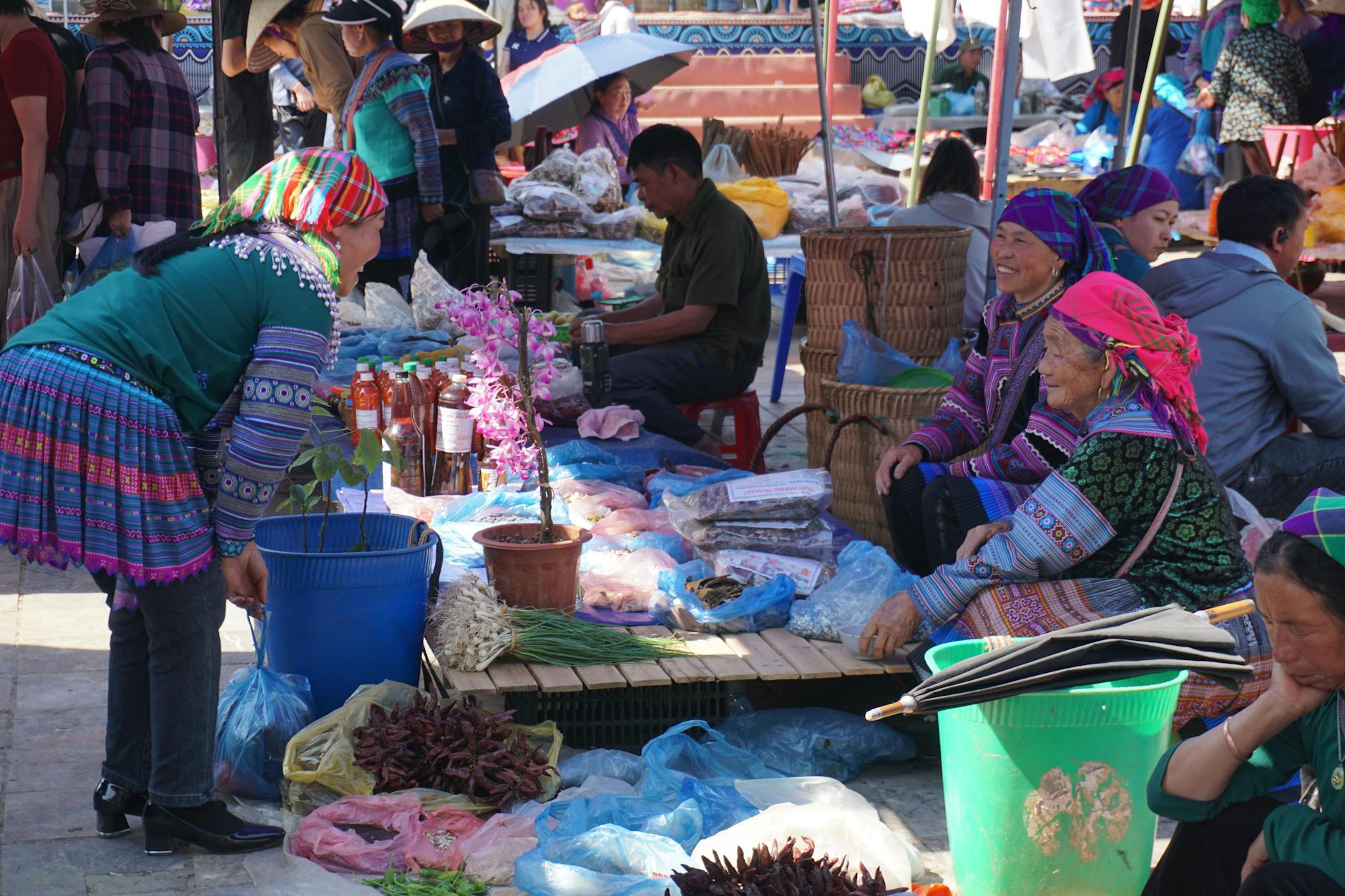
What's the Simple Answer: Is Bac Ha Market on Sunday?
Yes, Bac Ha Market is held on Sunday morning. It's the weekly gathering place for the surrounding ethnic minorities (Flower Hmong, Dao, Tay, Nung, Phu La). However, since 2024-2025, the organization has evolved: the livestock market (buffalo, horses) now takes place on Saturday, separate from the main market.
Don't make the mistake of coming on Sunday hoping to see the buffalo. You'll be disappointed. The general Sunday market remains the most lively and colorful, with hundreds of stalls selling handicrafts, traditional clothing, spices, and local food.
Pro tip: If you want the full experience (livestock + general market), arrive Saturday morning for the buffalo market, stay overnight, and enjoy the Sunday market from 6:00 AM.
Why Has the Bac Ha Market Day Changed?
Since 2023, the buffalo market has changed days several times (Friday, Thursday, Saturday) due to local reorganizations. The current (2026) version is stable: the general market remains on Sunday, but the heavy livestock sale takes place on Saturday morning.
Why the change? Local authorities wanted to separate the activities for several reasons:
- Reduce crowding between tourists and animals in the main aisles.
- Allow farmers to negotiate without the pressure of photographers.
- Create a dedicated livestock area, more spacious and better organized.
Before you go, always check local information. Some paper guides or old blogs still indicate the old schedule. Rely on recent sources (2025-2026) or ask your accommodation in Sapa the day before.
What Time Should You Arrive at Bac Ha Market?
The market officially starts around 6:00 AM, but peak activity is between 7:00 AM and 9:00 AM. By 6:30 AM, the first vendors are setting up their stalls. From 10:00 AM, tourist numbers increase and the atmosphere becomes more commercial. Around noon, the market starts to empty.
Here's a time guide by zone:
| Market Zone | Products | Best Time | Authenticity (1-5) | Photo Tips |
|---|---|---|---|---|
| Livestock Market (Saturday) | Buffalo, horses, pigs | 6:00 AM - 8:00 AM | 5 | Arrive before 7 AM for the light |
| Handicrafts & Textiles | Bags, scarves, embroidered tablecloths | 7:30 AM - 10:00 AM | 3 | Early morning, fewer people |
| Food | Thang co, pho, coffee, fruit | 7:00 AM - 11:00 AM | 4 | Smoke from the stalls creates a beautiful effect |
| Agricultural Products | Spices, tea, medicinal herbs | 6:30 AM - 9:00 AM | 5 | Ask before photographing |
Warning: From 10:30 AM, tourist buses arrive in droves. The atmosphere changes radically. Leave before 11:00 AM if you're seeking authenticity.
How to Get to Bac Ha Market from Sapa, Lao Cai, or Hanoi
Transport options vary depending on your starting point. Here's a comparison table to help you choose:
| Starting Point | Mode | Duration | Cost (VND/EUR) | Frequency | Tips |
|---|---|---|---|---|---|
| Sapa | Local bus | 2h30 | 50,000 - 80,000 VND (2-3 EUR) | Departures at 5 AM and 6 AM on Sunday | Book the day before through your hotel |
| Sapa | Private taxi | 2h00 | 800,000 - 1,200,000 VND (32-48 EUR) | On demand | Useful for a group of 4 people |
| Lao Cai | Local bus | 1h30 | 30,000 - 50,000 VND (1.20-2 EUR) | Every 30 min until 3 PM | Bus departs from the bus station |
| Lao Cai | Taxi | 1h15 | 400,000 - 600,000 VND (16-24 EUR) | On demand | More comfortable for families |
| Hanoi | Night train + bus | 8-10h | 450,000 - 900,000 VND (18-36 EUR) | Daily trains | Take the train to Lao Cai, then local bus |
From Sapa, a day trip is not recommended: 5 hours of travel for 3 hours at the market. From Hanoi, the night train to Lao Cai followed by a local bus remains the most comfortable solution.
Pro tip: If coming from Hanoi, book your night train on the official Vietnam Railways website. Avoid intermediaries who add fees. For more transport options, see our guide Hanoi to Sapa in 2026: Trains, Buses & Costs Compared.
Should You Stay Overnight or Do a Day Trip?
Staying overnight in Bac Ha (Saturday) is highly recommended for three reasons:
- See the buffalo market on Saturday morning.
- Arrive at the Sunday market before the tourist crowd.
- Explore the surrounding area (villages, rice terraces, Hmong King's palace).
A day trip from Sapa is possible but not recommended: you'll spend more time in transit than at the market. If you only have one day, leave Sapa at 5:00 AM to arrive before 7:30 AM.
Bac Ha offers several simple but decent accommodations:
- Hotels in the town center: 200,000 - 400,000 VND (8-16 EUR) per night.
- Homestays with locals: 150,000 - 300,000 VND (6-12 EUR) with meals included.
- Guesthouses near the market: 250,000 - 500,000 VND (10-20 EUR).
Warning: Accommodation in Bac Ha is basic. Don't expect luxury. Hot water can be unreliable. Bring a headlamp in case of power outages.
What Happens If I Come on a Day Other Than Sunday?
Outside of Sunday, Bac Ha Market is almost empty. However, the region offers other ethnic markets on different days. Here's a table of alternatives:
| Market | Day | Hours | Distance from Bac Ha | Atmosphere | Main Ethnic Groups |
|---|---|---|---|---|---|
| Can Cau | Saturday | 6:00 AM - 12:00 PM | 20 km (30 min) | Very authentic, not very touristy | Hmong, Phu La |
| Coc Ly | Tuesday | 6:00 AM - 11:00 AM | 30 km (45 min) | Picturesque, by the river | Hmong, Dao |
| Lung Phin | Sunday | 6:00 AM - 11:00 AM | 15 km (20 min) | Small, very local | Hmong |
| Muong Khuong | Thursday | 6:00 AM - 12:00 PM | 40 km (1h) | Colorful, over 30 ethnic groups | Hmong, Tay, Nung |
| Si Ma Cai | Wednesday | 6:00 AM - 11:00 AM | 25 km (40 min) | Very rural, few tourists | Hmong, Dao |
If you arrive on a Monday, Bac Ha Market will be closed. But you can visit the surrounding villages or go for a hike in the rice terraces. On Wednesday, head to Si Ma Cai. On Thursday, Muong Khuong. On Saturday, Can Cau is an excellent alternative.
Pro tip: Can Cau Market on Saturday is often considered more authentic than Bac Ha. Fewer tourists, more animals, and a beautiful mountain setting. If you can't come on Sunday, this is your best option.
Is Bac Ha Market Too Touristy?
Yes and no. The market attracts many tourists, but it remains a genuine place of exchange for local people. The handicraft and food section is the most visited by tourists; the livestock and agricultural product area remains authentic.
Here's an honest assessment of the tourism/authenticity ratio:
- Livestock Market (Saturday): Very authentic. Few tourists. Farmers are focused on their transactions.
- Handicraft Zone (Sunday): Very touristy. Inflated prices. Negotiation required.
- Food Zone (Sunday): Authentic in the morning, touristy after 10 AM. The food is still good.
- Agricultural Zone (Sunday): Authentic. Few tourists venture here.
To maximize your experience:
- Arrive before 7:00 AM.
- Avoid the handicraft zone between 10 AM and 12 PM.
- Explore the side alleys, not just the central square.
- Talk to the vendors, even with hand gestures and a smile.
Warning: Some vendors double prices for tourists. Always compare before buying. If a price seems too high, walk away. Often, they'll call you back with a more reasonable offer.
What Other Ethnic Markets Should You Not Miss in the Region?
The Bac Ha region is home to several remarkable ethnic markets. Here are the main ones:
Can Cau (Saturday): Known for its mountain setting and livestock market. Less touristy than Bac Ha. Ideal for photographers. 20 km from Bac Ha.
Coc Ly (Tuesday): Held on the banks of the Chay River. Accessible by boat or motorbike. Peaceful atmosphere. Beautiful embroidered textiles. 30 km from Bac Ha.
Muong Khuong (Thursday): Attracts over 30 different ethnic groups. Very colorful. Impressive livestock market. 40 km from Bac Ha.
Lung Phin (Sunday): Small local market. Few tourists. Ideal for a more intimate experience. 15 km from Bac Ha.
Si Ma Cai (Wednesday): Very rural. Almost no tourists. Livestock and agricultural products market. 25 km from Bac Ha.
For a multi-day itinerary, combine Saturday (Can Cau + Bac Ha buffalo market) and Sunday (Bac Ha market + Lung Phin). For more options in the region, see our guide Bac Ha Market.
How Much Time Should You Plan for the Market?
A complete visit to Bac Ha Market takes between 2 and 4 hours depending on your pace and interests. For photographers, plan 3-4 hours to explore all zones. For a simple discovery, 2 hours is enough.
Here's a chronological visit plan:
- 6:00 AM - 7:00 AM: Arrival and exploration of the agricultural and livestock area (if Sunday).
- 7:00 AM - 8:30 AM: Handicraft and textile zone. Fewer people, better light.
- 8:30 AM - 9:30 AM: Food zone. Breakfast on site (thang co, pho, coffee).
- 9:30 AM - 10:30 AM: Final exploration of the side alleys.
- 10:30 AM - 11:00 AM: Depart before the massive influx of tourists.
What Budget Should You Plan for Bac Ha Market?
Market entry is free. Product prices are generally affordable, but beware of inflated prices for tourists.
| Item | Minimum Price | Maximum Price | Tips |
|---|---|---|---|
| Coffee | 15,000 VND (0.60 EUR) | 25,000 VND (1 EUR) | Try the local coffee, different from Sapa coffee |
| Local meal (pho, thang co) | 30,000 VND (1.20 EUR) | 50,000 VND (2 EUR) | Eat where the locals eat |
| Textile souvenir (scarf) | 50,000 VND (2 EUR) | 150,000 VND (6 EUR) | Negotiate, the initial price is often doubled |
| Hand-embroidered bag | 100,000 VND (4 EUR) | 300,000 VND (12 EUR) | Check the quality of the stitching |
| Mountain tea | 30,000 VND (1.20 EUR) | 80,000 VND (3.20 EUR) | Ask to taste before buying |
| Corn alcohol | 40,000 VND (1.60 EUR) | 100,000 VND (4 EUR) | Beware, very strong (40-50°) |
Pro tip: Bring small bills (10,000-20,000 VND). Vendors don't always have change for large notes. Avoid pulling out wads of cash; it attracts attention.
What Are the Risks and Pitfalls to Know?
Bac Ha Market has a few classic pitfalls. Here are the main ones:
Inflated prices for tourists: This is the most common. Vendors often double prices. Negotiate calmly, without aggression. If the price isn't right, walk away.
Poor quality products: Some textiles are factory-made and sold as "local handicrafts." Check the stitching and fabric quality. Genuine hand-embroidered items have irregularities.
Unsolicited photography: Don't take photos without asking. Some ethnic groups consider this rude. Offer 5,000-10,000 VND if you want to photograph someone.
Road safety: Access roads are winding and sometimes slippery, especially in the rainy season (May to September). If you're driving a motorbike, be careful. For more information on safety in Vietnam, see our guide Is Vietnam Safe in 2026? An Honest Country-Wide Risk Assessment.
Health and hygiene: Street food is generally safe, but avoid dishes that have been sitting out for hours. Eat where it's busy. For more tips, read Vietnamese Street Food Safety: How to Eat Everywhere Without Getting Sick.
Warning: In the rainy season, the market can be very muddy. Wear closed, waterproof shoes. Protect your camera from humidity.
FAQ
Q: What day is Bac Ha Market? A: The main Bac Ha Market takes place on Sunday morning, from 6:00 AM to around 12:00 PM. The buffalo and horse market is now held on Saturday morning, separate from the general market. There is no market on other days of the week.
Q: Can you eat raw bac ha? A: This question seems to refer to a vegetable (bac ha) and not the market. Bac Ha Market offers many cooked dishes, notably thang co (horse or buffalo meat stew). It is not recommended to consume raw or uncooked foods at Vietnamese markets for hygiene reasons.
Q: What is the most beautiful floating market in Vietnam? A: This question concerns floating markets in southern Vietnam (Cai Rang, Phong Dien), not Bac Ha Market, which is a mountain market. The two types of markets are very different and complementary in a trip to Vietnam. For more information, see our guide Can Tho Floating Market: Complete 2026 Guide for Visiting Cai Rang and Phong Dien.
Q: What are the good deals to bring back from Vietnam? A: At Bac Ha Market, good purchases include: hand-embroidered textiles (bags, scarves, tablecloths), local corn alcohol, mountain tea, spices, and medicinal herbs. Beware of counterfeits and inflated prices for tourists.
Q: Do you need a guide to visit Bac Ha Market? A: No, a guide is not necessary for the market itself, which is easily explored on foot. A guide can be useful for treks in the surrounding villages or to facilitate communication with vendors who don't speak English.
Q: Is Bac Ha Market accessible to people with reduced mobility? A: Partially. The market is spread over several levels and uneven terrain (slopes, gravel, mud in rainy weather). The main areas are accessible, but some sections (livestock, ground-level artisans) are difficult to access.
Q: Can you visit Bac Ha Market with children? A: Yes, but with precautions: arrive early to avoid the crowd, close supervision in the animal area, sun protection, and hydration. Children generally enjoy the colors, animals, and street food.