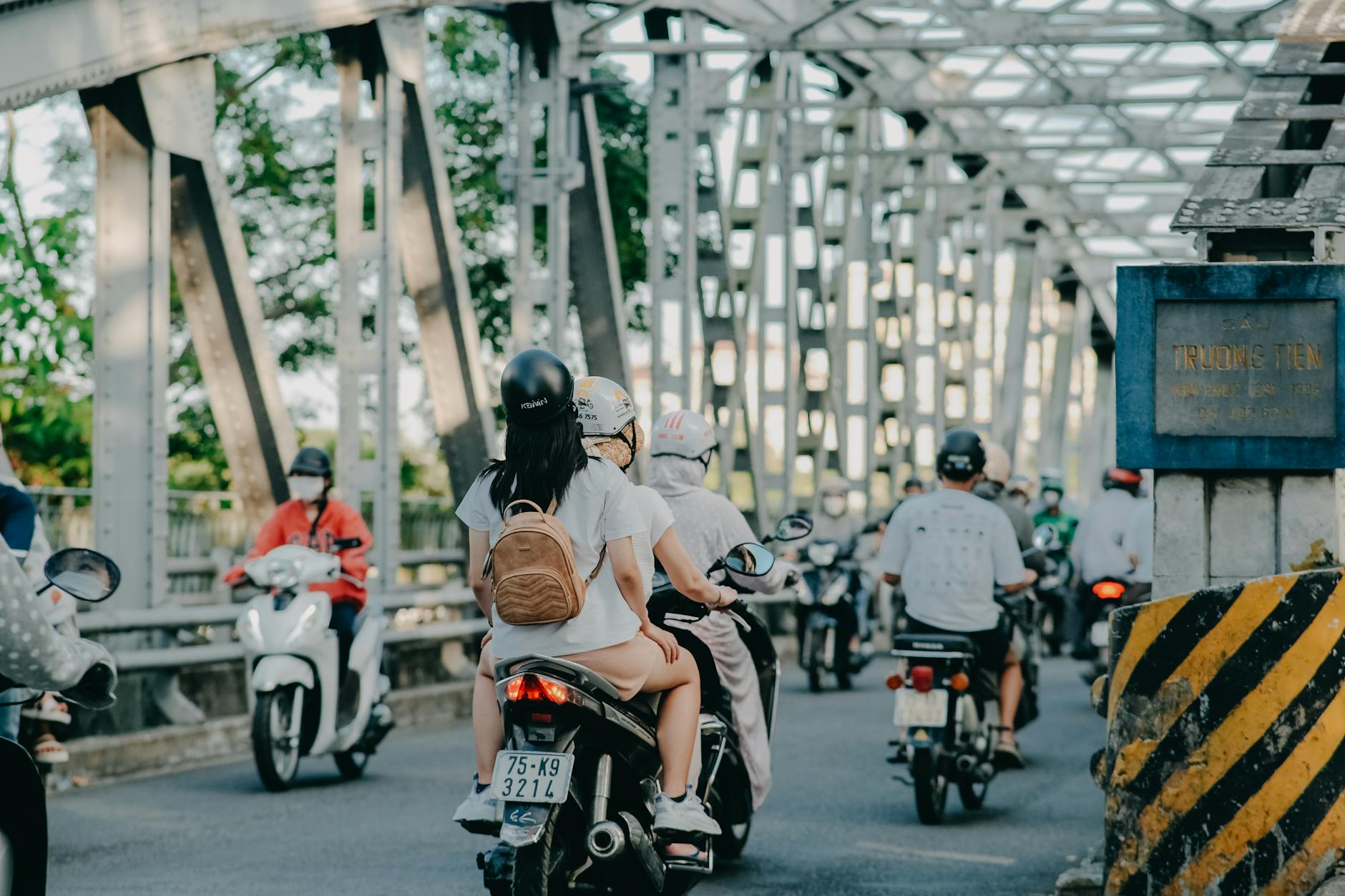
But "safe" is a complicated word. A country can have low murder rates and still kill more travelers through road accidents than any other cause. It can welcome LGBTQ+ visitors in cosmopolitan districts and frown on public affection in conservative provinces. This 2026 assessment cuts past the marketing language and gives travelers the honest picture — by region, by risk category, and by traveler profile.
Traffic: The Real Danger Most Guides Underplay
The single greatest threat to tourists in Vietnam is not crime, scams, or natural disasters. It is the road.
Vietnam's National Traffic Safety Committee reported approximately 21,500 road deaths in 2024, with provisional 2025 figures trending similar. The country has roughly 75 million registered motorbikes for a population of 100 million. Lane discipline is fluid, helmet laws are uneven in enforcement outside major cities, and intersections rely on a system of negotiated movement rather than strict right-of-way.
For tourists, the risk concentrates in three activities: renting motorbikes without proper licenses, crossing busy urban streets, and taking long-distance road journeys at night.
| Activity | Risk Level (2026) | Notes |
|---|---|---|
| Walking in Hanoi Old Quarter | Moderate | Constant motorbike flow on sidewalks |
| Self-driving motorbike (Hai Van Pass, Ha Giang Loop) | High | Most tourist fatalities occur here |
| Crossing streets in Ho Chi Minh City | Moderate | Walk slowly, predictably; never run |
| Grab car / metered taxi | Low | Safest mode of transport |
| Overnight sleeper bus | Moderate | Accident risk on mountain routes |
| Domestic flights | Very Low | Vietnam Airlines, Bamboo, Vietjet safety records solid |
Tip: If you must rent a motorbike, ensure you hold a valid International Driving Permit with motorcycle endorsement. Without it, your travel insurance will deny any accident claim — and 2026 hospital bills for foreigners in Da Nang or Hanoi commonly exceed 50,000,000 VND (~$2,000 USD) for fracture treatment alone.
Petty Theft and Scams: A City-by-City Reality Check
Vietnam is not a violent-crime destination, but opportunistic theft is real and geographically uneven. Bag-snatching from passing motorbikes remains the most reported tourist crime, particularly in Ho Chi Minh City's Districts 1 and 5.
| City | Petty Theft Risk | Most Common Issue |
|---|---|---|
| Ho Chi Minh City | High | Phone/bag snatching by motorbike |
| Hanoi | Moderate | Taxi meter fraud, fake tour offices |
| Nha Trang | Moderate-High | Beach theft, money-changing scams |
| Da Nang | Low | Mostly safe; occasional taxi overcharging |
| Hoi An | Low | Tailor disputes, deposit issues |
| Hue | Low | Cyclo overcharging |
| Sapa | Low | Aggressive market vendors, not theft |
| Phu Quoc | Low-Moderate | Beach belongings, scooter rental disputes |
| Ha Giang | Very Low | Almost no recorded tourist theft |
| Da Lat | Very Low | Quiet, family-oriented tourism |
Common 2026 scams to know:
- The "closed" attraction redirect: Drivers claim a museum or temple is closed and offer alternative tours.
- Rigged taxi meters: Use Grab, Be, or Xanh SM (the all-electric fleet now dominant in major cities).
- Shoeshine bait-and-switch: A man "fixes" your shoes unsolicited, then demands 500,000 VND (~$20 USD).
- Fake monks selling bracelets near pagodas — genuine Buddhist monks do not solicit money on streets.
Tip: Carry your phone in a zipped interior pocket when walking near roads. The single most common theft pattern in 2026 is a passenger on a passing motorbike grabbing a phone from a tourist's hand mid-text.
Natural Hazards by Region
Vietnam's S-shaped geography means weather threats vary enormously by latitude and season.
Northern Vietnam (Hanoi, Ha Long, Sapa, Ha Giang)
- Typhoon season: July–September
- Flash flooding in mountain provinces: June–August
- Winter cold snaps in highlands: December–February (can hit 0°C in Sapa)
Central Vietnam (Hue, Da Nang, Hoi An, Quy Nhon)
- The highest typhoon and flood risk in the country
- Peak storm season: September–November
- Hoi An's old town floods predictably most years; check forecasts October–November
- The 2024 Typhoon Yagi reminded planners that mountain landslides in central provinces are intensifying
Southern Vietnam (Ho Chi Minh City, Mekong Delta, Phu Quoc)
- Rainy season: May–October, generally short afternoon downpours
- Mekong saline intrusion (March–April) — drinking water concerns inland, not tourist areas
- Minimal typhoon exposure
| Region | Best Months (Safety) | Avoid |
|---|---|---|
| North | October–April | August typhoons |
| Central | February–May | October–November floods |
| South | December–April | Late-summer thunderstorms |
Tip: Travel insurance for 2026 trips to central Vietnam between September and November should explicitly cover weather-related cancellation. Standard policies often exclude typhoon delays unless purchased before the storm is named.
Political Climate: What Travelers Actually Need to Know
Vietnam is a one-party state, and 2026 brings continued political stability under the leadership transition that consolidated after the 14th National Congress. For tourists, this stability translates to predictability: no protests, no civil unrest, no curfews.
What travelers should understand:
- Photography restrictions: Military installations, border posts, and some government buildings prohibit photography. Signs are not always in English.
- Social media: Posts critical of the Communist Party or state leaders have led to deportations of foreigners. Casual political commentary is best avoided publicly.
- Drugs: Vietnam maintains the death penalty for trafficking. Possession of even small amounts of cannabis carries multi-year sentences. Enforcement against tourists is real, particularly in beach areas where police periodically sweep nightlife venues.
- Border zones: Approach to the Chinese and Laotian borders may require permits. Ha Giang province removed its tourist permit requirement years ago, but Muong Nhe and parts of Dien Bien still require local registration.
The US, UK, Australian, and Canadian governments all currently list Vietnam at their lowest standard travel advisory level for 2026 — "exercise normal precautions."
Women's Safety: Honest Reporting
Vietnam is, by Southeast Asian standards, a comparatively safe destination for solo female travelers. Street harassment exists but rarely escalates. Sexual assault against tourists is statistically uncommon compared to many Western capitals. Female travelers report Hanoi, Da Nang, Hoi An, and Da Lat as particularly comfortable.
That said, honest reporting requires acknowledging:
- Drink spiking has been reported in backpacker areas of Ho Chi Minh City (Bui Vien) and Nha Trang. Never accept open drinks from strangers.
- Late-night xe om (motorbike taxi) rides for women alone are best replaced with Grab or Xanh SM rides, which provide trip tracking.
- Modest dress is expected at temples and pagodas — shoulders and knees covered. This is cultural norm, not legal requirement, but ignoring it draws attention.
- Some homestays in remote areas may have minimal door locks. Bring a portable door wedge for peace of mind.
| Destination | Solo Female Comfort Rating |
|---|---|
| Hoi An | Excellent |
| Da Nang | Excellent |
| Hanoi | Very Good |
| Da Lat | Very Good |
| Ho Chi Minh City | Good (avoid Bui Vien late) |
| Sapa | Good |
| Nha Trang | Moderate |
| Remote homestays (Mai Chau, Pu Luong) | Good with preparation |
LGBTQ+ Safety in 2026
Vietnam occupies an unusual position: it has no laws criminalizing homosexuality, hosts Viet Pride events in multiple cities, and saw the Ministry of Health formally declare in 2022 that homosexuality is not a disease. Same-sex marriage is not legally recognized, but cohabitation is unrestricted, and the country has been quietly progressive compared to several ASEAN neighbors.
In 2026, the practical reality:
- Ho Chi Minh City, Hanoi, and Da Nang have visible LGBTQ+ nightlife and accepting attitudes in tourist zones.
- Hoi An, Da Lat, and Nha Trang are comfortable for same-sex couples, though public affection (gay or straight) is uncommon in Vietnamese culture generally.
- Rural and northern mountain provinces are not hostile but are conservative — discretion is sensible.
- Trans travelers should know that Vietnam passed a Gender Affirmation Law framework, but ID document gender markers may not match presentation; carry passport documentation that resolves quickly at hotels and airports.
Tip: Booking platforms in 2026 increasingly flag LGBTQ+-friendly hotels in Vietnam. In Ho Chi Minh City, look at properties in District 1 and District 3; in Hanoi, the Hoan Kiem and Tay Ho districts are most welcoming.
Solo Travel Reality
Solo travel in Vietnam works well — possibly better than in any other Southeast Asian country except Singapore and Japan. Infrastructure supports it: Grab and Xanh SM cover all major cities, domestic flights are inexpensive (Hanoi–Da Nang in 2026 starts at 1,200,000 VND / ~$48 USD), and the Reunification Express train network now offers high-comfort sleeper cabins.
The honest caveats:
- Loneliness can hit harder in rural areas where English is limited. Build in social stops — Hoi An, Da Lat, Hanoi Old Quarter — between quieter legs.
- Medical emergencies alone in remote provinces are genuinely difficult. International-standard hospitals exist only in Hanoi (Vinmec, French Hospital), Ho Chi Minh City (FV Hospital), and Da Nang (Vinmec Da Nang).
- Solo motorbike touring on the Ha Giang Loop in 2026 remains popular but kills travelers annually. Group tours with backup vehicles have become the safer norm; expect to pay 3,500,000–5,500,000 VND (~$140–$220 USD) for a 3-day guided loop.
Health Risks Worth Taking Seriously
Mosquito-borne dengue fever cases climbed in 2024–2025, particularly in the Mekong Delta and central coast during rainy season. There is no preventive medication; bring strong repellent (30%+ DEET or picaridin). Malaria risk is now negligible in standard tourist areas.
Food hygiene in Vietnam is broadly excellent — street food in Hanoi and Hoi An is statistically safer than in many countries — but travelers' diarrhea affects a meaningful percentage of visitors in the first 72 hours. Carry oral rehydration salts.
Tap water remains non-potable. Filtered or bottled water only. Ice in established restaurants is safe; ice in beach shacks is best skipped.
Frequently Asked Questions
Is Vietnam safer than Thailand in 2026? Statistically yes, by most peace and crime indices. Both are safe destinations, but Vietnam has lower rates of violent crime against tourists and a more stable political environment than Thailand has shown in recent years.
Can tourists carry their passports, or leave them at the hotel? Vietnamese law technically requires foreigners to carry identification. A clear photocopy of your passport photo page and visa, plus the hotel registration receipt, is widely accepted in practice. Carry the original only when crossing provinces or boarding domestic flights.
Is it safe to drink the local rice wine offered in homestays? The homemade rice wine (rượu) served in northern homestays is generally safe in established tourism areas but unregulated in alcohol content. Cases of methanol poisoning have been reported from cheap commercial knockoffs sold in tourist bars, not from village-distilled rượu. When in doubt, decline politely.
What's the emergency number for tourists in 2026? Police: 113. Ambulance: 115. Fire: 114. Tourist Hotline (English): 1800 1010 — this service expanded in 2024 and now operates 24/7 in major destinations.
How much money should be kept on a person versus in the hotel safe? Carry one day's spending in cash plus one card. Vietnam in 2026 is rapidly cashless in urban areas (Grab, restaurants, even market stalls accept QR payments), but rural areas remain cash-only. Keep passports and excess cash in hotel safes — theft from rooms in licensed hotels is extremely rare.
Are demonstrations or protests a risk for tourists? No. Public demonstrations are extremely rare and not directed at foreigners. The political risk for tourists in Vietnam is overwhelmingly about what one posts online or photographs, not about being caught in unrest.
Is travel insurance genuinely necessary? Yes — primarily for the medical and motorbike accident risk. A reputable policy covering Vietnam for a two-week trip in 2026 costs roughly 1,500,000–3,000,000 VND (~$60–$120 USD) and may save tens of thousands of dollars in a hospital scenario. Confirm motorbike coverage explicitly and ensure your license matches the policy's requirements.
The Bottom Line
Vietnam in 2026 is a safe country with one significant exception: the road. Travelers who respect traffic, carry sensible insurance, watch their phones in crowded districts, and stay aware of seasonal weather patterns will find Vietnam not just safe but easier to navigate than most regional alternatives. The honest risk assessment is not "be afraid" — it is "be specific about what to be careful of." For most visitors, that specificity is the difference between a memorable trip and an avoidable problem.