This guide fixes that. It separates authentic handcrafted hats from tourist trinkets. It tells you exactly which villages to visit, what to pay, and how to pack a conical hat so it arrives in one piece.
What is a non la and why does it matter for your trip
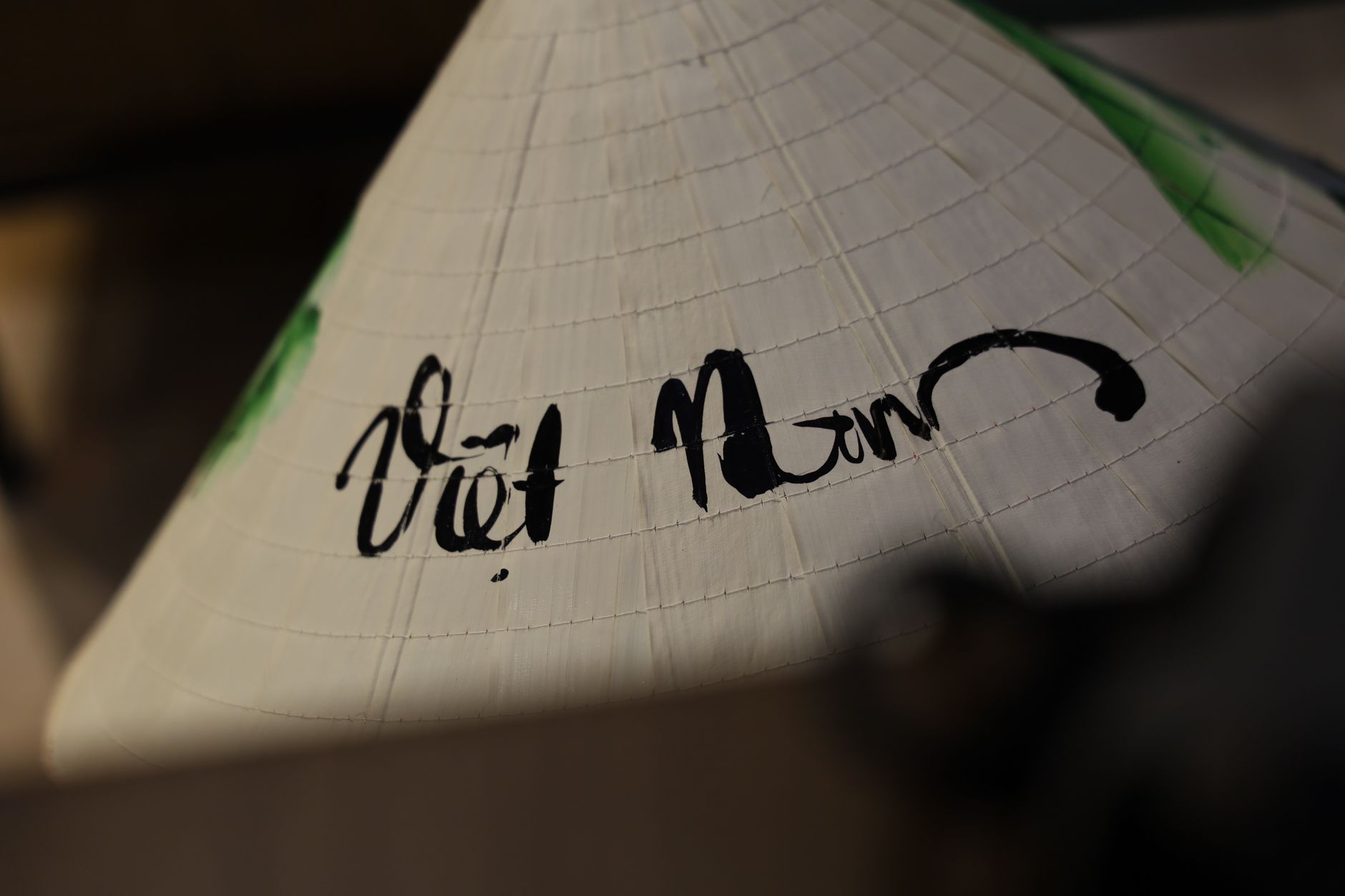
The name "non la" (nón lá) translates literally to "leaf hat." It is a conical headpiece made from palm leaves and bamboo. Vietnamese people have worn it for thousands of years.
The hat serves multiple practical purposes. It blocks the sun during rice farming. It sheds rain during monsoon season. Women use it as a fan on hot days. Farmers flip it over and use it as a basket for vegetables. In rural areas, it is a working tool, not a fashion accessory.
Understanding the non la enriches your trip beyond buying a photo prop. When you watch an artisan spend four hours hand-sewing palm leaves onto a bamboo frame, you see the skill behind the object. When you know that Hue poem hats hide verses between leaf layers, you appreciate the craft. The hat becomes a connection to Vietnamese rural life, not just a souvenir.
Distinguish between everyday working hats and ceremonial versions. Working hats are plain, functional, and cheap. Ceremonial hats include the poem hats of Hue, embroidered hats, and painted hats for festivals and performances. Both types matter, but they serve different purposes.
The legend and history behind the conical hat
Vietnamese legend tells of a goddess who descended from the sky to help farmers. She wore a conical hat made of leaves. People copied her design to protect themselves from the sun and rain.
Archaeological evidence supports a much older origin. Images of conical hats appear on Ngoc Lu bronze drums dating back 2,500 years. These drums belong to the Dong Son culture, one of Vietnam's earliest civilizations. The hat shape has remained largely unchanged for millennia.
The non la evolved from a practical farming tool to a national symbol. It appears in Vietnamese poetry, folk songs, and photography. The poem "Hat on the Head" by Nguyen Binh describes a woman's conical hat as part of her beauty. Modern photographers like Rehahn use the non la to frame portraits of Vietnamese women.
During the 20th century, the hat became a symbol of Vietnamese identity abroad. Soldiers wore them during the Vietnam War. Diplomats gave them as gifts. Today, the non la appears on postage stamps, currency, and tourism logos.
What are non la hats made of? Materials explained
Authentic non la hats use three primary materials.
Palm leaves. Two species are common. La co (palm leaf) grows in northern Vietnam and produces broad, flexible leaves. La goi grows in central Vietnam and produces thicker, more durable leaves. Both types are harvested green, then dried in the sun for several days.
Bamboo. The circular frame consists of 14 to 16 concentric rings. Each ring is split from a single bamboo stem and shaved thin. The rings determine the hat's shape and stability.
Tree bark. The Moc tree provides a thin bark layer used to bind the rings together. This bark is flexible and waterproof. Some artisans use nylon thread instead, but traditionalists prefer bark.
Finishing oil. A coat of oil from the trau tree or cashew nut shell makes the hat waterproof. The oil also gives the hat its characteristic golden-brown color.
Cheap imitations substitute plastic for bamboo, glue for stitching, and synthetic fabric for palm leaves. These hats look similar from a distance but feel heavier, smell like chemicals, and fall apart quickly. A real non la weighs under 100 grams. A fake weighs twice that.
How authentic non la hats are made: step by step
The process takes three to four hours for a skilled artisan. Here is how it works.
Step 1: Harvest and dry the leaves. Palm leaves are cut green and spread in the sun for three to five days. They turn from bright green to pale yellow-brown.
Step 2: Iron the leaves flat. Artisans use a hot iron to press each leaf flat. This removes the natural curl. The leaf becomes flexible and easy to work with.
Step 3: Build the bamboo frame. The artisan splits bamboo into thin strips and shapes them into concentric rings. The rings range from large at the base to small at the tip. Each ring is tied to the next with tree bark or thread.
Step 4: Sew the leaves onto the frame. The artisan places dried leaves over the bamboo frame and sews them in place using a long needle and thread. The stitches run from the tip down to the brim. A skilled artisan makes 200 to 300 stitches per hat.
Step 5: Trim the edges. Excess leaf is cut away from the brim. The edge is bound with thread to prevent fraying.
Step 6: Sun-dry the hat. The completed hat sits in direct sunlight for one day. This sets the shape and hardens the leaves.
Step 7: Apply oil. A thin coat of oil is brushed onto the hat's outer surface. The hat is left to dry for another day. This makes it waterproof.
Step 8: Add the chin strap. A fabric or silk chin strap is attached to two points on the inside of the brim.
Handmade hats have slight imperfections. Stitch spacing varies slightly. Leaf color is not perfectly uniform. The frame may be slightly asymmetrical. These are signs of authenticity. Machine-made hats have perfect symmetry and identical stitches.
The poem hats of Hue (non bai tho)
Hue's poem hats are the most famous variation. They contain verses hidden between two layers of palm leaves. The poems are invisible in normal light. Hold the hat up to sunlight or a bright lamp, and the text appears.
Artisans select traditional Vietnamese poems, love verses, or calligraphy. They write the text on thin paper or directly onto a leaf layer. Then they sew a second leaf layer over it. The light passing through reveals the writing.
Some poem hats include bamboo silhouette scenes. Artisans cut thin bamboo into shapes of landscapes, boats, or people. These silhouettes are sandwiched between leaf layers. When held to light, the scene appears.
Poem hats require more skill and time to make. The artisan must align the text perfectly with the hat's shape. The verses must be centered and readable. This extra effort explains the higher price.
Where to buy poem hats. Phu Cam village in Hue specializes in poem hats. Dong Ba Market in Hue sells them at fair prices. Avoid buying poem hats in Hanoi or Ho Chi Minh City. They are often poor imitations with printed verses that peel off.
Prices. Poem hats cost 200,000 to 400,000 VND (USD 8 to 16). Bargaining is acceptable at markets but not at village workshops.
Hat-making villages you can visit
Four villages welcome visitors who want to see hats being made.
Chuong village (Hanoi)
Chuong village sits 30 kilometers south of Hanoi center. About 80 percent of villagers produce hats. The village makes 7,000 to 8,000 hats daily.
How to get there. Take bus 103 from Giap Bat bus station. The ride takes 45 minutes. A taxi from Hanoi center costs approximately 200,000 VND (USD 8) one way.
What to see. Family workshops line the main road. Three generations often work together. Grandmothers sew leaves while grandchildren trim edges. The best time to visit is morning, between 8:00 AM and 11:00 AM, when most artisans are working.
Prices. Hats cost 30,000 to 100,000 VND (USD 1.20 to 4.00) depending on quality.
Phu Cam village (Hue)
Phu Cam village is located near the Hue Citadel. It specializes in poem hats. The village is smaller than Chuong, with fewer than 50 active artisans.
How to get there. Walk or cycle from the Citadel. The village is 15 minutes away on foot.
What to see. Artisans demonstrate the poem insertion process. Visitors can request custom poems. The village atmosphere is quiet and intimate.
Prices. Poem hats cost 200,000 to 400,000 VND (USD 8 to 16).
Dong Yen village (Hoi An)
Dong Yen village is 5 kilometers from Hoi An Old Town. It produces higher quality palm leaf hats than many other villages.
How to get there. Bicycle from Hoi An. The ride takes 20 minutes on flat roads. Combine the visit with Tra Que vegetable village, which is nearby.
What to see. Artisans use la goi palm leaves, which are thicker and more durable. The hats from Dong Yen last longer than those from Chuong.
Prices. Hats cost 50,000 to 150,000 VND (USD 2.00 to 6.00).
Other notable villages
Tay Ho village near Hue produces high-quality working hats. Kieu Ky village near Hanoi makes the non quai thao, a wider-brimmed hat worn by northern women. Binh Dinh province produces Go Cang hats, which use extra-thick palm leaves for durability.
How to identify a real non la vs a tourist fake
Use these checks before buying.
Visual inspection. Real hats have slight color variation in the leaves. The stitches are visible and slightly irregular. The frame feels flexible, not rigid. Fakes have uniform color, invisible stitches, and stiff frames.
Smell test. Real palm leaves smell vegetal and earthy. Fakes smell like glue, plastic, or chemicals.
Weight test. A real non la weighs under 100 grams. A fake weighs 150 grams or more due to glue and synthetic materials.
Price test. Any hat sold for 20,000 VND (USD 0.80) or less is not authentic. At that price, the materials alone cost more than the finished product.
Stitch test. Real hats have stitches running from tip to brim in straight lines. Fakes often have glued leaves with decorative stitching on the brim only.
Realistic prices for different types of non la
| Hat type | Typical quality | Price VND | Price USD | Where to buy |
|---|---|---|---|---|
| Basic working hat | Functional, plain | 30,000-50,000 | 1.20-2.00 | Village workshops |
| Standard tourist quality | Decent, machine-assisted | 50,000-100,000 | 2.00-4.00 | Markets, night markets |
| Handmade artisan hat | High quality, fully handcrafted | 100,000-200,000 | 4.00-8.00 | Chuong, Dong Yen villages |
| Hue poem hat | Hidden verses, bamboo silhouettes | 200,000-400,000 | 8.00-16.00 | Phu Cam village, Dong Ba Market |
| Embroidered or painted | Decorative, ceremonial | 300,000-800,000 | 12.00-33.00 | Art galleries, specialty shops |
| Museum-quality antique | Rare, collectible | 1,000,000+ | 40+ | Antique dealers, specialty auctions |
Where price variations occur. Village workshops offer the lowest prices. Hoi An Central Market charges fair prices. Hanoi Old Quarter shops mark up hats two to three times. Airport souvenir shops charge the most for the lowest quality.
Bargaining tips. Start at 50 percent of the asking price at markets. Village workshops have fixed prices. Do not bargain aggressively at villages where families make hats. The prices are already fair.
Where to buy a non la in Vietnam: best locations by city
Hanoi. Dong Xuan Market has a large selection of tourist-quality hats. Chuong village is the best place for handmade hats. The night market in the Old Quarter sells cheap hats for 20,000 to 50,000 VND (USD 0.80 to 2.00), but these are not authentic.
Hoi An. Central Market has fair prices and decent quality. The night market along the river sells tourist hats. Dong Yen village offers the best quality within cycling distance.
Hue. Dong Ba Market sells poem hats and working hats. Phu Cam village offers the best poem hats. Shops near the Citadel sell decent quality at slightly higher prices.
Ho Chi Minh City. Ben Thanh Market has limited selection and higher prices. Binh Tay Market in Cho Lon has better prices but fewer options. Buy hats in Hanoi or Hoi An instead.
Da Nang. Con Market and Han Market sell hats at fair prices. Selection is smaller than Hanoi or Hoi An.
How to pack and transport a non la without damage
This is the most important section for travelers. Most guides ignore it. Here is how to get your hat home intact.
Method 1: Suitcase center (recommended). Wrap the hat in soft clothing such as t-shirts, scarves, or socks. Place the wrapped hat in the center of your suitcase. Surround it with soft items on all sides. Do not put heavy items on top. This method works for checked luggage.
Method 2: Hat as a bowl. Place the hat upside down in your suitcase. Fill the cone with small souvenirs such as scarves, jewelry, or socks. This uses the hat's shape to protect both the hat and the souvenirs. Wrap the entire assembly in a t-shirt.
Method 3: Carry-on. Some hats are small enough for carry-on luggage. Check your airline's size limits. Most budget airlines allow carry-on dimensions of 56cm x 36cm x 23cm. A standard non la has a diameter of 45 to 50cm, which fits. Larger hats may not.
Method 4: Shipping. Vietnam Post offers international shipping for hats. Pack the hat in a cardboard box with bubble wrap. Shipping to the United States costs approximately 200,000 to 300,000 VND (USD 8 to 12) and takes two to three weeks. Shipping to Europe costs slightly more. Purchase insurance for valuable hats.
| Packing method | Difficulty | Success rate | Best for | Risk level |
|---|---|---|---|---|
| Suitcase center | Easy | 90% | Checked luggage | Low |
| Hat as bowl | Easy | 85% | Multiple hats or limited space | Low |
| Carry-on | Medium | 95% | Small hats, fragile items | Very low |
| Shipping | Medium | 80% | Large hats, multiple hats | Medium |
Pro tip: Do not put heavy items such as shoes, toiletries, or books on top of the hat. Even with soft wrapping, weight crushes the cone.
Can you wear a non la in Vietnam as a tourist?
Yes, with some guidelines.
Appropriate settings. Rural areas, rice fields, markets, and festivals are fine. Tourists wearing non la for photos in Hoi An is common and accepted. The hat provides excellent sun protection. Its UPF equivalent is approximately 50+.
Inappropriate settings. Do not wear the hat in formal settings such as temples, government buildings, or restaurants. Remove it indoors. In cities, wearing a non la looks out of place because locals no longer wear them there.
How to wear it correctly. The chin strap goes under the chin, not behind the head. The hat should sit level on your head. Do not tilt it back like a halo.
Safety warning. Do not wear a non la on a motorbike. It is not a helmet. It has no safety certification. Police may fine you for not wearing a proper helmet. The hat also blocks peripheral vision, making riding dangerous.
Caring for your non la after purchase
Cleaning. Dust the hat with a soft brush or cloth. Never submerge it in water. Water damages the leaves and causes the frame to warp.
Storage. Keep the hat away from direct sunlight when not in use. Sunlight fades the leaves and makes them brittle. Store it in a cool, dry place.
Repairs. Loose stitches can be re-sewn with a needle and thread. A bent frame can be gently reshaped by hand. Cracked leaves cannot be repaired. Replace the hat when multiple leaves crack or the frame breaks.
Lifespan. A well-maintained hat lasts three to five years. Hats used daily in the sun and rain last one to two years.
Beyond the classic shape: regional variations
| Hat name | Region | Key feature | Who wears it | Typical price |
|---|---|---|---|---|
| Non quai thao | Chuong village, Hanoi | Wider brim, higher cone | Northern women | 50,000-100,000 VND |
| Non Go Cang | Binh Dinh province | Thicker palm leaves | Farmers | 40,000-80,000 VND |
| Non Cao Bang | Cao Bang province | Red-dyed bamboo frame | Tay ethnic group | 80,000-150,000 VND |
| Non la sen | Various | Made from lotus leaves | Rare, collectors | 300,000-500,000 VND |
| Non bai tho | Hue | Hidden verses, bamboo silhouettes | Tourists, collectors | 200,000-400,000 VND |
The non quai thao is the most distinct variation. It has a wider brim and a higher cone than the standard non la. Women in northern Vietnam wear it during festivals and ceremonies. The hat's shape creates a distinctive silhouette.
The non Cao Bang stands out for its red bamboo frame. The Tay ethnic group in northern Vietnam dyes the bamboo using natural pigments. The red frame contrasts with the pale yellow leaves.
The non la sen is made from lotus leaves instead of palm leaves. It is rare and expensive because lotus leaves are more fragile and harder to work with. These hats are decorative rather than functional.
Non la in Vietnamese culture today
Everyday use of the non la has declined sharply in cities. Motorbike helmet laws require all riders to wear safety helmets. Young people prefer baseball caps and sun hats. The non la is now associated with older generations and rural life.
In rural areas, the non la remains essential. Women wear them while farming, selling goods at markets, and walking in the sun. The hat is still the most practical headwear for outdoor work in Vietnam's tropical climate.
Tourism has given the non la a second life. Hotels use them as wall decorations. Restaurants serve drinks in miniature non la cups. Photographers pay models to wear them for portraits. The hat has become a symbol of Vietnam for international visitors.
Preservation efforts focus on hat-making villages. Chuong village has received government support to train young artisans. Phu Cam village has opened workshops for tourists. These programs ensure the craft survives.
Younger Vietnamese view the hat with mixed feelings. Some see it as a nostalgic symbol of their grandparents' generation. Others see it as outdated and associated with poverty. The hat's meaning continues to evolve.
Frequently asked questions about buying non la
Q: What is a Vietnamese conical hat called?
A: The Vietnamese conical hat is called "non la" (nón lá), which translates literally to "leaf hat." It is also called "non bai tho" (poem hat) for the Hue version with hidden verses. The English term "coolie hat" is considered outdated and potentially offensive. Use "non la" or "conical hat."
Q: Is the non la still worn today?
A: Yes, but usage has declined in cities due to motorbike helmet laws and changing fashion. The non la remains common in rural areas among farmers, market vendors, and older generations. In tourist areas like Hoi An, many women working in tourism still wear it daily.
Q: What are conical hats made of?
A: Traditional non la hats are made from palm leaves (typically la co or la goi), bamboo for the circular frame, and tree bark from the Moc tree. The leaves are dried, ironed flat, then sewn onto a frame of 14 to 16 concentric bamboo rings. A coat of oil is applied for waterproofing.
Q: How much does a real non la cost in Vietnam?
A: A basic working hat costs 30,000 to 50,000 VND (USD 1.20 to 2.00). Standard tourist-quality hats range from 50,000 to 100,000 VND (USD 2.00 to 4.00). Handmade artisan hats from village workshops cost 100,000 to 200,000 VND (USD 4.00 to 8.00). Hue poem hats cost 200,000 to 400,000 VND (USD 8.00 to 16.00).
Q: Can I bring a non la on a plane?
A: Yes, but packing is critical. Wrap the hat in soft clothing and place it in the center of your suitcase surrounded by soft items. Do not put anything heavy on top. Carry-on is possible for hats under 55cm diameter. Shipping from Vietnam Post costs approximately 200,000 to 300,000 VND (USD 8 to 12) to most countries.
Q: Where can I see non la being made in Vietnam?
A: The most accessible hat-making village is Chuong village, 30km south of Hanoi (bus 103 from Giap Bat station). In Hue, visit Phu Cam village near the Citadel for poem hat demonstrations. Near Hoi An, Dong Yen village is 5km from Old Town and bicycle-accessible. Visit in the morning when artisans are actively working.
Q: How can I tell if a non la is handcrafted or machine-made?
A: Handcrafted hats have slight irregularities in stitch spacing, leaf color variation, and frame symmetry. The smell should be vegetal and natural. Machine-made hats have perfectly uniform stitches, identical leaf color, and often a chemical smell. Real hats weigh under 100 grams. Price under 30,000 VND (USD 1.20) is almost certainly machine-made.
Q: What is special about the poem hats of Hue?
A: Hue poem hats (non bai tho) have verses or calligraphy stitched between two layers of palm leaves. The poems are invisible in normal light but appear when the hat is held up to sunlight or a bright lamp. Some hats also feature bamboo silhouette scenes. These hats require more skill to make and cost 200,000 to 400,000 VND (USD 8 to 16). They are best purchased in Hue at Phu Cam village or Dong Ba Market.