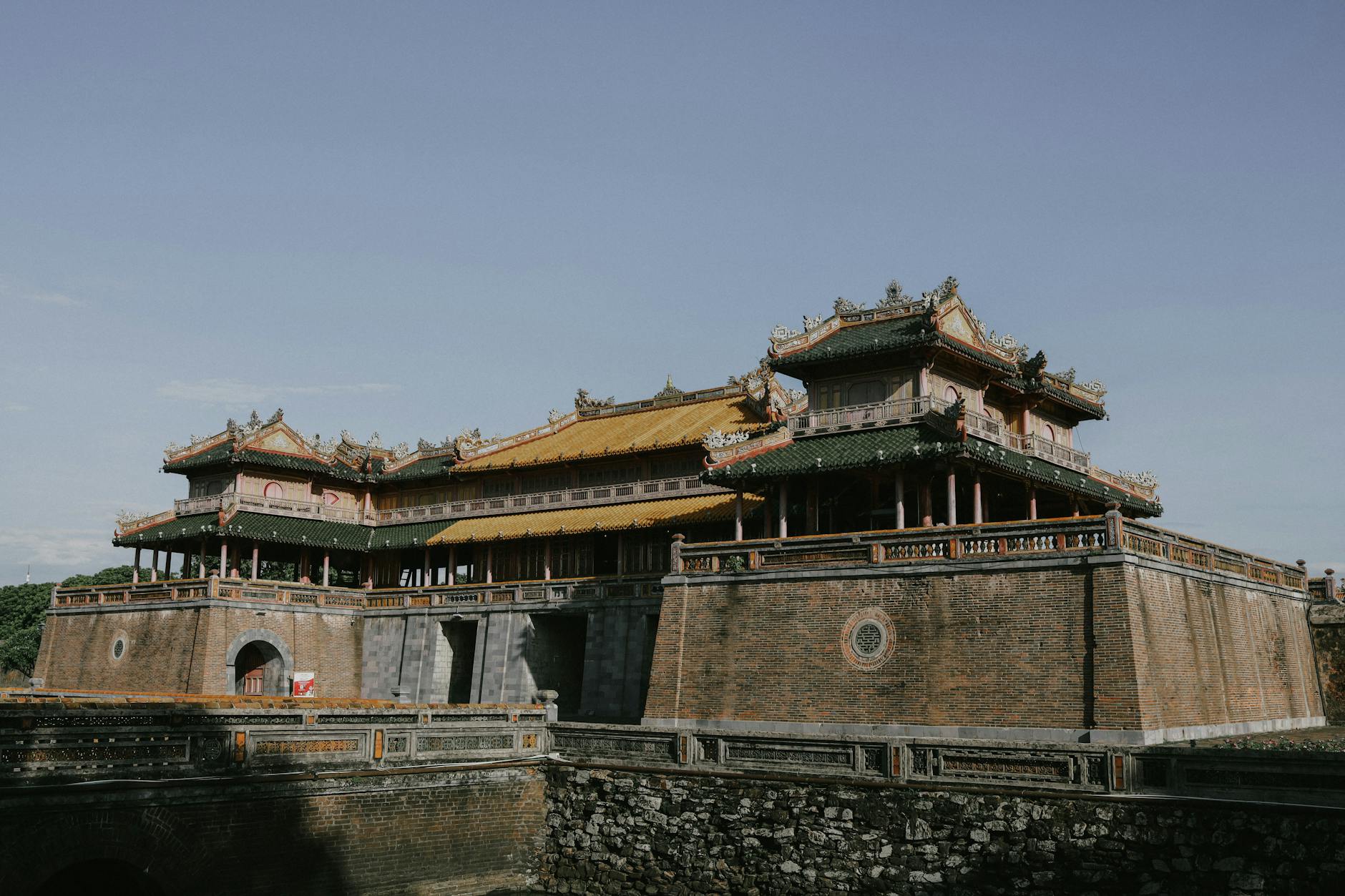
Geography & Orientation
Hue sits in central Vietnam, in Thua Thien-Hue Province, roughly midway between Hanoi (700 km north) and Ho Chi Minh City (1,100 km south). The city straddles the Perfume River (Sông Hương), which splits Hue into two distinct halves. The north bank holds the historic Imperial Citadel and its moat-ringed walls. The south bank is the modern city center — home to markets, restaurants, hotels, and the backpacker quarter.
Beyond the city, the terrain rises quickly. The Truong Son mountain range frames the western horizon, and the Hai Van Pass — one of Vietnam's most dramatic coastal roads — lies about 50 km south. Royal tombs are scattered across the forested hills to the southwest. Distances between sites are moderate: most major attractions sit within 10–15 km of the center, making Hue compact enough to explore thoroughly in 2–3 days.
Orientation tip: Use the Truong Tien Bridge as your mental landmark. It connects the south bank city center with the north bank Citadel area. Once you know where that bridge is, you always know where you are.
History & Cultural Context
Hue served as Vietnam's imperial capital from 1802 to 1945, under the reign of the Nguyen Dynasty — the country's last ruling royal family. Thirteen emperors ruled from here, overseeing a court that produced an exceptionally sophisticated culture in literature, music, architecture, and cuisine.
The city carries deep historical wounds as well. The 1968 Tet Offensive saw some of the Vietnam War's fiercest urban combat take place within and around the Citadel, leaving lasting scars on both the population and the monuments. Much of the Imperial City was damaged; restoration work has been ongoing for decades.
This blend of imperial grandeur, Buddhist devotion, and wartime memory gives Hue an atmosphere that is hard to find elsewhere in Vietnam: reflective, layered, and quietly proud. The city was designated a UNESCO World Heritage Site in 1993.
Must-See Sites & Monuments
The Imperial City (Đại Nội)
The crown jewel of visiting Hue is undoubtedly the Imperial Citadel, a massive walled complex modeled on Beijing's Forbidden City. Constructed from 1802, it once served as the political, cultural, and religious center of the Nguyen Dynasty. Inside, you'll find the Thai Hoa Palace (Throne Hall), ornate ceremonial gates, temple pavilions, and the inner Forbidden Purple City, once accessible only to the emperor and his closest household.
- Entry: $8 / 200,000 VND (adults), $1.60 / 40,000 VND (children)
- Hours: 6:30 AM – 5:30 PM (summer), 7:00 AM – 5:00 PM (winter)
- Time needed: 2–3 hours minimum
Allow at least half a day here. The complex is vast, and rushing through it means missing the quieter inner courtyards and restored pavilions.
The Royal Tombs
The hills south of Hue hide a series of imperial mausoleums, each with a distinct architectural personality:
- Minh Mang Tomb — Symmetrical and serene, set among lakes and pine forests; reflects Confucian ideals. Entry: $6 / 150,000 VND
- Tu Duc Tomb — The most romantic, with pavilions over a lotus lake; Emperor Tu Duc reportedly composed poetry here. Entry: $6 / 150,000 VND
- Khai Dinh Tomb — The most visually striking: a fusion of Vietnamese and European Baroque styles, with floor-to-ceiling mosaics of ceramics, porcelain, and glass. Entry: $6 / 150,000 VND
Don't try to see all three in one morning. Two tombs per half-day is the comfortable maximum if you want to appreciate them properly.
Thien Mu Pagoda
Perched on a bluff above the Perfume River, Thien Mu Pagoda is Hue's most iconic religious site. Its seven-tiered Phuoc Duyen Tower, built in 1844, is the tallest stupa in Vietnam. The pagoda has deep political significance: it was a center of Buddhist protest in 1963, and still houses the blue Austin Westminster car belonging to monk Thích Quảng Đức, who drove it to Saigon before his act of self-immolation in protest against government persecution.
- Entry: Free
- Hours: 8:00 AM – 6:00 PM
- Access: Best reached by a short boat ride along the Perfume River (15–20 min)
An Dinh Palace
Often overlooked, An Dinh Palace was the private residence of Emperor Bao Dai, Vietnam's last monarch. Its elegant blend of French colonial and traditional Vietnamese architecture, surrounded by a lush garden, offers a more intimate glimpse into royal life than the grand Citadel.
- Entry: $1 / 25,000 VND
- Hours: 6:30 AM – 5:30 PM
Neighborhoods to Explore
Phu Hoi & Vinh Ninh (City Center)
The south bank city center is the natural base for most travelers. Phu Hoi is packed with guesthouses, restaurants, and travel agencies, particularly along Nguyen Cong Tru and Hung Vuong streets. Adjacent Vinh Ninh is slightly quieter with a more local feel while still being walkable to the river. This area is the most convenient for first-time visitors.
Pham Ngu Lao & Chu Van An (Backpacker Quarter)
This compact cluster of streets within Phu Hoi transforms into a pedestrian walking zone on weekends, filling with lantern-lit stalls, live music, street food vendors, and backpacker bars. It is the heart of Hue's after-dark energy and the best place to meet other travelers.
Imperial Citadel Side (North Bank)
Quieter and more residential, the north bank feels like a different city. Tree-lined streets, tile-roofed houses, and the Citadel's moat create a peaceful, traditional atmosphere. Ideal for travelers who prioritize culture and calm over nightlife.
Vy Da Ward
A short ride north of the center, Vy Da is a semi-rural ward known for its clam rice eateries along a rustic riverbank peninsula called Con Hen. Prices here are lower, the pace is slower, and the food is more authentic. Worth a half-day visit even if you're not staying there.
Food in Hue — A Royal Culinary Tradition
Hue has one of the most distinctive regional cuisines in Vietnam. Its food culture is rooted in the Nguyen royal court, where chefs competed to create elaborate, refined dishes. The result is a cuisine that is more complex, more spiced, and more varied than you'll find in most Vietnamese cities.
Essential Hue Dishes
- Bún Bò Huế — The city's signature dish: a bold, lemongrass-scented beef and pork noodle soup, spicier and richer than phở. Eaten at breakfast or lunch at small street-side restaurants. Expect to pay $1–$2 / 25,000–50,000 VND per bowl.
- Bánh Bèo — Tiny steamed rice cakes topped with dried shrimp, crispy pork skin, and scallion oil; served in sets of six to ten small dishes. A refined, delicate snack.
- Bánh Khoái — A thick, crispy Hue-style pancake filled with shrimp, pork, and bean sprouts, served with a rich peanut dipping sauce (distinct from the thin bánh xèo of southern Vietnam).
- Cơm Hến — Baby clam rice, a Vy Da specialty: spicy, pungent, and deeply local. Not for everyone, but unmistakably Hue.
- Chè Huế — A wide family of sweet dessert soups featuring lotus seeds, beans, coconut milk, and colored jellies. Refreshing and beautifully presented.
Where to Eat
- Hue Cuisine & Café — Good spot to sample multiple Hue specialties in one sit-down meal
- Banh Khoai Hong Mai — A well-known address for bánh khoái
- Com Hen Nhu Y (Vy Da) — Authentic clam rice in a local setting
- Thị's Kitchen — Reliable barbecue spot popular with repeat visitors
Morning ritual: Start your day like a local with a bowl of bún bò Huế at a sidewalk stall before 8 AM. Prices are lowest early, and the broth is freshest.
Nightlife & Going Out
Hue is not a late-night city by Vietnamese standards, but it has a lively and compact evening scene centered on the backpacker quarter. Pham Ngu Lao Street and its neighboring lanes (Chu Van An, Vo Thi Sau) come alive after 7 PM, particularly on weekends when they become pedestrian-only.
- DMZ Bar and Vietnam Backpacker Hostels anchor the social scene for budget travelers
- Xeco Coffee & Pub offers jazz music and cocktails at reasonable prices ($2–$4 / 50,000–100,000 VND)
- The Perfume Riverfront promenade is worth a quiet evening stroll, especially around the illuminated Truong Tien Bridge
- For a more cultural experience, traditional Hue Royal Court Music (Nhã Nhạc) performances are staged at the Imperial City in the evenings — a UNESCO-recognized art form
Hue is generally quiet by midnight. If you are looking for late-night clubbing, you will need to travel to Da Nang (1.5–2 hours away).
Shopping & Crafts
Hue has a strong artisan tradition, and its markets and boutiques reflect this heritage:
- Dong Ba Market — Hue's historic riverside market (north bank, near the Citadel). Best for local produce, spices, conical hats (nón lá), and everyday goods. Lively and authentic.
- Hue Walking Street Weekend Market — Crafts, souvenirs, lanterns, and street food in the backpacker quarter
- Silk and embroidery — Hue is known for fine embroidered textiles; small shops near the Citadel offer handmade pieces
- Conical hats (nón lá Huế) — Hue's version is famously delicate, made with translucent lacquered leaves; look for the shadow-poem designs (nón bài thơ) when held up to the light
Budget $5–$20 / 125,000–500,000 VND for most handicraft souvenirs.
Unusual Activities
Beyond the heritage circuit, Hue offers a few less conventional experiences:
- Ho Thuy Tien Abandoned Water Park — A crumbling 2004 water park famous for its enormous dragon-head building and eerie atmosphere. Overgrown pools, vines reclaiming slides, and mossy ruins make it a surreal urban exploration site. Officially off-limits but tolerated for a small informal fee (~$0.80 / 20,000 VND at the gate). Wear grip-soled shoes — surfaces are slippery.
- An Bang Cemetery ("City of Ghosts") — Vietnam's most opulent cemetery, about 1 hour from Hue: towering two- to three-story family tombs covered in gold carvings, ceramics, and vivid colors. Free entry, best visited by private driver.
- Perfume River Sunset Cruise — Traditional wooden dragon boats offer short cruises with live Hue traditional music. Around $10–$15 / 250,000–375,000 VND per person for a 2-hour cruise.
- Hai Van Pass by motorbike — The coastal mountain road between Hue and Da Nang is one of Vietnam's most scenic drives. Rent a motorbike for the day ($8–$10 / 200,000–250,000 VND) or hire an Easy Rider guide.
Day Trips from Hue
| Destination | Distance | Travel Time | Highlights |
|---|---|---|---|
| Lang Co Beach | ~50 km | ~1 hour | White sand beach, turquoise water, mountains backdrop |
| Bach Ma National Park | ~45 km | ~1 hour | Hiking, waterfalls (Do Quyen), Five Lakes (Ngu Ho) |
| Da Nang | ~100 km | ~1.5–2 hours | Marble Mountains, My Khe Beach, Han River Bridge |
| Hoi An | ~120 km | ~2.5 hours | Lantern-lit Old Town, tailoring, river town atmosphere |
| DMZ Sites | ~70 km | ~1.5 hours | Khe Sanh, Vinh Moc Tunnels, Ben Hai River |
For the Da Nang / Hoi An route, the coastal road via the Hai Van Pass is far more scenic than the tunnel — add 30–40 minutes but the views are worth it.
Practical Information
Getting There
- By air: Phu Bai International Airport (HUI) handles domestic flights from Hanoi (1 hour) and Ho Chi Minh City (1.5 hours). Flights typically cost $20–$60 / 500,000–1,500,000 VND with budget carriers like VietJet and Bamboo Airways.
- By train: Hue sits on the Reunification Express line. The overnight sleeper from Hanoi (~14 hours) and the scenic daytime train from Da Nang (~2.5 hours) are both solid options.
- By bus/car transfer: From Da Nang or Hoi An, a car transfer (2.5–3 hours) is practical and comfortable, especially for groups.
Getting Around in Hue
- Grab (rideshare app): The most convenient option; download it before arriving. Note that mobile data can be unreliable outside the center — buy a local SIM card.
- Motorbike rental: ~$8–$10 / 200,000–250,000 VND per day; ideal for reaching tombs and pagodas on your own schedule.
- Private driver: ~$30–$50 / 750,000–1,250,000 VND for a full-day tour; the most comfortable option for covering multiple sites efficiently.
- Bicycle: Good for the city center and riverfront; rentable at most guesthouses for ~$2–$3 / 50,000–75,000 VND per day.
Budget Overview
| Traveler Type | Estimated Daily Budget | What It Includes |
|---|---|---|
| Budget | $25–$40 / 625,000–1,000,000 VND | Hostel dorm, street food, motorbike rental |
| Mid-range | $50–$90 / 1,250,000–2,250,000 VND | Guesthouse, restaurant meals, private driver |
| Comfort | $100–$180 / 2,500,000–4,500,000 VND | Boutique hotel, full-day tours, riverside dining |
Weather
| Season | Months | Conditions | Notes |
|---|---|---|---|
| Best time | Jan – Mar | Warm, dry, 24–28°C | Ideal for sightseeing |
| Hot season | Apr – Aug | Hot, sunny, 32°C+ | Heat can be intense |
| Rainy season | Sep – Dec | Heavy rain, storms | Cheap rates, small crowds — but pack waterproofs |
Hue's rainy season is notably intense compared to other Vietnamese cities. Typhoons occasionally affect the region in October–November.
Useful Tips
- The Hue Monument Conservation Centre sells a combo ticket covering the Citadel and select tombs — worth it if you plan to visit multiple sites
- Dress modestly when visiting pagodas and the Citadel: covered shoulders and knees are required
- Tipping is appreciated but not obligatory; rounding up at restaurants is a kind gesture
- Most ATMs dispense VND without issue; notify your bank before travel
- English is spoken at most tourist sites and in the backpacker quarter
Suggested Itineraries
2 Days in Hue — The Essentials
Day 1 — Imperial Hue: Morning: Imperial Citadel (2–3 hours). Lunch near the Citadel. Afternoon: Thien Mu Pagoda by river taxi, then Khai Dinh Tomb. Evening: Stroll the Perfume Riverfront, dinner in the backpacker quarter.
Day 2 — Tombs & Table: Morning: Minh Mang Tomb and Tu Duc Tomb by motorbike. Midday: Return to town for bún bò Huế and a coffee. Afternoon: Dong Ba Market and Thanh Toan Tile Bridge. Evening: Hue Royal Court Music performance at the Citadel.
3 Days in Hue — Deeper Exploration
Add to the above: Day 3: Day trip to Lang Co Beach or Bach Ma National Park. Alternatively, rent a motorbike for the Hai Van Pass drive toward Da Nang, with a return by evening.
Hue as Part of a Wider Vietnam Trip
Hue sits perfectly between Hoi An (2.5 hours south) and Phong Nha (3 hours north). A 10–14 day central Vietnam itinerary might run: Hanoi → Phong Nha → Hue (2–3 nights) → Hoi An → Da Nang → Ho Chi Minh City.