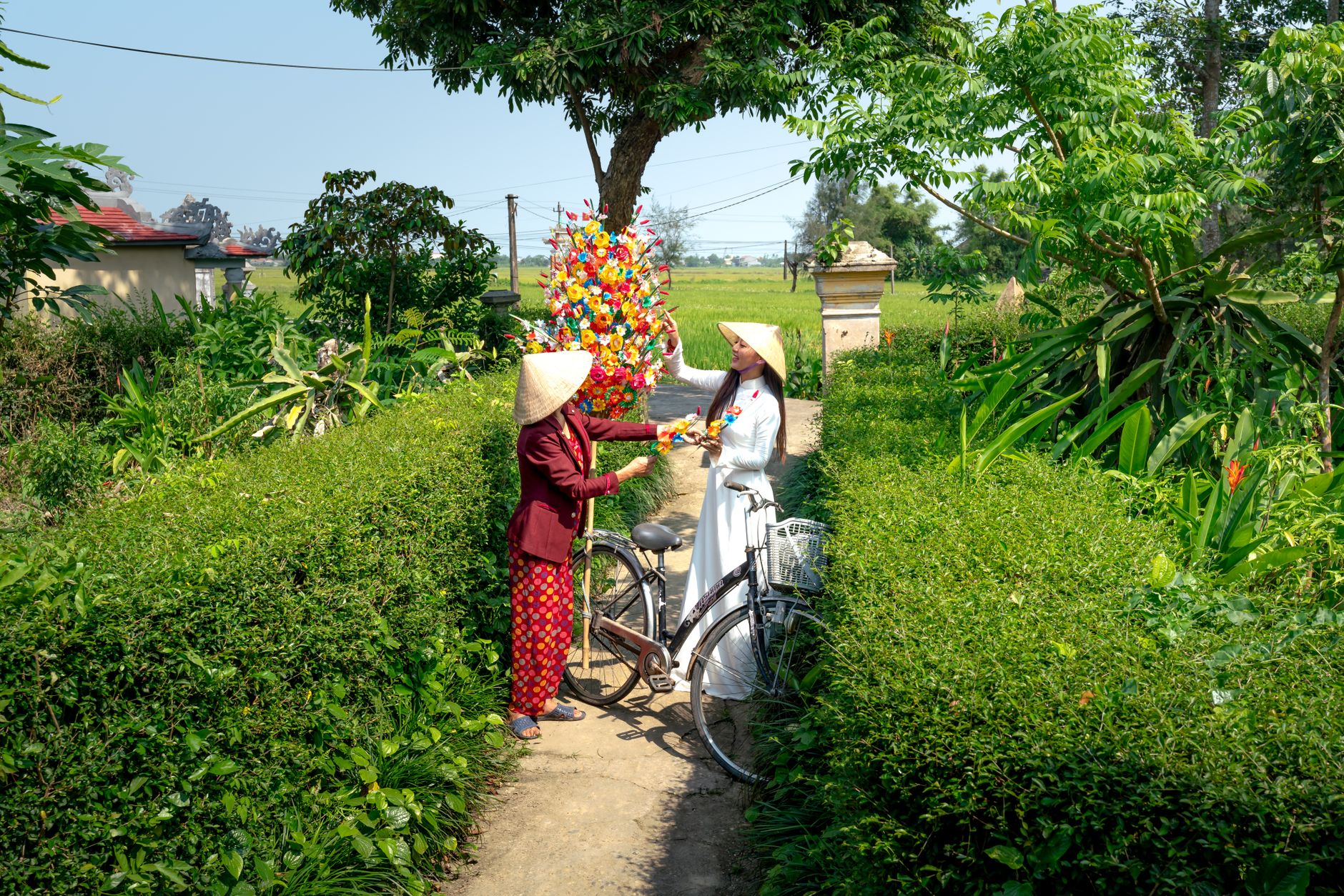
This guide covers the essential social rules every traveler needs to know. From the correct way to say hello to avoiding common faux pas, these are the practical details that separate a good trip from a great one.
Greetings: more than just "xin chào"
The most common greeting in Vietnam is "xin chào" (sin chow). It means "hello" and works in almost any situation. But Vietnamese greetings are more nuanced than a simple two-word phrase.
The language uses age-based pronouns. You address someone differently depending on their age relative to yours. An older man is "ông" (ong). An older woman is "bà" (bah). Someone your age or slightly older is "anh" (ang) for a man or "chị" (chee) for a woman. Younger people are "em" (em).
A proper greeting combines the pronoun with "chào." For an older man, you say "chào ông." For a woman your age, "chào chị." This shows respect and awareness of social hierarchy.
Pro tip: When in doubt, use "xin chào" with a smile. It works universally and locals appreciate the effort.
The Vietnamese also use "ạ" (ah) at the end of sentences to show politeness. "Chào anh ạ" is more respectful than "chào anh" alone. It is a small addition that carries weight.
Pronouns and age hierarchy: the foundation of social interaction
Age determines everything in Vietnamese social structure. It dictates how you address people, how you behave, and what is expected of you.
When meeting someone new, Vietnamese people often ask about age, marital status, and occupation. These questions are not intrusive. They are practical. The answers help determine the correct pronoun and social dynamic.
As a foreigner, you will generally be called "anh" or "chị" regardless of your actual age. Locals adjust their language to make you comfortable. But if you learn to use the correct pronouns yourself, you show respect for their system.
Here is a quick reference table for common Vietnamese pronouns:
| Pronoun | Who to use it for | Example |
|---|---|---|
| Ông | Older man (grandfather age) | Chào ông |
| Bà | Older woman (grandmother age) | Chào bà |
| Anh | Man your age or slightly older | Chào anh |
| Chị | Woman your age or slightly older | Chào chị |
| Em | Anyone younger than you | Chào em |
| Cô | Middle-aged woman (auntie age) | Chào cô |
| Chú | Middle-aged man (uncle age) | Chào chú |
Warning: Using "em" for someone older than you can be seen as arrogant. When unsure, err on the side of respect and use "anh" or "chị."
The concept of face: why public behavior matters
"Face" is the Vietnamese concept of social reputation and dignity. It operates in every interaction. Losing face means public embarrassment or shame. Causing someone to lose face is a serious social offense.
Face affects how people communicate. Vietnamese people rarely say "no" directly. They might say "maybe" or "I will think about it" when they mean no. They avoid confrontation in public settings. Disagreements happen behind closed doors.
For travelers, this means:
- Do not criticize someone publicly. Keep complaints private.
- Do not raise your voice. Losing your temper makes you lose face and causes everyone around you to lose face too.
- Accept a "maybe" as a polite refusal. Do not push for a clearer answer.
- Compliment people indirectly. Direct praise can make the recipient feel obligated to downplay it.
The concept of face also explains why Vietnamese people might not admit they are lost. A taxi driver who does not know the way will keep driving rather than say "I do not know." This is not dishonesty. It is a face-saving mechanism.
Pro tip: If your taxi driver seems lost, say "I think the hotel is near here. Let me check the map." This gives them an exit without losing face.
Handshakes vs bows: the physical greeting
The traditional Vietnamese greeting involves a slight bow with hands clasped together at chest level. This is called "chắp tay" (chup tie). It is similar to the Thai wai or the Indian namaste.
In practice, most Vietnamese people today use handshakes, especially in cities and with foreigners. But the style matters.
A Vietnamese handshake is softer than a Western one. It is not a firm grip. It is a gentle clasp that may last longer. Two hands are sometimes used to show extra respect. The left hand supports the right forearm or wrist during the handshake.
Bowing is still common in formal situations or when greeting elderly people. The depth of the bow indicates the level of respect. A slight nod works for casual encounters. A deeper bow is for elders or authority figures.
Women sometimes avoid handshakes with men, especially in rural areas. In this case, a slight bow with a smile is the correct response. Do not extend your hand first to a woman unless she offers hers.
Warning: Avoid touching someone's head, even in a friendly way. The head is considered the most sacred part of the body. Patting a child's head is also inappropriate.
Gift-giving basics: what to bring and what to avoid
Gift-giving is common in Vietnam, especially when visiting someone's home or meeting business partners. The rules are simple but specific.
Good gift choices include:
- Fruit (a nice basket of local fruit)
- Tea or coffee (Vietnamese or imported)
- Sweets or pastries (avoid dairy if traveling in hot weather)
- Flowers (yellow or red are safe colors)
- Incense or candles
Gifts to avoid:
- Sharp objects like knives or scissors (they symbolize cutting ties)
- Handkerchiefs (associated with funerals)
- White flowers (associated with death and mourning)
- Clocks (the phrase "giving a clock" sounds like "attending a funeral" in Vietnamese)
Gifts should be wrapped in bright colors. Red and yellow are lucky. Gold is auspicious. Avoid black and white wrapping paper.
Present gifts with both hands. The recipient will likely not open the gift in front of you. This is normal. Do not ask them to open it.
When receiving a gift, accept it with both hands. Thank the giver. Do not refuse a gift more than once or twice, but a polite initial refusal is standard.
Pro tip: If invited to a Vietnamese home, bring a small gift. Fruit or a box of local sweets from your home country works well.
Common faux pas foreigners make
Even well-meaning travelers make mistakes. Here are the most common ones and how to avoid them.
Pointing your feet. Feet are considered the lowest and dirtiest part of the body. Pointing your feet at someone, especially an older person, is rude. Do not put your feet on furniture. When sitting, keep your feet flat on the floor.
Touching someone's head. As mentioned, the head is sacred. Avoid touching anyone's head, including children's heads.
Using one hand. Always use both hands when giving or receiving something. This includes money, business cards, and gifts.
Public displays of affection. Holding hands is fine. Kissing in public is not, especially in rural areas. Keep intimate gestures private.
Shoes indoors. Remove shoes before entering someone's home. Some temples also require removing shoes. Look for a pile of shoes at the entrance and follow the local practice.
Loud behavior. Vietnamese people generally speak softly in public. Loud talking, shouting, or laughing draws negative attention.
Direct eye contact. Prolonged eye contact can be seen as aggressive or challenging. Brief eye contact with a smile is fine. Staring is not.
Discussing sensitive topics. Avoid discussing the Vietnam War, politics, or religion unless the other person brings it up. Even then, tread carefully.
Not learning basic phrases. A simple "cảm ơn" (thank you) or "xin lỗi" (excuse me) goes a long way. Locals appreciate the effort even if your pronunciation is imperfect.
Warning: Pointing with your finger is rude. Use your whole hand with palm facing up to gesture toward something.
Practical tips for specific situations
Business meetings. Arrive on time. Dress conservatively. Exchange business cards with both hands. Study the card briefly before putting it away. Do not write on someone's business card in their presence.
Temple visits. Dress modestly. Cover shoulders and knees. Remove shoes before entering prayer halls. Do not touch statues or religious objects. Women should avoid physical contact with monks.
Dining etiquette. Wait for the oldest person to start eating before you begin. Use chopsticks correctly. Do not stick chopsticks upright in a bowl of rice (this resembles incense sticks at funerals). Do not pass food with chopsticks directly to someone else's chopsticks.
Tipping. Tipping is not expected in most situations but is appreciated for exceptional service. For a detailed breakdown, read Tipping in Vietnam 2026: When It's Insulting, When It's Expected.
Street food. Sit on the small plastic stools like everyone else. Eat with the provided utensils. Do not complain about the conditions. For more on eating safely, see Vietnamese Street Food Safety: How to Eat Everywhere Without Getting Sick.
Regional differences in etiquette
Vietnam is not uniform. Northern, Central, and Southern regions have distinct social norms.
In the North (Hanoi, Ha Giang, Cao Bang), people are more formal and reserved. Greetings are more elaborate. The concept of face is stronger. Gifts and compliments are handled with more ceremony.
In the Center (Hue, Da Nang, Hoi An), the culture is influenced by the old imperial court. Etiquette is more refined. Speech is softer. People are more indirect.
In the South (Ho Chi Minh City, Mekong Delta), people are more relaxed and direct. Greetings are simpler. The pace is faster. Formality is lower.
These differences matter. A handshake that works in Saigon might feel too casual in Hanoi. Observing local behavior and matching it is the safest approach.
Pro tip: When traveling between regions, adjust your behavior. What is acceptable in Ho Chi Minh City might be too forward in Hue.
Frequently asked questions
Q: Is it okay to use "xin chào" with everyone? Yes. "Xin chào" is the universal greeting and works in all situations. Adding the correct pronoun shows more respect, but "xin chào" alone is never wrong.
Q: Do I need to bow when greeting someone in Vietnam? A slight bow or nod is polite but not required. Handshakes are standard in cities. In rural areas, a bow with hands clasped is more common, especially when greeting older people.
Q: What should I do if I accidentally offend someone? Apologize sincerely. Say "xin lỗi" (sin loy) which means "I am sorry." A smile and a respectful tone help diffuse the situation. Do not make excuses or blame the other person.
Q: Is it rude to refuse food or drink when offered? It can be. A polite refusal once is acceptable. If the host insists, accept a small portion. Even a sip of tea or a bite of food shows respect.
Q: Can I wear shorts and tank tops in Vietnam? In tourist areas and beach towns, yes. In temples, pagodas, and rural villages, no. Cover your shoulders and knees. For a full packing guide, see What to wear in Vietnam in May female.
Q: How do I address a monk or nun? Address monks as "thầy" (teacher) and nuns as "sư cô" (sister). Do not touch them. Women should not hand anything directly to a monk. Place the item on a table or surface instead.
Q: What is the biggest mistake tourists make in Vietnam? Not learning basic greetings and assuming Vietnamese culture works like Western culture. The concept of face and age hierarchy are fundamental. Ignoring them creates awkward situations. For more, read What is one of the biggest mistakes you can make in Vietnam?.