The lunar calendar is not a relic. It is a living framework that shapes daily decisions for millions of Vietnamese people. Street vendors consult it before launching a new business. Families plan their Tet travels around it. Even young, tech-savvy Vietnamese check lunar auspicious days before booking a wedding date or signing a contract.
This guide covers the essential superstitions and calendar customs that travelers encounter in Vietnam. It explains why certain days matter, what behaviors to avoid, and how to participate respectfully in festivals that follow the moon.
How the lunar calendar works in Vietnam
The Vietnamese lunar calendar is a lunisolar system. It tracks both the moon's phases and the sun's position. Months begin with the new moon. A typical lunar year has 12 months of 29 or 30 days, totaling about 354 days. To stay aligned with the solar year, an extra leap month is added roughly every three years.
Each year is associated with one of 12 zodiac animals. These rotate in a fixed cycle: Rat, Buffalo, Tiger, Cat, Dragon, Snake, Horse, Goat, Monkey, Rooster, Dog, and Pig. 2026 is the Year of the Horse. The animal of your birth year is believed to influence your personality and fortune.
The calendar also assigns attributes to each day. Certain days are considered "good" for starting a journey, signing documents, or getting married. Others are "bad" and best reserved for rest or reflection. Many Vietnamese consult these designations before making important decisions.
For travelers, the most practical application is knowing when major festivals fall. Tet Nguyen Dan (Lunar New Year) occurs in late January or early February. The Mid-Autumn Festival falls in September or October. Monthly full-moon days draw crowds to pagodas and temples.
Lucky days and the art of choosing the right moment
Vietnamese people rarely make major moves without checking the calendar. Opening a business, buying a car, or even moving into a new home requires selecting an auspicious date. This practice is called xem ngay (looking at the day).
The calculation involves the zodiac animal of the person, the day's animal sign, and the elemental五行 (five elements). Professional fortune tellers and online apps provide these readings. Many hotels and business owners quietly consult these systems before launching new services.
For travelers, the practical takeaway is simple. If you see a shop opening with incense burning and offerings of fruit, it is likely an auspicious day chosen by the owner. Do not walk through the offerings or disturb the ceremony. Stand back and observe. This is a private ritual, not a performance.
Some days are universally avoided. The "Day of the Dog" is considered bad for travel. The "Day of the Rat" is good for starting new projects but bad for medical procedures. These variations matter less to tourists than to locals, but knowing they exist helps explain why your Vietnamese friend might refuse to book a flight on a certain date.
First-footing at Tet: the tradition that sets the year's tone
Tet Nguyen Dan is the most important event on the lunar calendar. It marks the beginning of a new year and a fresh start. One of the most deeply observed Tet traditions is xong dat (first-footing).
The first person to enter a home after midnight on Tet Eve is believed to bring either good or bad luck for the entire year. Families carefully select this person based on their zodiac sign, age, and personal fortune. A person born in a compatible animal year is preferred. Someone born in a conflicting year is politely asked to stay away until later in the day.
For travelers staying in Vietnamese homes or homestays during Tet, this tradition matters. If you are invited to visit a family during Tet, your arrival time and your zodiac sign could be significant. The host may have already arranged for a specific person to be the first-footer. Do not insist on being the first to enter. Wait for the host to guide you.
Hotels and guesthouses sometimes observe a modified version. A staff member with a favorable zodiac sign may be designated to open the property on the first day of Tet. Guests arriving early on Tet morning might notice a small ceremony at the entrance. This is the hotel ensuring good fortune for the year ahead.
For a complete guide to Tet customs, closures, and travel logistics, read Tet Nguyen Dan: The Complete Traveler's Guide to Vietnamese Lunar New Year. For survival tips on transport and food during the holiday, see Traveling in Vietnam During Tet: A Survival Guide to Closures, Transport and Food.
Numbers to avoid and numbers to embrace
Number superstition in Vietnam follows sound-based logic. The number 4 is avoided because it sounds like tu (death). Buildings often skip the fourth floor. Floor numbers go 1, 2, 3, 5. Hospital room numbers avoid 4. Phone numbers and license plates with multiple 4s are considered unlucky and sell for less.
The number 8 is lucky because it sounds like phat (prosperity). Number 9 is lucky because it sounds like cuu (longevity). Number 6 is associated with loc (fortune). Number 7 can be unlucky in certain contexts because it sounds like that (loss).
For travelers, the practical impact is minimal but worth knowing. When choosing a hotel room, avoid room 4 or rooms with 4 in the number if you want to be sensitive to local staff. When bargaining at markets, offering a price ending in 8 or 9 is considered more polite than offering a round number. For bargaining tips, see Bargaining in Vietnam: Complete Guide to Negotiating Like a Local in 2026.
Gift giving also follows number logic. Giving two of something is better than one. Giving one item is associated with funerals. A pair of items symbolizes togetherness and completeness. Avoid giving sharp objects like knives or scissors, as they symbolize cutting ties. Avoid giving clocks, as the phrase "giving a clock" sounds like "attending a funeral."
Taboos travelers unknowingly break
Vietnamese superstitions are not aggressively enforced. Locals understand that foreigners do not know the rules. But breaking certain taboos can cause quiet discomfort or embarrassment. Here are the most common ones travelers stumble into.
Pointing feet at altars or Buddha statues. Feet are considered the lowest and dirtiest part of the body. Pointing them at a family altar, a Buddha statue, or a person's head is disrespectful. When sitting in a temple or a Vietnamese home, tuck your feet under you or sit with them pointing away from altars. For temple-specific rules, read Temple etiquette in Vietnam: what to wear, do and avoid.
Whistling at night. Many Vietnamese believe whistling after dark attracts snakes or evil spirits. This superstition is strongest in rural areas but persists in cities too. A hotel staff member might politely ask you to stop whistling in the hallway at night.
Buying one of something. As noted above, pairs are preferred. Buying a single item, especially for gifts, carries funeral associations. When buying souvenirs, purchase in pairs or even numbers.
Sleeping with your head pointing west. Traditional belief holds that the west is the direction of the setting sun and death. Some older Vietnamese avoid sleeping with their head pointing west. Hotel bed arrangements usually do not follow this rule, but if you are staying in a homestay, check with your host.
Touching someone's head. The head is considered the seat of the spirit. Touching it, even playfully, is disrespectful. This applies especially to children. Avoid patting a child's head, even if you mean it affectionately.
Using your index finger to call someone. Pointing with one finger is considered rude. Use your whole hand with palm facing down, or gesture with your chin. For a full guide on social norms, see Vietnamese greetings and social etiquette: a practical guide for travelers.
Taking photos of altars without permission. Family altars and temple shrines are sacred spaces. Ask before photographing them. In some temples, photography is entirely forbidden in the main sanctuary.
Full-moon festivals and monthly rituals
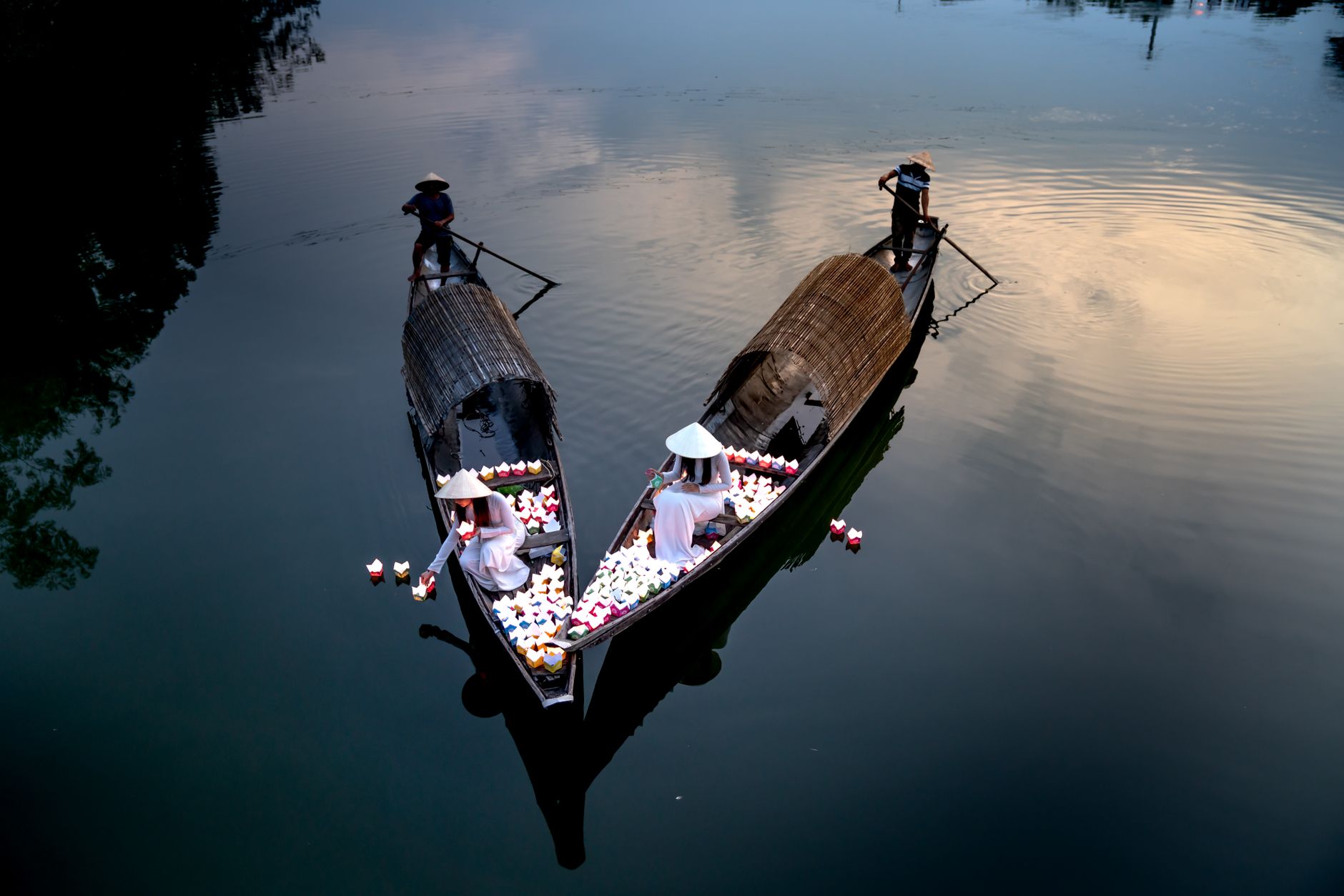
The 15th day of each lunar month is the full moon, called ngay ram. It is a significant day for Buddhist practice. Many Vietnamese visit pagodas to make offerings, pray for good fortune, and release captive animals (birds, fish, turtles) as an act of merit.
The largest full-moon celebrations happen on the first full moon of the lunar year (January or February) and the Mid-Autumn Festival (eighth lunar month, September or October). During the Mid-Autumn Festival, children carry lanterns, eat mooncakes, and watch lion dances. For details, see Mid-Autumn Festival in Vietnam: When, Where & What to Expect.
Every full moon, Hanoi's Old Quarter transforms. The area around Hang Ma Street fills with vendors selling paper offerings, incense, and votive objects. The scent of burning incense thickens near temples like Bach Ma and Ngoc Son. In Hoi An, the Old Town hosts a monthly lantern festival on the full moon, with electric lights turned off and the streets lit only by silk lanterns and candles.
For travelers, visiting a pagoda on a full-moon day offers a glimpse of living Buddhism. The atmosphere is more crowded and more vibrant than on ordinary days. Monks chant, laypeople bow, and offerings pile up on altars. For context on Buddhist practice, see Buddhism and pagodas in Vietnam: a traveler's guide to temples and rituals.
What to do at a full-moon pagoda visit:
- Dress modestly. Cover shoulders and knees.
- Remove shoes before entering the main hall.
- Walk clockwise around the main altar.
- Do not point your feet at Buddha statues.
- Offer incense if you wish. Light three sticks, bow three times, and place them in the sand urn.
- Do not take photos during chanting.
Comparing lunar calendar festivals by region
| Festival | Lunar date | Gregorian window | Best place to experience |
|---|---|---|---|
| Tet Nguyen Dan | 1st day of 1st month | Late Jan to mid-Feb | Anywhere, but Hanoi and HCMC have largest celebrations |
| Full Moon of January | 15th day of 1st month | Feb to Mar | Pagodas nationwide; Yen Tu in Quang Ninh |
| Hung Kings Festival | 10th day of 3rd month | April | Hung Temple, Phu Tho province |
| Buddha's Birthday | 15th day of 4th month | May | Major pagodas in all cities |
| Mid-Autumn Festival | 15th day of 8th month | Sept to Oct | Hoi An, Hanoi Old Quarter, Cho Lon in HCMC |
| Full Moon of December | 15th day of 12th month | January | Family altars and local temples |
Practical tips for traveling with the lunar calendar
Check the lunar date before booking. If you want quiet temples, avoid full-moon days. If you want to see local life at its most vibrant, plan around them. For weather considerations, see Vietnam Weather by Month: The Best Time to Visit Each Region.
Tet requires advance planning. Most businesses close for 3 to 7 days. Transport fills up weeks in advance. Hotels raise prices. If you travel during Tet, book everything early and expect limited services. For a month-by-month guide, see What is the best month to travel to Vietnam? A detailed 12-month reference guide for beginners.
Respect private rituals. If you see a family burning votive paper on the sidewalk, do not walk through the smoke. It carries offerings to deceased ancestors. Wait or walk around.
Do not buy single items at markets if giving gifts. Buy in pairs. This applies to everything from ao dai to ceramic bowls. For information on Vietnam's national dress, see Ao dai: the story of Vietnam's national dress and where to see it today.
Learn the zodiac animal of your birth year. Vietnamese people often ask. Knowing your animal sign is a simple conversation starter. The current cycle: 2026 is Horse, 2027 is Goat, 2028 is Monkey.
Ask before entering a home during Tet. Even if you are invited, confirm the timing. The first-footing tradition may mean the family wants you to arrive at a specific hour.
Frequently asked questions
Q: Do Vietnamese people still follow the lunar calendar in daily life? Yes. The lunar calendar is used alongside the Gregorian calendar. Most Vietnamese know their lunar birth date. Businesses, weddings, and funerals are often scheduled according to lunar auspicious days. Young people may check the calendar less frequently, but major life events still follow lunar timing.
Q: Is it rude to give gifts in odd numbers? It is not rude, but it is less thoughtful. Even numbers are preferred because they symbolize completeness and togetherness. The exception is funeral gifts, which are often given in odd numbers. For general gift giving, stick to pairs.
Q: What should I do if I accidentally break a superstition? Apologize briefly and move on. Vietnamese people are generally forgiving toward foreigners who make cultural mistakes. A simple "xin loi" (sorry) and a respectful bow is sufficient. Do not over-apologize or make a scene.
Q: Can I participate in full-moon ceremonies at pagodas? Yes. Visitors are welcome to observe and participate respectfully. Follow the dress code, remove shoes, and imitate what locals do. Do not interrupt chanting or take flash photos. Offering incense is appropriate if you follow the correct procedure.
Q: Are there any days when I should avoid traveling in Vietnam? The first three days of Tet are the most difficult for travel. Roads are crowded, trains sell out, and many services close. The 15th day of the seventh lunar month (Ghost Month) is considered unlucky for starting new journeys, but transport still runs normally. For safety during typhoon season, see Is it safe to travel to Vietnam during typhoon season? A practical guide for 2026.
Q: How do I find out the lunar date for a specific day? Smartphone apps like Lịch Việt or Google Calendar with the Vietnamese lunar calendar enabled show both dates. Most Vietnamese hotels and homestays have a wall calendar displaying both systems. Asking a local "Hom nay la ngay ram hay ngay gi?" (Is today a full moon or what day?) is an easy conversation starter.
Q: Does the lunar calendar affect restaurant and market hours? Generally no. Markets and restaurants operate on regular schedules. However, on the first and 15th of the lunar month, some Buddhist households eat vegetarian. Many restaurants offer expanded vegetarian menus on these days. During Tet and the Mid-Autumn Festival, hours change dramatically.