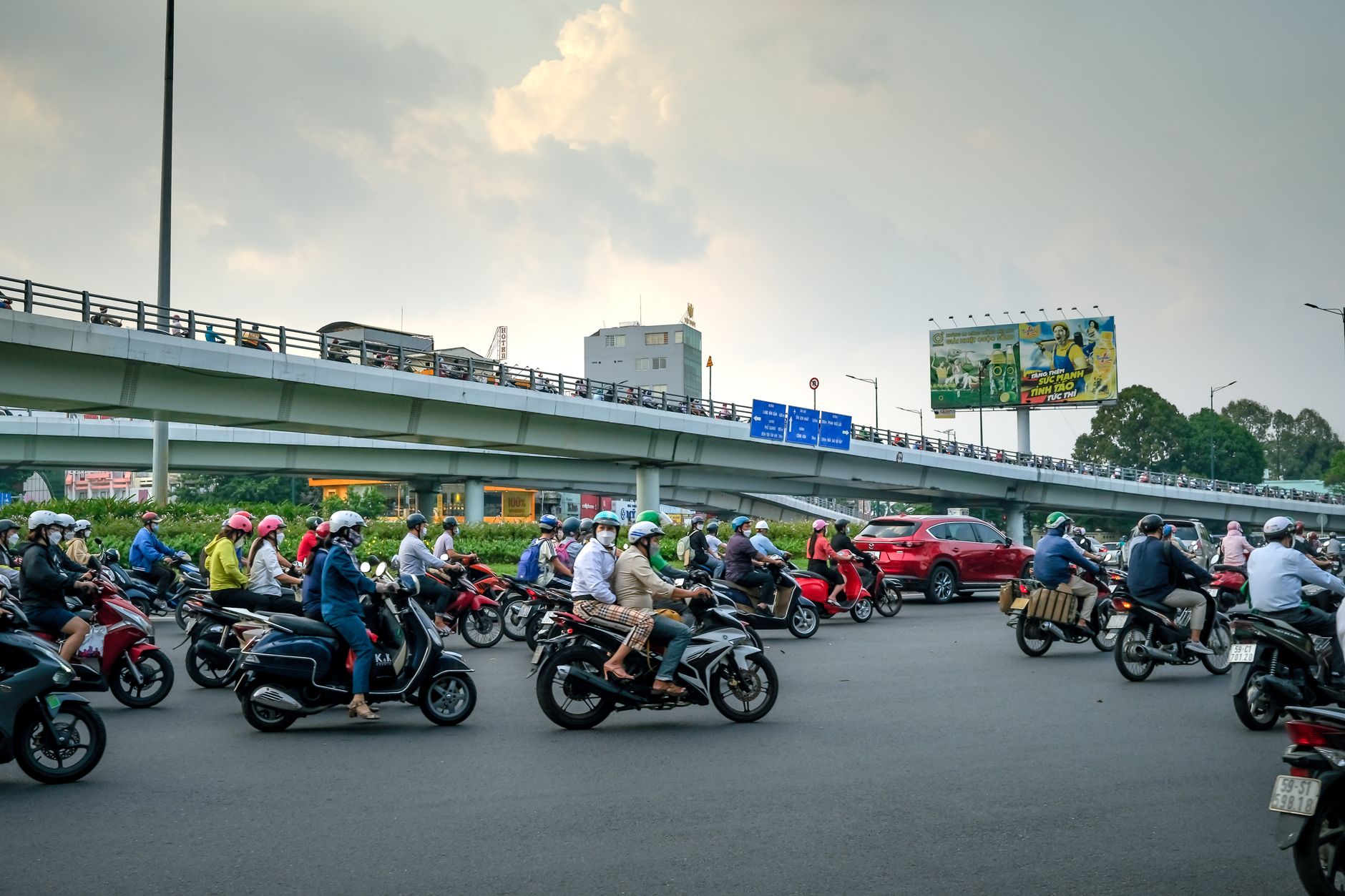
Walk five minutes into any Vietnamese city and the motorbike reveals itself as the backbone of daily life. A family of four balances on a single Honda Wave. A pig tied to the back seat grunts through Saigon traffic. A teenager in an ao dai rides sidesaddle, phone in one hand, coffee in the other. The scooter carries everything. It carries everyone.
This article explains how motorbike culture works in Vietnam. It covers family transport, xe om (motorbike taxis), the delivery economy, crossing the street as a pedestrian, and how travelers fit in safely and legally.
The scooter as family transport: four people, one bike
Vietnamese families do not own cars the way Western families do. Cars remain expensive due to import taxes that can double the purchase price. A new Toyota Vios costs around 650 million VND ($26,000). A Honda Wave scooter costs 30 million VND ($1,200). The math is simple.
So families adapt. A typical scene in Ho Chi Minh City at 7:00 AM: father drives, mother sits behind him holding a toddler, and an older child stands on the front footboard. Nobody wears helmets on the child. Nobody thinks twice about it. This is normal.
The scooter serves school runs, grocery shopping, and hospital visits. It carries construction materials, livestock, and wedding cakes. During Tet, the Lunar New Year, families load scooters with potted apricot blossoms and gift baskets for the journey home. Read more about Tet Nguyen Dan: The Complete Traveler's Guide to Vietnamese Lunar New Year.
Pro tip: If you see a family of four on a scooter, do not stare. This is not a spectacle. It is a practical solution to expensive car ownership and narrow streets.
Xe om: the motorbike taxi network
Xe om translates to "hug vehicle." The name comes from the way passengers must hold the driver. These drivers wait at street corners, bus stations, and market entrances. They wear jackets with numbers stitched on the back. They know every alley in their neighborhood.
A xe om ride costs 10,000-30,000 VND ($0.40-1.20) for short trips within a district. Longer cross-city rides cost 50,000-100,000 VND ($2-4). The price is negotiable. Always agree on the fare before getting on.
Grab, the Southeast Asian ride-hailing app, has transformed xe om. The GrabBike service shows the driver's name, photo, and license plate. The fare is fixed. Payment happens through the app or in cash. This eliminates the language barrier and price haggling. Read our guide on Does Grab Work in Vietnam?.
For travelers, xe om offers the fastest way through city traffic. Cars get stuck. Scooters weave between lanes. A 30-minute car ride becomes a 12-minute scooter ride. The tradeoff is exposure to weather and a slightly higher risk of accidents.
Pro tip: Carry a spare helmet if you plan to use xe om frequently. Driver helmets are often old and may not fit properly.
The delivery economy: everything on two wheels
Vietnam runs on delivery scooters. In Ho Chi Minh City alone, delivery platforms process over 20 million orders per week. GrabFood, ShopeeFood, and Baemin employ hundreds of thousands of riders. These riders navigate chaotic traffic with insulated boxes strapped to the back.
The delivery economy extends beyond food. Pharmacies send medicine via scooter. Electronics stores deliver laptops. Flower shops send bouquets. Even documents between government offices travel by scooter. The speed of delivery in Vietnam rivals any developed country.
For travelers, this means you can order almost anything to your hotel. Need a phone charger at midnight? It arrives in 20 minutes. Craving bun cha at 10 PM? A rider brings it. The cost is 10,000-20,000 VND ($0.40-0.80) for delivery within a 2-kilometer radius.
The downside is the pressure on riders. They work 12-hour shifts in heat and rain. They skip meals. They take risks in traffic. The average delivery rider earns 8-12 million VND ($320-480) per month, which is decent by local standards but demanding work.
Crossing the street as a pedestrian: the real technique
Every traveler fears crossing the street in Vietnam. The first attempt feels like a death wish. Scooters come from every direction. Traffic lights seem optional. There are no clear pedestrian crossings.
The technique is counterintuitive. Do not wait for a gap in traffic. There will never be a gap. Instead, step into the street and maintain a steady, predictable pace. Do not speed up. Do not slow down. Do not stop. The scooters will flow around you.
The logic works like water. Scooter drivers are constantly scanning for obstacles. A pedestrian moving predictably is easy to avoid. A pedestrian who suddenly stops or runs creates confusion. The drivers expect you to keep walking.
Make eye contact with oncoming drivers. This confirms they see you. Raise a hand slightly if you feel uncertain. Drivers will adjust their path. The key is commitment. Hesitation causes accidents.
For a deeper breakdown of this technique, read our dedicated guide: Crossing the street in Vietnam: the real technique nobody explains clearly.
Warning: Do not cross while looking at your phone. Do not wear noise-canceling headphones. You need full awareness of your surroundings.
How travelers fit in safely and legally
Renting a motorbike in Vietnam is tempting. The country offers some of the world's most scenic routes. The Ha Giang Loop, the Hai Van Pass, and the Cao Bang Loop attract thousands of riders each year. But the legal situation is more complicated than most travelers realize.
The international driving permit requirement
Vietnam requires an International Driving Permit (IDP) issued under the 1968 Vienna Convention on Road Traffic. This is different from the IDP issued in the United States, which follows the 1949 Geneva Convention. Vietnam does not recognize the 1949 version.
What does this mean in practice? If you rent a motorbike without a valid IDP, your insurance is void. If you get into an accident, you pay out of pocket. If police stop you, they can impound the bike and fine you 2-6 million VND ($80-240).
Many travelers rent bikes anyway. The enforcement is inconsistent. Police in tourist areas like Nha Trang and Da Lat check more frequently. In remote areas like Ha Giang, checks are rare but not nonexistent.
For a complete breakdown of the legal situation, read Renting a Motorbike in Vietnam: The Legal Truth Nobody Tells Tourists.
Rental apps vs street rentals
Several apps now offer motorbike rentals with proper documentation. In Hanoi, apps like Renta and Motorme provide bikes with helmets, insurance, and sometimes a basic IDP guide. In Ho Chi Minh City, similar services operate. Street rentals remain cheaper but come with risks: poorly maintained bikes, hidden damage fees, and passport retention.
| Feature | Street rental | App-based rental |
|---|---|---|
| Daily cost | 100,000-150,000 VND ($4-6) | 150,000-250,000 VND ($6-10) |
| Helmet quality | Often poor | Usually good |
| Insurance | None | Basic coverage included |
| Passport required | Yes, held as deposit | No, digital copy accepted |
| English support | Limited | App-based chat |
| Bike condition | Variable | Inspected regularly |
For app recommendations, see Hanoi Motorbike Rental Apps and Saigon Motorbike Rental Apps.
The Ha Giang Loop and Cao Bang Loop
These two routes represent the pinnacle of motorbike travel in Vietnam. The Ha Giang Loop runs through the northernmost province, passing through Dong Van Karst Plateau and Ma Pi Leng Pass. The Cao Bang Loop offers quieter roads with Ban Gioc Waterfall and Pac Bo Cave.
Both loops require experience on a manual or semi-automatic bike. The roads include sharp curves, loose gravel, and sudden weather changes. Riders should have at least six months of experience on two wheels before attempting these routes.
For a comparison of the two, read Cao Bang Loop vs Ha Giang Loop: Which One Should You Ride?.
What to wear
Helmets are legally required for both driver and passenger. The fine for not wearing one is 200,000-400,000 VND ($8-16). Beyond the legal requirement, a good helmet saves lives.
Long pants and closed-toe shoes are practical. They protect against road rash in a fall and against sunburn during long rides. A lightweight jacket with armor inserts is ideal. Rain gear is essential from May to October.
For female travelers, read What to wear in Vietnam in May female for specific packing advice.
Etiquette on the road
Vietnamese traffic follows a logic of negotiation rather than rules. Horns communicate presence, not anger. A short beep means "I am here." A long beep means "I am passing." Do not take horn use personally.
Use your turn signals. This is not common among locals, but as a foreigner, you will be watched more closely. Signal your intentions clearly.
Do not ride in the middle of the lane. Vietnamese scooters stay to the left or right, leaving the center for larger vehicles. This is opposite to Western habits.
For broader cultural tips, see Vietnamese greetings and social etiquette: a practical guide for travelers.
The environmental and urban impact
Forty-five million scooters create problems. Air pollution in Hanoi and Ho Chi Minh City regularly exceeds WHO safety limits. The fine particulate matter from two-stroke engines contributes to respiratory illness. Noise pollution from constant traffic makes quiet neighborhoods rare.
The Vietnamese government has responded with limited success. Hanoi banned motorbikes from the Old Quarter on weekends. Ho Chi Minh City introduced a metro line in 2024. Electric scooter adoption is growing, with brands like VinFast and Dat Bike gaining market share.
But the scooter will not disappear. The infrastructure cannot support mass car ownership. The streets are too narrow. The parking is too limited. The scooter remains the most efficient solution for a rapidly urbanizing population.
Frequently asked questions
Q: Do I need a motorcycle license to rent a scooter in Vietnam? Yes. Legally, you need a valid motorcycle license from your home country plus an International Driving Permit (1968 Vienna Convention). Many rental shops ignore this requirement, but doing so voids your insurance.
Q: Is it safe to ride a scooter in Vietnam as a beginner? No. Vietnamese traffic is chaotic even for experienced riders. Beginners should use Grab, xe om, or buses instead. Take a guided easy rider tour if you want to experience the roads without driving yourself.
Q: How much does it cost to rent a scooter for a month? Monthly rentals cost 1.5-3 million VND ($60-120) depending on the bike model and location. Long-term rentals in Da Nang and Hoi An are cheaper than in Hanoi or Ho Chi Minh City.
Q: What should I do if I get into an accident? Call emergency services at 115 for an ambulance or 113 for police. Do not move the bike until police arrive. Contact your embassy if injuries are serious. Do not admit fault on the scene.
Q: Can I use Grab motorbike with luggage? GrabBike is designed for passengers without luggage. For airport trips with suitcases, use GrabCar or a taxi. Some drivers accept small backpacks, but large bags will not fit.
Q: What is the best scooter for Vietnam roads? The Honda Wave 110cc and Honda Air Blade 125cc are the most common. They are reliable, fuel-efficient (50-60 km per liter), and easy to repair anywhere in the country. Avoid 50cc scooters for mountain routes.