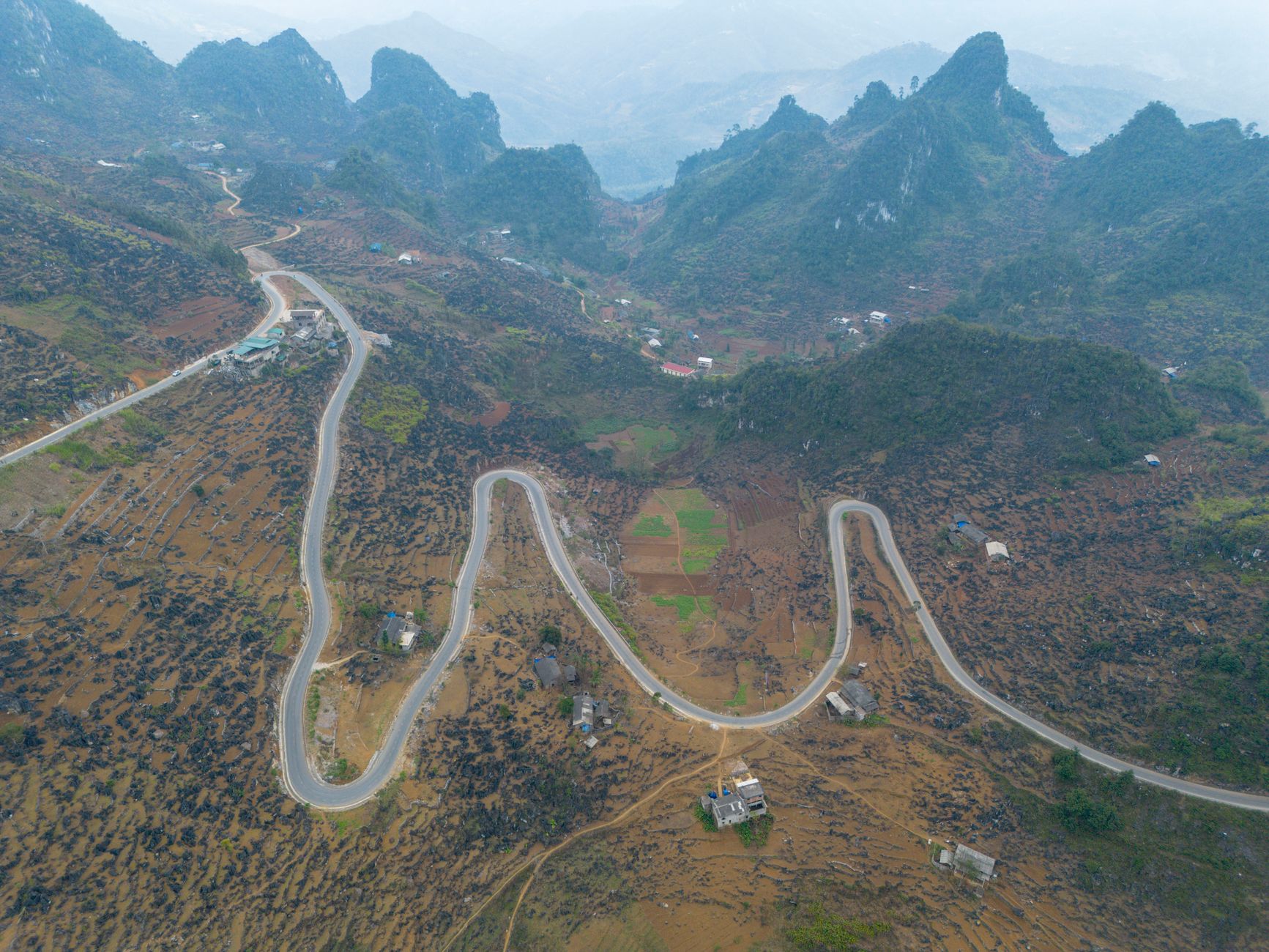
Both loops trace the northern border with China. Both serve up karst peaks, ethnic minority villages, and roads that demand your full attention. But they are not the same trip. One is a bucket-list challenge. The other is a quieter, more forgiving version of the same dream.
This comparison breaks down the differences in road conditions, scenery, crowds, costs, and time commitment. By the end, you will know which loop fits your riding style, your schedule, and your tolerance for tour buses.
The Ha Giang Loop: The Famous One
Ha Giang province sits at Vietnam's northernmost point. The loop typically starts and ends in Ha Giang City, running through Quan Ba, Yen Minh, Dong Van, and Meo Vac. The total distance is 300 to 400 kilometers depending on the route.
The road crosses four major mountain passes. Ma Pi Leng Pass is the crown jewel, a dramatic cliff-hugging stretch above the Nho Que River. The views are staggering. The switchbacks are relentless. The altitude hits 1,500 meters at several points.
Riders come here for the challenge. The asphalt is generally good, but the gradients are steep and the blind corners are frequent. Easy riders (tour groups on the back of local guides' bikes) swarm the route during peak season from October to April. Solo travelers on rented semiautomatic bikes share the road with vans, trucks, and the occasional herd of water buffalo.
The ethnic diversity is striking. Hmong, Tay, Dao, and Giay communities live in the valleys and on the slopes. The Sunday market in Dong Van is a genuine cultural experience, not a tourist show. Homestays in villages like Lung Cam or Du Gia offer basic beds and family meals for 100,000-200,000 VND ($4-8) per night.
For detailed planning, read the Ha Giang Loop: The Honest 2026 Guide.
The Cao Bang Loop: The Underrated Alternative
Cao Bang province lies east of Ha Giang. The loop covers 250 to 300 kilometers and can be completed in two to three days. The route goes from Cao Bang City to Ban Gioc Waterfall, then loops back through Nguyen Binh and the Phia Oac-Phia Den area.
The roads are wider and less congested. The passes are gentler. The traffic is sparse. This makes Cao Bang a better option for less experienced riders or anyone who wants to focus on the scenery rather than survival.
Ban Gioc Waterfall is the main draw. It sits on the border with China and measures 300 meters wide, making it the largest natural waterfall in Vietnam. The cascade drops 30 meters into a turquoise pool. Visitors can take bamboo rafts close to the base for 50,000 VND ($2).
The loop also includes Pac Bo Cave, where Ho Chi Minh lived after returning from China in 1941. The historical site is modest but meaningful. The Phia Oac-Phia Den National Park offers hiking trails through mossy forests and past abandoned French mining infrastructure.
Cao Bang feels less commercialized than Ha Giang. Homestays are simpler. Guesthouses are cheaper. The local markets, like the one in Cao Bang City, serve locals first and tourists second. Read more in Cao Bang travel guide: Is it touristy in 2026?.
Road conditions and difficulty
The most practical difference between the two loops is the riding difficulty.
Ha Giang demands respect. The Ma Pi Leng Pass has steep drops with no guardrails. The road to Lung Cu (Vietnam's northernmost point) is narrow and rough in sections. Rain turns the surface into a slick hazard. Riders need experience with hairpin turns and altitude shifts.
Cao Bang is more forgiving. The road to Ban Gioc Waterfall is flat and straight for long stretches. The mountain sections near Nguyen Binh have curves but few extreme gradients. A rider with basic motorbike skills can handle Cao Bang without anxiety.
Both loops require a reliable bike. Rent a Honda XR150 or a semi-automatic Honda Blade. Avoid scooters with small wheels. The rental cost is 200,000-400,000 VND ($8-16) per day for a semi-automatic and 400,000-700,000 VND ($16-28) for a manual. Read the legal details in Renting a Motorbike in Vietnam: The Legal Truth Nobody Tells Tourists.
Scenery comparison
Both loops offer limestone karsts, rice terraces, and river valleys. But the character differs.
Ha Giang is dramatic. The peaks are sharper. The valleys are deeper. The views from Ma Pi Leng are the kind that stop riders in the middle of the road. The landscape feels vertical and imposing.
Cao Bang is lush. The karsts are rounded and covered in dense vegetation. The rice fields are flatter and more spread out. Ban Gioc Waterfall adds a water element that Ha Giang lacks. The scenery feels more accessible and less intimidating.
Neither is objectively better. Ha Giang wins for epic panoramas. Cao Bang wins for variety and ease of appreciation.
Crowds and tourism development
Ha Giang has become a mainstream destination. Easy rider groups with pillion passengers clog the main passes during peak season. Guesthouses in Dong Van and Meo Vac fill up by early afternoon. The atmosphere is lively but crowded.
Cao Bang remains quieter. The loop attracts fewer travelers. The easy rider phenomenon has not taken over. Homestays and guesthouses rarely fill up outside of national holidays. The experience feels more authentic and less curated.
For travelers who want solitude, Cao Bang is the clear choice. For travelers who want social interaction and a party scene at the homestay, Ha Giang delivers.
Cost comparison
Both loops are cheap by international standards. The daily costs are similar.
| Expense | Ha Giang Loop | Cao Bang Loop |
|---|---|---|
| Motorbike rental per day | 200,000-400,000 VND ($8-16) | 200,000-350,000 VND ($8-14) |
| Gas per day | 50,000-100,000 VND ($2-4) | 50,000-80,000 VND ($2-3) |
| Homestay per night | 100,000-200,000 VND ($4-8) | 80,000-150,000 VND ($3-6) |
| Meals per day | 150,000-250,000 VND ($6-10) | 100,000-200,000 VND ($4-8) |
| Total per day | 500,000-950,000 VND ($20-38) | 430,000-780,000 VND ($17-31) |
Cao Bang is slightly cheaper because accommodation and food cost less. The difference is not huge. For a detailed breakdown of Cao Bang costs, see How much does a Cao Bang loop cost? A complete 2026 budget breakdown.
Time commitment
Ha Giang needs three to five days. The standard route is three days and two nights, but four days and three nights allows for better pacing and side trips. Rushing it in two days is possible but exhausting.
Cao Bang needs two to three days. The loop can be done in two days and one night if the goal is just Ban Gioc Waterfall and the return. Three days and two nights gives time for Phia Oac hiking and market visits.
Travelers on a tight schedule should pick Cao Bang. Travelers with a full week should ride Ha Giang.
Getting there
Both loops start from their respective provincial capitals. Ha Giang City is 300 kilometers from Hanoi. Cao Bang City is 270 kilometers from Hanoi.
Sleeper buses run from Hanoi to both cities. The trip takes six to eight hours and costs 200,000-350,000 VND ($8-14). Limousine vans are faster and more comfortable at 400,000-600,000 VND ($16-24). Read the Hanoi to Ha Giang options in Hanoi to Ha Giang: 3 Routes Compared (Sleeper Bus, Limousine Van, Private Car).
For Cao Bang, buses depart from Hanoi's My Dinh and Giap Bat stations. The journey takes seven to eight hours. See How to get to Cao Bang for details.
Book your bus ticket at least one day in advance during peak season. Same-day tickets sell out for both destinations.
Safety considerations
Both loops are safe for experienced riders. Neither is safe for beginners.
Ha Giang has more accidents. The combination of steep drops, blind corners, and heavy traffic creates risk. Several travelers die on the loop each year. Most accidents involve riders going too fast on unfamiliar roads.
Cao Bang has fewer accidents. The roads are wider and less trafficked. The main risk is the highway section near the Chinese border, where trucks and buses move fast.
Both loops require a valid international driving permit (IDP) with a motorcycle endorsement. Vietnamese law requires it. Police checkpoints exist on both routes. Riding without the proper license can result in fines of 2,000,000-4,000,000 VND ($80-160) and bike impoundment.
Read the safety assessment in Is the Cao Bang Loop safe to drive?.
Weather and best time
The best months for both loops are September to November and March to May.
September to November has clear skies, comfortable temperatures, and golden rice harvests. March to May has blooming flowers and moderate heat.
December to February is cold. Temperatures at altitude drop to 5-10°C (41-50°F). Fog and drizzle reduce visibility. June to August is the rainy season. Landslides and flash floods can close roads.
Cao Bang handles rain better than Ha Giang. The roads are less prone to landslides. The lower altitude means warmer temperatures in winter.
Check the weather guide in The Best and Worst Months to Visit Vietnam: A Region-by-Region Guide.
Which loop should you ride?
Choose Ha Giang if:
- You want the most famous motorbike route in Vietnam
- You have three to five days available
- You have solid riding experience with mountain passes
- You want social homestays and a lively atmosphere
- You are willing to deal with crowds and easy rider groups
Choose Cao Bang if:
- You want a quieter, less crowded experience
- You have two to three days available
- You are a less experienced rider or prefer gentler roads
- You want to see Ban Gioc Waterfall
- You want lower costs and simpler accommodations
Some riders combine both loops. Starting in Ha Giang and riding east to Cao Bang takes five to seven days. This is the ultimate northern Vietnam motorbike trip. The route connects through the border road between Dong Van and Cao Bang City. It is rough in places but rewarding.
Frequently asked questions
Q: Can I do the Cao Bang Loop on a scooter? A scooter with small wheels can handle Cao Bang's roads, but a semi-automatic or manual bike is safer. The road to Ban Gioc is flat and smooth. The mountain sections near Nguyen Binh require more power.
Q: Do I need a guide for either loop? No. Both loops are well-marked and easy to navigate with Google Maps or a GPS. Guided tours cost 2,000,000-4,000,000 VND ($80-160) per day and remove the freedom of independent travel.
Q: Which loop has better homestays? Ha Giang has more developed homestays with better amenities. Cao Bang has simpler homestays that feel more authentic. Neither has luxury options.
Q: Is it safe to ride the loops alone? Yes, for solo travelers with riding experience. Both loops have enough traffic that mechanical breakdowns are not dangerous. Locals will help stranded riders. Read the solo travel advice in Vietnam Solo Travel 2026: A Safety Guide for First-Time Women.
Q: Can I do both loops in one week? Yes, but the pace will be rushed. Five to seven days is enough to ride both loops with one rest day. The border road connecting Ha Giang to Cao Bang adds one full day.
Q: What should I pack for the loops? Rain gear, warm layers for altitude, a reusable water bottle, and basic tools. October requires a jacket and gloves. See the packing guide in How to dress for Vietnam in October: A complete packing guide for every region.
Q: Do I need a visa to ride the loops? Yes. All foreign travelers need a visa. The e-visa is valid for 90 days and single entry. Apply at least one week before departure. See Vietnam E-Visa 2026: Step-by-Step Guide, Rejections & Traps.