Is Cao Bang touristy? An honest assessment for 2026
The short answer is no. Not yet. But the situation is changing.
Cao Bang province received roughly 2.5 million visitors in 2025, compared to Sapa's 7 million and Ha Giang's 4 million. The crowds are concentrated in specific spots. Ban Gioc Waterfall sees the most traffic, especially between 10am and 2pm when tour buses arrive from Hanoi. Outside those hours, the waterfall is nearly empty.
Cao Bang city itself feels like a provincial Vietnamese town, not a tourist hub. You will see backpackers at a few guesthouses but nothing like the chaos of Sapa's main street. The remote valleys like Phong Nam and the villages around Thang Hen Lake see maybe a dozen foreign visitors per day.
What does "touristy" mean here? It means a few things:
- Ban Gioc Waterfall has a ticket booth, paved paths, and bamboo boat operators. It is developed but not overcrowded.
- Nguom Ngao Cave has lighting and concrete walkways. It is a proper tourist attraction.
- Phong Nam Valley and Me Pia Pass have no infrastructure. You navigate by GPS and luck.
The Reddit and forum complaints about Cao Bang getting "discovered" are overstated. The province remains less visited than Ha Giang and far less than Sapa. The long travel time from Hanoi filters out casual tourists. For now, Cao Bang rewards those willing to make the journey.
Where is Cao Bang and how hard is it to reach?
Cao Bang city sits 280km north of Hanoi, right on the Chinese border. The province shares the border with China for over 300km. This proximity to the border affects everything from drone restrictions to road quality.
The journey from Hanoi takes 6 to 9 hours depending on your transport. Google Maps says 5 hours. It lies. The roads are winding mountain passes with frequent construction. Add at least an hour to any estimate.
The remoteness is a feature, not a bug. The 6-hour minimum drive filters out package tourists on tight schedules. You will not find day-trippers from Hanoi. Everyone in Cao Bang has committed to being there.
How to get to Cao Bang from Hanoi and beyond
Bus and limousine van options
Standard sleeper buses run from My Dinh station and the Old Quarter. They cost 250,000-350,000 VND ($10-14) and take 7-9 hours. Buses depart throughout the day and night.
Limousine vans are the better choice. They cost 350,000-500,000 VND ($14-20) and take 6-7 hours. They have more legroom, air conditioning, and fewer stops. Book through 12Go.asia or at your Hanoi guesthouse.
The road quality varies. The first 3 hours from Hanoi are smooth highway. The last 3 hours into Cao Bang are winding mountain roads. Motion sickness is common. Bring medication.
Motorbiking from Hanoi or Ha Giang
Motorbiking gives you freedom but requires experience. From Hanoi, the ride is 6-8 hours on mostly paved roads. From Ha Giang, it is 5-6 hours through the mountains connecting the Ha Giang Loop to Cao Bang.
Road conditions are generally good in dry season but treacherous in rain. Landslides are common May to September. Fuel costs about 100,000-150,000 VND ($4-6) for the trip from Hanoi.
This route is easier than the Ha Giang Loop. The passes are less dramatic and traffic is lighter. But it is still a full day of riding. Do not attempt without previous mountain driving experience.
Getting to Cao Bang from Sapa, Ninh Binh, or Ha Long Bay
No direct connections exist. You must route through Hanoi for all options.
From Sapa, take a night bus to Hanoi (6 hours, 250,000 VND / $10), then transfer to a Cao Bang bus. From Ninh Binh, same process: bus to Hanoi (2 hours, 100,000 VND / $4), then onward. From Ha Long Bay, bus to Hanoi (4 hours, 200,000 VND / $8), then onward.
This adds a full day to your trip. Plan accordingly.
Getting around Cao Bang province
Motorbike rental in Cao Bang city
Motorbike rental is available in Cao Bang city. Semi-automatic bikes (Honda Wave style) cost 150,000-250,000 VND ($6-10) per day. Automatic scooters cost 200,000-350,000 VND ($8-14) per day.
You need an International Driving Permit (IDP) for Vietnam. The legal requirement is strict. Police checks exist on the road to Ban Gioc. Without an IDP, you risk fines of 1,000,000-4,000,000 VND ($40-160). See Renting a Motorbike in Vietnam: The Legal Truth Nobody Tells Tourists for details.
Road conditions vary. The main highway to Ban Gioc is paved but narrow. Side roads to Phong Nam and Thang Hen are rough gravel. Rain turns them to mud. Check your bike's brakes and tires before leaving the city.
Easy riders and local guides
If you cannot ride, hire an easy rider. These are local drivers who take you on the back of their motorbike. Costs run 500,000-800,000 VND ($20-32) per day including fuel and the driver's meals.
The advantages are real. Local drivers know the best viewpoints, the cheapest eateries, and the roads that flood during rain. They also handle police checks and language barriers. Many speak basic English.
Book through your homestay or through Cao Bang Eco Travel. Avoid booking through Hanoi agencies who add a 50% markup.
Taxis and public buses
Grab does not work in Cao Bang province. The app shows no cars available. See Does Grab Work in Vietnam? Complete Guide 2026 for details.
Local taxis operate from Cao Bang city. Save the number of Mai Linh Taxi (0206 385 5855) or Cao Bang Taxi (0206 382 2222). A ride from the city to Ban Gioc costs around 600,000-800,000 VND ($24-32) one way.
Public buses connect Cao Bang city to Ban Gioc and other towns. They run infrequently, maybe 3-4 per day. No fixed schedule exists online. Ask at your hotel for departure times.
When to visit Cao Bang for the best experience
Dry season (October to April)
This is the best time to visit. Temperatures range from 5-20°C (41-68°F) from November to February. The skies are clear, the roads are dry, and the views are unobstructed.
At the end of dry season (March-April), a controlled water release at Ban Gioc Waterfall occurs between 10:30am and 1:00pm. This creates the most dramatic waterfall flow. Outside these hours, the water level drops significantly.
Pack warm layers. Cao Bang gets cold at night. A fleece jacket and long pants are essential November through February.
Wet season (May to September)
Fewer tourists visit during wet season. The landscapes are greener. Rice terraces in Phong Nam Valley are at their most vibrant. The rice harvest in late August to September turns the fields golden.
The downsides are significant. Landslides close roads. Rain reduces visibility at viewpoints. The waterfall is muddy brown rather than clear. Check Vietnam Rainy Season Travel: Honest Tips for Monsoon Months for preparation advice.
Festival periods and holiday crowds
Lunar New Year (Tet) brings Vietnamese domestic tourists to Cao Bang. Hotels fill up. Prices double. Many restaurants close for the holiday. See Tet in Vietnam: The Closure Trap That Ruins Tourist Trips for timing details.
National Day (September 2) also sees crowds. Local festivals happen throughout the year but rarely affect foreign travelers.
How many days do you need in Cao Bang?
2 days covers Ban Gioc Waterfall and Nguom Ngao Cave. You arrive day one, see the waterfall morning of day two, and leave afternoon of day two. This is rushed but possible.
3-4 days is the sweet spot. Day one: travel to Cao Bang city. Day two: Ban Gioc, cave, pagoda. Day three: Phong Nam Valley and Angel Eye Mountain. Day four: depart. This lets you see the major sights without rushing.
5-7 days covers everything including Me Pia Pass, Thang Hen Lake, and the craft villages. You can also combine Cao Bang with Ba Be Lake for a longer northern Vietnam trip.
Top things to do in Cao Bang
Ban Gioc Waterfall
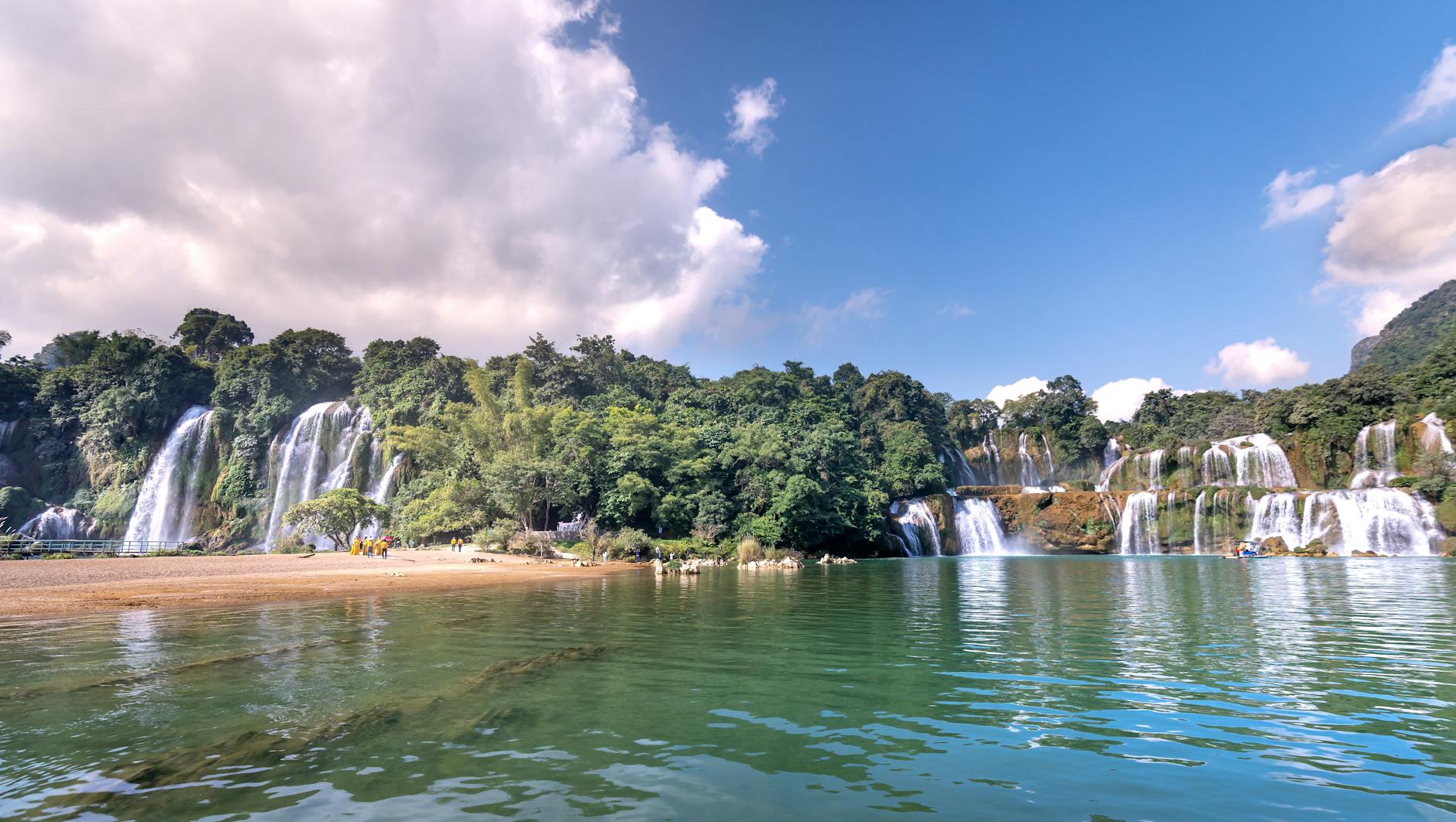
This is the main reason people come to Cao Bang. It is the largest waterfall in Vietnam and the fourth largest跨国 waterfall in the world. The entrance fee is 45,000 VND ($1.80). Bamboo boat rides cost 50,000 VND ($2) and take you close to the base of the falls.
Drone flying is strictly prohibited. This is a border zone. Military police confiscate drones and issue fines up to 15,000,000 VND ($600). Do not risk it.
Visit early morning (before 9am) or late afternoon (after 3pm) to avoid tour groups. Midday is crowded with Vietnamese tourists taking selfies.
Nguom Ngao Cave (Tiger Cave)
The entrance fee is 45,000 VND ($1.80). The cave extends 1km of open section with another 2km closed to visitors. The walk takes 45-60 minutes.
The paths are slippery. Wear sturdy shoes. The "lotus room" at the end has impressive stalactite formations. Many visitors miss it because they turn back early. Keep walking until you reach the exit.
Truc Lam Phat Tich Pagoda
Free entry. A short hike from Ban Gioc Waterfall leads to the pagoda with panoramic views of the waterfall valley.
A common scam: parking attendants at the bottom of the hill charge 10,000-20,000 VND ($0.40-0.80) for parking. You can drive your motorbike to the top for free. Ignore the attendants and keep going.
Phong Nam Valley
This is the remote valley with rice fields, water buffalo, and the famous S-shaped river bend. Access is by motorbike only. The road is unpaved and rough.
GPS coordinates for the main viewpoint: 22.6815, 106.2471. Visit during golden hour (4-5pm) for the best light. The valley is nearly empty of tourists.
Angel Eye Mountain (Nui Mat Than) and God's Eye
A stone arch formation that frames the sky like an eye. Best visited at sunset. Camping is possible in the valley below, but the area floods during rainy season. Check weather conditions before camping.
The hike from the parking area takes 20 minutes. No entrance fee.
Thang Hen Lake system
36 interconnected lakes with emerald green water. Entrance fee is 30,000 VND ($1.20). The experience differs by season. Dry season: clear water, visible lake beds. Wet season: higher water levels, greener surroundings.
Access to Tuyet Tinh Coc (Mountain Eye) is nearby. This is a collapsed cave with a lake inside. The path is steep and slippery.
Lenin's Stream and Pac Bo Historical Complex
This is where Ho Chi Minh lived after returning from China in 1941. The site includes a museum (free), a stream named after Lenin, and the cave where Ho Chi Minh slept.
Entrance fee is 30,000 VND ($1.20). The museum closes for lunch 11:30am-1:30pm. The walk to the cave takes 15 minutes along a paved path.
Craft villages (Phuc Sen forging, Phia Thap incense, Khuoi Ky stone)
Phuc Sen is the most developed. Blacksmiths forge tools using traditional methods. You can watch and buy. Phia Thap makes incense sticks from bamboo and natural dyes. Khuoi Ky is the most authentic, with stone houses and minimal tourism infrastructure.
Phuc Sen is 30 minutes from Cao Bang city by motorbike. Phia Thap is 45 minutes. Khuoi Ky is right next to Ban Gioc Waterfall.
Me Pia Pass viewpoint
The famous "snake road" viewpoint is 2-3 hours drive from Cao Bang city. The road twists through mountains with dramatic drops. A 30-minute hike from the parking area leads to the best photo spot.
The road is narrow with no guardrails. Drive slowly. Do not attempt in wet weather.
Where to stay in Cao Bang
| Area | Type | Price range (VND) | Price range (USD) | Best for |
|---|---|---|---|---|
| Cao Bang city | Hotels and homestays | 200,000-800,000 | $8-32 | Access to restaurants and transport |
| Near Ban Gioc (Khuoi Ky) | Stone village homestays | 150,000-400,000 | $6-16 | Early access to waterfall |
| Phong Nam Valley | Rural homestays | 150,000-300,000 | $6-12 | Scenery and solitude |
In Cao Bang city, try GiaBinh Homestay or Lan's Homestay. Both are clean, friendly, and within walking distance of restaurants.
Near Ban Gioc, Nguom Ngao-Ban Gioc Homestay offers basic rooms in the stone village. The location is excellent for early morning visits to the waterfall.
Phong Nam Station is the only accommodation in the valley. It is basic but the setting is incredible.
Food and drink in Cao Bang
Local specialties to try
- Pho Chua: Sour noodle soup with pork, peanuts, and herbs. The signature Cao Bang dish.
- Banh Cuon: Steamed rice rolls filled with minced pork and mushrooms. Eaten for breakfast.
- Trung Khanh chestnuts: Season October to December. Roasted or boiled. Sweet and creamy.
- Roast duck with mac mat fruit: A local specialty. The mac mat fruit gives a sour, tangy flavor.
- Ant-egg cakes: Seasonal (March-April). Deep-fried cakes with ant eggs inside. Not for everyone, but worth trying.
Where to eat in Cao Bang city
The riverside area has the best concentration of restaurants. Bia hoi joints serve cheap beer (5,000-10,000 VND / $0.20-0.40 per glass) and grilled meats.
The night market on Tran Hung Dao street has street food stalls. Try the grilled corn and quail eggs.
Near Ban Gioc Waterfall
Restaurants near the waterfall charge 20-50% more than places 5-10 minutes away. Drive towards Khuoi Ky village for local eateries. A bowl of Pho Chua costs 30,000-40,000 VND ($1.20-1.60) away from the tourist zone versus 50,000-70,000 VND ($2-2.80) at the waterfall.
Cao Bang on a budget: Realistic costs for 2026
| Item | Cost (VND) | Cost (USD) |
|---|---|---|
| Sleeper bus Hanoi-Cao Bang | 250,000-350,000 | $10-14 |
| Motorbike rental per day | 150,000-250,000 | $6-10 |
| Budget homestay per night | 150,000-300,000 | $6-12 |
| Mid-range hotel per night | 400,000-800,000 | $16-32 |
| Ban Gioc entrance | 45,000 | $1.80 |
| Bamboo boat ride | 50,000 | $2 |
| Local meal | 30,000-60,000 | $1.20-2.40 |
| Bia hoi (glass) | 5,000-10,000 | $0.20-0.40 |
A daily budget of $30-40 covers accommodation, three meals, transport, and one attraction. Add $10-15 per day if hiring an easy rider.
Practical tips for a smooth trip
Internet and phone connectivity
Download offline maps before arriving. Google Maps works offline but only if you download the area first. Cell service is unreliable near the Chinese border. Viettel and Mobifone have the best coverage in the province.
Language barriers
English is limited outside Cao Bang city. Download Google Translate with Vietnamese offline. Learn these phrases:
- "Bao nhiêu?" (How much?)
- "Cảm ơn" (Thank you)
- "Ở đâu?" (Where is?)
Most homestays have someone who speaks basic English. Restaurants rarely do.
Safety considerations
Road accidents are the biggest risk. Drive slowly on mountain passes. Avoid night driving. Wet season brings landslides. Check weather forecasts before heading to remote areas.
Drones are prohibited in the entire border zone. This includes Ban Gioc Waterfall, Me Pia Pass, and any area within 10km of the Chinese border. Military police are active.
Photography is restricted near military installations. Do not take photos of soldiers or military vehicles.
What to pack
- Warm layers (November-February): fleece jacket, long pants, closed shoes
- Rain gear (May-September): waterproof jacket, pants, bag cover
- Sturdy shoes for caves and viewpoints
- Cash: limited ATMs outside Cao Bang city. Withdraw enough in Hanoi or Cao Bang city.
- First aid kit: pharmacies are basic outside the city
Cao Bang versus alternatives: Which destination fits your trip?
| Destination | Travel time from Hanoi | Difficulty | Crowds | Best attraction | Best for |
|---|---|---|---|---|---|
| Cao Bang | 6-9 hours | Moderate | Low | Ban Gioc Waterfall | Waterfall lovers, cave explorers |
| Ha Giang | 6-8 hours | High | Medium | Ha Giang Loop | Motorbike adventurers |
| Sapa | 6-8 hours | Easy | High | Fansipan, rice terraces | Hikers, first-timers |
| Ba Be Lake | 5-6 hours | Easy | Low | Boat trips on the lake | Nature lovers, families |
Cao Bang versus Ha Giang
Cao Bang has the waterfall and caves. Ha Giang has the loop and more dramatic mountain passes. Cao Bang is easier for less experienced riders. Ha Giang requires confidence on a motorbike.
Cao Bang versus Sapa
Sapa is more developed, more touristy, and easier to reach. Cao Bang offers more authentic ethnic minority experiences and fewer crowds. Sapa has better hiking infrastructure. Cao Bang has better motorbike routes.
Cao Bang versus Ba Be Lake
Ba Be is closer to Hanoi and offers boat trips on the lake. Cao Bang has more diverse attractions but requires more travel time. Combine both for a 5-7 day trip.
Sample itineraries for Cao Bang
2-day express itinerary (Ban Gioc focus)
- Day 1: Arrive Cao Bang city by bus. Drive to Ban Gioc (2 hours). Visit waterfall late afternoon. Stay in Khuoi Ky.
- Day 2: Visit Nguom Ngao Cave and Truc Lam Pagoda in the morning. Return to Cao Bang city. Depart.
4-day comprehensive itinerary
- Day 1: Travel to Cao Bang city. Explore city markets and river walk.
- Day 2: Ban Gioc Waterfall, Nguom Ngao Cave, Truc Lam Pagoda. Stay near Ban Gioc.
- Day 3: Phong Nam Valley, Angel Eye Mountain, Thang Hen Lake. Return to Cao Bang city.
- Day 4: Craft villages (Phuc Sen, Phia Thap). Depart.
7-day northern Vietnam loop (including Cao Bang)
- Hanoi to Ha Giang (2 days) to Cao Bang (3 days) to Ba Be Lake (1 day) to Hanoi (1 day).
This route covers the best of northern Vietnam without rushing. See Cao Bang Loop self drive: The complete 2026 guide for detailed routing.
FAQ
Q: Is Cao Bang worth visiting? Yes, for travelers seeking waterfalls, caves, and authentic ethnic minority culture without the crowds of Sapa or Ha Giang. The main drawbacks are the long travel time (6-9 hours from Hanoi) and limited English infrastructure.
Q: Is $1000 enough for 2 weeks in Vietnam? Yes, $1000 USD is sufficient for 2 weeks in Vietnam if traveling on a budget. This covers accommodation (budget homestays), local food, bus transport, and attraction fees. Cao Bang specifically costs approximately $30-40 per day including accommodation, food, and activities.
Q: Is $100 USD a lot in Vietnam? Yes, $100 USD (approximately 2,500,000 VND) is a significant amount in Vietnam. This covers 4-5 nights in budget accommodation, 10-15 local meals, or a 2-day motorbike rental with fuel in Cao Bang.
Q: Can I wear red in Vietnam? Yes, wearing red is perfectly fine for tourists in Vietnam. Red is a lucky color in Vietnamese culture, associated with celebrations and festivals. There are no cultural taboos against wearing red for visitors.
Q: When is the best time to visit Ban Gioc Waterfall? The best time is October to April (dry season). At the end of dry season (March-April), a controlled water release occurs between 10:30am and 1:00pm, creating the most dramatic waterfall flow.
Q: How many days should I spend in Cao Bang? Minimum 2 days for Ban Gioc Waterfall and one cave. 3-4 days allows for the major sights including Phong Nam Valley and Angel Eye Mountain. 5-7 days covers remote areas like Me Pia Pass.
Q: Do I need a motorbike to explore Cao Bang? A motorbike is the most practical option for independent exploration. However, easy riders (hired drivers) are available for 500,000-800,000 VND ($20-32) per day, and some tours cover the main attractions by minibus.
Q: Is Cao Bang safe for solo travelers? Yes, Cao Bang is safe for solo travelers. The main risks are road accidents (poor driving conditions, especially in wet season) and limited English medical services. Petty crime is very low compared to Hanoi or Ho Chi Minh City.