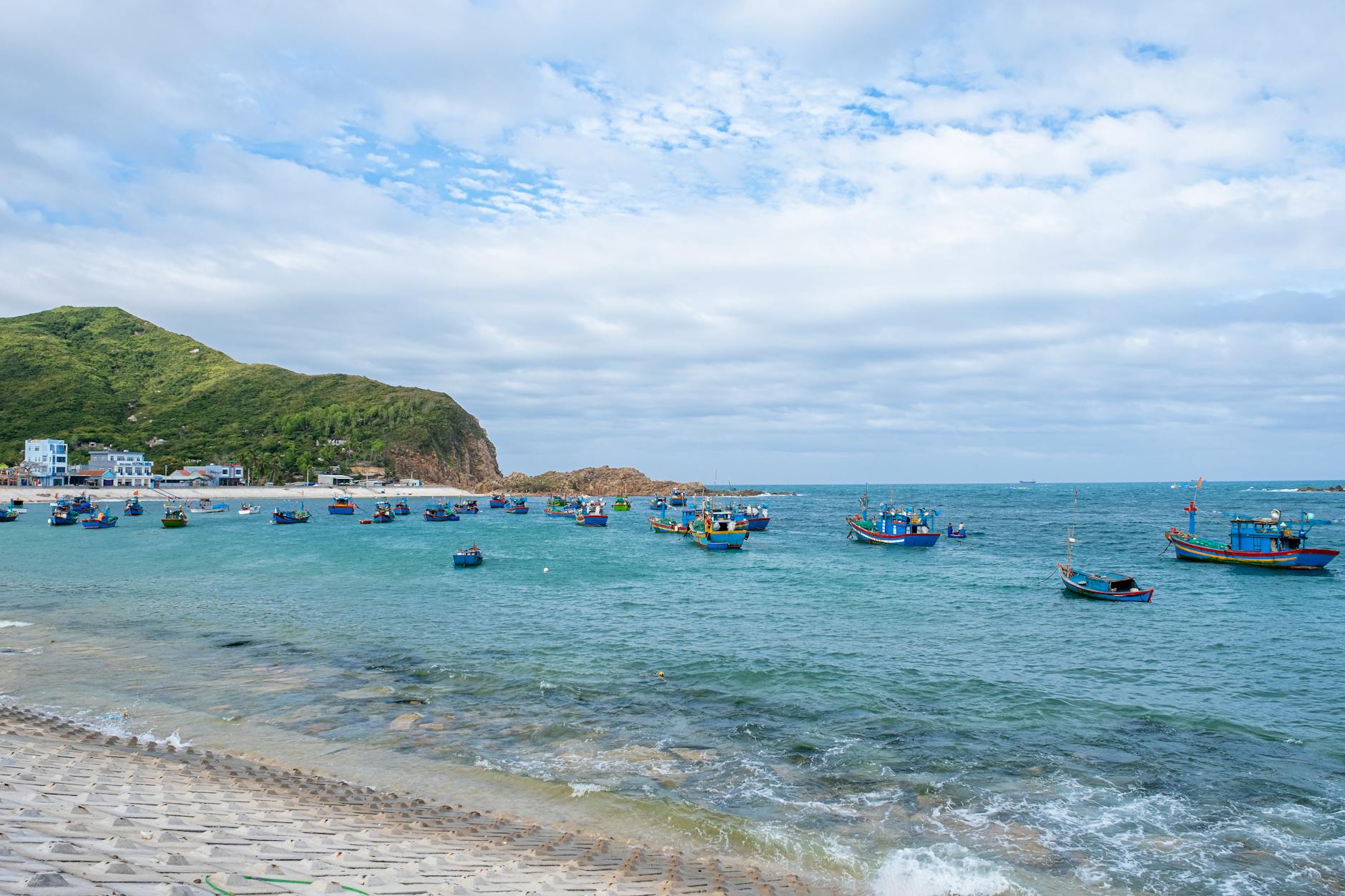
That morning taught me something most Vietnam itineraries get wrong: the famous places aren't necessarily the best ones. They're just the loudest.
After eight years crisscrossing this country on night buses, fishing boats, and the occasional borrowed Honda Wave, I've built a shortlist of places that deliver everything the icons promise — minus the cruise-ship crowds and the inflated bún chả prices.
Here are ten of them.
The North: Beyond the Halong–Sapa Circuit
Bai Tu Long Bay (instead of Halong)
Same emerald water, same limestone karsts, roughly one-tenth the boat traffic. Bai Tu Long sits directly northeast of Halong and shares the exact same geology, but UNESCO drew its protected zone elsewhere — so the cruise industry never moved in en masse.
Boats leave from Hon Gai port in Ha Long City, not the chaotic Tuan Chau marina. A two-day, one-night cruise with a small operator like Indochina Junk runs around $155 / 3,900,000 VND all-in.
Pro tip: ask your captain to anchor near Cong Do island for the night. The bioluminescent plankton there in summer turns every swim stroke into a streak of blue fire.
Ha Giang's Du Gia Valley (instead of Sapa)
Sapa has Fansipan cable cars and Instagram queues at every rice terrace. Du Gia, a four-hour ride southeast of Ha Giang city, has a waterfall you can swim under and homestays where dinner is whatever the grandmother cooked.
- Homestay with dinner & breakfast: $10 / 250,000 VND
- Motorbike rental in Ha Giang: $8/day from QT Motorbikes on Nguyen Thai Hoc Street
- Best months: September–November (rice harvest gold)
Cao Bang and Ban Gioc Falls
The largest waterfall in Southeast Asia sits on the Chinese border and almost no Western tourists make it up here. The drive from Cao Bang town takes three hours through karst valleys that look like a Chinese ink painting got loose.
Entry to Ban Gioc is 45,000 VND. Bamboo rafts to the base of the falls cost 50,000 VND per person — go on a weekday morning to have it nearly to yourself.
The Center: Skip Hoi An's Lantern Crush
Phong Nha (instead of Hue's tourist trail)
This dusty town in Quang Binh province sits on top of the world's largest cave system. Tu Lan, Hang En, and Son Doong are all here — but you don't need the $3,000 Son Doong permit to be floored.
A day trip to Paradise Cave and the Dark Cave zipline-mud-bath combo runs about $30 / 750,000 VND through Oxalis or Jungle Boss. The Phong Nha Farmstay on the edge of the rice paddies is where most expats end up drinking too many Huda beers.
Quy Nhon (instead of Nha Trang)
Nha Trang became a Russian-Chinese package-tour zone years ago. Quy Nhon, three hours south, kept its fishing-village soul and added a strip of beach hotels that locals from Saigon escape to on weekends.
Eat bánh xèo tôm nhảy (jumping shrimp pancakes) at Cô Năm, 49 Đống Đa Street, for 40,000 VND a plate. The shrimp are alive when they hit the batter.
Tuy Hoa and the Phu Yen coast
Phu Yen province is what Vietnam's central coast looked like before the resort builders arrived. Black volcanic cliffs at Ghenh Da Dia, empty crescent beaches at Bai Mon, and a lighthouse at Mui Dien that catches the country's first sunrise.
- Train from Saigon to Tuy Hoa: $25 / 620,000 VND, soft sleeper
- Scooter rental: $6/day
- Seafood dinner on the beach: ~$8/person
The South and Highlands: The Real Off-Grid
Buon Ma Thuot and the coffee highlands
Vietnam is the world's second-largest coffee producer, and almost all of it comes from Dak Lak province. Buon Ma Thuot is the unglamorous capital — red dirt roads, coffee warehouses, and the World Coffee Museum (free entry, 8am–5pm).
Drive 50 km to Lak Lake and stay in a stilt house in a M'Nong ethnic village. Sunrise over the lake with a cup of fresh cà phê chồn is worth the bumpy ride.
Con Dao Islands (instead of Phu Quoc)
Phu Quoc has become a casino-and-cable-car megaresort. Con Dao, a 45-minute flight from Saigon, has sea turtles, a dark colonial prison history, and beaches like Dam Trau where you'll share the sand with a few French divers and nobody else.
Local secret: scooter to Bai Nhat beach at low tide — it only appears for a few hours a day, then the sea swallows it back.
Chau Doc and the Mekong border
Most Mekong Delta tours dump you in Can Tho for the floating market and call it done. Chau Doc, near the Cambodian border, has a floating Cham Muslim village, Sam Mountain with views into Cambodia, and a fish-sauce-and-mam stink at the market that means you've arrived somewhere real.
The Victoria Chau Doc Hotel sunset cruise is overrated; instead, hire a sampan from the river edge for 150,000 VND/hour.
Mai Chau (instead of doing Sapa again)
Four hours west of Hanoi, Mai Chau valley is a flat patchwork of rice fields ringed by mountains, with White Thai stilt-house villages where you can sleep for $8 a night. Rent a bicycle, get lost between Lac and Pom Coong villages, eat sticky rice cooked inside bamboo tubes.
Insider Tips
What most tourists get wrong:
- Booking everything through Hanoi or Saigon agencies — you'll pay 40-60% more than booking locally on arrival
- Assuming "remote" means "no ATM" — most of these towns have Vietcombank and Agribank branches now, but bring cash for homestays and small boats
- Trying to do three of these in a week. Pick two regions max.
- Ignoring the train. Vietnam Railways' SE-series sleepers are cheap, scenic, and run on time
The honest move: don't tell your hostel hosts in Hanoi where you're going next. They'll try to sell you their cousin's tour. Book direct with the homestay via Facebook Messenger — Vietnamese tourism runs on Messenger, not email.
On scams: the only consistent issue in these places is overpriced motorbike rentals when the owner spots a foreigner. Agree on the price, photograph the bike before you ride off, and never hand over your passport — a photocopy is enough.
Practical Info
Budget snapshot (per day, mid-range)
| Item | Cost |
|---|---|
| Homestay or guesthouse | $12–25 / 300,000–625,000 VND |
| Three meals locally | $10 / 250,000 VND |
| Scooter rental + fuel | $8 / 200,000 VND |
| Entry fees & boats | $5–15 |
| Daily total | $35–60 |
When to go
| Region | Best window | Avoid |
|---|---|---|
| Ha Giang, Cao Bang | Sept–Nov, March–April | June–August (landslides) |
| Phong Nha | Feb–May | Oct–Nov (cave flooding) |
| Quy Nhon, Phu Yen | March–August | Oct–Dec (typhoons) |
| Con Dao | Dec–April | June–Sept (rough seas) |
| Mekong (Chau Doc) | Sept–Nov (floating season) | March–April (dusty, hot) |
Getting there
- Trains: book via dsvn.vn or Baolau (English interface, small fee)
- Domestic flights: Vietjet, Bamboo Airways — Saigon to Con Dao or Tuy Hoa from $40
- Sleeper buses: Futa Bus and Hoang Long are reliable; avoid no-name companies that pick up off the street
Vietnam's icons aren't lying to you — they're just not telling the whole story. The whole story is on a stilt house porch in Mai Chau at 6am, when the mist lifts and you realize nobody else is watching.