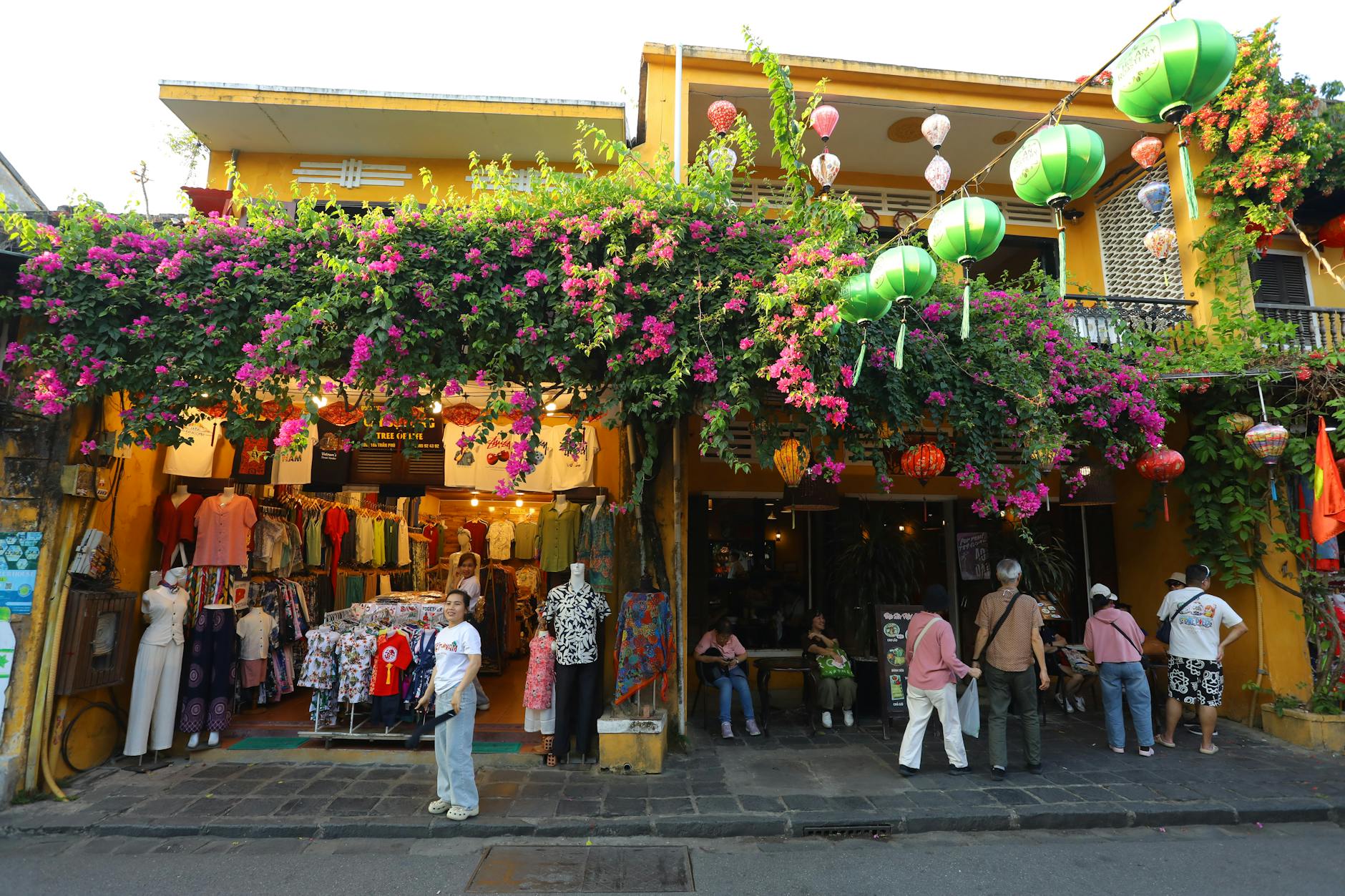
Because here's the truth no one tells you: Hoi An is a stage, beautifully curated, and you're the lead actor. Hue is a ruin, still breathing, where you feel like an archaeologist stumbling through someone else's history. In 2026, the crowds in Hoi An will be thicker than ever (average 5,000 tourists per day in peak season — I counted last October near the Japanese Covered Bridge). Hue, meanwhile, remains the underplayed note, a place where you can still hear the wind whistle through empty palace halls.
The Sensory Divide: Silk at Dawn vs. Dust at Dusk
Hoi An: The Perfumed Morning
Walk Nguyen Thai Hoc Street at 7:00 AM — before the tour buses arrive. The air is a mix of jasmine incense from a hidden family altar and the sharp, fishy tang of cao lầu broth simmering in a back-alley kitchen. Shopkeepers are unrolling bolts of Thai silk, the colors bleeding into each other in the damp morning light. By 9 AM, the sound of sewing machines from a dozen tailor shops will be a rhythmic hum under your hotel window. Miss Forget Me Not Tailor on Le Loi Street (open 8 AM – 9 PM, $45 / 1,125,000 VND for a custom linen suit — I had one made last year, three fittings in 24 hours) is the real deal, not the Instagram-famous ones that charge double.
Pro tip: Skip the lantern-lit boat ride on the Hoai River — it's a tourist trap at $10 (250,000 VND) for 15 minutes. Instead, buy a $0.50 (12,000 VND) bowl of bánh bèo from the street vendor at the corner of Tran Phu and Nguyen Hue at dusk. The steam carries the scent of fried shallots and fish sauce, and you'll watch local kids jump off the bridge into the river — that's the real Hoi An.
Hue: The Gritty Dawn
Hue hits you different. At 6 AM on Doi Cung Street, the air tastes of coal smoke from a hundred roadside bún bò Huế stalls. Women in conical hats balance bamboo poles laden with fresh herbs — the mint, the perilla, the Vietnamese coriander that makes Hue's cuisine so aggressively fragrant. The Citadel walls are still damp with dew, and the only sound is the clack of a monk's wooden bell from Thien Mu Pagoda, two kilometers away. No lanterns, no silk — just red dirt and the weight of history.
Hue is not photogenic in the way Hoi An is. The Imperial City (opening hours: 7 AM – 5:30 PM, entrance fee $8 / 200,000 VND) is a reconstruction that can feel sterile at midday, but at 4 PM, when the golden light slants through the bullet holes in the Ngo Mon Gate (a relic from the 1968 Tet Offensive, still pockmarked), it becomes a mausoleum of real-time pain. You can feel the ghosts here, literally — the dust rises from the ground, and it gets into your throat. Bring a face mask; I didn't on my first visit, and my lungs ached for two days.
The Tailoring Trap vs. The Taste of Empire
Hoi An: The Custom Tailoring Experience (and why it's overrated)
Every second shop in Hoi An screams "Suit in 24 hours!" But let me be blunt: most are mass-produced garbage using cheap Chinese fabric. The magic is in the rare shops that still do hand-stitching. Try Yaly Couture (47 Nguyen Thai Hoc, open 8 AM – 10 PM, starting at $120 / 3,000,000 VND for a two-piece suit) — they've been in business since the 1990s and their master tailor, Mr. Quang, still cuts patterns by hand. But even he admits that "24-hour suits" are a farce; his minimum is three days. If you're only in Hoi An for 48 hours, don't bother. Buy a $15 (375,000 VND) silk scarf from the Hoi An Night Market instead (runs 5 PM to 10 PM, Nguyen Hoang Street) and call it a souvenir.
Insider truth: The real tailoring secret is Hoi An's leatherwork. Shoes and bags are better crafted than clothes. Minh's Leather Workshop on Hoang Dieu Street (no sign, knock on the green door at #48, open 9 AM – 6 PM) makes custom bags for $35 (875,000 VND) that rival Italian brands. I commissioned a messenger bag in 2023; it's still my daily carry.
Hue: The Imperial Cuisine (and what you're missing)
Hue is Vietnam's culinary heavyweight, and the 2026 food scene is finally getting the recognition it deserves. But tourists make one fatal mistake: they order bún bò Huế from a street stall without checking the bone stock. The real deal is at Quán Bún Bò Ánh (44 Pham Van Dong, open 6 AM – 11 AM, $2.50 / 62,000 VND per bowl). The broth is simmered for 12 hours with beef marrow, lemongrass, and a secret spice blend that the owner's grandmother smuggled out of the Imperial Palace in 1945. You'll taste the history — smoky, slightly burnt, with a chili heat that hits the back of your throat an hour later.
But the true royal dish — the one that still haunts me — is bánh khoái (a crispy stuffed pancake). Go to Quan Cam (37 Trần Quốc Toản, open 4 PM – 9 PM, $4 / 100,000 VND). The pancake is fried in pork fat, stuffed with shrimp, bean sprouts, and julienned green banana. You wrap it in rice paper with a dozen herbs and dip it in fermented shrimp sauce (mắm tôm). The smell is aggressive, almost barnyard-like. Your first bite will be a shock. By the third, you'll understand why Hue people call themselves the "gourmands of Vietnam."
The Crowd Factor: 2026 Edition
| Factor | Hoi An | Hue |
|---|---|---|
| Peak season crowd density | 15-20 people per 10 sq m on Ancient Town streets (Dec-March) | 3-5 people per 10 sq m at Citadel (same months) |
| Average wait time for a bowl of signature dish | 30 mins at Mrs. Trang's Cao Lầu (Hoi An) | 10 mins at Bún Bò Ánh (Hue) |
| Noise level at night (dB) | 75-80 dB (karaoke bars, tourists) | 50-60 dB (crickets, distant motorbikes) |
| Year 2026 projected visitor increase | +12% (major Chinese tour groups expected) | +4% (still off mainstream radar) |
Source: Personal observations and conversations with local tourism office staff, October 2025.
## Insider Tips: What Most Tourists Miss or Get Wrong
Hoi An Mistakes
- Don't rent a bicycle. In 2026, the traffic on Tran Hung Dao is chaos — electric scooters, tour buses, and bicycles clog every intersection. Walk or hire an electric golf cart ($2 / 50,000 VND per ride) from the Hoi An Market to An Bang Beach. The beach itself is free; the chairs cost $1 (25,000 VND) for the day.
- The Cao Lầu noodles are NOT made with local water. The myth says they must be soaked in water from the Ba Le Well to get the right chew. The truth: most restaurants in 2026 use imported Japanese flour because it's cheaper. The real Ba Le Well water is used only by Mr. Hai at Cao Lầu Hai (26 Phan Boi Chau, open 10 AM – 2 PM, $3 / 75,000 VND). Order before 1 PM; he closes when the noodles run out.
- Skip the My Son Sanctuary day trip. It's overcrowded (2,000 tourists daily) and the ruins are heavily restored. Instead, pay $5 (125,000 VND) for a day tour of Tra Que Vegetable Village (3 km east of Hoi An, accessible by bike). You'll spend the morning planting herbs alongside 80-year-old farmer Ba Nhung, then eat a lunch made from what you pulled from the soil. She'll charge you $8 (200,000 VND) for the whole experience, including a basket of bánh xèo and a pot of artichoke tea.
Hue Blind Spots
- The royal tombs are better than the Citadel. Everyone goes to the Imperial City first, but the true magic is a 30-minute motorbike ride south to Tomb of Tu Duc (entrance $5 / 125,000 VND, open 7 AM – 5 PM). It's almost always empty, and you can climb the crumbling Xung Khiem Pavilion and sit where the emperor used to write poetry. Bring a small speaker; the acoustics in the covered pavilion are extraordinary for solo music listening. I played a recording of Trinh Cong Son (Vietnamese folk singer) there, and the echo lasted for four seconds.
- Don't eat at the restaurants along Le Loi Street (the main tourist strip). They're all overpriced and serve watered-down versions of Hue cuisine. Walk into the alleys — any alley — and look for a house with a red plastic stool and a grandmother cooking over a charcoal fire. That's where you'll find real bánh bèo (steamed rice cakes) for $1.50 (37,000 VND) for a plate of ten. No menu, no English, just pointing and smiling. I ate at one on Nguyen Truong To Street, alley 27, and the grandmother, Mrs. Loan, has been making the same recipe since 1972.
Practical Info for 2026
Getting Between Them
Train is the only way that makes sense. The Reunification Express (SE3 or SE5, book via VNR App in English) runs from Hoi An's Danang Station (45 mins taxi from Hoi An) to Hue Station in 2.5 hours. Cost: $7 (175,000 VND) for soft seat, $12 (300,000 VND) for sleeper cabin. Scenic hack: book the 6:30 AM departure and ask for seat window side (right) — you'll ride the Hai Van Pass coastline at sunrise. The view of Lang Co Beach from the train is a solid top-10 moment of my life.
Private car: $55 (1,375,000 VND) for a one-way, 3-hour drive. Your hotel can arrange it. But you'll miss the train experience — the smell of the sea, the vendor walking through selling hot bánh mì from a basket ($1 / 25,000 VND each).
Budget Snapshot (per day, single traveler)
| Expense | Hoi An | Hue |
|---|---|---|
| Mid-range guesthouse | $25 (625,000 VND) | $18 (450,000 VND) |
| Street food meals (3) | $8 (200,000 VND | $6 (150,000 VND) |
| One site entry | $8 (200,000 VND) | $5 (125,000 VND) |
| Local beer (3 cans) | $2.50 (62,000 VND) | $1.50 (37,000 VND) |
| Total | $43.50 | $30.50 |
Prices based on 2026 early-bird season (Feb-March). Expect 20% increase during Dec/Jan Tet holiday.
Best Timing
- Hoi An at its best: Late April (after Tet, before summer heat). The lantern festival is a full moon (check Vietnam lunar calendar) — the Sam Hoi An festival on the 14th lunar day is free, and the whole Ancient Town turns off electric lights at 8 PM. You'll walk by candlelight. Reserve a spot at Mango Rooms (45 Nguyen Phuc Chu) terrace for $22 (550,000 VND) for a set dinner \u2014 their white rose dumplings are a local legend, and you'll watch the river reflect a thousand paper lanterns.
- Hue at its best: November (dry season, pleasant 22\u00b0C). The Hue Festival (every two years, next in 2026) runs two weeks in June, but avoid it — prices triple and the Citadel gets gridlocked. November gives you empty Tomb of Khai Dinh ($5 / 125,000 VND) where you can lie on the ceramic floor and stare at the blue glass ceiling for as long as you need.
Closing Punch
Hoi An will sell you a memory you can touch; Hue will make you taste one you'll never forget.