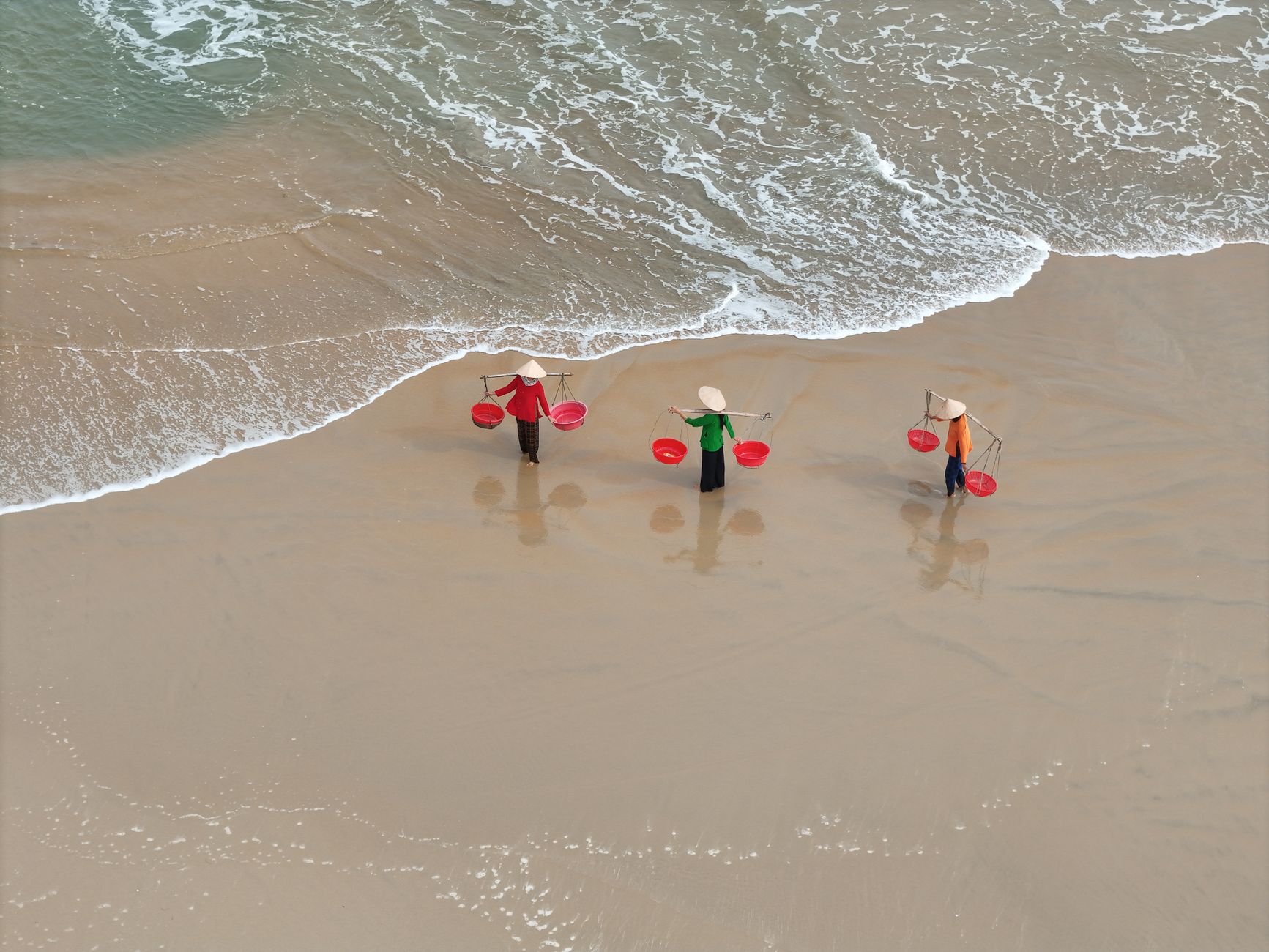
August in Vietnam at a glance: where it is hot, wet or cool
Pack for heat and rain at the same time, and never trust a national average. August splits the country into three realities:
- Hot and wet: the northern lowlands and the south.
- Hot and mostly dry: the central coast, Nha Trang, Quy Nhon and Mui Ne.
- Cool and wet: the highlands (Sapa, Da Lat, Dong Van plateau).
The suitcase answer is a light-layer system: an ultra-light quick-dry base, one warm layer for altitude and air conditioning, and a rain strategy that changes by zone.
| Zone | Typical day / night | Rain in August | What to wear |
|---|---|---|---|
| Hanoi and Ninh Binh | 33°C / 25 to 26°C | 300+ mm, 16 to 18 rainy days | Linen shirts, quick-dry tees, grippy sandals, umbrella |
| Sapa | 23 to 25°C / 16 to 18°C | 350+ mm, frequent fog | Quick-dry base, fleece, breathable shell, trail shoes |
| Ha Giang and Mu Cang Chai | 24 to 28°C / 17 to 20°C | Heavy, fog on passes | Long trousers, closed shoes, waterproof shell, dry bags |
| Mai Chau and Pu Luong | 31 to 33°C / 23 to 25°C | Frequent showers | Quick-dry long sleeves, water sandals, light sleeping layer |
| Ha Long and Lan Ha | 31 to 33°C / 25 to 27°C | 350 to 450 mm | UPF shirt, thin windbreaker, water shoes, dry bag |
| Hue, Da Nang, Hoi An | 33 to 36°C / 25 to 26°C | 90 to 130 mm | Lightest linen, UPF shirt, wide-brim hat, slip-on sandals |
| Phong Nha | 34 to 36°C / 24 to 25°C | Moderate, heat spikes | Quick-dry clothing, water shoes, drainage footwear |
| Nha Trang and Quy Nhon | 32 to 34°C / 24 to 26°C | 40 to 80 mm, lowest on the coast | Rash guard, sarong, secure sandals |
| Da Lat | 24 to 26°C / 16 to 17°C | 250 mm, afternoon showers | Long trousers, fleece, packable shell, closed shoes |
| Buon Ma Thuot | 29 to 31°C / 21 to 22°C | 250 to 300 mm | Quick-dry clothing, poncho, closed shoes |
| HCMC and Mekong | 31 to 33°C / 24 to 26°C | 270 mm, 18 to 20 rainy days | Light base, thin layer, waterproof sandals, poncho |
| Phu Quoc | 30 to 32°C / 25°C | 400 to 500 mm, rough seas | Quick-dry beachwear, rash guard, poncho, slides |
| Con Dao | 30 to 31°C / 25°C | Wet and windy | Modest dark clothes, secure sandals, quick-dry shoes |
| Mui Ne | 31 to 33°C / 24 to 26°C | 60 to 100 mm, driest coast | Cover-up, hat, buff for sand, grippy shoes |
Typhoon, flood and landslide risk: what it changes in the suitcase
July to September is the peak risk window for the north. Storms or their remnants can bring days of rain, flooded streets, landslides on mountain roads and suspended Ha Long cruises. Central coast storms become more likely from late August, with the main season from September.
Packing consequences: a backup set of clothes in a dry bag, essential items in carry-on, a waterproof phone pouch, no tight schedule on sleeping-bag-dependent treks, and a check of insurance wording on named storms. Follow the national hydrometeorological forecasting centre and local authority announcements.
This is a risk, not a certainty. Most August days are hot with a short heavy shower.
Hot rain versus cold rain
Lowland rain falls at 27 to 30°C, so a poncho or umbrella is enough and a waterproof shell causes sweat-soaking. Highland rain falls at 15 to 20°C with wind, where a breathable shell is genuinely useful.
Northern cities: Hanoi and Ninh Binh
This is the most uncomfortable heat of the trip for many travelers. Averages hide a heat index of roughly 38 to 42°C and nights that stay around 26°C.
Hanoi
Conditions: about 33°C day, 25 to 26°C night, 300+ mm rain, roughly 16 to 18 rainy days, humidity above 80%. Downpours are short and heavy, and streets flood in places.
Wear: loose linen or lyocell shirts, ultra-light quick-dry tees, wide-leg lightweight trousers, knee-length shorts or midi skirts, and a scarf for sleeves in pagodas.
Layers: none for the weather, but one thin layer for air-conditioned cafés, museums and the Lao Cai night train.
Footwear: grippy sandals with straps or quick-dry mesh sneakers. Wet tile and marble are slippery, and leather soles fail.
Rain: a packable umbrella (also shade) or a thin poncho.
Ninh Binh (Tam Coc, Trang An, Hang Mua)
Conditions: about 33 to 34°C day, 25°C night. The rice is green rather than golden (harvest is May to June and September to October).
Wear: UPF long-sleeve shirt, hat with chin strap, quick-dry shorts or trousers, and sunscreen.
Hang Mua: about 500 steps. Go early or late, and wear trail shoes or grippy sandals.
Boats: operators usually provide ponchos, but pack a phone pouch.
Northern mountains: Sapa, Ha Giang, Mu Cang Chai, Mai Chau and Pu Luong
Wet, green, misty and slippery. August is the wettest month in much of the northern mountains, and landslides can close roads.
Sapa and Fansipan (including trekking and night temperatures)
Conditions: about 23 to 25°C day, 16 to 18°C night, 350+ mm rain, frequent fog. The Fansipan summit is roughly 8 to 14°C with wind.
Layers: quick-dry base, a 100 to 200 weight fleece or light insulated layer for evenings and the summit, and a breathable waterproof shell with ventilation.
Trekking: quick-dry trekking trousers (not leggings that soak and cling), merino or synthetic socks (three pairs, because nothing dries), leech socks or gaiters for rice terrace and forest paths, and trail shoes with deep lugs.
Concrete village paths and muddy terrace tracks are slippery. Homestay rooms are damp and heating is minimal. Rubber boots are loaned or sold cheaply in town.
Ha Giang loop (Dong Van plateau)
Conditions: about 24 to 27°C day on the plateau (higher in Ha Giang city), 17 to 20°C night, heavy rain, fog on Ma Pi Leng.
Motorbike dress: closed shoes (not sandals), long trousers, waterproof jacket or shell, thin gloves, and a helmet that fits. Cheap ponchos supplied with rentals tear easily.
Packing system: waterproof liner or dry bag for every item, because soft luggage on a bike gets soaked.
Risk note: landslides and road damage are common in August. Flexible dates matter more than clothing.
Mu Cang Chai
Conditions: about 26 to 28°C day, 18 to 20°C night.
Terraces: green in August, with gold from mid-September, so the visual expectation needs to be set.
Wear: a fleece for the evening and a poncho for terrace walks.
Mai Chau and Pu Luong
Conditions: about 31 to 33°C day, 23 to 25°C night. Warmer and more humid than Sapa.
Wear: quick-dry long sleeves against mosquitoes, shorts or trousers for trails, and water sandals or trail shoes for streams and wet fields.
Homestays: stilt-house floors, mosquito nets and shared sleeping areas make a light sleeping layer useful. Leeches are common on wet forest trails.
Ha Long Bay and Lan Ha Bay cruises
Conditions: about 31 to 33°C day, 25 to 27°C night, wet month (~350 to 450 mm). Sea breeze and a hot midday sun deck, with a cool, windy sundeck at dusk.
Wear on deck: a UPF long-sleeve shirt, light wind layer for evening and early morning (a thin windbreaker is enough, not a fleece), and a hat with strap.
Kayaking and swimming: a rash guard or quick-dry tee, quick-dry shorts, water shoes or secure sandals, and a waterproof pouch for the phone. Swimwear dries slowly, so pack two.
Cabin: air conditioning is strong, so a light layer for sleeping.
Cave steps (Sung Sot, Surprise Cave): grip soles.
The authorities suspend tourist boat departures under storm warnings, and itineraries are often shortened or cancelled. Pack a dry bag for the transfer and a flexible plan for the day after.
Lan Ha has quieter water for kayaking but the same weather rules apply.
Central coast: Hue, Da Nang, Hoi An, Phong Nha, Nha Trang and Quy Nhon
The hottest and sunniest part of August (UV 10+). Rain is lower than the north (about 90 to 130 mm in Hue and Da Nang), but a late-August storm is possible. Hot, dry foehn winds from Laos can push Hue and Phong Nha to 37 to 40°C.
Hue
Conditions: about 34 to 36°C day, 25°C night.
Wear: the lightest outfits of the trip, white or pale linen, a UPF shirt, wide-brim hat and an umbrella for shade. The Imperial City and royal tombs have almost no shelter at midday.
Dress code: knees and shoulders covered at Thien Mu Pagoda and the tombs (a sleeve scarf is enough).
Plan: sightseeing before 10:00 and after 16:00.
Da Nang and Hoi An
Conditions: about 33 to 35°C day, 25 to 26°C night, with ~100 mm of rain on a few days.
Wear: quick-dry beachwear, a sarong for beach clubs with restaurant dress rules, linen for the evening, and slip-on sandals.
Ba Na Hills: about 5 to 10°C cooler than the coast with frequent fog and drizzle, so bring a light layer.
Hoi An Old Town: covered shoulders and knees are expected at assembly halls. Tailor-made linen can replace packing evening clothes.
Hai Van Pass: wind and showers if travelling by motorbike or open vehicle.
Phong Nha
Conditions: about 34 to 36°C day, 24 to 25°C night. The foehn wind can bring heat spikes.
Caves: quick-dry clothing and water shoes for the Dark Cave (mud, swimming, zipline) and Paradise Cave boardwalk (cool inside, steps and humidity).
Hang En and river treks: depend on water levels and can be cancelled. Expect wading, so wear quick-dry trousers and shoes with drainage.
Nha Trang and Quy Nhon
Conditions: about 32 to 34°C day, 24 to 26°C night, lowest rain on the coast (~40 to 80 mm). Sun, breeze, and a good sea in August.
Wear: rash guard, hat, sarong, secure sandals or water shoes for rocky beaches and islands.
Domestic crowds: school holidays fill beaches. Vietnamese swimmers wear shorts or T-shirts, so swim in modest swimwear and cover up off the sand.
Central Highlands: Da Lat and Buon Ma Thuot
A separate climate: altitude cooling, daily rain and fog.
Da Lat
Conditions: about 24 to 26°C day, 16 to 17°C night, ~250 mm rain, humidity near 85% and frequent afternoon showers.
Layers: the only place in the south half of the country where a fleece or light sweater is useful (evenings, motorbike rides, waterfall visits).
Wear: long trousers, a packable shell, closed shoes with grip for canyoning, waterfalls and pine forest trails. Leeches are possible in forest national parks.
Quick-dry: canyoning operators usually provide wetsuits, but swimwear and a change of clothes are needed.
Buon Ma Thuot
Conditions: about 29 to 31°C day, 21 to 22°C night, wet month (~250 to 300 mm).
Wear: light quick-dry clothing, a poncho, and boots or closed shoes for coffee plantations, waterfalls and national park trails (mud, leeches).
Elephant-related activities: wear closed shoes and avoid anything dangling.
Southern cities: Ho Chi Minh City and the Mekong Delta
Conditions: about 31 to 33°C day, 24 to 26°C night, ~270 mm rain with roughly 18 to 20 rainy days. Showers are predictable: usually a heavy 1 to 2 hour burst in the afternoon or evening. Street flooding is possible.
Ho Chi Minh City
Wear: the same light base as Hanoi, a thin layer for strong air conditioning in malls and cafés, and a compact umbrella or poncho in the day bag.
Footwear: waterproof sandals or quick-dry shoes. Flooded streets ruin leather and canvas.
War Remnants Museum: shoulders and knees covered.
Cu Chi tunnels: closed shoes, since forest paths are muddy.
Rooftop bars: smart casual, no flip-flops at many venues.
Cao Dai temple in Tay Ninh: modest clothes, no sleeveless tops or shorts. The noon ceremony is a visitor highlight.
Mekong Delta
Wear: UPF long-sleeve top and hat for boat trips, mosquito protection at dusk (dengue risk peaks in the rainy season), and shoes that can get wet.
Floating markets: early starts are cooler. Ponchos are useful, and a dry bag protects electronics.
Southern beaches and islands: Phu Quoc, Con Dao and Mui Ne
Three contrasting climates in one region.
Phu Quoc
Conditions: about 30 to 32°C day, 25°C night, one of the wettest places in the country in August (~400 to 500 mm). Rough seas on the west coast, with reduced snorkel visibility and boat trips sometimes cancelled. Some hotels apply low-season rates.
Wear: quick-dry beachwear, rash guard, thin poncho, slides and secure sandals.
Honest advice: a beach-only week is risky here this month. Compare with Nha Trang, Quy Nhon or Mui Ne.
Con Dao
Conditions: about 30 to 31°C day, 25°C night, wet and windy with rough sea. Ferries and flights can be disrupted.
Wear: modest, dark, quiet clothes for the prison and Hang Duong cemetery (including night visits). Turtle-nesting tours require dark clothing and no lights. The season runs roughly May to September, so verify with the park.
Footwear: secure sandals and quick-dry shoes for forest walks.
Mui Ne
Conditions: about 31 to 33°C day, 24 to 26°C night, one of the drier coastal areas (~60 to 100 mm).
Wear: lightweight cover-up, hat, sunglasses, and a buff or scarf for dune wind and sand. Wear shoes or sandals for hot dune sand, and grippy shoes for the fishing village rocks.
What to wear for temples, pagodas and the Ho Chi Minh mausoleum
- Baseline rule: shoulders and knees covered, no see-through fabric (wet white cotton becomes transparent), no bare midriffs, and no hats inside prayer halls.
- Shoes: slip-ons that come off easily. Floors can be wet and hot in the sun, and socks are optional.
- Women: a shawl or light long-sleeve shirt carried in the day bag covers a tank top quickly.
- Men: shorts to the knee at minimum, but trousers are safer.
- Ho Chi Minh Mausoleum (Hanoi): strict code with long trousers or knee-length skirts, covered shoulders and no hats. Bags and cameras are usually checked in, and silence and hands out of pockets are expected. It opens in the morning only, usually closes on Monday and Friday, and has an annual maintenance closure that typically starts around early September. Late-August visitors should check before planning.
- Vu Lan and pagoda crowds: the Ullambana festival (15th day of the 7th lunar month) falls around mid-August in 2027. Pagodas are crowded, with worshippers in modest, often white or muted, clothes.
- Domestic holiday crowds: National Day on 2 September creates late-August and early-September crowds around Hanoi's Ba Dinh Square.
- Other sites: Cao Dai (Tay Ninh), Khmer pagodas in the Mekong, and Hue's pagodas follow the same rules.
Men's and women's notes
Women: shorts are acceptable in cities and beach towns, but locals dress conservatively and cover up from the sun (sleeves, masks, hats). Skirts are a poor choice on motorbike taxis and for Ha Giang, and long skirts get soaked in rain. A sports bra or quick-dry bra is better than cotton. Rain makes white and thin fabrics see-through. Larger bra and shoe sizes are hard to buy locally.
Men: quick-dry short-sleeve button shirts work for restaurants, and shorts need to be knee-length for sites. Tank tops draw attention in temples, and larger shoe sizes (above EU 43) are hard to find.
Both: dark or patterned colours hide sweat and mud. Neutral and pale colours stay cooler in the sun, and long sleeves in light colours protect from sun and mosquitoes.
Footwear and fabrics: what works and what fails in August
Footwear strategy: three pairs maximum
- Closed quick-dry trail shoes with real grip (not waterproof membrane shoes for lowlands, which trap water and sweat). A waterproof option is only worth it for Sapa and Ha Giang.
- Secure strap sandals for walking, wet streets and boats.
- Flip-flops or slides for temples, homestays, showers and beach.
Optional water shoes for Phong Nha, Lan Ha and canyoning. Avoid leather and canvas, which stay wet for days. Foot care matters: anti-chafe balm, blister plasters and an antifungal powder. Wet-season feet are a real issue.
| Zone | Shoe type | Waterproof or quick-dry | Why |
|---|---|---|---|
| Hanoi, HCMC, Mekong | Strap sandals or mesh sneakers | Quick-dry | Flooded streets and sudden downpours |
| Sapa, Ha Giang | Trail shoes with deep lugs | Waterproof option worth it | Mud, wet rock, cool rain |
| Ha Long, Lan Ha | Water shoes or secure sandals | Quick-dry | Kayaking, cave steps, wet decks |
| Central coast | Slip-on sandals | Quick-dry | Heat, sand, temple shoe removal |
| Da Lat, Buon Ma Thuot | Closed shoes with grip | Quick-dry | Canyoning, mud, forest trails |
| Phu Quoc, Con Dao, Mui Ne | Slides plus secure sandals | Quick-dry | Beach, rough surf, hot sand |
Fabrics that work and fail in August
| Fabric | Drying time in humid conditions | Comfort in heat | Odour | Verdict |
|---|---|---|---|---|
| Polyester, nylon | 1 to 3 hours | High | Builds up | Best for travel days |
| Linen and blends | 4 to 8 hours | Very high | Low | Best for cities and temples |
| Lyocell, Tencel | 4 to 6 hours | High | Low | Good all-rounder |
| Bamboo viscose | 5 to 8 hours | High | Low | Soft, slower to dry |
| Light merino | 6 to 10 hours | Medium | Very low | Mountain layers only |
| Heavy cotton | 24 to 48 hours | Medium | High when damp | Fails on travel days |
| Denim | 24 to 48 hours | Low | Medium | Leave at home |
| Silk | 6 to 12 hours | Medium | Low | Water stains, not worth it |
Cotton is fine for a short, air-conditioned city day but poor for travel days. Synthetics smell, so a wash routine is needed.
Rain gear by zone
A poncho or umbrella is enough for the lowlands, since a shell is too hot. A breathable shell with pit zips is for Sapa, Ha Giang, Da Lat and Ba Na Hills. A dry bag or pack liner is the most valuable rain item for everyone.
Packing lists by itinerary type
Two weeks from north to south (carry-on plus 35 to 45 L pack)
- 5 quick-dry tops, 2 linen shirts
- 2 lightweight trousers, 2 shorts or one skirt
- 1 swimsuit, 1 sarong
- 8 underwear, 5 socks (one wool pair for Sapa)
- 1 light fleece, 1 packable shell, 1 poncho
- 1 hat, sunglasses, sunscreen
- 3 footwear pairs: trail shoes, sandals, slides
- Dry bag, phone pouch, microfibre towel
Laundry rhythm every four to five days.
Beach week (Nha Trang, Quy Nhon, Mui Ne; Phu Quoc caveat)
- 2 to 3 swimsuits, 1 rash guard
- 2 cover-ups, 1 sarong
- Water shoes, hat, secure sandals
- Thin poncho and dry bag for Phu Quoc and Con Dao, plus flexible plans for rough seas
Trekking trip (Sapa, Ha Giang, Pu Luong, Mai Chau, Da Lat)
- 3 quick-dry long sleeves, 2 trekking trousers
- 3 merino or synthetic socks, leech protection
- Trail shoes, light fleece, breathable shell
- Dry bags, a spare set kept dry for the night
- Headlamp, microfibre towel
City and culture (Hanoi, Hue, Hoi An, HCMC)
- 3 linen shirts, 2 lightweight trousers
- 1 midi dress or skirt, 1 scarf for temples
- Slip-on shoes, compact umbrella
- 1 smart outfit, room for tailor-made garments
What to buy cheaply in Vietnam instead of packing, and laundry
| Item | Buy or bring | Indicative price |
|---|---|---|
| Disposable poncho | Buy | 20,000 to 50,000 VND ($0.80 to $2) |
| Reusable poncho | Buy | 100,000 to 200,000 VND ($4 to $8) |
| Umbrella | Buy | 50,000 to 150,000 VND ($2 to $6) |
| Flip-flops | Buy | 80,000 to 250,000 VND ($3 to $10) |
| Conical hat | Buy | 50,000 to 120,000 VND ($2 to $5) |
| Sun sleeves | Buy | 30,000 to 100,000 VND ($1 to $4) |
| Sarong or scarf | Buy | 60,000 to 200,000 VND ($2.50 to $8) |
| Imported sunscreen | Bring | 300,000 to 600,000 VND ($12 to $23) |
| Hoi An custom linen trousers | Buy | 500,000 to 1,000,000 VND ($19 to $38) |
| Good shell, trail shoes, merino socks | Bring | Varies |
| Medication, large sizes | Bring | Varies |
Counterfeit outdoor brands in tourist markets have unreliable waterproofing. Buy from proper outdoor shops if gear matters.
Laundry in a humid month
Cost is about 20,000 to 40,000 VND ($0.80 to $1.50) per kg in tourist areas, and hotel per-piece prices are higher. Indoor air-drying can take 24 to 48 hours in Hanoi or Sapa. Ask for machine drying ("sấy"), use same-day services, and avoid thick items. Wash synthetics nightly in the sink, roll in a towel to speed drying, and keep a "never wet" set in a dry bag. Do not put damp clothes into the luggage for long transfers, because they mildew.
What to wear in other months: January · February · March · April · June · July · September · October · November · December
FAQ
Q: What is the best month for visiting Vietnam?
No single month suits the whole country. March to April and October to November are the most balanced overall. August is good for the central coast, Nha Trang, Quy Nhon and Mui Ne but wet in the north and parts of the south. See the October guide for comparison.
Q: What to pack for Vietnam in January?
January is the opposite of August. Hanoi and the north are cool and grey (about 14 to 20°C), and Sapa can be near freezing, so insulated layers are needed, while the south stays hot and dry. Most August items (poncho, ultra-light fabrics) do not carry over.
Q: Can a woman wear shorts in Vietnam?
Yes in cities, beach towns and on trails, and many Vietnamese women also wear them. Locals cover up from the sun and dress more conservatively in the countryside. Shorts are not suitable for temples, the mausoleum or the Cao Dai temple, where knees must be covered.
Q: What clothing is Vietnam known for?
The áo dài (long tunic over trousers), the conical leaf hat (nón lá), the áo bà ba of the south and the tailoring tradition of Hoi An. In August, light linen made to measure in Hoi An is a practical purchase. Allow a day or two for fitting.
Q: Do I need a rain jacket or a poncho in August?
A poncho or umbrella is enough in lowland cities and beaches, where rain is warm and short. A breathable shell is worth packing for Sapa, Ha Giang, Da Lat and Ba Na Hills, where rain is cool and windy. A dry bag matters more than either.
Q: Is it too hot for long sleeves?
Not if the fabric is right. A loose, light-coloured UPF or linen shirt gives shade, protects from UV (index 10+ on the central coast) and reduces mosquito bites (dengue risk is higher in the rainy season). Short sleeves are enough for short city days.
Q: Do I need warm clothes for Sapa in August?
Yes, a light fleece and a shell. Nights are about 16 to 18°C and the Fansipan summit is much colder, with damp and wind adding to the chill. A heavy jacket is unnecessary.
Q: What if a typhoon hits during the trip?
Expect cancelled cruises, delayed flights and closed mountain roads for a day or more. Keep medication and chargers in carry-on, a spare dry set in a dry bag, and check insurance wording on named storms. Follow official forecasts and local authority announcements, and keep a day of slack around Ha Long and Ha Giang.