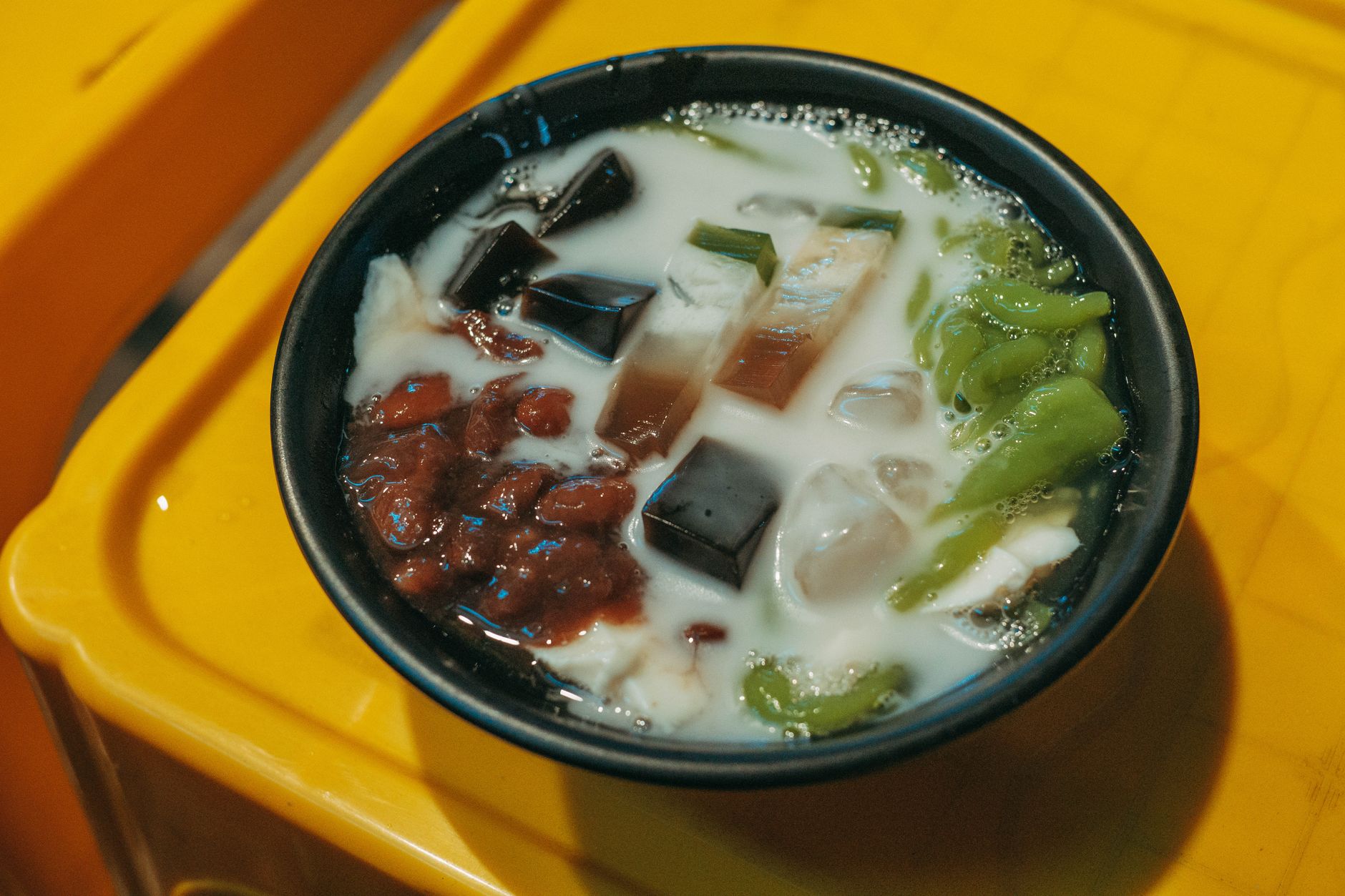
Che is not a single dish. It is a family of hundreds of variations built on beans, rice, fruit, jelly, and coconut milk. Some versions are served hot, some cold, some over crushed ice. Some are as thin as tea, others thick enough to eat with a spoon. What unites them is sweetness, and the fact that they are everywhere once you start looking.
For travelers, che offers a window into how Vietnamese home cooking works. It uses the same ingredients as savory food, but flips them into dessert. Mung beans become a smooth pudding. Sticky rice becomes a creamy porridge. Coconut milk does double duty as both a savory braising liquid and a sweet base. Understanding che means understanding how Vietnamese cooks think about balance, texture, and seasonality.
This guide breaks down the main types of che, the ingredients that define them, how they change across regions and seasons, and where to find the best bowls in Vietnam's major cities.
What is che, exactly?
The word che covers a broad category. In its simplest form, it is a sweet soup or liquid dessert made by boiling ingredients in water or coconut milk, then sweetening with sugar. The texture ranges from brothy to porridge-like. It is served in small bowls or glasses, often with a spoon and sometimes a straw.
Che is sold at dedicated stalls, from pushcarts, in markets, and at casual restaurants. It is rarely a sit-down affair. Most people eat it standing or perched on a tiny plastic stool, finishing a bowl in under ten minutes. It works as an afternoon snack, a post-meal dessert, or a late-night treat.
The ingredient list is long. Common bases include mung beans, black beans, red beans, kidney beans, taro, sweet potato, corn, lotus seeds, and various forms of sticky rice. Fruits such as banana, jackfruit, durian, and longan appear in many versions. Jellies made from grass jelly, agar, or pandan add texture. Coconut milk, either thick or thin, is the most common liquid base. Crushed ice is added to cold versions.
Sugar is non-negotiable. Vietnamese che is unapologetically sweet, often more so than Western desserts. The sweetness is meant to contrast with the natural bitterness of beans or the earthiness of taro. It is not subtle. It is not supposed to be.
The main types of che you will encounter
While the variations run into the hundreds, most che falls into a few recognizable categories. Here are the ones travelers are most likely to see.
Che dau (bean-based che)
Beans are the backbone of many che recipes. Mung beans are the most common, appearing both whole and split. They are often cooked until soft, then sweetened and mixed with coconut milk. Che dau trang is a simple version using white kidney beans. Che dau den uses black beans, sometimes with a hint of vanilla. Che dau xanh is mung bean based and often served with coconut cream on top.
The texture is important. Beans should be soft but not mushy, holding their shape while yielding easily to the spoon. The liquid is usually thin, more like a sweet broth than a thick pudding.
Che ba mau (three-color che)
This is the most visually striking version, and one of the most popular. Che ba mau translates to "three-color che." It layers red beans, mung beans, and green pandan jelly in a tall glass, then tops it with coconut milk and crushed ice. The colors come from natural ingredients: the red from adzuki beans, the yellow from mung beans, the green from pandan leaf extract.
The glass is assembled so the layers stay distinct. The eater stirs everything together before digging in. The combination of soft beans, chewy jelly, and rich coconut milk makes it a textural experience as much as a flavor one.
Che troi nuoc (glutinous rice balls in ginger syrup)
This is the cold-weather che. Che troi nuoc consists of small balls made from glutinous rice flour, each filled with a nugget of mung bean paste. They are boiled, then served in a warm, sweet ginger syrup. Some versions float the balls in coconut milk instead.
The dish is associated with the Cold Food Festival, which falls on the third day of the third lunar month. But it appears in markets and dessert shops throughout the cooler months, especially in northern Vietnam. The ginger syrup is warming and slightly spicy, a counterpoint to the soft, chewy rice balls.
Che chuoi (banana che)
Che chuoi is one of the simplest versions. Ripe bananas are simmered in coconut milk with tapioca pearls and sugar. The result is thick, creamy, and intensely banana-flavored. It is often served warm, though cold versions exist.
This is a home-style che, the kind a grandmother might make on a rainy afternoon. It does not look fancy, but the flavor is deeply comforting. Some versions add peanuts or sesame seeds on top for crunch.
Che thap cam (assorted che)
Che thap cam is the "everything" version. It combines whatever the vendor has on hand: beans, jellies, fruits, tapioca pearls, lotus seeds, and coconut milk. It is the equivalent of a dessert sundae, assembled to order from a row of glass cases.
This is a good option for first-timers who want to sample a bit of everything. The exact contents vary by vendor and region, so no two bowls are quite the same. Point at what looks interesting and let the vendor build the bowl.
Che kho (dry che)
Che kho is a different beast entirely. The word kho means "dry" or "braised," and this version is thick enough to eat with a fork. It is made by cooking ingredients down until almost no liquid remains, then pressing the mixture into a mold. It is often cut into squares or diamonds and served on a small plate.
Che kho is more common in central Vietnam, particularly around Hue. It is denser and richer than other che, almost like a firm pudding or a very soft cake. It is often served at festivals and celebrations rather than as a casual street snack.
Regional differences: north, central, south
Vietnamese cuisine splits into three broad regional traditions, and che follows the same pattern. The differences are subtle but noticeable to anyone who eats enough bowls.
Northern che: lighter and less sweet
In Hanoi and the surrounding region, che tends to be lighter. The liquid is thinner, the sweetness is more restrained, and the ingredients lean toward beans and rice rather than fruit and jelly. Northern che is also more likely to be served warm, especially in cooler months.
Che troi nuoc and che con ong (a honeycomb-textured rice cake in syrup) are northern specialties. The northern palate generally favors less sugar than the south, so northern che can taste almost savory by comparison.
Central che: imperial and elaborate
Hue, the former imperial capital, has the most refined dessert tradition in Vietnam. The royal court employed dedicated pastry chefs, and their legacy survives in the city's dessert shops. Central che tends to be more complex, with multiple components arranged carefully in the bowl.
Hue's signature versions include che kho, the dense pressed dessert mentioned above, and che hat sen, made with lotus seeds from the nearby Perfume River. The presentation is more careful than in the north or south. Central che is a reminder that Hue was once the culinary center of the country.
Southern che: sweetest and most indulgent
Saigon and the Mekong Delta go all in on sweetness. Southern che is the sweetest of the three regions, with sugar added generously and coconut milk used without restraint. Fruits play a bigger role here, thanks to the tropical climate and abundant orchards.
Durian che is a southern specialty. The pungent fruit is blended into coconut milk and combined with sticky rice or sago pearls. It is an acquired taste, but for durian fans it is heaven. Che thap cam is also more common in the south, with vendors offering a dizzying array of toppings.
The south also has more cold che. Crushed ice is standard, and many vendors serve their che in tall glasses with a straw. This makes sense in a region where temperatures rarely drop below 25°C (77°F).
Seasonal variations and when to eat what
Che is not a year-round constant. Many versions are tied to specific seasons or festivals, and vendors adjust their menus accordingly.
Hot weather che
From April to September, cold che dominates. Che ba mau, che thap cam, and fruit-based versions are served over crushed ice. The goal is refreshment as much as sweetness. Vendors in southern Vietnam run these all year, but they peak in the hot months.
Cool weather che
From November to February, hot che takes over. Che troi nuoc appears in the north, along with warm versions of bean che and ginger-sweetened desserts. The warming effect of the ginger and the comforting texture of the rice balls make these ideal for Hanoi's cool, damp winters.
Festival che
Certain che are tied to specific celebrations. Che troi nuoc is associated with the Cold Food Festival in the third lunar month. Che kho appears during Tet, the Lunar New Year, and at weddings. The Mid-Autumn Festival brings its own desserts, though mooncakes rather than che take center stage.
For travelers, the practical takeaway is simple: in hot months, look for cold che; in cool months, look for hot che. The vendors know what fits the weather, and following their lead is the easiest way to eat well.
Common ingredients and what they taste like
Understanding the ingredients makes ordering easier. Here is a quick rundown of what shows up most often.
- Mung beans: the workhorse of che. Split and hulled mung beans cook into a soft, slightly nutty paste. They absorb sugar and coconut milk well.
- Black beans: earthy and slightly smoky. Often paired with vanilla or coconut.
- Red beans (adzuki): sweet and creamy when cooked. A staple of che ba mau.
- Tapioca pearls: chewy, neutral balls that absorb surrounding flavors. Similar to boba in bubble tea.
- Pandan: a tropical leaf with a grassy, vanilla-like aroma. Used to flavor and color jellies and rice.
- Grass jelly: a black, slightly bitter jelly made from plant extract. Adds contrast to sweet bases.
- Coconut milk: the most important liquid ingredient. Rich, sweet, and essential to most che.
- Lotus seeds: mild and slightly sweet, with a soft texture. A Hue specialty.
- Taro: starchy and purple-flecked. Cooks into a soft, creamy texture.
- Jackfruit and durian: tropical fruits that add intense flavor. Jackfruit is mild and sweet; durian is polarizing.
- Glutinous rice: sticky and dense. Used in both whole-grain and ground forms.
The combinations are endless, and most vendors mix two or three ingredients per bowl. The key is the contrast: soft beans against chewy jelly, sweet coconut against bitter grass jelly, warm rice balls against cooling syrup.
Where to try che in Vietnam's major cities
Che is everywhere, but some spots are better than others. Here is where to look in the three main tourist hubs.
Hanoi
The Old Quarter is the best hunting ground. Night markets and street stalls set up in the early evening, and many stay open past midnight. Look for vendors with glass display cases filled with colorful ingredients. The area around Hang Bac and Hang Dieu has a cluster of well-established che stalls.
For a more local scene, head to the area near the Quang Ba Flower Market, where early-morning workers grab a warm bowl before the sun rises. In winter, seek out che troi nuoc from any vendor with a steaming pot.
Hanoi's che tends to be less sweet than the south, so it is a good entry point for travelers who find southern desserts cloying.
Hue
Hue is the place for imperial-style che. The city has a handful of famous dessert shops, many of them family-run for generations. Look for che hat sen (lotus seed che) and che kho (the pressed version). These are more refined than the street versions in Hanoi or Saigon.
Hue's central location also makes it a natural stop on a north-to-south itinerary. The city's food scene is one of the best in Vietnam, and che is part of the reason.
Ho Chi Minh City
Cholon, the city's Chinatown, is the dessert capital of the south. The area around Thap Muoi and Hai Thuong Lan Ong streets has numerous che vendors, many operating late into the night. This is where to find durian che, che thap cam, and the sweetest, most indulgent versions in the country.
The Mekong Delta is also a source of southern che traditions. Can Tho's night market has several che stalls, and the floating markets often sell coconut-based desserts from small boats.
Beyond the big three
Da Nang, Hoi An, and Nha Trang all have solid che scenes, though less famous than the big cities. Hoi An's night market has a few stalls, and Da Nang's local food scene includes several well-regarded che shops. In the central highlands, Da Lat's cool weather makes hot che a natural fit, and the city's market has several vendors.
Pro tip: The best time to eat che is between 3 PM and 8 PM. This is when vendors have freshly made batches and the stalls are busiest. Late-night che is also good, but the selection may be thinner.
How to order che without confusion
Ordering che is simple once the system is understood. Most vendors display their ingredients in glass cases. Point at what looks good, or say "che thap cam" for an assorted bowl. The vendor will assemble it, pour coconut milk over the top, and add ice if requested.
For hot che, ask for "che nong." For cold, say "che da" (with ice) or "che lanh" (cold). Asking for less sugar is harder, but "it duong" (less sugar) usually works. Most vendors will accommodate.
Prices range from 10,000 to 40,000 VND (USD 0.40 to 1.60) per bowl. Fancier ingredients like durian or lotus seeds push the price up. A bowl of che ba mau from a street cart should cost around 15,000 VND (USD 0.60). A sit-down dessert shop in a tourist area might charge double that.
Pro tip: Watch how locals eat. Many southern Vietnamese stir everything together, then drink the liquid through a straw before eating the solids with a spoon. The order matters less than the mixing.
Che and Vietnamese food culture
Che is more than a dessert. It is a social food, eaten in groups, shared from a single table, and ordered in rounds. It is also a nostalgic food. Many Vietnamese adults associate che with childhood trips to the market or grandmother's kitchen.
The category also reflects broader patterns in Vietnamese cuisine. The use of beans and rice in desserts mirrors their role in savory food. The preference for contrasting textures, soft and chewy, crunchy and smooth, carries over from dishes like banh xeo and goi cuon. And the regional differences in sweetness and preparation track with the same north-south divide that shapes the rest of the cuisine.
For travelers, che is a low-risk way to explore this culinary logic. It is cheap, widely available, and easy to order. It is also a good conversation starter with vendors, many of whom take pride in their recipes.
Pro tip: If a che shop is busy with locals, that is the sign to stop. Empty stalls are a warning. Follow the crowd, especially in the late afternoon when the day's batch is freshest.
A comparison of common che types
| Type | Base ingredients | Temperature | Sweetness | Typical price (VND/USD) | Best region |
|---|---|---|---|---|---|
| Che ba mau | Red beans, mung beans, pandan jelly, coconut milk | Cold, with ice | Medium-high | 15,000-25,000 / USD 0.60-1.00 | South |
| Che troi nuoc | Glutinous rice balls, mung bean paste, ginger syrup | Hot | Medium | 20,000-30,000 / USD 0.80-1.20 | North |
| Che chuoi | Banana, tapioca pearls, coconut milk | Warm or cold | High | 15,000-25,000 / USD 0.60-1.00 | South |
| Che kho | Beans, rice, coconut, pressed into a block | Room temperature | Very high | 25,000-40,000 / USD 1.00-1.60 | Central |
| Che thap cam | Assorted beans, jellies, fruits, coconut milk | Cold, with ice | High | 20,000-35,000 / USD 0.80-1.40 | South |
| Che hat sen | Lotus seeds, sugar, sometimes coconut milk | Cold or warm | Low-medium | 25,000-40,000 / USD 1.00-1.60 | Central |
How che fits into a larger food itinerary
Che works as a palate cleanser between savory meals, a mid-afternoon energy boost, or a late-night dessert after a dinner of bun bo Hue or com tam. It pairs well with the street food circuit that many travelers follow from north to south.
On a two-week itinerary, che provides a useful marker of regional change. The light, warm bowls of Hanoi give way to the refined desserts of Hue, then to the sweet, iced creations of Saigon. Eating che in each city is a way to track the culinary geography of the country.
Che is also a good option for travelers who skip the night markets. Many vendors open by mid-morning and run through the evening. Unlike bia hoi, which is strictly an evening affair, che works at almost any hour.
Final thoughts on eating che
Che is one of the most accessible entry points into Vietnamese food culture. It is cheap, sweet, and everywhere. It requires no special knowledge to enjoy, and the variety means there is always something new to try.
The best approach is simple: find a busy stall, point at something that looks interesting, and eat it. Repeat until the options run out. That might take a while. There are hundreds of versions, and the vendors are not running out of ideas anytime soon.
FAQ
Q: What does che taste like? A: Most che is sweet, often very sweet. The flavor depends on the base ingredients. Bean-based che has an earthy, nutty sweetness. Coconut milk adds richness. Fruit versions taste like the fruit, amplified by sugar. The texture is usually more interesting than the flavor, with soft beans, chewy jellies, and crunchy ice all in one bowl.
Q: Is che served hot or cold? A: Both. Cold che, served over crushed ice, dominates in southern Vietnam and during hot months. Hot che, like che troi nuoc, appears in the north and during cooler months. Some versions, like che chuoi, work either way. Ask for "che nong" (hot) or "che da" (with ice) if the vendor does not ask.
Q: Is che vegetarian or vegan? A: Most che is naturally vegan. The base ingredients are beans, rice, fruit, and coconut milk. No animal products are used in the majority of versions. Some vendors may add egg or dairy to certain recipes, so it is worth asking if that matters. For a country with a growing vegan scene, che is one of the easiest foods to find plant-based.
Q: How much does che cost? A: A bowl of che from a street cart costs between 10,000 and 25,000 VND (USD 0.40 to 1.00). Sit-down dessert shops in tourist areas may charge 30,000 to 40,000 VND (USD 1.20 to 1.60). Fancy ingredients like durian or lotus seeds push the price up. It is one of the cheapest foods in Vietnam.
Q: When is the best time to eat che? A: Late afternoon to early evening is the sweet spot. Vendors have fresh batches, and the stalls are busy with locals. Late-night che is also good, especially in Saigon where dessert stalls run past midnight. In hot months, cold che is refreshing any time of day.
Q: Can I find che outside of Vietnam? A: Yes, but it is not common. Vietnamese restaurants in the United States, Australia, and France sometimes serve che as a dessert. The selection is usually limited to a few versions like che ba mau or che chuoi. The full range, with hundreds of variations and regional styles, only exists in Vietnam.
Q: Is che safe to eat? A: Yes, with the usual caveats. Street food in Vietnam is generally safe when the vendor is busy and the ingredients are cooked fresh. Che is boiled, so the main ingredients are cooked. The main risk is ice, which is usually made from filtered water in cities. Stick to busy stalls and avoid anything that has been sitting out for hours.