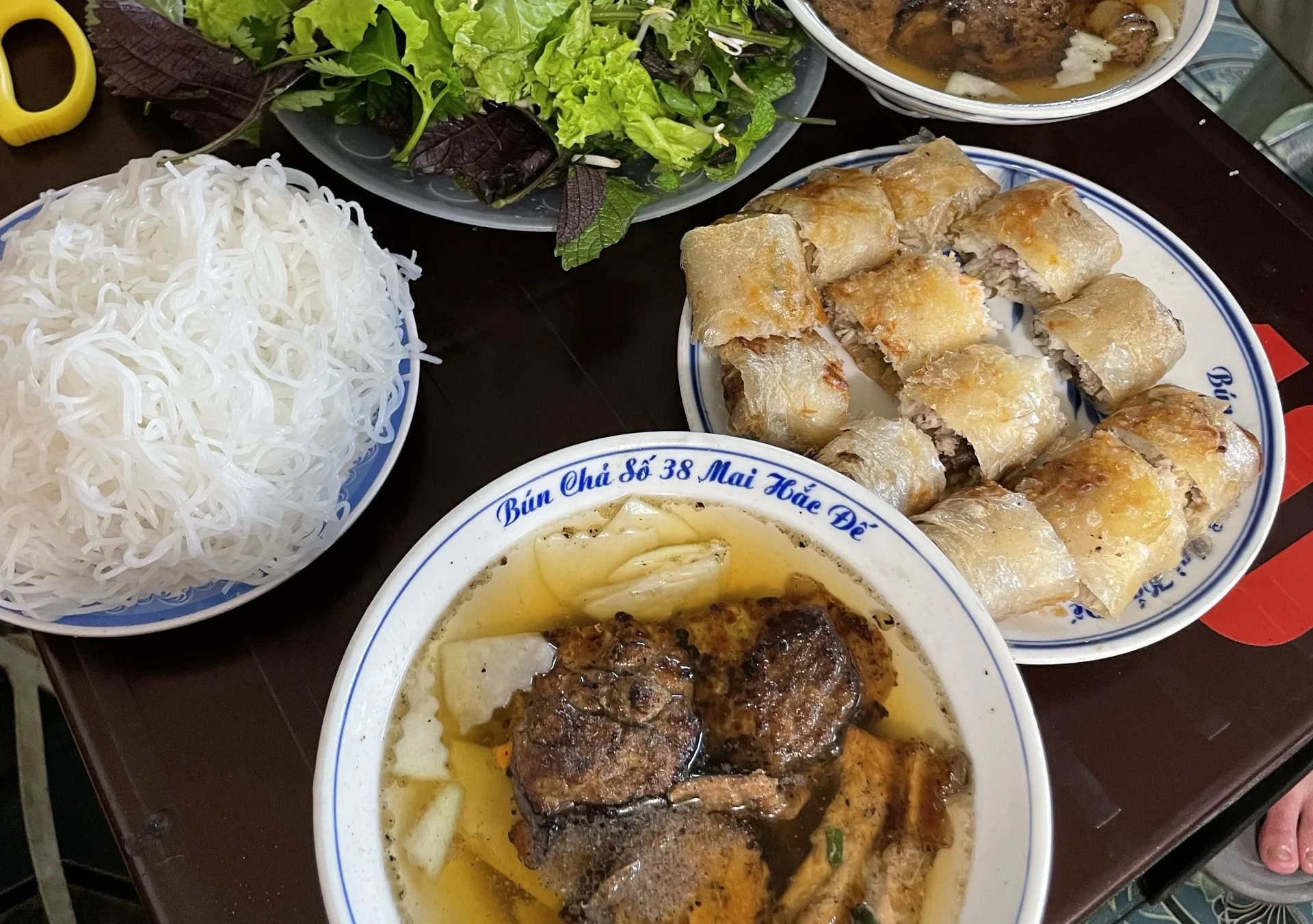
The two dishes share three letters and absolutely nothing else. One is grilled pork over cold rice noodles. The other is a fire-red beef broth that could strip paint.
Mix them up in the wrong city and you'll either get a polite redirect or, worse, a sad bowl made by someone who's never cooked it properly. Here's how to never confuse them again.
Why Travelers Keep Confusing These Two Dishes
Both start with "bun" — the Vietnamese word for round white rice vermicelli. That's where the similarity ends, but it's enough to send Google Translate into a spiral and tourists into the wrong restaurant.
The confusion gets worse because some Hanoi menus list both, badly. And southern tourist traps in Hoi An sometimes throw a sad version of each onto the same laminated card.
Bun Cha: Hanoi's Smoky Lunch Ritual
Bun cha is a northern dish, full stop. You'll smell it before you see it — charcoal smoke curling out of sidewalk grills around Hang Than and Dong Xuan market between 11am and 2pm.
What lands on your plastic stool table:
- A bowl of warm, sweet-savory nuoc cham broth with floating grilled pork patties and pork belly slices
- A cold pile of white bun noodles on a separate plate
- A mountain of herbs: perilla, mint, lettuce, coriander
- Optional nem cua be (crab spring rolls) on the side
You dunk the noodles into the broth bite by bite. It's a lunch dish — most legit places close by 2pm or sell out earlier.
Pro tip: If a bun cha joint is open at 8pm, it's a tourist trap. The real ones run out of pork by mid-afternoon and shut the grill.
Bun Bo Hue: The Imperial Capital's Fire Bowl
Bun bo Hue is a central Vietnamese dish from the old imperial capital of Hue, about 700km south of Hanoi. The noodles are thicker — almost spaghetti-width — and the broth is a different universe.
What you're looking at:
- Deep red, lemongrass-and-shrimp-paste broth with a slick of chili oil on top
- Slices of beef shank, pork knuckle, congealed pig's blood cubes, sometimes a chunk of Hue sausage
- Thick round rice noodles (not the thin bun of the north)
- A side plate of banana blossom, bean sprouts, lime, and raw chili
The heat hits in three layers: lemongrass aromatics, fermented mam ruoc funk, and a slow-building chili burn. It's typically eaten for breakfast in Hue, not lunch.
The Three-Second Visual Test
If you can't read the menu, look at the bowls on nearby tables:
| Feature | Bun Cha | Bun Bo Hue |
|---|---|---|
| Broth color | Pale amber | Deep red-orange |
| Noodle thickness | Thin | Thick, round |
| Noodles served | On separate plate | In the bowl |
| Protein | Grilled pork | Beef shank, pork hock, blood |
| Time of day | Lunch only | Breakfast mainly |
| Region | Hanoi (north) | Hue (central) |
Insider Tips: What Most Tourists Get Wrong
Don't Order Bun Bo Hue in Hanoi (Usually)
There are maybe three places in Hanoi that do bun bo Hue properly, and they're run by Hue transplants. Everywhere else, you'll get a watered-down northern interpretation — too sweet, not enough shrimp paste, no funk.
If you're in Hanoi, eat bun cha, pho, or bun thang. Save the bun bo Hue craving for when you're actually in Hue, where a proper bowl costs around $1.50 / 35,000 VND at Ba Do on Nguyen Du street.
Don't Order Bun Cha for Dinner
I've watched countless travelers wander Hanoi's Old Quarter at 7pm looking for bun cha. The grills are cold. The good ones — Bun Cha Huong Lien (the Obama spot at 24 Le Van Huu), Bun Cha Dac Kim at 1 Hang Manh, Bun Cha Ta at 21 Nguyen Huu Huan — all wind down by 2-3pm.
What you'll find at night is reheated meat or a chain place catering to tourists. Lunch is the only window.
The Shrimp Paste Question
Bun bo Hue broth gets its backbone from mam ruoc — fermented shrimp paste. Some restaurants tone it down for foreigners without asking.
If you want the real thing, say "cho mam ruoc nhieu" (more shrimp paste). If you're shrimp-allergic or hate fermented funk, say "khong mam ruoc" — but honestly, then don't order this dish.
Local secret: Add a squeeze of lime and a pinch of raw banana blossom to bun bo Hue right before eating. It cuts the richness and wakes the broth up. Locals do it. Tourists forget.
Pronunciation Cheats
- Bun cha = "boon cha" (short, two syllables)
- Bun bo Hue = "boon baw hway" (three syllables, "Hue" rhymes with "sway")
Say it wrong in the wrong city and you'll get blank stares. Saying "bun bo" in Hanoi sometimes gets you bun bo Nam Bo — a totally different stir-fried beef noodle dish. Welcome to Vietnam.
Practical Info
Where to Eat Each Dish (Verified Spots)
Bun Cha in Hanoi:
- Bun Cha Huong Lien — 24 Le Van Huu, open 8am-8:30pm (the rare exception with longer hours, but lunch is still best). Around $3 / 75,000 VND with crab rolls.
- Bun Cha Dac Kim — 1 Hang Manh, 10am-3pm. Touristy but solid. About $4 / 90,000 VND.
- Bun Cha 34 — 34 Hang Than, 10:30am-2pm. Smaller, more local. Around $2.50 / 60,000 VND.
Bun Bo Hue in Hue:
- Ba Do — Nguyen Du street, 6am-10am. $1.50 / 35,000 VND. Breakfast crowd of grandmothers and motorbike drivers.
- Bun Bo Hue Ba Tuyet — 47 Nguyen Cong Tru, 5:30am-11am. Slightly larger bowls, around $2 / 45,000 VND.
- Quan Cam — 45 Le Loi, 6am-1pm. Tourist-accessible but still authentic.
Budget Snapshot
| Item | Bun Cha (Hanoi) | Bun Bo Hue (Hue) |
|---|---|---|
| Standard bowl | $2-3 | $1.50-2 |
| With extras | $4-5 | $2.50-3 |
| Tourist-trap price | $7+ | $5+ |
| Iced tea (included) | Free | Free |
Best Timing
- Bun cha: 11:30am-1:30pm, any day. Avoid Monday at some smaller spots (closed).
- Bun bo Hue: 6am-9am for the authentic breakfast experience. Bowls served later are often reheated.
Getting There
Hanoi and Hue are connected by:
- Reunification Express train — 13-16 hours, $25-50 depending on berth class
- Domestic flights — Hanoi to Hue (or Da Nang, 1hr from Hue) for $40-80, 1h15min
- Sleeper bus — 12-14 hours, $15-20, only if you enjoy suffering
Eat them in their home cities. The geography is the whole point.
Get the dish right, in the right city, at the right hour — and Vietnam stops being confusing and starts tasting like itself.