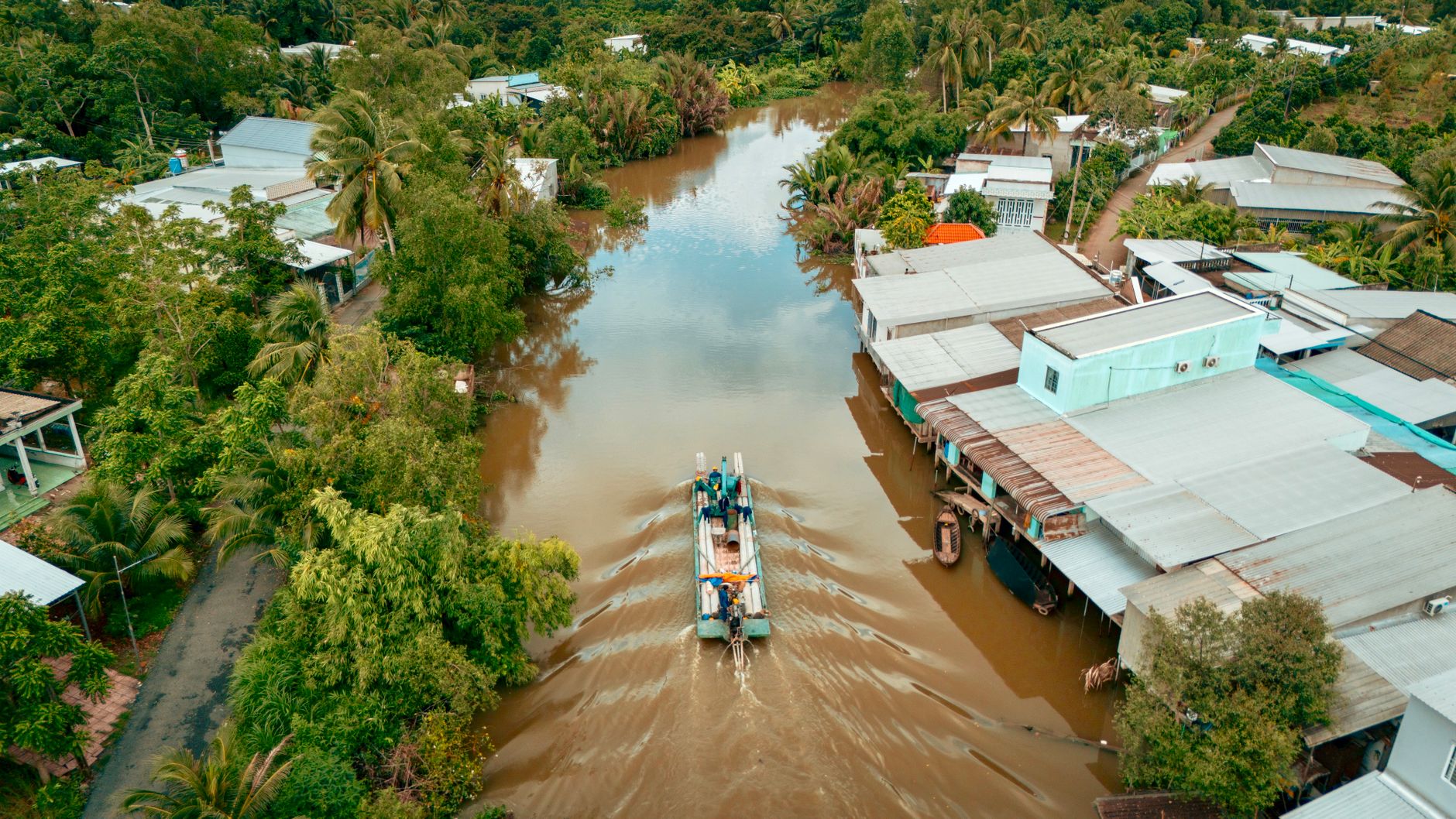
The Delta does not work in eight hours. It works in the early morning mist over the Bassac River. It works in the silence of a homestay at dusk, when the only sound is the slap of water against a boat hull. It works in the maze of canals where the main mode of transport is a paddle and the main crop is something you have never seen before.
This guide covers how to spend 2 to 4 days in the Mekong Delta properly. No rushed tours. No scripted stops. Just the real Delta, moving at the Delta's pace.
Why the day trip undersells the Delta
The problem with day trips is simple: timing. The floating markets operate from 4am to 9am. Most day tours arrive at 10am. By then the serious trading is done. You see a few boats tied together, some women selling coffee, and a handful of tourists. You do not see the wholesale fruit barges, the noodle boats serving breakfast to traders, or the quiet negotiation between a farmer and a wholesaler that sets the price for pomelos across the region.
The Delta is also large. Really large. The Mekong Delta covers 40,000 square kilometers. That is roughly the size of Switzerland. A day trip covers maybe 50 kilometers of that. You see one canal, one market, one village. You miss the staggering diversity between provinces: the coconut groves of Ben Tre, the fruit orchards of My Tho, the bird sanctuaries of Tra Vinh, the Khmer pagodas of Soc Trang, the remote channels of Dong Thap.
Staying overnight changes everything. You wake up at 5am for the market. You eat breakfast on a boat. You cycle through villages in the late afternoon when the heat breaks. You eat dinner with a local family. You hear the frogs and the geckos and the river lapping at the stilts below your room.
Getting to the Delta: buses, boats and routes
The most practical entry point is Can Tho. It sits at the center of the Delta and has the best transport connections. From Ho Chi Minh City, buses run every 30 minutes from the Miền Tây bus station (District 6). The journey takes 3 hours and costs 120,000-180,000 VND ($5-7). Several companies operate this route, including Phương Trang (Futa Bus Lines). The buses are air-conditioned and comfortable enough for a morning nap.
For the earliest possible arrival, take the 5am bus from Ho Chi Minh City. You will reach Can Tho by 8am, drop your bags at a homestay, and still make the tail end of the morning market action.
An alternative route goes through Mỹ Tho and Bến Tre first, then south to Can Tho. This works well for a 3-4 day itinerary. The bus from Ho Chi Minh City to Mỹ Tho takes 90 minutes and costs 60,000 VND ($2.50). From Mỹ Tho, local buses run to Bến Tre (45 minutes, 30,000 VND). From Bến Tre, buses continue to Can Tho (2 hours, 80,000 VND).
Private cars cost 800,000-1,200,000 VND ($32-48) for the same routes. They save time but cost more. For a group of three or four, the price difference is negligible.
Flying is not an option. Can Tho airport has limited domestic flights from Hanoi and Da Nang, but the flight time savings are eaten by airport transfers. The bus is faster door-to-door from Saigon.
2-day Mekong Delta itinerary: the essential route
This itinerary focuses on Can Tho and one other province. It is the minimum time needed to experience the Delta properly.
Day 1: Ho Chi Minh City to Can Tho
Take the early bus from Ho Chi Minh City. Arrive in Can Tho by late morning. Check into a homestay in the Cái Răng district, near the floating market. Most homestays here sit right on the river.
Spend the afternoon exploring Can Tho city. The Cần Thơ Museum is worth an hour. It covers the history of the Delta, the Khmer and Chinese communities, and the French colonial period. The museum is free. The building itself is a fine example of French colonial heritage in Vietnam: architecture, history and where to find it.
Walk along the Ninh Kiều waterfront in the late afternoon. Street vendors set up along the promenade. Try bánh xèo (crispy pancakes) from the stalls near the statue of Hồ Chí Minh. The Can Tho Night Market: 2026 Practical Guide for an Authentic Evening starts around 6pm. It is smaller than Saigon's night markets but more local. The grilled seafood is excellent.
Go to bed early. The floating market starts before sunrise.
Day 2: Cái Răng floating market and return
Wake at 4:30am. Your homestay host will have a boat ready. The trip to Cái Răng takes 20 minutes from most homestays. Arrive by 5:30am. The market is in full swing.
Cái Răng is the largest wholesale floating market in the Delta. Hundreds of boats cluster at the confluence of the Cần Thơ and Bassac rivers. Each boat displays its wares on a long pole: a pineapple, a bunch of bananas, a jackfruit. This is the "cây bẹo" system, the floating advertisement that tells buyers what is for sale.
Stay for an hour. Watch the noodle boat pull up alongside the fruit boats. The women on the noodle boat serve steaming bowls of hủ tiếu (pork noodle soup) to traders. This is breakfast on the water. It costs 15,000 VND ($0.60) per bowl. It is the best meal you will have in the Delta.
The noodle boat at Cái Răng is easy to spot: it has a red flag and a small gas stove. Wave it down. The woman will paddle over and serve you from her boat. Pay in small bills.
Return to the homestay by 8am. Have a proper breakfast. Pack your bags. Take the afternoon bus back to Ho Chi Minh City.
This 2-day trip costs approximately 1,200,000-1,600,000 VND ($48-64) per person, including transport, homestay, meals, and the boat tour.
3-day itinerary: adding Ben Tre coconut country
Three days allows you to explore a second province. Bến Tre is the obvious choice. It is the coconut capital of Vietnam. The province produces 70% of the country's coconut crop. The landscape is flat, green, and crisscrossed with canals. The pace is slower than Can Tho.
Day 1: Ho Chi Minh City to Bến Tre
Take the morning bus to Mỹ Tho. From Mỹ Tho, catch a local bus or taxi to Bến Tre city (30 minutes). Check into a homestay along the Hàm Luông River.
Spend the afternoon cycling. Most homestays rent bicycles for 50,000 VND ($2) per day. The back roads of Bến Tre are quiet. You cycle past coconut plantations, brick kilns, and small temples. Stop at a coconut candy workshop. These are small operations, not tourist factories. The workers will show you how they boil the coconut milk, spread it flat, and cut it into squares. Buy a bag for 20,000 VND ($0.80). It makes a good gift.
Day 2: Bến Tre canals and transfer to Can Tho
Take a morning boat through the smaller canals of Bến Tre. These channels are narrow. The overhanging coconut palms shade the water. You pass floating fish farms and houses on stilts. The boat is rowed by hand or powered by a small engine. The engine is loud but necessary for the wider canals.
Return to the homestay by noon. Take the afternoon bus from Bến Tre to Can Tho. The journey takes 2 hours. Check into a homestay near the Cái Răng market.
Day 3: Cái Răng floating market and return
Follow the Day 2 schedule from the 2-day itinerary. Wake early, visit the market, return for breakfast, and take the afternoon bus back to Ho Chi Minh City.
This 3-day trip costs approximately 1,800,000-2,400,000 VND ($72-96) per person.
4-day itinerary: deeper into the Delta
Four days opens up the southern Delta. This itinerary adds a day in Trà Vinh or Sóc Trăng, where the Khmer influence is strongest. The pagodas here are different from the Vietnamese temples in the north. They are colorful, ornate, and surrounded by palm trees.
Day 1: Ho Chi Minh City to Bến Tre
Same as Day 1 of the 3-day itinerary.
Day 2: Bến Tre to Trà Vinh
Take the morning bus from Bến Tre to Trà Vinh. The journey takes 2 hours. Trà Vinh is off the main tourist route. Few foreigners come here.
Visit the Âng Pagoda, a Khmer temple complex set in a 20-hectare forest. The pagoda grounds are home to thousands of fruit bats. At dusk, they take flight in a dark cloud that stretches across the sky. The sight is surreal.
Stay overnight at a homestay in Trà Vinh. The homestays here are basic. They cost 200,000-400,000 VND ($8-16) per night.
Day 3: Trà Vinh to Can Tho
Take the morning bus from Trà Vinh to Can Tho. The journey takes 2.5 hours. Check into a homestay near Cái Răng.
Spend the afternoon cycling the back roads of Cái Răng district. The area around the floating market is busy, but 2 kilometers inland the roads are empty. You pass fruit orchards, rice fields, and small villages.
Day 4: Cái Răng floating market and return
Same as Day 2 of the 2-day itinerary.
This 4-day trip costs approximately 2,500,000-3,200,000 VND ($100-128) per person.
Where to stay: homestays vs hotels
Homestays are the better choice for the Delta. Hotels in Can Tho city are fine, but they disconnect you from the river. A homestay puts you on the water.
| Type | Price per night | Meals included | Location | Best for |
|---|---|---|---|---|
| Homestay (basic) | 200,000-400,000 VND ($8-16) | Breakfast only | Rural, riverside | Budget travelers, solo |
| Homestay (mid-range) | 400,000-800,000 VND ($16-32) | Breakfast + dinner | Riverside, near market | Couples, families |
| Hotel (3-star) | 500,000-1,000,000 VND ($20-40) | Breakfast only | Can Tho city center | Business, comfort |
| Hotel (4-star) | 1,000,000-2,000,000 VND ($40-80) | Breakfast included | Ninh Kieu waterfront | Luxury, convenience |
The best homestays in Cái Răng are run by families who have lived on the river for generations. They speak basic English. They know the market schedule. They will arrange boat tours at cost price, not the inflated rate that hotels charge.
Book homestays directly through booking platforms or by calling ahead. Walk-in rates are often higher. Confirm whether the price includes boat transport to the floating market. Some homestays charge extra for this.
Getting around: boats, bikes and buses
The Delta runs on three modes of transport. Use all three.
Boats: Private boat tours cost 300,000-600,000 VND ($12-24) for a 2-hour trip. Shared boat tours cost 150,000-300,000 VND ($6-12) per person. The private option is worth the extra money. You control the pace. You can stop at smaller canals that the group boats skip.
Bicycles: Most homestays rent bicycles. The Delta is flat. Cycling is easy. The best cycling is in Bến Tre and the back roads of Cái Răng. Avoid the main roads between cities. The traffic is dangerous.
Buses: Local buses connect all Delta cities. They are cheap, frequent, and reliable. The buses are old but air-conditioned. The main routes run every 30 minutes from 5am to 6pm.
Do not rent a motorbike in the Delta unless you have experience driving in Vietnam. The roads are narrow. The bridges are precarious. The ferry crossings are chaotic. Stick to buses and bicycles.
When to visit the Mekong Delta
The Delta has two seasons: dry and wet.
The dry season runs from November to April. This is the best time to visit. The water levels are lower, the canals are calmer, and the floating markets are more active. The temperature ranges from 25°C to 35°C. The humidity is high but bearable.
The wet season runs from May to October. The Delta floods. This sounds dramatic, but the flooding is a natural part of the cycle. The water brings nutrients to the rice fields. The canals are fuller, which means boat travel is easier. The rain usually falls in short, heavy bursts in the afternoon. The mornings are often clear.
For detailed weather planning, see the Vietnam Weather by Month: The Best Time to Visit Each Region guide.
If visiting during the wet season, pack a lightweight rain jacket and sandals that can get wet. The paths between homestays and boats are often muddy.
What to eat in the Delta
The Delta has its own cuisine. It is different from the food in Hanoi or Saigon. The ingredients are fresher. The flavors are brighter.
Bánh xèo: The Delta version of this crispy pancake is smaller and thinner than the Central version. It is stuffed with shrimp, bean sprouts, and coconut cream. Eat it wrapped in lettuce with herbs.
Hủ tiếu: This pork noodle soup is the Delta's answer to phở. The broth is clearer. The noodles are thinner. The toppings include ground pork, shrimp, and quail eggs. The floating market version is the best.
Cơm tấm: Broken rice with grilled pork. This is a Saigon dish, but the Delta version uses local pork that is raised on coconut husks. The meat has a sweetness you cannot find elsewhere.
Fresh fruit: The Delta grows the best fruit in Vietnam. Try the pomelos from Bến Tre, the rambutans from Vĩnh Long, and the durians from Cái Mơn. The fruit at the floating market is cheaper and riper than anything in the city.
For more on Delta cuisine, read the Mekong Delta on a Shoestring: My Bus-and-Boat Route to the Backwaters guide.
Practical tips for the Delta
Cash is king. ATMs exist in Can Tho city but are rare in rural areas. Carry enough cash for your homestay, meals, and boat tours. Most homestays do not accept cards.
Learn basic greetings. A simple "xin chào" (hello) and "cảm ơn" (thank you) go a long way. The Vietnamese greetings and social etiquette: a practical guide for travelers covers the basics.
Dress appropriately for temples. The Delta has many Khmer and Vietnamese pagodas. Cover your shoulders and knees. Remove your shoes before entering. The Temple etiquette in Vietnam: what to wear, do and avoid guide has full details.
Bargain respectfully. The floating market prices are negotiable. Start at half the asking price. Settle at 60-70%. The Bargaining in Vietnam: Complete Guide to Negotiating Like a Local in 2026 guide explains the technique.
Stay hydrated. The Delta is hot and humid. Drink at least 2 liters of water per day. Avoid ice from street vendors unless you see it being made from bottled water.
Watch for mosquitoes. The Delta has mosquitoes, especially near the water at dusk. Use DEET-based repellent. The Mosquitoes, Dengue and Malaria in Vietnam: The Realistic Risk Map for Travelers guide explains the risks.
FAQ
Q: Is the Mekong Delta safe for solo travelers? Yes. The Delta is safe for solo travelers, including women traveling alone. The main risk is road traffic, not crime. Stick to buses and boats. Avoid driving a motorbike. Stay at homestays with good reviews. The hosts will look out for you.
Q: Can I visit the floating markets in the afternoon? No. The wholesale trading ends by 9am. After that, the boats disperse. A few boats remain for tourists, but the atmosphere is gone. Visit between 5am and 7am for the real experience.
Q: Do I need to book homestays in advance? Yes, especially during the dry season (November to April). The best homestays book out weeks ahead. Book through booking platforms or contact the homestay directly via WhatsApp or Facebook.
Q: How much does a boat tour cost? Private boat tours cost 300,000-600,000 VND ($12-24) for 2 hours. Shared tours cost 150,000-300,000 VND ($6-12) per person. Negotiate the price before boarding. Confirm what is included (fuel, guide, canal access).
Q: What should I pack for the Mekong Delta? Lightweight clothing, a rain jacket (wet season), sandals that can get wet, sunscreen, insect repellent, a hat, and a reusable water bottle. Leave the high heels and fancy clothes at home. The Delta is casual.
Q: Can I do the Delta without speaking Vietnamese? Yes. English is spoken at homestays, bus stations, and tourist sites. In rural areas, use Google Translate. Learn basic numbers for bargaining. The Nod, Smile, and Swipe: How to Survive Vietnam Without Speaking Vietnamese guide has practical tips.
Q: Is the Delta worth visiting during the wet season? Yes. The wet season (May to October) is less crowded. The canals are fuller. The rain usually falls in short afternoon bursts. The mornings are often clear. The floating markets are active year-round.