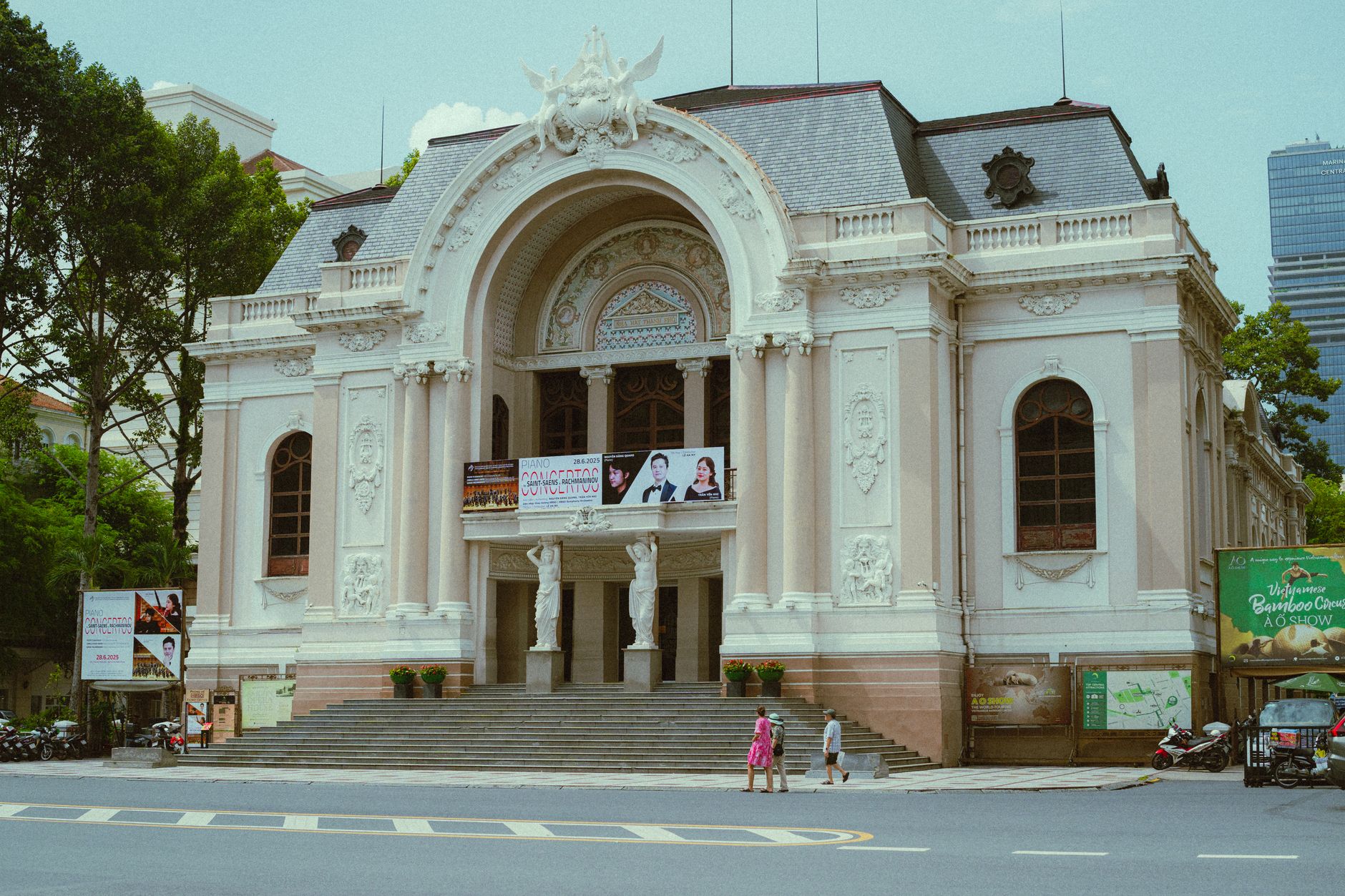
This guide covers the most significant colonial-era buildings in Vietnam’s major cities. It offers historical context without nostalgia. The buildings are part of Vietnam’s story. They are not romantic relics. They are functional spaces that have been adapted, repurposed, and in some cases, neglected.
The logic of colonial architecture in Vietnam
French colonizers built for control and comfort. The architecture served two purposes: to assert French authority and to make European settlers feel at home in a tropical climate.
The typical French colonial building in Vietnam combines European neoclassical forms with local adaptations. Shutters, high ceilings, verandas, and large windows allowed airflow in the heat. Yellow paint was common because it was cheap and durable. Red tile roofs and arched windows became standard.
The buildings were not designed for Vietnamese people. They housed French administrators, military officers, and wealthy merchants. Vietnamese people were largely excluded from these spaces until after independence.
Today, these buildings are Vietnamese. They house Vietnamese institutions. The post office still processes mail. The opera house still stages performances. The villas have become hotels or private homes. The colonial past is a layer in Vietnam’s urban fabric, not the defining one.
Hanoi: the opera house, the cathedral, and the government quarter
Hanoi has the densest concentration of French colonial architecture in Vietnam. The city was the capital of French Indochina from 1902 to 1954. The French built wide boulevards, administrative buildings, and residential quarters around Hoan Kiem Lake and the area now known as the French Quarter.
Hanoi Opera House (1 Trang Tien Street) is the most recognizable colonial building in the city. Completed in 1911, it was modeled on the Palais Garnier in Paris. The building took seven years to construct. Materials were imported from France. The interior features marble floors, crystal chandeliers, and a 900-seat auditorium.
The opera house was not just a cultural venue. It was a symbol of French civilization imposed on a colonized population. After independence, it became a site of political significance. The Viet Minh used it for meetings. Today, it hosts performances and is open for guided tours. Tickets for shows range from 100,000 to 500,000 VND (4 to 20 USD). Walk-in visits are not always possible. Check the schedule in advance.
St. Joseph’s Cathedral (40 Nha Chung Street) was completed in 1886. Its neo-Gothic design resembles Notre Dame de Paris. The cathedral sits on the site of a former Buddhist pagoda, which was demolished to make way for the church. This was a deliberate act of cultural replacement. Today, the cathedral remains an active place of worship. Mass is held daily. The exterior is free to view. The interior is open during non-service hours.
The Government Guest House (12 Ngo Quyen Street) was originally the French Governor’s Palace. Built in 1901, it is now used for official state functions. It is not open to the public, but the exterior is worth seeing. The building sits on a tree-lined street in the French Quarter.
Other notable buildings in Hanoi:
- The State Bank of Vietnam (47 Hang Dau Street) – former Bank of Indochina, completed 1925
- The Vietnam National Museum of History (1 Trang Tien Street) – former French School of the Far East, completed 1932
- The Sofitel Legend Metropole Hotel (15 Ngo Quyen Street) – opened 1901, still operating as a luxury hotel
Pro tip: The French Quarter is walkable. Start at the Opera House, walk south along Trang Tien Street, then loop back through Ngo Quyen and Ly Thai To streets. The entire walk takes about 90 minutes.
Ho Chi Minh City (Saigon): the post office, the basilica, and the city hall
Saigon was the commercial capital of French Indochina. The architecture here is more ornate and grandiose than in Hanoi. The French built wide boulevards, a central market, and imposing civic buildings.
Saigon Central Post Office (2 Cong Xa Paris Street) is the most photographed colonial building in Vietnam. Completed in 1891, it was designed by Gustave Eiffel’s firm. The building combines Renaissance and Gothic elements. The interior features a vaulted ceiling, a giant portrait of Ho Chi Minh, and wooden phone booths that still function.
The post office remains operational. Locals and tourists send mail and packages here. It is open daily from 7:00 AM to 7:00 PM. Entry is free.
Notre-Dame Cathedral Basilica of Saigon is directly across from the post office. Construction began in 1863 and finished in 1880. All materials were shipped from France. The red bricks came from Toulouse. The stained glass windows were made in Chartres.
The cathedral has been under renovation since 2017. The exterior is partially covered by scaffolding. The interior is closed to visitors. The renovation is expected to continue through 2027. The square in front of the cathedral is a popular meeting point.
Ho Chi Minh City Hall (86 Le Thanh Ton Street) was completed in 1908. It was originally the French colonial city hall. The building is not open to the public, but the facade is one of the finest examples of French colonial architecture in the city. The statue of Ho Chi Minh in front was added after 1975.
Other notable buildings in Saigon:
- The Municipal Theatre (7 Lam Son Square) – also known as the Saigon Opera House, completed 1900
- The Ho Chi Minh City Museum of Fine Arts (97A Pho Duc Chinh Street) – housed in a colonial villa built 1929
- The Continental Hotel (132-134 Dong Khoi Street) – opened 1880, still operating
Pro tip: The area around Notre-Dame Cathedral and the Central Post Office is pedestrian-friendly. Visit early in the morning (before 8:00 AM) to avoid crowds and heat.
Da Lat: the hill station villas and the railway station
Da Lat was developed by the French as a hill station escape from the heat of the lowlands. The city sits at 1,500 meters above sea level. The climate is cool year-round. The French built hundreds of villas here between 1900 and 1945.
Da Lat Railway Station (1 Quang Trung Street) was completed in 1938. The design is a mix of Art Deco and local Central Highland architecture. The three gables represent the three peaks of the Lang Bian mountain range. The station served the Da Lat-Thap Cham railway line, which was considered one of the most scenic in Vietnam. The line was damaged during the war and partially closed. Today, a short tourist train runs to the nearby village of Trai Mat. Tickets cost 108,000 VND (4.50 USD) round trip.
The villas of Da Lat are scattered across the city. The most concentrated area is around Tran Hung Dao Street and the former French quarter near the Da Lat Palace Hotel. Many villas have been converted into hotels, guesthouses, and cafes. Some are abandoned and overgrown.
Notable villas include:
- The Palace Hotel (2 Tran Phu Street) – originally the Lang Bian Palace Hotel, built 1922
- The former residence of Emperor Bao Dai (1 Trieu Viet Vuong Street) – a colonial villa used by the last Vietnamese emperor
- The Domaine de Marie Church (1 Ngo Quyen Street) – a French-built convent with a distinctive curved roof
Pro tip: Renting a motorbike is the best way to explore Da Lat’s villas. Many are on narrow, winding streets. Walking is possible but tiring due to the hills. See our motorbike rental dalat guide for details.
Hai Phong: the forgotten colonial port city
Hai Phong was the main port of French Indochina. The city received significant colonial investment. Today, it is often overlooked by tourists. That makes it a good destination for those interested in architecture without crowds.
Hai Phong Opera House (30 Tran Hung Dao Street) was completed in 1912. It is smaller than Hanoi’s opera house but similar in style. The building is used for performances and public events. The exterior is free to view. Interior access depends on the schedule.
The Queen of the Rosary Cathedral (46 Hoang Van Thu Street) was built between 1872 and 1886. The neo-Gothic design features two bell towers and a large rose window. The cathedral is active. Mass is held daily.
Hai Phong City Center has a grid of streets with colonial-era buildings. The most notable are:
- The former Hotel de Ville (now the People’s Committee building) on Dien Bien Phu Street
- The Hai Phong Museum (66 Dien Bien Phu Street) – housed in a colonial building
- The central market area around Quang Trung Street
Hai Phong is 100 kilometers from Hanoi. The train takes about 2 hours. Buses are also available. The city can be visited as a day trip or overnight stay.
Pro tip: Hai Phong’s colonial quarter is compact. Walk from the opera house to the cathedral. Stop at a local cafe for coffee. The city feels like Hanoi did 20 years ago.
Comparison table: colonial architecture by city
| City | Key building | Year completed | Entry fee | Accessibility |
|---|---|---|---|---|
| Hanoi | Opera House | 1911 | 100,000-500,000 VND (4-20 USD) | Guided tours only |
| Ho Chi Minh City | Central Post Office | 1891 | Free | Open daily, operational |
| Da Lat | Railway Station | 1938 | 108,000 VND (4.50 USD) | Tourist train only |
| Hai Phong | Opera House | 1912 | Free (exterior) | Event-dependent interior |
Practical considerations for visiting colonial buildings
Opening hours. Government buildings often close for lunch (11:30 AM to 1:30 PM). Check before visiting. Post offices and markets keep longer hours.
Photography. Most buildings allow photography. Some government buildings restrict interior photos. Tripods may require permission.
Dress code. Religious buildings require covered shoulders and knees. Opera houses and cultural venues may have dress codes for performances.
Language. Signage is in Vietnamese. Some buildings have English information. A guide or audio tour is helpful for deeper context.
Weather. Hanoi and Hai Phong are hot and humid from May to October. Da Lat is cool year-round. Ho Chi Minh City is hot year-round. Dress accordingly. See our guide on what to wear in Vietnam in May female for packing tips.
Getting around. Hanoi and Ho Chi Minh City have reliable taxi and ride-hailing services. Da Lat is best explored by motorbike. Hai Phong is walkable in the center. See does Grab work in Vietnam for transport options.
The legacy beyond the buildings
French colonial architecture in Vietnam is not a theme park. It is a living part of the urban landscape. The buildings have been repurposed by Vietnamese people for Vietnamese purposes. The post office still processes mail. The opera house still hosts performances. The villas have become homes and hotels.
Understanding the colonial context helps travelers see these buildings clearly. They were tools of control. They were also spaces where Vietnamese people worked, resisted, and eventually reclaimed. The architecture is beautiful. But it is also a reminder of a difficult history.
For travelers interested in deeper historical context, the War Remnants Museum in Ho Chi Minh City offers a Vietnamese perspective on the colonial and war periods. The DMZ tours from Hue cover the later conflict that ended French involvement in the region.
Frequently asked questions
Q: Are French colonial buildings in Vietnam open to the public? Most are open to the public, either as operational buildings or museums. Government buildings may restrict access. Check individual listings before visiting.
Q: Which city has the best French colonial architecture? Hanoi has the highest concentration of well-preserved colonial buildings. Ho Chi Minh City has the most ornate examples. Da Lat has unique hill station villas.
Q: Can I stay in a French colonial building in Vietnam? Yes. Several hotels operate in colonial-era buildings. The Sofitel Legend Metropole in Hanoi and the Continental Hotel in Saigon are the most famous examples.
Q: Is there an entry fee for colonial buildings? Most exterior views are free. Interior access ranges from free to 500,000 VND (20 USD) for performances at the opera houses.
Q: How long does it take to see the colonial architecture in Hanoi? A focused walking tour of the French Quarter takes 2 to 3 hours. Add time for interior visits at the Opera House and Museum of History.
Q: Are there guided tours of colonial architecture? Yes. Several companies offer walking tours focused on colonial architecture. Independent exploration is also easy in all four cities mentioned.
Q: What is the best time of year to visit these cities? The dry season from November to April is best for northern cities (Hanoi, Hai Phong). Ho Chi Minh City is visitable year-round. Da Lat is cool and pleasant year-round. See Vietnam weather by month for details.