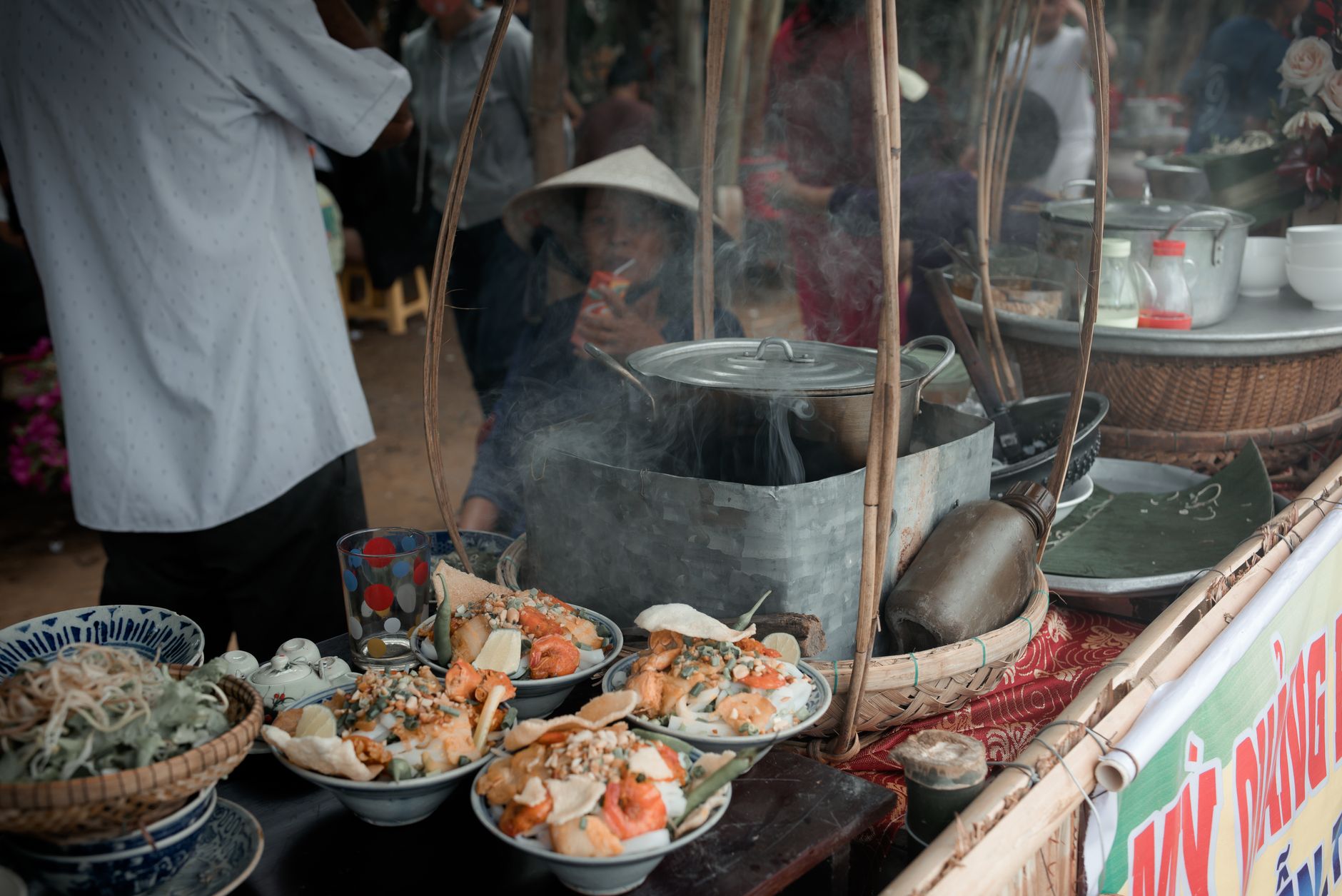
Vietnam's food changes dramatically from north to south. The north uses light broths and black pepper. The center favors spice and imperial sophistication. The south adds sugar, coconut milk, and fresh herbs. This two-week itinerary follows that progression, giving each region the days it deserves.
What you need to know before you go
The best time for a food-focused trip is October to April. The dry season means fewer weather disruptions and better produce. Avoid July-September when rain floods street stalls and reduces ingredient quality. Central Vietnam floods heavily October-November, which can limit access to Hue and Hoi An.
Geography affects ingredients. The north's cooler climate produces lighter broths and heartier vegetables. The center's narrow coastline delivers the country's best seafood. The south's tropical climate means year-round herbs, fruits, and sweeter flavors.
Stomach adjustment takes 2-3 days. Start with cooked foods like pho and com tam. Introduce raw herbs and vegetables gradually. Ice in Vietnam is industrially produced and generally safe. Drink bottled water, not tap water.
Eat at stalls with high turnover where locals queue. Avoid restaurants with English menus and pictures. The best food is at stalls without English signage.
How this food itinerary works
Starting in Hanoi makes culinary sense. The north's subtle flavors build a baseline for understanding how Vietnamese food evolves as you travel south. Flavors get bolder, sweeter, and more complex with each stop.
Skipping central Vietnam means missing the country's most distinctive cuisine. Hue's imperial dishes and Hoi An's trading port noodles have no equivalents elsewhere. This itinerary includes both.
Here is the day-by-day overview:
| Day | City | Signature dish | Meal type | Estimated cost (VND) |
|---|---|---|---|---|
| 1-3 | Hanoi | Pho bo, bun cha, cha ca | Breakfast, lunch, dinner | 30,000-150,000 per dish |
| 4-5 | Ninh Binh | De (goat), com chay | Lunch, dinner | 50,000-200,000 per dish |
| 6-7 | Hue | Bun bo Hue, banh beo | Breakfast, lunch, dinner | 20,000-100,000 per dish |
| 8-9 | Hoi An | Cao lau, banh mi, white rose | Breakfast, lunch, dinner | 15,000-50,000 per dish |
| 10-11 | Da Nang | Mi quang, banh xeo, seafood | Lunch, dinner | 30,000-200,000 per dish |
| 12-13 | Ho Chi Minh City | Com tam, hu tieu, goi cuon | Breakfast, lunch, dinner | 20,000-80,000 per dish |
| 14 | Departure | Last meals near airport | Breakfast, lunch | 30,000-100,000 per dish |
The eating rhythm is realistic: one major meal, one street snack, and one exploration window per day. Do not try to eat five full meals daily. Quality over quantity applies here.
Day 1-3: Hanoi — The noodle capital
Hanoi's signature dishes rarely travel well south. Pho broth in Saigon is sweeter and cloudier. Bun cha in Hoi An uses different marinades. Eat these dishes in Hanoi or miss their original form.
Pho: Hanoi's claim to culinary fame
Hanoi's pho bo (beef pho) is the benchmark. The broth is clear, light, and simmered for hours with beef bones, charred onion, ginger, and star anise. It is served with fresh herbs, lime, and chili. Do not add hoisin sauce or sriracha. Hanoi purists consider that a crime.
Pro tip: Eat pho for breakfast. Most Hanoi locals eat pho between 6-9 AM when the broth is freshest. Stalls like Pho Thin on Lo Duc and Pho Gia Truyen on Bat Dan are legendary for a reason.
Bun cha: The dish that won Anthony Bourdain
Bun cha is grilled pork patties and belly served in a sweet-savory dipping broth with cold rice noodles and fresh herbs. President Obama ate it with Bourdain at Bun Cha Huong Lien on Le Van Huu Street. The restaurant now has a "Obama combo" on the menu. The food is still excellent.
Eat bun cha for lunch. The charcoal grills fire up around 10 AM and the pork is best when freshly grilled.
Cha ca La Vong: A one-dish institution
Cha ca is turmeric-marinated fish fillets grilled at your table with dill and green onion. It is served with rice noodles, peanuts, and shrimp paste. Cha Ca La Vong on Cha Ca Street has served only this dish since 1871.
Warning: Cha Ca La Vong restaurant is expensive by street food standards at 200,000 VND ($8) per portion. It is worth the price for the experience. Budget accordingly.
Breakfast options: Banh cuon and xoi
Banh cuon are steamed rice rolls filled with minced pork and wood ear mushrooms, topped with fried shallots and served with fish sauce. Xoi is sticky rice with toppings like mung bean, shredded chicken, or pork floss. Both are quick, cheap, and filling breakfast options.
Day 4-5: Hanoi to Ninh Binh — Goat and mountain rice
Ninh Binh is a two-hour drive or train ride south of Hanoi. It is famous for limestone karsts and river caves. For food travelers, it is famous for mountain goat dishes and com chay.
De (goat) specialties
Ninh Binh's goats graze on limestone mountains, giving their meat a lean, gamey flavor. De tai chanh is raw goat meat sliced thin and served with lime, lemon leaves, and peanuts. De nuong is grilled goat with lemongrass and chili. De xao lan is stir-fried goat with turmeric and dill.
Eat goat at a restaurant near Tam Coc or Trang An. Locals recommend Co Ba or Thuy Linh.
Com chay: Burnt rice as a delicacy
Com chay is the crispy rice crust that forms at the bottom of the cooking pot. In Ninh Binh, it is fried until golden and served with pork belly, shrimp, or as a side dish. The texture is crunchy on the outside, chewy on the inside.
Regional freshwater seafood
Ninh Binh's rivers and rice paddies produce freshwater shrimp, crab, and snail. Oc (snails) are stir-fried with coconut milk and lemongrass. They are an acquired taste but worth trying.
Day 6-7: Hue — The imperial kitchen
Hue's cuisine is the most sophisticated in Vietnam. It was developed for the Nguyen emperors who ruled from the Imperial City. Dishes are small, colorful, and precisely balanced.
Bun bo Hue: The south's answer to pho
Bun bo Hue is a spicy beef noodle soup with a deep red broth from annatto seeds and lemongrass. It includes slices of beef shank, pork knuckle, and cubes of congealed pig blood. The heat comes from chili oil and satay.
Pro tip: Bun bo Hue is a breakfast dish in Hue. Eat it at stalls on Nguyen Hue Street or at Bun Bo Hue Me Keo. Do not order it in Hanoi or Saigon. It will not taste the same.
Royal cuisine and banh beo
Banh beo are tiny steamed rice cakes topped with minced shrimp, crispy pork skin, and scallion oil. They are served in small ceramic dishes, usually 5-10 per order. Other royal dishes include banh nam (flat steamed rice cake with shrimp) and banh loc (tapioca dumplings with shrimp and pork).
Vegetarian Hue: A legacy of Buddhist emperors
Several Nguyen emperors were devout Buddhists. This created a strong vegetarian tradition in Hue. Look for "com chay" (vegetarian rice) restaurants. Dishes use tofu, mushrooms, and vegetables to mimic meat textures. The flavors are complex and satisfying.
Warning: Many "vegetarian" dishes in Vietnam use fish sauce. Ask for "khong mam" (no fish sauce) to ensure the dish is truly vegetarian.
Day 8-9: Hoi An — The noodle town
Hoi An's food reflects its history as a trading port. Chinese, Japanese, and European influences mix with local ingredients.
Cao lau: The noodle that can only be made here
Cao lau is thick, chewy noodles made with water from the ancient Ba Le well. The noodles are topped with sliced pork, fresh herbs, bean sprouts, and crispy rice crackers. The broth is dark and savory but served in small quantity.
Legend says cao lau can only be made with water from Hoi An's wells. The noodles taste different outside the town.
Banh mi: Hoi An's version versus Saigon's
Banh mi Phuong is the most famous banh mi in Vietnam. Anthony Bourdain ate there. The bread is lighter and crispier than Saigon's version. Fillings include grilled pork, pate, cold cuts, pickled vegetables, and fresh herbs. It costs 20,000-30,000 VND ($0.80-$1.20).
Saigon's banh mi is denser and uses more pate. Both are excellent. Try both and decide which you prefer.
White rose dumplings and fried wontons
White rose dumplings (banh vac) are shrimp dumplings shaped like roses, made from translucent rice paper. Fried wontons are wonton wrappers topped with shrimp, tomato, and onion sauce. Both are Hoi An specialties.
Day 10-11: Da Nang and the central coast
Da Nang is 30 minutes north of Hoi An. Its seafood scene is considered the country's best.
Mi quang: Central Vietnam's signature noodle
Mi quang is wide rice noodles in a small amount of turmeric-colored broth. Toppings include shrimp, pork, quail eggs, peanuts, and sesame rice crackers. It is served with fresh herbs and lettuce.
Eat mi quang for lunch. Stalls on Hoang Dieu Street serve excellent versions.
Banh xeo and fresh rice paper
Banh xeo are crispy pancakes filled with shrimp, pork, and bean sprouts. They are eaten by wrapping pieces in lettuce with fresh herbs and dipping in fish sauce. Da Nang's version is larger and crispier than Saigon's.
Seafood along My Khe Beach
My Khe Beach has dozens of seafood restaurants. Choose stalls where locals eat. Grilled scallops with onion and peanuts, steamed clams with lemongrass, and fried squid with salt and pepper are reliable choices.
Pro tip: Check the price before ordering. Some seafood restaurants charge market rates. Others overcharge tourists. Ask to see the price list.
Day 12-13: Ho Chi Minh City — The southern melting pot
Saigon's food culture is sweeter, bolder, and more diverse than Hanoi's. The city's history as a trading hub means Chinese, Khmer, and French influences are everywhere.
Com tam: Saigon's everyday staple
Com tam is broken rice with grilled pork chops, shredded pork skin, steamed egg meatloaf, and pickled vegetables. It is served with fish sauce and scallion oil. Eat it for breakfast or lunch.
Try com tam at Com Tam Bui on Pham Viet Chanh Street or Com Tam Moc on Ly Thuong Kiet Street.
Hu tieu: The Chinese-Vietnamese crossover
Hu tieu is a pork and seafood noodle soup with clear broth. It originated with Chinese immigrants in Cholon, Saigon's Chinatown. The noodles are thin and chewy. Toppings include shrimp, squid, pork liver, and quail eggs.
Hu tieu is lighter than pho but more complex. It is a breakfast dish in Saigon.
Goi cuon versus cha gio: Fresh versus fried
Goi cuon are fresh spring rolls with shrimp, pork, rice noodles, and herbs wrapped in rice paper. They are served with hoisin-peanut dipping sauce. Cha gio are fried spring rolls filled with pork, mushroom, and glass noodles.
Both are essential Saigon snacks. Eat goi cuon for a light meal. Eat cha gio as a starter.
Cholon: Eating in Saigon's Chinatown
Cholon is Saigon's Chinatown. The food here is distinctly Chinese-Vietnamese. Try dim sum at Trieu Chau restaurants, roasted duck, and banh bao (steamed buns). The night market on Hai Thuong Lan Ong Street is excellent for street food.
Day 14: Departure day eating
Tan Son Nhat airport has decent food options. For a last meal near the airport, try Banh Mi Huynh Hoa in District 1 or Pho Hoa on Pasteur Street. Both are within 15 minutes of the airport.
Edible souvenirs include Vietnamese coffee (whole bean or ground), fish sauce from Phu Quoc, rice paper, dried noodles, and spices like cinnamon and star anise. Pho kits sold at airports make good gifts but cost 3x the local market price.
Warning: Do not buy fresh herbs or meats for travel. Customs will confiscate them. Pack coffee and spices in checked luggage.
What to drink along the way
Vietnam's coffee culture is essential to the food experience.
| Drink | Region | Where to find it | Price range (VND) |
|---|---|---|---|
| Egg coffee (ca phe trung) | Hanoi | Cafe Giang, Cafe Dinh | 35,000-50,000 |
| Coconut coffee | South | Cong Caphe, Saigon | 35,000-55,000 |
| Iced milk coffee (ca phe sua da) | Everywhere | Any street stall | 15,000-25,000 |
| Fresh sugarcane juice | Everywhere | Street carts | 5,000-15,000 |
| Bia hoi (fresh beer) | Hanoi | Bia hoi corner on Ta Hien Street | 5,000-10,000 per glass |
Drink the tea. Vietnamese green tea is served at most restaurants for free. It aids digestion and cleanses the palate.
Practical food safety and etiquette
Ice is typically industrially produced and safe. Look for cylindrical ice with a hole in the middle. That is factory-made ice. Avoid crushed ice from unknown sources.
Use chopsticks and a spoon. Vietnamese food is eaten with chopsticks for noodles and a spoon for soup. Do not stick chopsticks upright in a bowl of rice. It resembles incense sticks at funerals.
Spice levels vary. Northern food uses black pepper. Central food uses chili. Southern food uses sugar and chili. Ask for "it cay" (less spicy) if you have a low tolerance.
Pro tip: Carry tissue paper. Many street stalls do not provide napkins. Wet wipes are also useful for sticky fingers.
Budget breakdown for two weeks of eating
| City | Street food per dish | Mid-range per dish | Fine dining per dish |
|---|---|---|---|
| Hanoi | 30,000-50,000 VND | 100,000-200,000 VND | 500,000+ VND |
| Ninh Binh | 30,000-50,000 VND | 80,000-150,000 VND | 300,000+ VND |
| Hue | 20,000-40,000 VND | 80,000-150,000 VND | 400,000+ VND |
| Hoi An | 15,000-30,000 VND | 80,000-150,000 VND | 350,000+ VND |
| Da Nang | 30,000-50,000 VND | 100,000-200,000 VND | 500,000+ VND |
| Ho Chi Minh City | 20,000-40,000 VND | 80,000-150,000 VND | 400,000+ VND |
Budget 200,000-300,000 VND ($8-$12) per day for generous street food eating. Mid-range dining costs 400,000-600,000 VND ($16-$24) per day. Fine dining costs 1,000,000+ VND ($40+) per meal.
Frequently asked questions about eating across Vietnam
Q: Can you do Hanoi to Ho Chi Minh City in 2 weeks? A: Yes, but only if you focus on food rather than sightseeing. The north-south train takes 30+ hours, so fly between major cities to maximize eating time. Budget 3 days each for Hanoi and Saigon, 2 days each for Hue and Hoi An, with travel days in between.
Q: Is $1000 enough for 2 weeks in Vietnam? A: For food alone, yes. Street food costs 15,000-50,000 VND ($0.60-$2) per dish. Budget 200,000-300,000 VND ($8-$12) per day for generous eating. The $1000 figure becomes tight when including accommodation, transport, and activities.
Q: What is the biggest mistake tourists make with Vietnamese food? A: Eating only pho and banh mi. Vietnam has dozens of regional noodle soups, rice dishes, and street snacks that never appear on tourist menus. The second mistake is eating at restaurants with English menus and pictures. The best food is at stalls without English signage.
Q: Is street food safe in Vietnam? A: Generally yes, with precautions. Eat at stalls with high turnover where locals queue. Avoid raw vegetables unless you see them washed in filtered water. Ice is typically industrially produced and safe. Stomach adjustment takes 2-3 days. Start with cooked foods and introduce raw elements gradually.
Q: What's famous to buy in Vietnam for food lovers? A: Vietnamese coffee (whole bean or ground), fish sauce from Phu Quoc, rice paper, dried noodles, spices (cinnamon, star anise), and green tea. Avoid buying fresh herbs or meats for travel. Pho kits sold at airports make good gifts but cost 3x the local market price.
Q: Can vegetarians eat well on this route? A: Yes, especially in Hue, which has a strong Buddhist vegetarian tradition. Look for "com chay" (vegetarian rice) restaurants. Hanoi and Saigon have growing vegan scenes. However, many "vegetarian" dishes use fish sauce. Ask for "khong mam" (no fish sauce).
Q: What is the best time of year for a food trip? A: October to April. The dry season means fewer weather disruptions and better produce. Avoid July-September when rain floods street stalls and reduces ingredient quality. Central Vietnam floods heavily October-November, which can limit access to Hue and Hoi An.
Q: Should I eat at tourist food tours or independently? A: Independent eating gives better value and authenticity. Food tours cost $30-$60 per person for dishes that cost $2-$3 total. However, a single guided morning market walk can teach you ingredient identification and ordering phrases that pay off for the rest of the trip.