This guide covers the history of the site, what you actually see there, how to get there, how much time to allow, and why some travelers leave disappointed. No filter.
What the Từ Hiếu pagoda really is
Từ Hiếu means "filial piety". The name is not decorative. The pagoda was founded in 1843 by the monk Thích Nhất Định, on the orders of Emperor Thiệu Trị, to honor the memory of his mother. Originally, it was a small hermitage in a pine forest, away from the imperial citadel.
Three years later, in 1848, the monk welcomed an unusual group: eunuchs of the court, set aside after the death of their protector. They came there to end their days, and some are buried there. Their tombs, lined up in a garden at the back of the site, form one of the rare eunuch burial complexes visible in Vietnam. It is a detail that most visitors completely overlook.
The pagoda then went through the wars, the French occupation, the American war, reunification. It was restored several times, notably in 1896 and in 1933. But its soul is above all tied to one man: the Zen master Thích Nhất Hạnh.
He entered the monastery in 1942, at the age of 16. He was ordained a novice monk there, studied there, returned during the war to found a school of young engaged Buddhists. In 1966, he went into exile. He only returned to Vietnam in 2005, then in 2018, to end his days at Từ Hiếu. He died there on January 22, 2022, at the age of 95. His room remains as it was. His tomb, sober, is in the garden.
To understand what this place represents for modern Vietnamese Buddhism, you need to read the broader context of Buddhism and pagodas in Vietnam.
What you see, in the order of the visit
The gate and the alley
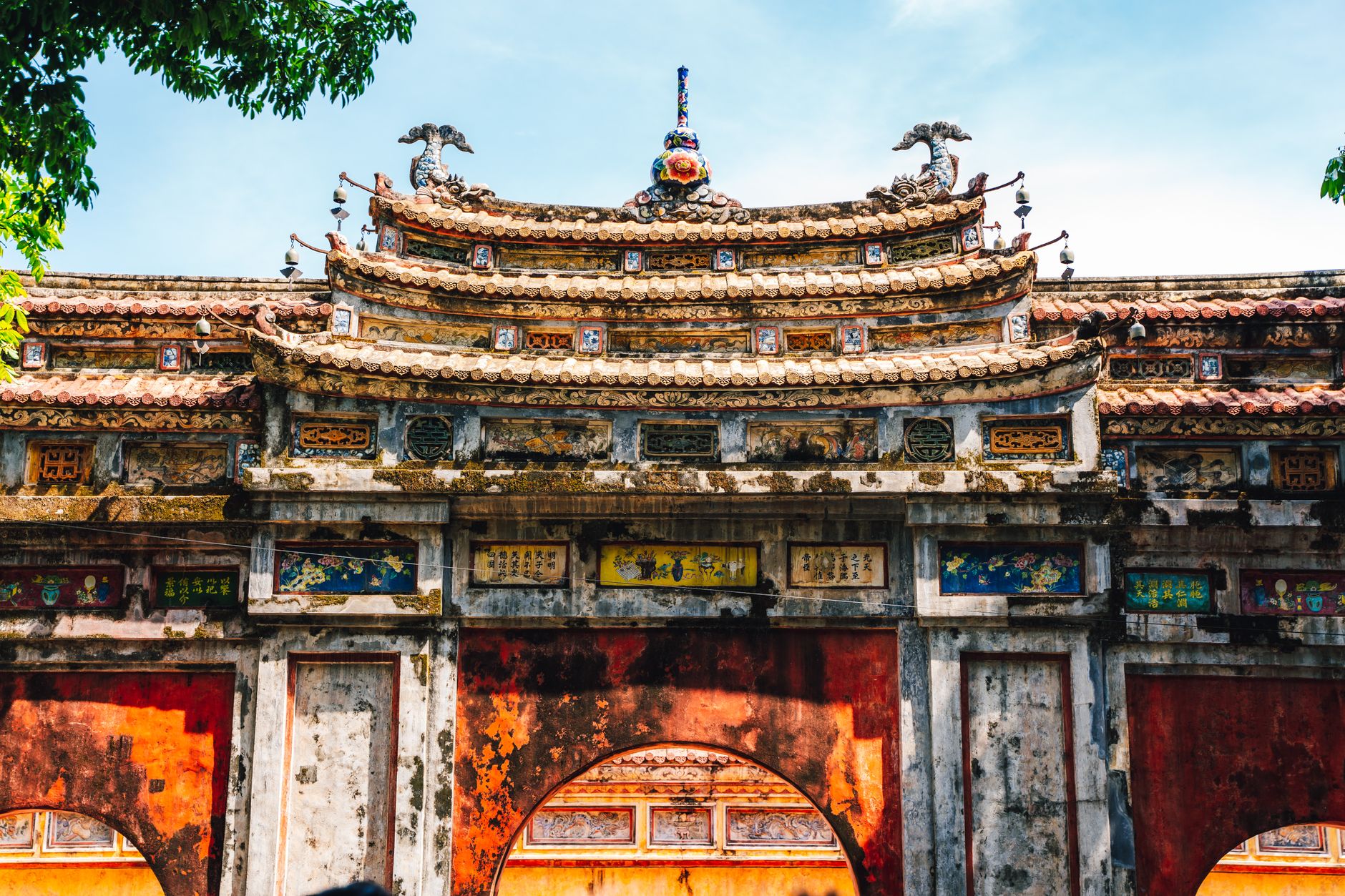
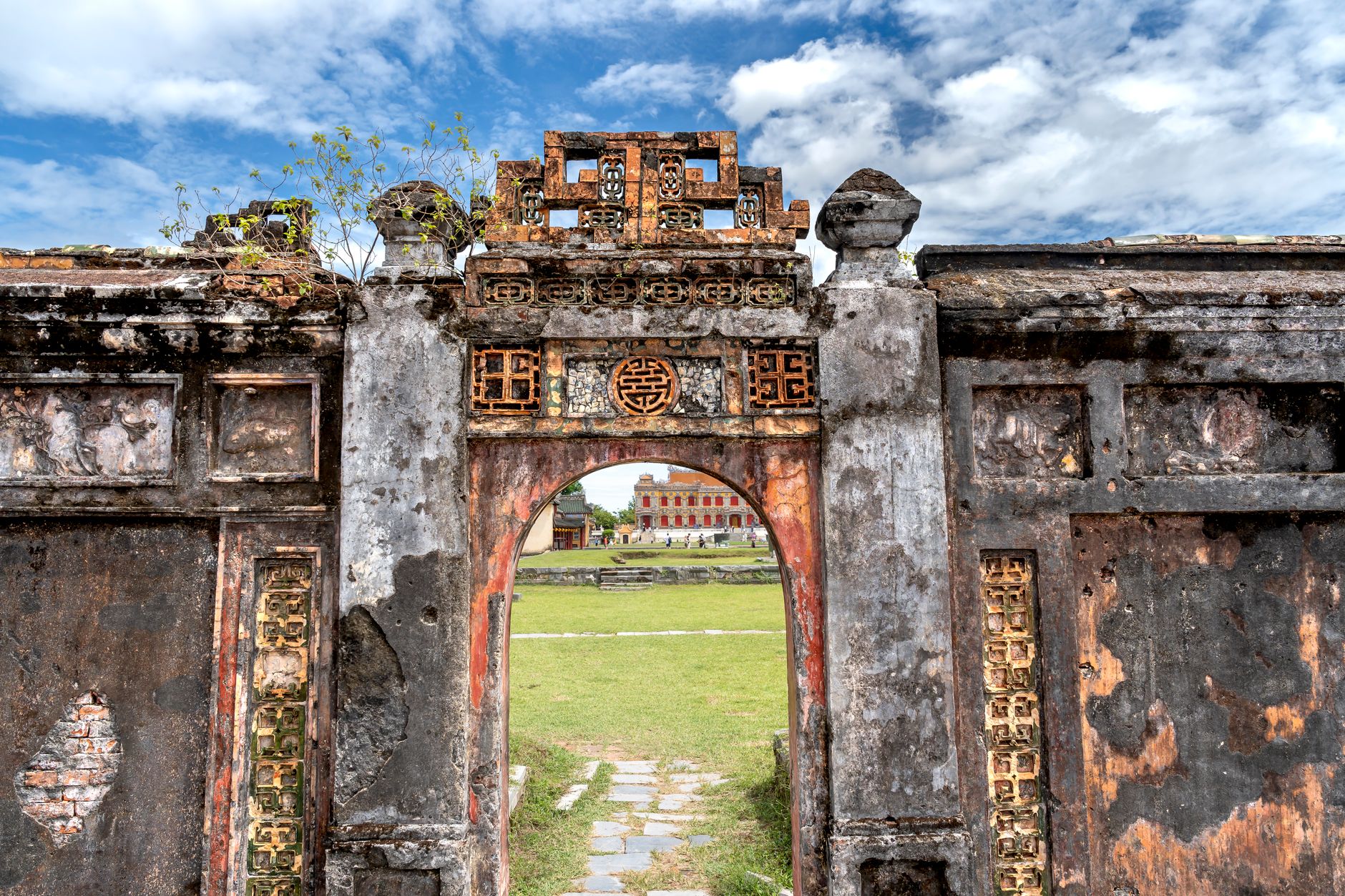
You enter through a low triple gate, preceded by a small bridge over a pond covered with lotus. The walls are ochre, weathered by the monsoon. No crowds, no ticket sellers. You are already somewhere else.
The central alley crosses a garden of pines and frangipanis. On the left, a small pavilion houses a bronze bell cast in 1843, the year of the foundation. The sound of this bell, struck at 5 a.m., can be heard as far as the neighboring rice fields.
The main hall
The main chamber houses a bronze Buddha Amitabha, surrounded by two bodhisattvas. The light there is low. Incense sticks burn continuously. The floor is red terracotta, worn by decades of footsteps.
The main hall is an active place of worship, not a museum. Do not photograph the faithful in prayer, even from behind.
The garden of tombs
At the back, behind the meditation hall, a discreet garden houses about twenty tombs. These are those of the court eunuchs, who died between 1848 and the end of the 19th century. The steles bear inscriptions in chữ Hán. Few visitors venture there. It is nevertheless the most singular part of the site.
The room of Thích Nhất Hạnh
A small room set apart, sober, with his wooden bed, his books, his bowl. It is not open to the public on a permanent basis. When it is, you enter in silence, without shoes, without a camera.
The meditation hall and the bamboo garden
To the right of the courtyard, a hall hosts meditation retreats. The bamboo garden that surrounds it is the calmest place on the site. It is there that you understand why generations of monks chose this place.
How to get there from the center of Huế
The pagoda is located at 1 đường Hương Thủy, in the Thủy Bằng neighborhood, about 5 km southwest of the city center. It is on the road that leads to the imperial tombs.
| Mode | Duration | Indicative price 2026 | Where to find it |
|---|---|---|---|
| Grab car | 15 to 20 min | 50,000 to 70,000 VND (2 to 2.60 €) | App, anywhere in Huế |
| Grab motorbike | 12 to 18 min | 25,000 to 35,000 VND (1 to 1.30 €) | App |
| Mai Linh taxi | 15 to 20 min | 70,000 to 90,000 VND (2.60 to 3.40 €) | Call or station |
| Bicycle | 25 to 35 min | Rental 50,000 VND/day (1.90 €) | Hotels and agencies in the center |
| Car with driver | 15 to 20 min | 400,000 to 600,000 VND/day (15 to 22 €) | Local agencies |
For a detailed comparison of transport options throughout the country, see the guide on taxis in Vietnam.
Many Grab drivers offer to wait and continue to the tomb of Tự Đức for 100,000 to 150,000 VND extra. This is often more convenient than ordering a new ride in this rural area.
Hours, prices and rules
Entry is free. It is an active pagoda, not a paid tourist site. The official hours are from 6 a.m. to 6 p.m., but they vary depending on the seasons and the retreats. In 2026, the last on-site check confirmed these hours, but it is better to call or check with your accommodation on the day itself.
There is no ticket, no counter, no souvenir shop. A small donation urn is located near the main hall.
Dress code: shoulders and knees covered. No hat inside the buildings. Shoes removed at the entrance of the worship halls. This is the same rule as in all the temples of the country, detailed in the guide to the dress code in Vietnam.
Photography: allowed in the gardens and outdoor courtyards. Prohibited in the main hall and the meditation hall. Never photograph the monks without their explicit consent.
Closures: the pagoda may close to the public during meditation retreats, generally in January and in July. Find out before you travel.
What sets Từ Hiếu apart from the other sites of Huế
Huế has dozens of pagodas. The best known is the Thiên Mụ pagoda, with its seven-story tower on the bank of the Perfume River. It is more photogenic, more frequented, more "monumental". Từ Hiếu is the opposite: discreet, alive, without staging.
| Criterion | Từ Hiếu | Thiên Mụ |
|---|---|---|
| Entry | Free | Free |
| Crowds | Low to moderate | High |
| Atmosphere | Active monastery, silent | Tourist site |
| Main interest | Spiritual history, eunuch tombs | Architecture, view of the river |
| Visit time | 45 min to 1h30 | 30 to 45 min |
| Access from the center | 5 km, Grab | 5 km, boat or Grab |
Compared to the imperial tombs, Từ Hiếu has neither the scale nor the ornamentation. It does not try to compete. Its interest is elsewhere: in what it represents for contemporary Vietnamese Buddhism, and in what it offers to those seeking a moment of real calm.
Who will love it, who risks being disappointed
Will love it: travelers interested in Buddhism, the contemporary history of Vietnam, meditation. Those seeking an authentic place, without crowds. Those who have read Thích Nhất Hạnh or want to understand his legacy. Patient photographers, ready to wait for the right light.
Risk being disappointed: those seeking a spectacular monument, gilding, French-style gardens, audio guides. There is none of that. The pagoda is modest, sometimes even a little neglected. The buildings are old and not restored to new. If you have three days in Huế and are looking to check boxes, this may not be the priority.
The honest verdict: Từ Hiếu is worth the detour if you have already seen the Citadel and at least one imperial tomb. It does not deserve a special trip if your time in Huế is less than two days.
Insider tips
The best time: early in the morning, between 5 a.m. and 7 a.m. The bell ceremony and the meditation begin around 5 a.m. The monks chant, the light is soft, the temperature pleasant. It is also the moment when the site is most alive, and the least frequented by tourists.
The best season: from February to April. This is the dry period in Huế, before the great heat of May to August and the rains of October to December. To understand how the monsoon affects the region, see the guide to the rainy season in Vietnam.
What most visitors miss: the garden of the eunuchs' tombs, at the back. Few people know it exists. You have to go around the meditation hall on the right and look for a small path.
How to avoid the crowds: there is practically never a crowd. Organized groups do not stop here. The only time the site fills up a little is on the weekend, around 9-10 a.m., when families from Huế come to make offerings.
Where to position yourself: in the bamboo garden, to the right of the main courtyard. It is the calmest spot, with stone benches in the shade.
To combine in the surroundings
The Từ Hiếu pagoda is on the axis of the imperial tombs. In half a day, you can chain together:
- Tomb of Tự Đức: 2 km away, one of the most beautiful in Huế, with its gardens and its pond. Entry 150,000 VND (5.70 €).
- Tomb of Minh Mạng: 7 km away, wilder, more architectural. Entry 150,000 VND (5.70 €).
- Tomb of Khải Định: 10 km away, more recent, a mix of Vietnamese and European styles. Entry 150,000 VND (5.70 €).
- Vọng Cảnh hill: 3 km away, viewpoint over the Perfume River.
- Village of Thủy Bằng: around the pagoda, a rural village with rice fields and garden houses.
To organize a full day around these sites, see the guide to things to do in Huế.
Where to eat and where to sleep
The pagoda has no restaurant. The closest options are in the center of Huế, 15 minutes away by Grab. The culinary scene of Huế is worth the trip on its own, with bún bò Huế and the imperial dishes. For an overview, see the guide to the food scene of Huế.
For accommodation, most travelers stay in the Phú Hội neighborhood, south of the Perfume River, 5 km from the pagoda. Options range from hostels at 150,000 VND (5.70 €) per night to charming hotels at 1,500,000 VND (57 €). The guide to accommodation in Huế details the neighborhoods by budget.
FAQ
Q: Is the Từ Hiếu pagoda open every day? Yes, in principle from 6 a.m. to 6 p.m. But it may close to the public during meditation retreats, generally in January and in July. Check with your accommodation before you travel.
Q: Do you have to pay an entry ticket? No. Entry is free. A donation urn is located near the main hall. No counter, no shop.
Q: How much time should you allow on site? Allow 45 minutes for a quick visit, 1h30 if you want to sit in the garden and observe. If you attend the morning meditation, allow 2 hours.
Q: Can you attend the meditation? Yes, but you must arrive before 5 a.m. and remain discreet. Women must wear clothing covering the shoulders and knees. Cameras stay put away.
Q: How to get there without Grab? By Mai Linh taxi (70,000 to 90,000 VND from the center), by bicycle (25 to 35 minutes), or by car with driver for the day (400,000 to 600,000 VND). Local buses pass on the main road, about 500 m from the entrance.
Q: Is the pagoda accessible to people with reduced mobility? Partially. The courtyards and the main garden are on one level, but the worship halls have steps and thresholds. The garden of the tombs is on uneven ground.
Q: What to do if you have little time in Huế? If you have only one day, prioritize the Citadel and one imperial tomb. If you have two days, add Từ Hiếu on the morning of the second day, before the tomb of Tự Đức. To plan according to the weather and the festival calendar, see the guide to the best time to visit Huế.