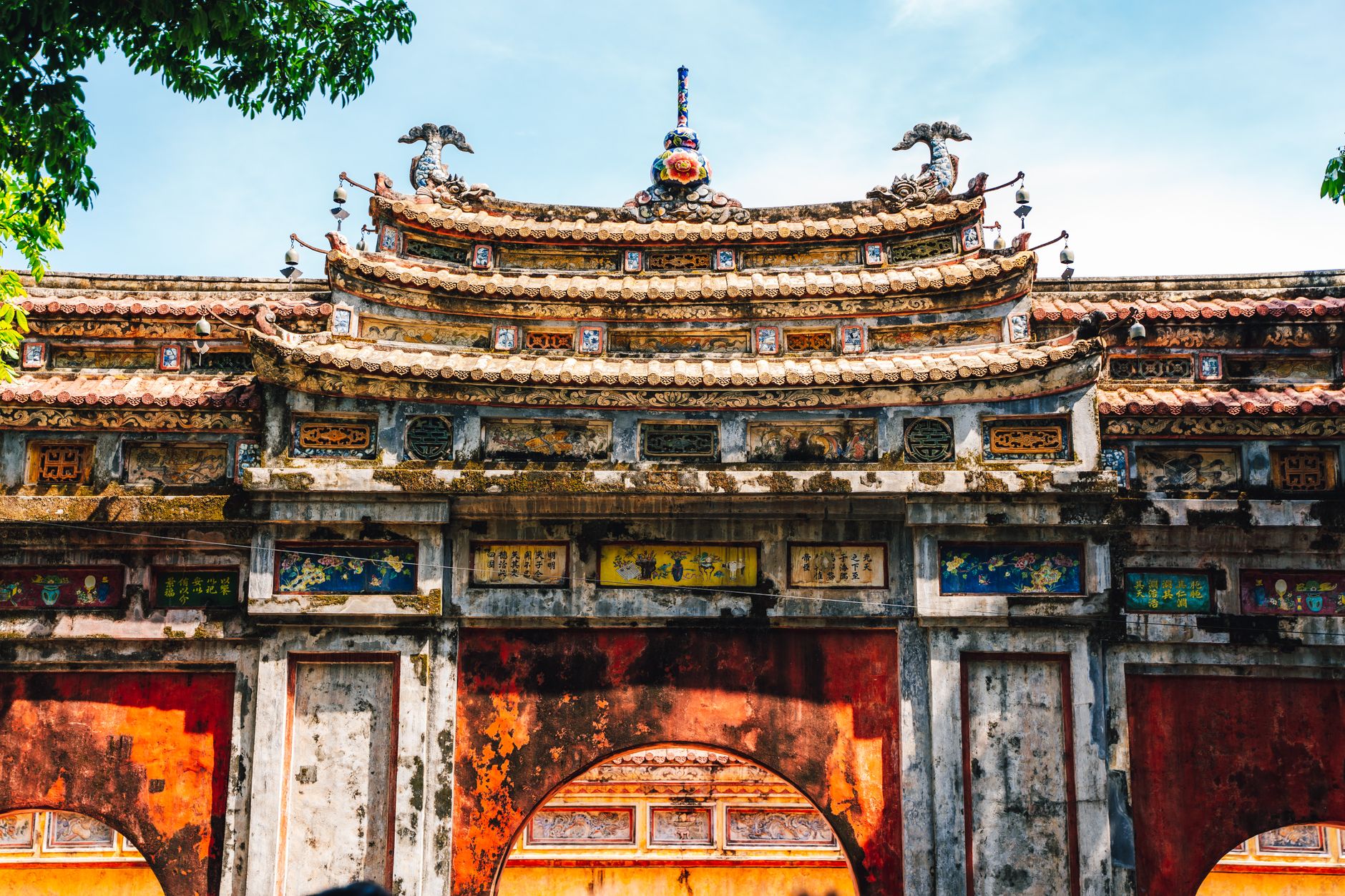
They are right. Hue was the imperial capital of Vietnam's Nguyen dynasty from 1802 to 1945, and that history shaped the kitchen. Royal chefs developed elaborate dishes for the court, and when the dynasty fell, those recipes spread to the city's home cooks and street vendors. Today Hue has both a street food culture and a surviving haute cuisine tradition, often served in the same meal.
This guide covers what to eat, where to eat it, and how to order without confusion. It focuses on the dishes that matter, the places locals actually go, and the practical details that make the difference between a good meal and a great one.
Bun bo Hue: the city's signature bowl
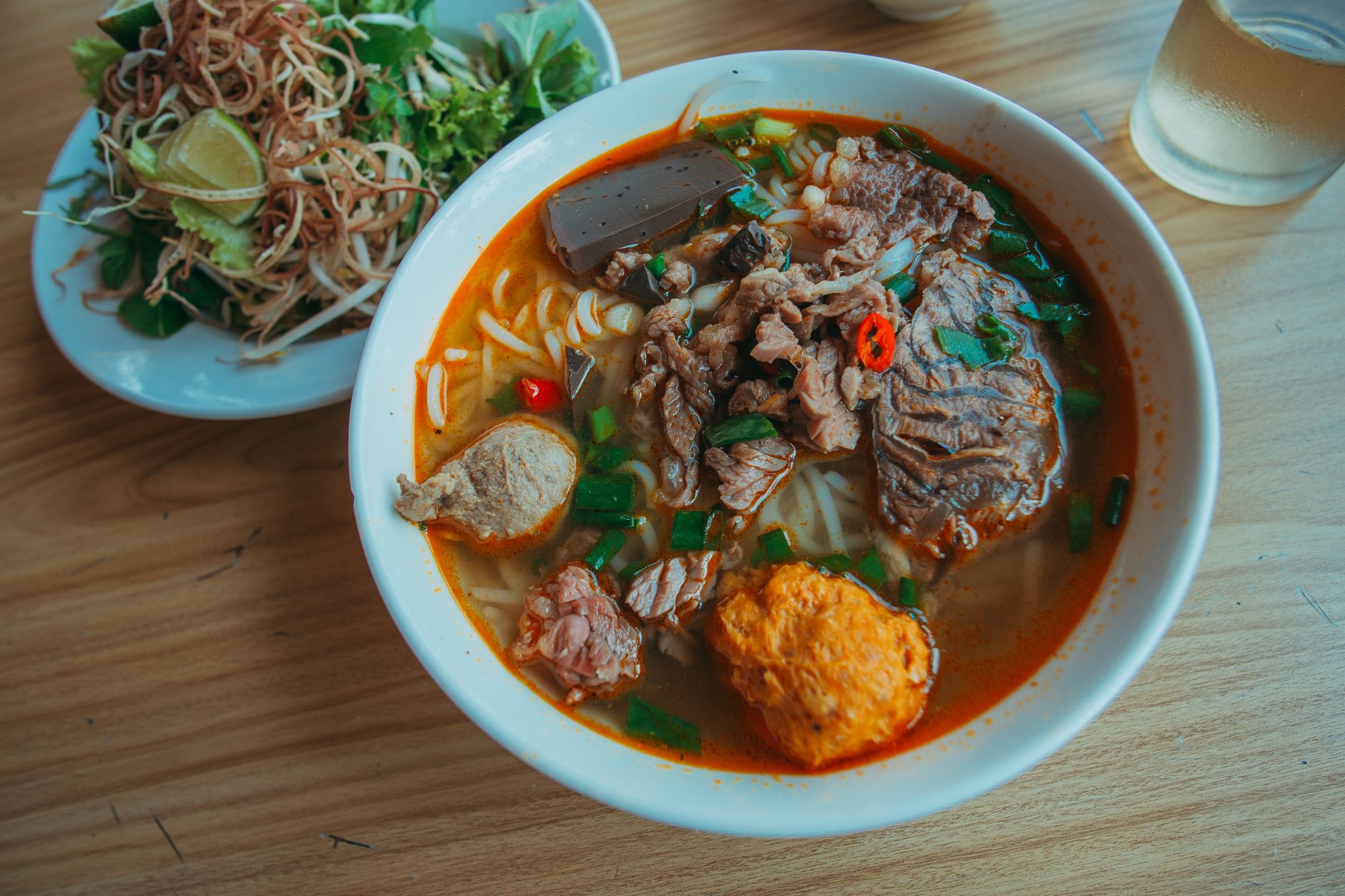
Bun bo Hue is the dish that put this city on the food map. It is a beef noodle soup, but it shares little with pho. The broth is darker, richer, and noticeably spicy. It gets its color and depth from lemongrass, annatto seeds, and a generous amount of fermented shrimp paste (mam ruoc). The noodles are thick round rice vermicelli, not the flat sheets used in pho. And the bowl usually arrives with slices of beef shank, chunks of oxtail, and sometimes cubes of congealed pork blood.
The spice level varies by vendor. Some places serve it mild, with chili paste on the side. Others build the heat directly into the broth. First-timers should ask for "it" (less spicy) or simply order and adjust with the lime, chili, and fresh herbs served on the side.
A proper bowl costs between 40,000 and 60,000 VND ($1.60 to $2.40). The best vendors are morning operations, often sold out by 10 a.m. A few notable addresses:
- Madam Thu (Bun Bo Hue Madam Thu): 3 Nguyen Du Street. The most famous bowl in town, consistently good, open from early morning until mid-afternoon. Expect a queue.
- Bun Bo Hue Hong Mai: 112 Dinh Tien Hoang Street. A local favorite with a slightly sweeter broth and generous portions of beef.
- Bun Bo Hue O Xao: 34 Nguyen Binh Khiem Street. Smaller portions but a deeper, more intense broth. Good for a second bowl if you are still hungry.
The key to eating bun bo Hue well is timing. Go early. The broth is freshest in the morning, and the best cuts of beef go first. By noon, most quality vendors have reduced their menu or closed entirely.
Pro tip: bun bo Hue is served with a side plate of raw vegetables, usually banana flower, shredded cabbage, and herbs. Tear them into the bowl as you eat. The crunch against the rich broth is part of the experience.
Imperial cuisine: the dishes that survived the court
Bun bo Hue is street food. Imperial cuisine is something else entirely. These are the dishes that Nguyen dynasty chefs created for the royal family, and they follow different rules: smaller portions, more intricate preparation, and an emphasis on visual presentation alongside flavor.
The most famous imperial dishes include:
- Banh khoai: a small, crispy pancake folded over a filling of shrimp, pork, and bean sprouts. Eaten with a thick peanut-based dipping sauce and fresh herbs. Not to be confused with banh xeo, which is larger and thinner.
- Banh beo: tiny steamed rice cakes topped with minced shrimp and crispy shallots, served in small ceramic bowls with fish sauce. The texture is soft, almost jelly-like. Usually eaten in one bite.
- Banh nam: a flat, steamed rice dumpling wrapped in banana leaf, filled with shrimp and pork. More substantial than banh beo, with a firmer texture.
- Banh bot loc: translucent tapioca dumplings filled with shrimp and pork, served with sweet fish sauce. Chewy, slippery, and deeply satisfying.
- Com hen: baby mussels served over cold rice with herbs, peanuts, and a complex fish sauce dressing. This was originally a poor person's dish, but it became a Hue classic because of the layering of flavors.
- Tom chua: fermented sour shrimp, often served as a side dish or appetizer. Sharp, salty, and unlike anything else in Vietnamese cuisine.
These dishes appear on menus across Hue, but the quality varies enormously. The best way to try them is to find a restaurant that specializes in them, rather than ordering them at random.
Lac Thien Restaurant (6 Dinh Tien Hoang Street) is the most famous address for imperial-style dishes. It is a family-run operation that has been serving banh khoai and nem lui (grilled pork skewers wrapped in rice paper) for decades. The space is basic, the service is brisk, and the food is excellent. Order the banh khoai and the nem lui and you will understand why people travel here to eat.
Y Thao Garden (3/5 Le Thanh Ton Street) is a more upscale option, set in a traditional garden house. The menu is broader, with several set menus that include multiple imperial dishes. Prices run 200,000 to 400,000 VND ($8 to $16) per person, which is steep by Hue standards but reasonable for the quality and setting.
Tinh Gia Vien (12/34 Nguyen Cong Tru Street) is another garden house restaurant, slightly less formal than Y Thao. The banh beo here is particularly good, and the staff can explain each dish in basic English. This is a solid choice for first-timers who want guidance.
Pro tip: imperial dishes are designed to be eaten in sequence, not all at once. If you order a set menu, pace yourself. The lighter dishes come first, the heavier ones later. Rushing through them misses the point.
Dong Ba Market: the one-stop food crawl
Dong Ba Market sits at the eastern end of Trang Tien Bridge, on the north bank of the Perfume River. It is the largest market in Hue, and its food section is the most efficient way to sample the city's specialties in a single visit.
The market is chaotic. Vendors call out, scooters weave through the aisles, and the smell of grilled meat mixes with the scent of fresh herbs. That chaos is part of the experience. Push through it.
The food stalls are concentrated in the eastern section, near the river side of the building. Most specialize in one or two dishes. Look for:
- Banh khoai stalls: usually two or three women working a large griddle, frying pancakes to order. The best ones are busy. If there is a queue, join it.
- Banh beo and banh nam stalls: these are often combined, with stacked bamboo steamers behind the counter.
- Com hen stalls: look for the bowls of pale pink mussels, mixed with herbs and peanuts.
- Che: Hue's sweet dessert soups, served cold or warm depending on the variety. The corn and bean versions are the most common.
Prices at Dong Ba are slightly higher than street stalls elsewhere in the city, but still cheap. Most dishes run 20,000 to 40,000 VND ($0.80 to $1.60). The market opens around 6 a.m. and winds down by early evening. The food stalls are busiest between 7 a.m. and 10 a.m., which is also when the selection is best.
Warning: the market's central aisles are packed with souvenir stalls selling identical trinkets. Ignore them. The food is on the edges, and the best stalls are often the ones without English signs.
Beyond the classics: Hue specialties worth hunting down
Bun bo Hue and the imperial dishes get the attention, but Hue has a deeper food culture worth exploring. These dishes are less famous but equally essential:
- Banh uot tom chay: steamed rice sheets topped with grilled shrimp paste and served with herbs and fish sauce. Lighter than banh khoai, with a similar flavor profile.
- Nem lui: grilled pork skewers, usually eaten by wrapping the meat in rice paper with herbs and dipping it in a thick peanut sauce. This is a communal dish, best shared with at least two people.
- Banh it ram: a combination of a fried rice cake and a soft dumpling, topped with shrimp. The contrast between the crispy bottom and the soft top is the whole point.
- Tre: a fermented pork roll, similar to nem chua but softer and more sour. Usually served as an appetizer with pickled vegetables.
- Banh canh nam pho: a thick noodle soup with a clear broth, often made with fish or crab. Different from bun bo Hue, but equally satisfying on a cool morning.
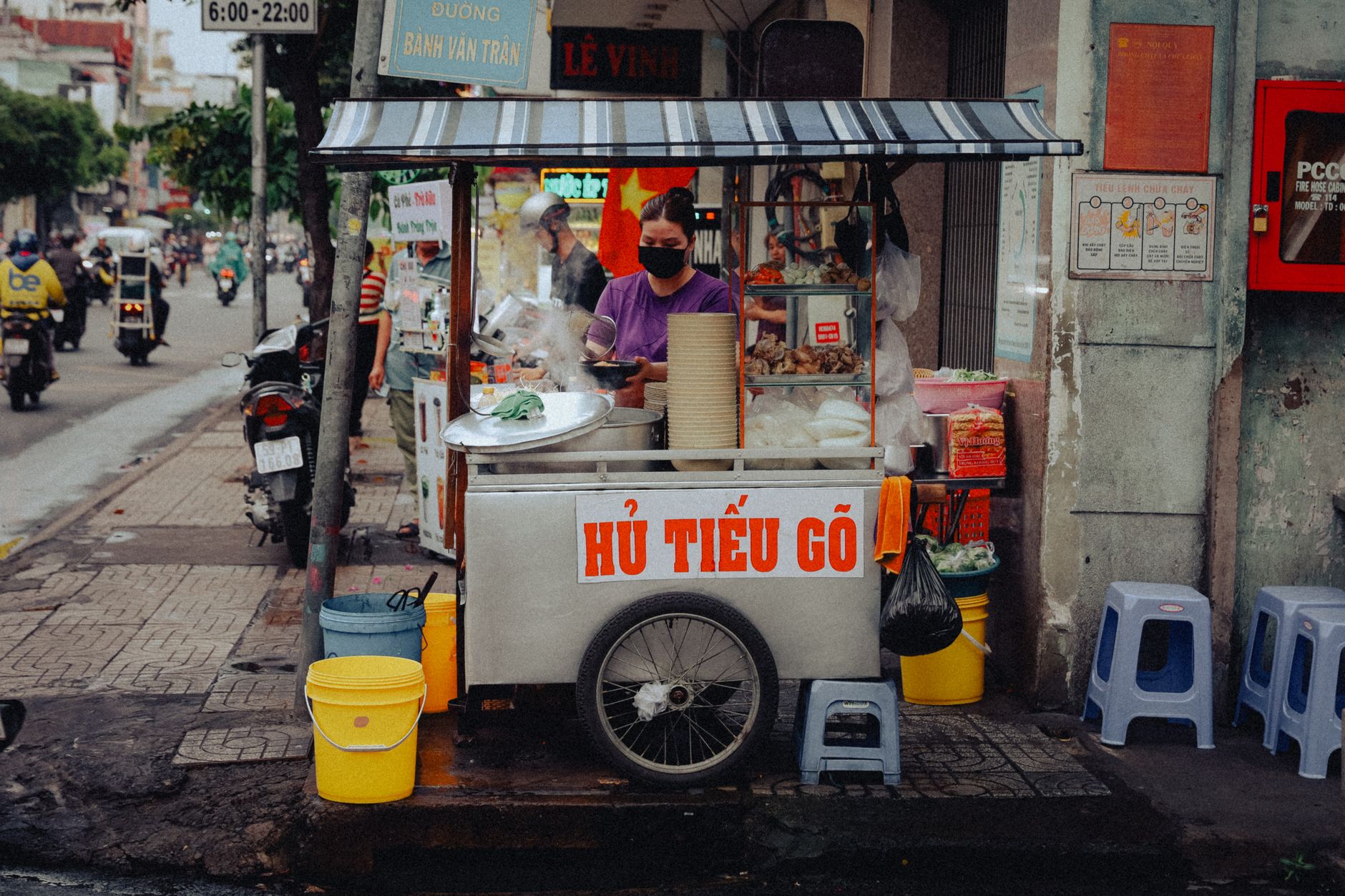
For these dishes, the best strategy is to follow the locals. Walk through the streets around the Citadel in the early evening, and you will see plastic stools set up outside homes, with small grills and steaming pots. These are the informal eateries where the real cooking happens. There are no menus, no English signs, and no tourists. Point at what others are eating, and you will be served.
Hanh Restaurant (11 Pho Duc Chinh Street) is a good introduction to these less famous dishes. It is a small, family-run place with an English menu and reasonable prices. The tre and nem lui are particularly good.
Ong Tao (18/4 Nguyen Binh Khiem Street) is another option, slightly more upscale, with a garden setting and a broader menu. The banh it ram here is excellent.
Where to eat: neighborhoods and practical tips
Hue's food scene is spread across several areas, each with its own character:
The Citadel area (north of the Perfume River) has the densest concentration of street food, especially around Dong Ba Market and the streets leading to the Imperial City. This is where to go for bun bo Hue in the morning and banh khoai in the evening.
The south bank (around Le Loi Street and the area near the Truong Tien Bridge) has more sit-down restaurants and cafes. This is where most tourists stay, and the food is slightly more expensive but still cheap by international standards. Good for imperial cuisine and for late-night eating.
The backpacker strip (around Pham Ngu Lao and Chu Van An streets) is the most tourist-oriented area, with a mix of Vietnamese and Western food. The Vietnamese options here are decent but not exceptional. Worth a visit for the atmosphere, not for the food.
For a full day of eating, consider this route: start with bun bo Hue at Madam Thu around 8 a.m., move to Dong Ba Market for banh beo and com hen by 10 a.m., take a break during the hottest part of the day, then return to the Citadel area in the evening for banh khoai at Lac Thien and a bowl of che for dessert.
| Dish | Type | Typical price | Where to find it |
|---|---|---|---|
| Bun bo Hue | Noodle soup | 40,000 to 60,000 VND ($1.60 to $2.40) | Madam Thu, Hong Mai, morning street stalls |
| Banh khoai | Crispy pancake | 25,000 to 40,000 VND ($1 to $1.60) | Lac Thien, Dong Ba Market |
| Banh beo | Steamed rice cakes | 20,000 to 35,000 VND ($0.80 to $1.40) | Dong Ba Market, Tinh Gia Vien |
| Com hen | Mussel rice bowl | 25,000 to 40,000 VND ($1 to $1.60) | Dong Ba Market, Hanh Restaurant |
| Nem lui | Grilled pork skewers | 60,000 to 100,000 VND ($2.40 to $4) | Lac Thien, Ong Tao |
| Imperial set menu | Multi-dish meal | 200,000 to 400,000 VND ($8 to $16) | Y Thao Garden, Tinh Gia Vien |
When to eat and how to order
Hue's food culture runs on a schedule. Most street food appears in the morning and disappears by early afternoon. The evening options are different: banh khoai, nem lui, and other grilled dishes take over after sunset.
Breakfast (6 a.m. to 9 a.m.) is bun bo Hue and other noodle soups. Lunch (11 a.m. to 1 p.m.) is lighter, often com hen or banh beo. Dinner (6 p.m. to 9 p.m.) is the time for imperial dishes, grilled meats, and the more elaborate preparations.
Ordering is straightforward if you know the basics. Point at what you want, or use the Vietnamese names. Most vendors in the tourist areas understand basic English, but a few phrases help:
- "Mot to bun bo Hue" (one bowl of bun bo Hue)
- "It cay" (less spicy)
- "Khong cay" (not spicy)
- "Mot dia banh khoai" (one plate of banh khoai)
Payment is usually expected after the meal, not before. Some street vendors prefer cash, so carry small bills. Most restaurants accept cards, but the smaller establishments do not.
Pro tip: if a street stall is busy with locals, the food is good. If it is empty, move on. This rule works everywhere in Vietnam, but especially in Hue, where the competition is fierce and the standards are high.
Hue food in context: how it fits the wider picture
Hue's food culture is distinct from the rest of Vietnam. The northern cuisine around Hanoi is more restrained, with lighter flavors and a focus on fish sauce. The southern cuisine around Ho Chi Minh City is sweeter and bolder, with more coconut milk and tropical ingredients. Hue sits in the middle, but it is not a blend of the two. It is its own thing: more complex, more layered, and more concerned with presentation.
This is partly a function of history. The Nguyen dynasty ruled from Hue for over a century, and the imperial court attracted chefs from across the country. They brought techniques and ingredients from the north and the south, then adapted them to local tastes. The result is a cuisine that is both familiar and strange, with dishes that appear nowhere else in Vietnam.
For travelers, this means Hue rewards a slower approach. Do not rush through the city in a day. Spend at least two nights, eat multiple meals, and let the food guide your exploration. The city is small enough that you can walk between the major eating areas, and the Hue things to do guide covers the sights if you need a break between meals.
The Hoi An vs. Hue comparison is worth reading if you are deciding between the two cities. Both have strong food scenes, but they are different in character. Hoi An is about market eating and fusion dishes like cao lau. Hue is about tradition and depth. Neither is better, but they are not interchangeable.
Practical details for food-focused travelers
- Water: do not drink tap water. Bottled water costs 10,000 to 15,000 VND ($0.40 to $0.60) everywhere. Ice in restaurants is generally safe, as it is made from filtered water.
- Cash: carry 500,000 to 1,000,000 VND ($20 to $40) in small bills. Most street vendors cannot break large notes.
- Hygiene: the best street stalls are not the cleanest-looking ones, but they are the busiest. High turnover means fresh ingredients. Use the same judgment you would anywhere else.
- Dietary restrictions: vegetarian options exist, especially at Buddhist temples and a few dedicated restaurants. Eating gluten-free in Vietnam has useful guidance, as fish sauce and soy sauce are everywhere.
- Weather: Hue is hot and humid from April to August, with frequent rain from September to November. The cooler months from December to March are the most comfortable for eating outdoors. See the Vietnam in January guide for more seasonal context.
Hue is not a city where you need to plan every meal in advance. The food finds you. Walk the streets, follow the crowds, and order what looks good. The worst meal in Hue is still better than the average meal in most places. That is not hype. It is the reputation this city has earned, one bowl at a time.
FAQ
Q: What is the difference between bun bo Hue and pho? A: Bun bo Hue uses thick round noodles, a spicy beef broth with lemongrass and shrimp paste, and is served with beef shank, oxtail, and often pork blood. Pho uses flat rice noodles, a mild beef broth, and thin slices of beef. They share almost nothing beyond the category of noodle soup.
Q: How spicy is bun bo Hue? A: It varies by vendor, but the default level is noticeably spicy. The heat comes from chili oil and fresh chilies, not from the broth itself. Ask for "it cay" (less spicy) if you want a milder bowl, and add chili paste at the table if you want more.
Q: Is Hue food safe for tourists to eat? A: Yes, with the same caveats as anywhere in Vietnam. Eat at busy stalls with high turnover, drink bottled water, and avoid anything that has been sitting out for hours. Street food in Hue is generally safe and the hygiene standards are comparable to other Vietnamese cities.
Q: What is the best time of day to eat at Dong Ba Market? A: Morning, between 7 a.m. and 10 a.m. This is when the food stalls are fully stocked and the vendors are cooking fresh batches. By early afternoon, many stalls have closed or are serving leftovers.
Q: How much should I budget for food in Hue per day? A: A budget traveler can eat well for 200,000 to 300,000 VND ($8 to $12) per day, eating mostly street food. A mid-range traveler spending 500,000 to 800,000 VND ($20 to $32) can add sit-down restaurants and imperial set menus. The Hoi An daily budget guide has comparable figures for the nearby city.
Q: Are there vegetarian options in Hue? A: Yes, especially around the Buddhist temples and pagodas. Many restaurants offer vegetarian versions of classic dishes, and there are a few dedicated vegetarian restaurants in the city center. The Da Lat food scene guide has more detail on vegetarian eating in Vietnam generally.
Q: Do I need to book a table at the famous restaurants? A: For the street stalls, no. They operate on a first-come, first-served basis. For the sit-down imperial restaurants like Y Thao Garden, a reservation helps, especially for dinner on weekends. A quick call or a message through the restaurant's Facebook page is usually enough.