This guide covers the emperor who built his own retreat while losing his country to France, a spot-by-spot route through the complex, and a dated practical section with fares, hours and an honest verdict.
Tomb of Tu Duc at a glance
Khiem Lang is the mausoleum and lifetime retreat of Emperor Tu Duc, fourth ruler of the Nguyen dynasty. It has formed part of the UNESCO-listed Complex of Hue Monuments since 1993.
- Location: Thuy Xuan area, about 6–7 km southwest of the Imperial City. The address commonly listed is 17/69 Le Ngo Cat. Thua Thien Hue province became a centrally governed city, Hue, on 1 January 2025, and wards were merged in mid-2025. Older addresses such as "Thuong Ba village", "Duong Xuan Thuong" and "Thua Thien Hue province" still circulate on maps and booking sites, so match listings by the tomb name rather than the administrative line.
- Size: about 12 ha inside the walls, with roughly 50 structures. Figures of 225 ha and 475 ha that appear online refer to the wider protected zone, not the tomb itself.
- Time needed: 75–120 minutes on site.
- Ticket: 150,000 VND adult as of October 2026 (about 5.70 USD or 5 EUR at roughly 26,300 VND/USD and 30,500 VND/EUR).
- Verdict: the most rewarding tomb for slow walkers and history readers, the least dramatic for photographers chasing grand staircases.
Who was Tu Duc: the poet emperor who lost the country
The melancholy that visitors feel here is not a marketing invention. It comes from the man who designed the place.
A scholar on the throne
Born Nguyen Phuc Hong Nham in 1829, son of Emperor Thieu Tri, he took the throne in late 1847, and the Tu Duc era is counted from 1848. That is why sources give either date. At 36 years, his was the longest reign of the Nguyen dynasty.
He was a Confucian scholar and a prolific poet in classical Chinese and Nom. The number of poems attributed to him ranges from roughly 400 to several thousand depending on the source, so treat any precise figure with suspicion. What matters is that poetry was not a hobby for him. It was how he processed a reign that went badly.
The French conquest
- 1858: a Franco-Spanish force attacks Da Nang.
- 1862: the Treaty of Saigon cedes three eastern provinces of Cochinchina (Bien Hoa, Gia Dinh, Dinh Tuong) and Con Dao to France.
- 1867: France seizes the three western provinces.
- 1874: a further treaty opens the Red River and northern ports.
- July 1883: Tu Duc dies, weeks before the Harmand Treaty turns Vietnam into a protectorate.
He also persecuted Catholics, a fact most travel pages skip. Mention it plainly: it was one of the pretexts France used for intervention, and it shaped how the court was seen abroad.
A childless emperor
Over 100 wives and concubines is the commonly cited figure, yet he had no biological heir. Most Vietnamese sources attribute this to smallpox in childhood. He adopted three nephews, including the future Kien Phuc and Dong Khanh, both of whom visitors will encounter again at the tombs.
How the tomb was built: forced labour, the Chay Voi revolt and a change of name
Construction began in 1864 under the name Van Nien Co, "Foundation of Ten Thousand Years". The main works were completed around 1867, with additions continuing afterwards.
Thousands of soldiers and labourers worked in harsh conditions. In 1866 this boiled over into the Chay Voi uprising, named after the lime pestles the rebels used as weapons. Led by Doan Huu Trung and his brothers, the revolt aimed to put Tu Duc's relative Dinh Dao on the throne. It was crushed and the leaders executed.
After the revolt, Tu Duc renamed the site Khiem Cung, "Palace of Modesty". After his death it became Khiem Lang, the Modest Tomb. That is why nearly every building name on site contains the word "Khiem".
He then used the complex as a second residence for about 16 years. He read, composed poetry, fished, hunted small game on the islet and watched theatre. No other Nguyen tomb was lived in like this, and that is the single best reason to choose it.
Legends and facts: the secret burial, the beheaded porters and the lotus-dew tea
Separate the stories from the record before you walk in, because guides on site mix them freely.
The secret grave. The story goes that Tu Duc was buried elsewhere and that around 200 porters were beheaded to keep the location secret. It has circulated since the colonial period and has never been proven. Most Vietnamese historians treat the official grave as possibly a cenotaph and the beheading story as unverified. No secret grave is visitable, so do not go looking.
The 20-tonne stele. The stone was quarried in Thanh Hoa and hauled roughly 500 km. The weight of about 20 tonnes is commonly cited. The detail that the haul took four years is anecdote rather than record.
Lotus-dew tea. Servants were said to collect dew from lotus leaves on Luu Khiem lake for the emperor's tea. This is tradition, not documentation. You can still buy lotus-scented tea in Hue, which makes the story easier to imagine.
The short stone mandarins. A popular joke says the court statues were carved small because the emperor was short. It is a guide's tale, but worth knowing because visitors always notice the scale.
Ignore any claim that the tomb was the first Vietnamese site digitised in 3D on Google Arts & Culture unless you can verify it on the platform itself. Several travel sites repeat it without a source.
What you see: the route spot by spot
The complex runs on two parallel axes, the palace (living area) and the tomb (burial area). Understanding that saves you from wondering why you double back. Follow this order from the entrance.
Vu Khiem gate and the brick path
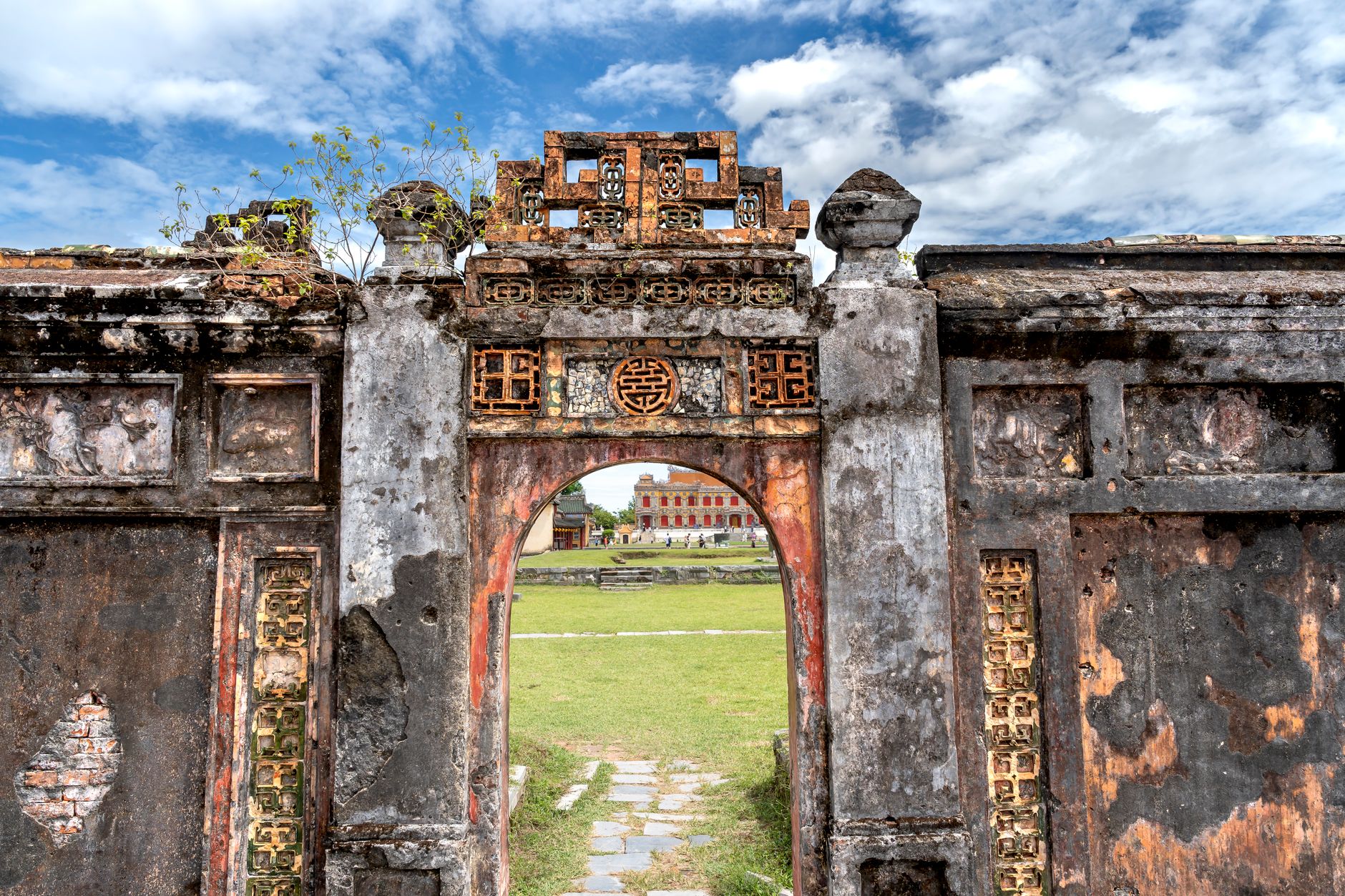
You enter through the east-side gate onto a shaded brick path under frangipani and pine. A few steps up to the left sits Chi Khiem Duong, the temple for the concubines. Most visitors walk straight past it.
Luu Khiem lake, Tinh Khiem islet and the two waterside pavilions
The lake began as a stream, reshaped into water. The islet was used for hunting and for planting rare flowers.
Xung Khiem Ta (1865) and Du Khiem Ta are pavilions on stilts over the water. The emperor wrote poetry in Xung Khiem Ta, and Du Khiem served as the boat landing. Stand inside Xung Khiem Ta and look across the lake toward the pine slope for the classic frame. Morning light comes from behind you.
Khiem Cung Mon and the palace courtyard
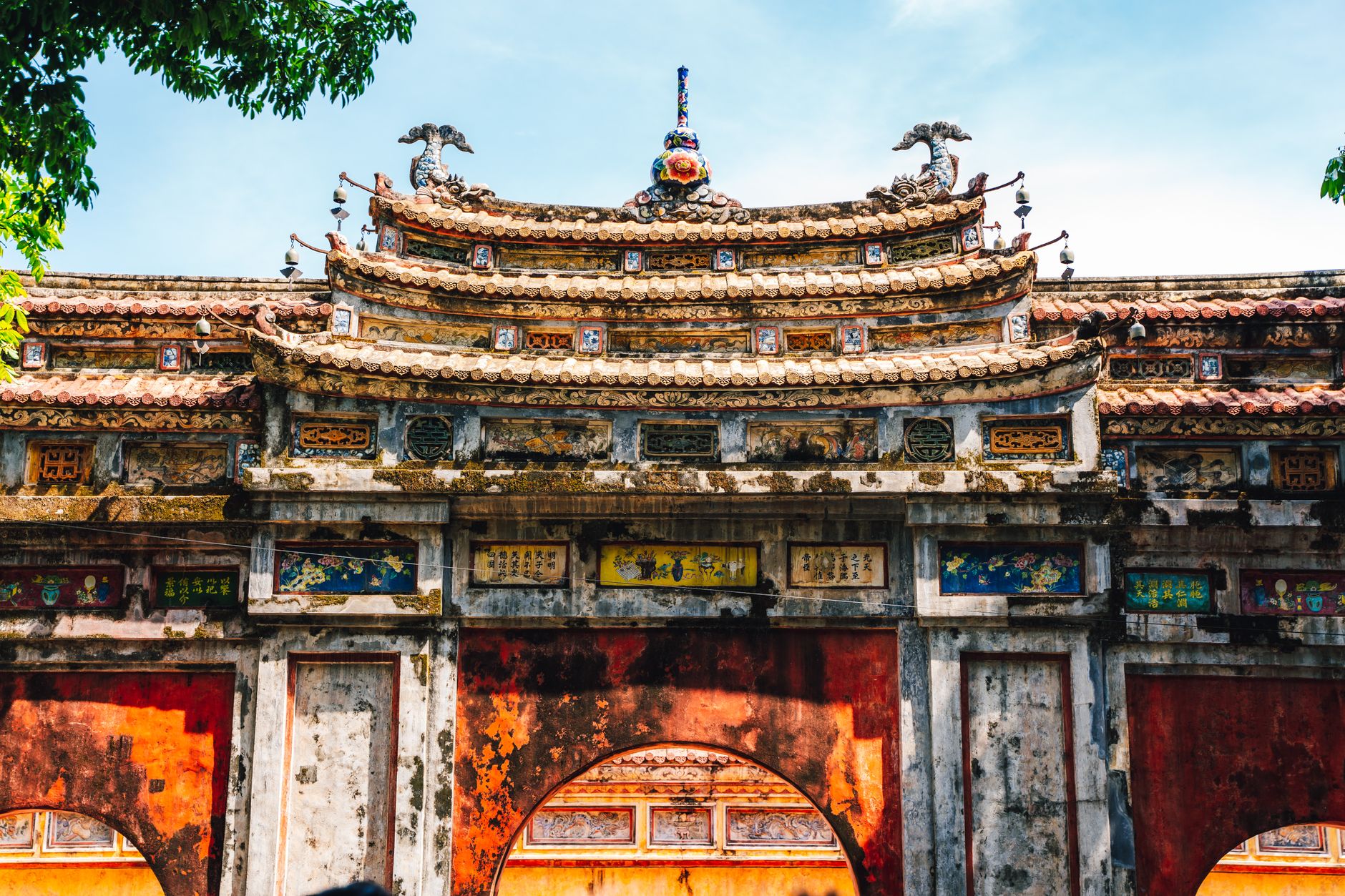
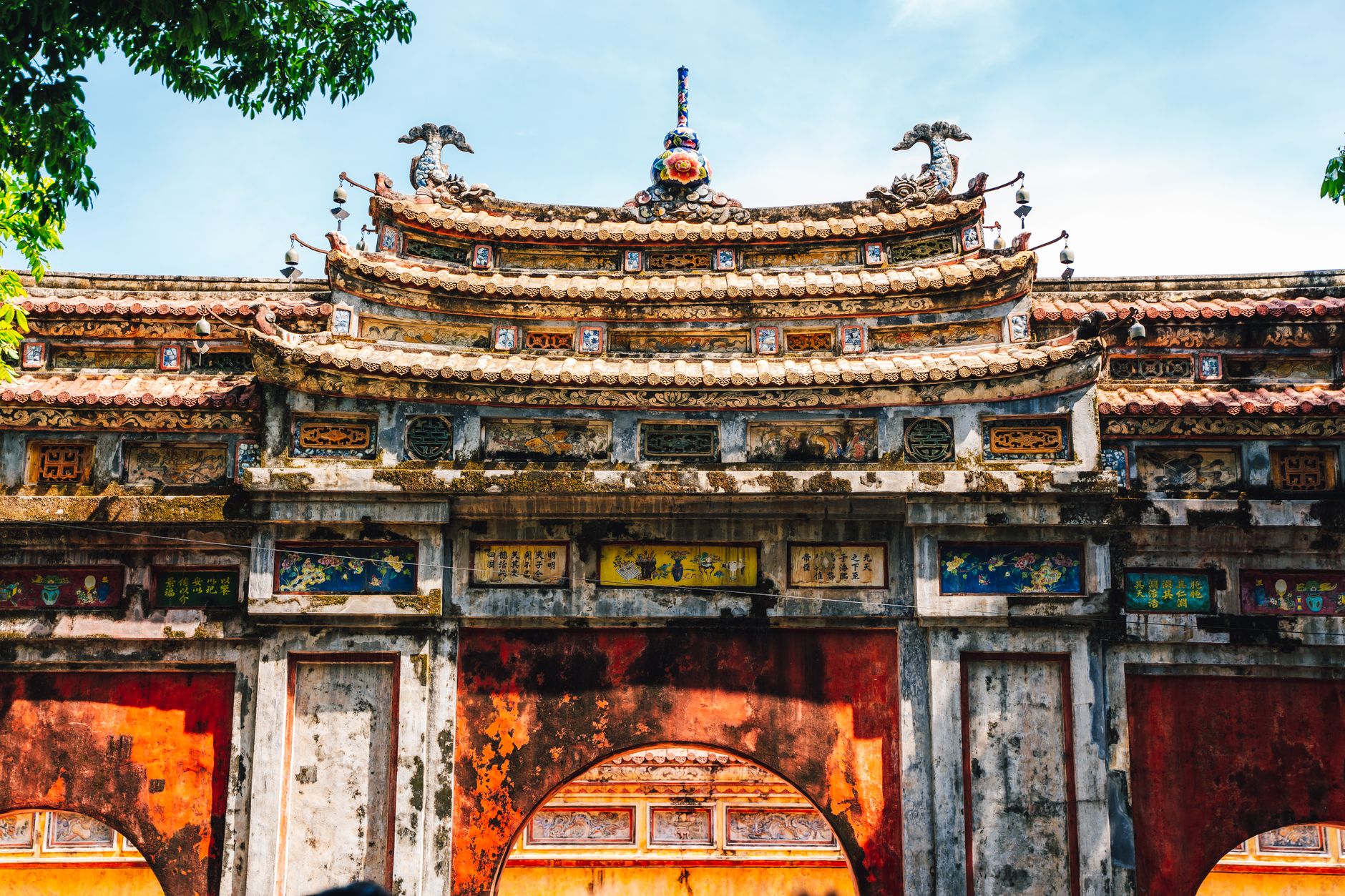
The two-storey gate leads up stone steps into the residential area. Hoa Khiem Dien was the working hall and later became the shrine for Tu Duc and Empress Le Thien Anh. Phap Khiem Vu and Le Khiem Vu are the side halls that once held the civil and military mandarins.
Minh Khiem Duong, one of Vietnam's oldest theatres
Built around 1866 for tuong (classical opera) and court music, it is usually described as one of the oldest surviving theatres in the country. Look up at the painted ceiling and along the lacquered columns. Costume photo rentals operate here or nearby, so expect a small crowd in ao dai and step around it.
Luong Khiem Dien, On Khiem Duong and the concubines' quarters
Luong Khiem Dien is the shrine to his mother, Empress Dowager Tu Du. On Khiem Duong was the storehouse. Tung Khiem Vien and Dung Khiem Vien, the concubines' residences, are often in partial ruin or under restoration. Be prepared for scaffolding.
Bai Dinh, the salutation court
Paired stone mandarins, elephants and horses stand in ranks. Note their small scale and the weathered faces.
Bi Dinh and the Khiem Cung Ky stele
The stele pavilion holds the largest stele of any Nguyen tomb, with two obelisks in front. The inscription runs to roughly 4,900 Chinese characters and was composed by Tu Duc himself. In it he lists his illnesses, his childlessness and his failures as a ruler. That frankness is almost unheard of for an emperor.
Read a short translated excerpt, or ask a guide to summarise it, before you stand in front of the stone. Most visitors photograph it without knowing what it says. The roofless pavilion is also the best shaded rest on the circuit.
Tieu Khiem Tri and Buu Thanh, the grave itself
A crescent-shaped pond leads to the walled enclosure, Buu Thanh, around a plain grave mound. The plainness surprises people, and that is the point. Tie it back to the legend of the secret burial.
The two tombs most visitors miss
- Tomb of Empress Le Thien Anh: Tu Duc's principal wife, buried inside the complex.
- Boi Lang: tomb of Kien Phuc, the adopted son who reigned about eight months in 1883–1884 and died young amid rumours of poisoning.
Both lie off to the left of the main axis. They are quieter and often deserted.
What sets it apart from the other royal tombs
If you are choosing between combo tickets, this is the section that matters.
| Tomb | Distance from centre | Style | Time needed | Crowd level | Best for |
|---|---|---|---|---|---|
| Tu Duc | 6–7 km | Lived-in garden with water, spread out | 75–120 min | Moderate to high mid-morning | Atmosphere, history, slow walking |
| Minh Mang | About 12 km | Strict axial symmetry along a reflecting lake | 60–90 min | Moderate | Grandeur and formal landscape |
| Khai Dinh | About 10 km | 1920s concrete hilltop, steep stairs, mosaic interior | 45–60 min | High | Spectacle and photography |
| Dong Khanh | Under 1 km from Tu Duc | Small, glass paintings, French-era decoration | 30–45 min | Low | A quiet add-on |
Tu Duc rewards wandering. Minh Mang impresses through order. Khai Dinh is compact and theatrical. Dong Khanh is the one to bolt on because it is next door.
Pick two by traveller type: Tu Duc plus Khai Dinh for maximum contrast, Tu Duc plus Minh Mang for history and landscape.
Who will love it, who may be disappointed, and an honest verdict
Will love it: history readers, slow travellers, anyone tired of the crowds at the Imperial City, garden lovers, and visitors between May and August when the lotus is out.
May be disappointed: visitors expecting monumental drama, since Khai Dinh delivers more of that. People who dislike heat and walking. Anyone visiting in heavy rain, when paths turn slippery and the lake goes grey. Some outbuildings are ruined or under scaffolding, and costume shoots plus tour-group bottlenecks around mid-morning can spoil the calm.
Verdict: worth the detour for almost everyone spending a full day or more in Hue. With half a day and time for one tomb only, choose Tu Duc for atmosphere or Khai Dinh for spectacle.
Insider tips: timing, crowds, where to stand and etiquette
Best hour
Arrive at opening (7:00) and you have until about 8:30 before the buses. Come after 15:30 for warm light on the lake. Mid-morning, roughly 9:30–11:30, is the peak for groups.
Best season
Lotus blooms roughly May to August, at the height of the heat, when temperatures reach 38–40°C with the dry "Lao wind". Any claim that lotus season is February to March is wrong. February to April is the most comfortable period overall.
September to December is the rainy season, with October and November the flood peak. Since this guide is written in October 2026, be explicit with yourself: typhoons and floods can close monuments at short notice, and severe flooding has hit Hue in recent autumns.
| Months | Weather | Lotus | Crowds | Closure risk |
|---|---|---|---|---|
| Feb–Apr | Mild, dry | No | Moderate | Low |
| May–Aug | Very hot, dry wind | Yes, peak Jun–Jul | Moderate | Low |
| Sep | Humid, showers | Fading | Low | Moderate |
| Oct–Nov | Rain, flood peak | No | Low | High |
| Dec–Jan | Cool, damp | No | Moderate | Moderate |
Crowd strategy
Do the circuit in reverse: head to the tomb area first, then the lake. Most groups start at the water. Visit on a weekday. Avoid the first days of Tet, which falls on 6 February 2027, when domestic visitor numbers surge.
What most visitors miss
Chi Khiem Duong, the content of the stele, Kien Phuc's tomb, the frangipani alley in the dry season, and the view back from the steps of Khiem Cung Mon.
Etiquette
- Cover shoulders and knees in the shrine halls.
- Do not step over or sit on the thresholds of worship buildings.
- Do not climb the stone statues.
- No drones without a permit.
- Keep voices low at the grave.
- Bargain politely with vendors at the parking area.
Practical information: tickets, opening hours and rules
Every price and time below is as of October 2026. The Hue Monuments Conservation Centre's official ticketing is the reference, and prices were last raised in 2023.
Tickets
| Ticket type | Adult price VND | Approx. USD/EUR | Child 7–12 | Validity | Best for |
|---|---|---|---|---|---|
| Single tomb | 150,000 | 5.70 / 5 | About 40,000 VND | Day of visit | One tomb only |
| Imperial City + 2 tombs | About 420,000 | 16 / 14 | Reduced | 2 days from first use | Most visitors |
| Imperial City + 3 tombs | About 530,000 | 20 / 17 | Reduced | 2 days from first use | Full tomb circuit |
Children under 7 enter free. One website lists separate Vietnamese and foreign prices (100,000 and 150,000 VND). Unless that is confirmed on the official page, assume a single price applies to all visitors.
Buy at the gate, where cash is standard and cards or QR payment are often accepted, or through the official e-ticket portal. Third-party resellers exist and may add a markup.
Opening hours
Daily, roughly 7:00–17:30 in summer and 7:00–17:00 in winter. Ticket sales stop before closing. Seasonal timetables change, and exceptional closures happen in storms, so check the official monuments page the day before if the weather is doubtful.
Rules and facilities
- Photography is allowed. No flash inside shrines.
- Drones need a permit.
- Ao dai and costume rental near the entrance costs roughly 50,000–150,000 VND.
- Toilets are near the entrance. Drinks are sold at the parking area.
- Motorbike parking costs about 5,000–10,000 VND.
Accessibility
Brick paths are uneven, with steps at every gate and high thresholds. The lake loop is manageable with a stroller. The tomb axis is hard. There is no step-free route to the grave.
How to get there from the city centre
Distances below are from the Imperial City and Le Loi riverside area, about 6–7 km.
| Mode | Time one way | Approx. cost VND (USD) | Pros | Cons and risks |
|---|---|---|---|---|
| GrabCar | 20–25 min | 80,000–130,000 (3–5) | Door to door, fixed price | Slow return pickups late afternoon |
| GrabBike | 20 min | 35,000–60,000 (1.30–2.30) | Cheapest and fastest | Helmet, heat, traffic |
| Metered taxi | 20–25 min | Similar to GrabCar | Easy to flag | Meter disputes |
| Scooter rental | 20 min | 120,000–200,000 per day | Freedom to combine tombs | Damage scams, licence rules |
| Bicycle | About 30 min | 50,000–80,000 per day | Pleasant on cool mornings | Heat, gentle hills |
| Walking | About 1h20 | Free | No cost | Hot, stretches without footpath |
Car pickups at the tomb can be slow late in the afternoon. Either agree a wait-and-return price with the driver, or book the ride back before signal and drivers thin out.
For the scooter route: take Dien Bien Phu street south past the Nam Giao Esplanade, then Le Ngo Cat. The road passes Tu Hieu pagoda and the incense stalls of Thuy Xuan. Photograph the bike before departure to avoid damage disputes. An international driving permit valid for Vietnam is required for motorbikes, and travel insurance often excludes unlicensed riding.
A city bus line has been reported, with bus 4 mentioned by one operator. Routes changed after the 2025 administrative reorganisation, so check locally rather than relying on it.
Dragon boats on the Perfume River stop mainly at Thien Mu and the Minh Mang landing, not at Tu Duc. Do not expect a boat to drop you at the gate.
What to combine nearby
- Tomb of Dong Khanh: under 1 km, walkable. A combined ticket with Tu Duc may be sold on site.
- Thuy Xuan incense village: stalls on the approach road. Photogenic, but the displays are staged for tourists and the stalls charge for photos or expect a purchase.
- Tu Hieu pagoda: about 1.5–2 km. The root temple of Thich Nhat Hanh, quiet, with a strict dress code. Morning chanting times can be checked locally.
- Vong Canh hill: a few km. Sunset view over the Perfume River.
- Nam Giao Esplanade: on the way back to the city.
- Lunch: com hen or bun bo Hue eateries along Le Ngo Cat.
Sample half-day loops: Tu Duc plus Dong Khanh plus Tu Hieu for a relaxed morning, or Tu Duc plus Khai Dinh plus Minh Mang for a full day by car.
FAQ
Q: Is the Tomb of Tu Duc worth visiting if I have already seen the Imperial City? Yes. It shows the private side of Nguyen court life that the Imperial City, heavily damaged in 1947 and 1968, cannot. The two complement each other: do the Citadel on day one and the tombs on day two using the 2-day combo ticket.
Q: Is Emperor Tu Duc really buried there? Officially the grave inside Buu Thanh is his. The secret-burial story and the execution of around 200 porters are unproven legends. Nothing beyond the marked grave is visitable.
Q: Which tombs should I choose with a combo ticket? Tu Duc plus Khai Dinh for maximum contrast, or Tu Duc plus Minh Mang for history and landscape. Add Dong Khanh because it is next door to Tu Duc. As of October 2026, the Imperial City plus two tombs combo costs about 420,000 VND and the three-tomb combo about 530,000 VND.
Q: When do the lotuses bloom at Tu Duc Tomb? Roughly May to August, peaking in June and July. Bloom depends on lake maintenance and water level, so there is no guarantee. Visits in February or March will not see flowers.
Q: Why is Hue called the Forbidden City? Hue's Imperial City enclosed the Tu Cam Thanh (Purple Forbidden City), reserved for the emperor's family, on the model of Beijing. Little of it survived the wars of 1947 and 1968. Tu Duc's tomb shows the same court aesthetic intact.
Q: Can I visit Tu Duc Tomb in the rainy season? Yes, but October and November bring flood and typhoon risk, occasional closures, slippery brick paths and mosquitoes. Check weather alerts and the official monuments page the day before, and carry a raincoat rather than an umbrella on the paths.
Q: What should I wear? Cover shoulders and knees for the shrine halls. Wear shoes with grip for worn brick and stone steps. Bring a hat and water, since much of the tomb axis is unshaded.