Tomb of Khai Dinh at a glance
| Item | Detail |
|---|---|
| Official name | Ứng Lăng (Ung Mausoleum) |
| Location | Chau Chu hill, about 10 km south of the Imperial City |
| Built | 4 September 1920 to 1931 |
| Footprint | About 117 m by 48.5 m |
| Steps | 127 |
| Time needed | 45 to 90 minutes |
| Ticket | 150,000 VND (about US$5.70), as of October 2026 |
| Status | Part of the UNESCO-listed Complex of Hue Monuments, inscribed 1993 |
A note on the address. Hue became a centrally governed city on 1 January 2025, and commune and ward boundaries were merged in mid-2025. Published sources still give the location as Thuy Bang commune, Huong Thuy, Thuy Xuan or Thuy Bang ward, and all of them were accurate at some point. Do not navigate by postal address. Type "Lăng Khải Định" into Google Maps or Grab and you will land at the ticket counter.
The emperor behind the tomb
Most accounts of this site reduce the history to two lines: built between 1920 and 1931, paid for by a tax rise. The politics behind those two lines is the reason the tomb feels the way it does.
A monarch chosen by the colonial administration
Khai Dinh was born Nguyễn Phúc Bửu Đảo on 8 October 1885, eldest son of Emperor Dong Khanh. He came to the throne in 1916, after the French deposed and exiled Emperor Duy Tan, who had backed a failed uprising that year. He was the 12th Nguyen emperor, not the last. That was his son Bao Dai. Khai Dinh reigned until his death on 6 November 1925, aged 40.
The 1922 trip to France and the backlash
In 1922 the emperor became the first reigning Vietnamese monarch to travel to Europe, attending the Marseille Colonial Exhibition. He left the young Bao Dai in France to be educated. Two famous critiques date from that year. Phan Chau Trinh's "Seven-point letter" (Thất điều thư) accused the emperor of seven offences, including extravagance and burdening the people. Nguyen Ai Quoc, the future Ho Chi Minh, wrote a satirical play, Le Dragon de bambou (The Bamboo Dragon), mocking the visit.
That is the context that makes the tomb complicated. It is admired as art and remembered as the monument of a compromised reign.
Building Ung Lang, 1920 to 1931
Geomancers chose the site. A small hill in front acts as a screen, hills on either side serve as the "green dragon" and "white tiger", and the Chau E stream runs across the front. Construction was directed by Lê Văn Bá and lasted 11 years. The emperor was buried here while work was still under way, and the tomb was completed in 1931, during Bao Dai's reign.
Bao Dai died in Paris in 1997 and has no tomb in Hue. That makes Ung Lang the final royal tomb of the dynasty, a fact that matters more than the "smallest and most expensive" line repeated everywhere.
How it was paid for
The commonly cited figure is a 30% increase in land tax. Treat it as widely reported rather than precisely documented. Materials came from abroad: cement, iron, steel and slate from France, porcelain and coloured glass from China and Japan.
Some guides repeat claims about the emperor's private life. They have circulated for decades and cannot be verified. One sentence is enough.
Why it looks like nothing else in Hue
Earlier tombs such as Minh Mang and Tu Duc are timber pavilions set in landscaped parks with lakes and pine groves. Khai Dinh's tomb is a vertical, reinforced-concrete composition climbing a hillside. The dark, vaguely Gothic look that some guides praise is largely mould and lichen on weathered concrete, not an original design intent. It photographs well. It was not planned.
The influences are deliberately mixed. Gate pillars with an Indian silhouette, stupa-like columns, obelisk-style pillars, a stele pavilion with a European flavour, wrought-iron detailing. Published sources disagree on whether to label these Hindu, Roman or Christian. Describe what is visible rather than assigning religious meaning. The cross-like motifs on the balustrades, for instance, are debated.
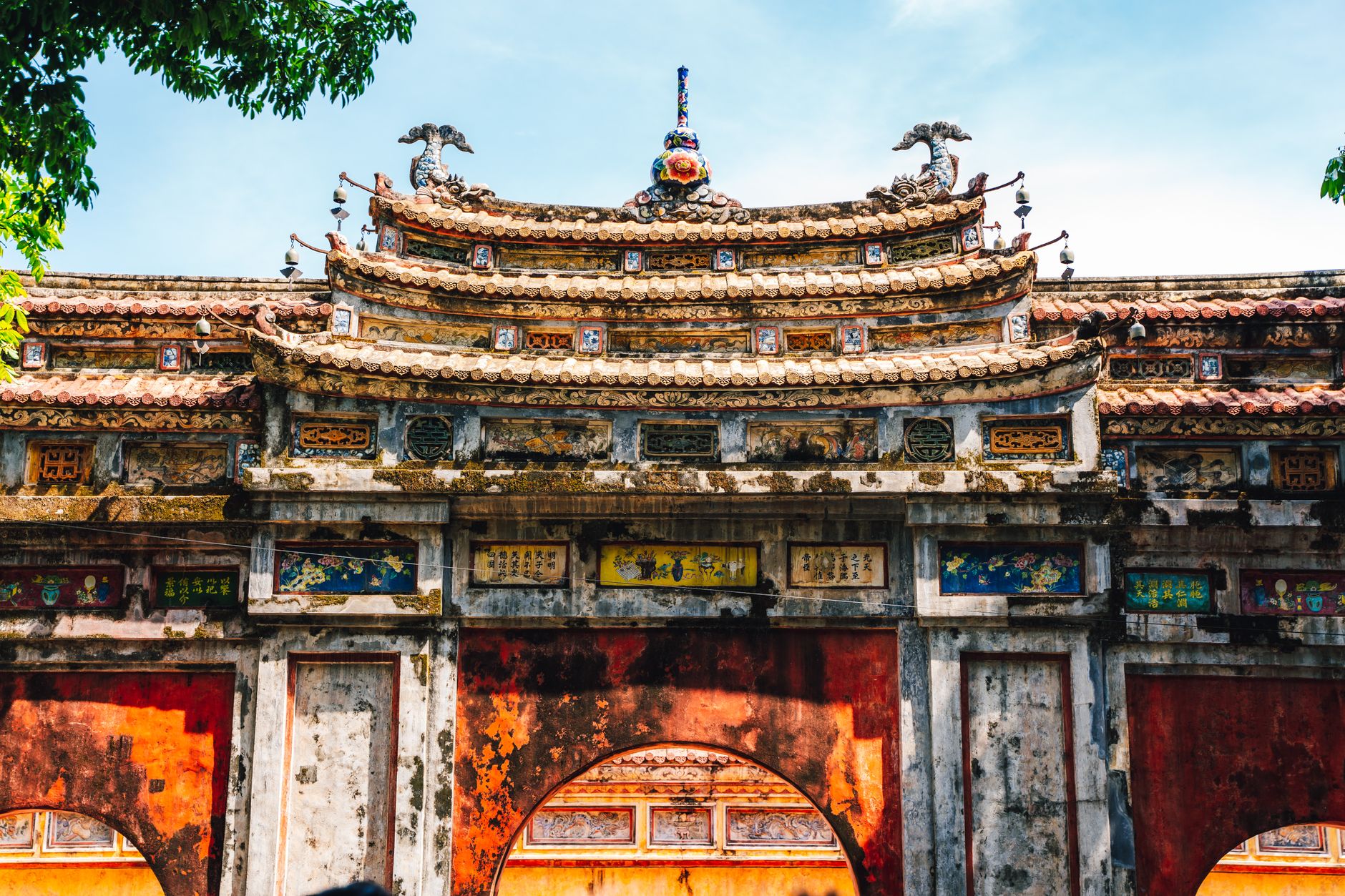
The real masterpiece is the sành sứ mosaic. Artisans inlaid broken porcelain, ceramic and glass, including fragments of bottles and bowls, onto mortar. The names most often credited are Phan Văn Tánh, Nguyễn Văn Khả, Ký Duyệt and Cửu Sừng. This is what visitors come for and what photographs never fully capture.
Visiting the tomb step by step
The site is a climb in stages. Follow this order and you will see everything without backtracking.
The dragon staircase and first terrace
The first 37 steps are flanked by long dragon balustrades, often cited as among the largest in Vietnam. At the top sit the Tả Tòng Tự and Hữu Tòng Tự, side houses for accompanying mandarins. One published visitor calls this terrace "of little interest". Be honest: it is a transition space. Look back down the stairs before moving on.
The salutation court (Bái Đình)
A further 29 steps bring you to the court. Two rows of stone mandarins, civil and military, along with soldiers, horses and elephants, form an honour guard. Look at the faces. Some carry a mix of European and Vietnamese features. The obelisk-like pillars (trụ biểu) frame the court and give the best straight-on view of the palace above.
The stele pavilion (Bi Đình)
An octagonal, two-tiered concrete pavilion shelters a large stone stele, often described as weighing around 10 tonnes. Treat the figure as reported. The inscription is in classical Chinese and recounts the emperor's life and achievements. It is attributed to Bao Dai.
Thien Dinh palace (Cung Thiên Định)
This is the summit building and the reason to come. Take its sections in order.
- The side guard rooms (Tả trực, Hữu trực). These now hold small exhibits: Nguyen dynasty material, a map of the Hue monuments, period photographs of the emperor, his funeral procession and the construction site, plus gifts including a French presidential gift to Emperor Dong Khanh. Most visitors walk straight past. Do not.
- Khai Thanh hall (Khải Thành điện). The front hall holds the altar and portrait of the emperor. The walls are covered in mosaic panels of the four seasons, the eight precious objects and the eight immortals. Look up at the ceiling painting of nine dragons hidden in clouds (Cửu long ẩn vân), attributed to Phan Văn Tánh.
- The statue chamber. A gilded bronze statue of Khai Dinh sits on a throne under a heavy canopy (bửu tán) that is concrete and mosaic yet reads as draped fabric. A radiating sun stands behind it.
- The crypt. The remains lie directly below the statue, unusual among Hue tombs, where the exact burial spot is traditionally hidden.
- The rear altar. For the emperor's spirit tablet.
Published sources disagree on several details. The crypt depth is given as 9 m or 18 m. The statue is said to have been cast in France in 1920 or 1922, often attributed to the sculptor Paul Ducuing in Marseille, with gilding done on site. The story that the ceiling was painted with the artist's feet is a tale told by guides, not a documented fact.
Looking back from the top
Before descending, turn around. The view south and east over the stream and the screen hill shows the geomantic layout in one glance. This is the moment the site's placement makes sense.
Details most visitors miss
- Everyday and European objects worked into the mosaics. Look closely at individual panels rather than hunting for named objects.
- Swastika (vạn) motifs in green glass, a Buddhist symbol of good fortune with no connection to its later Western use.
- The canopy's fabric illusion, best seen from the side where the light catches the mosaic.
- The mosaic-covered altar table and hanging plaque in Khai Thanh hall.
- The construction photographs in the side rooms, which show how raw the hillside was in the 1920s.
- The trilingual information plaques in Vietnamese, English and French.
- Wear on the dragon balustrades, polished by a century of hands.
- Moss patterns after rain, which some photographers prefer to dry-season conditions.
How it compares with Hue's other royal tombs
| Tomb | Built | Emperor | Style and materials | Setting | Distance from Citadel | Time needed | Best for |
|---|---|---|---|---|---|---|---|
| Khai Dinh | 1920 to 1931 | Khai Dinh | Concrete, mosaic, vertical | Compact hillside | About 10 km | 45 to 90 min | Decorative arts, photography, colonial history |
| Minh Mang | 1840 to 1843 | Minh Mang | Timber, brick, axial symmetry | Lakes, pine groves, large grounds | About 12 km | 60 to 90 min | Landscape, serenity, architecture |
| Tu Duc | 1864 to 1867 | Tu Duc | Timber, brick, garden pavilions | Wooded park with lake | About 5 to 7 km | 60 to 90 min | Atmosphere, a slow stroll |
| Dong Khanh | 1888 to 1913 | Dong Khanh | Mixed traditional and European | Small, quiet, wooded | About 6 km | 30 to 45 min | A quiet counterpoint, Khai Dinh's father |
Minh Mang and Tu Duc are about atmosphere and landscape. Khai Dinh is about one extraordinary interior. With time for one tomb, the choice is between a park and a jewel box. With time for two, Khai Dinh plus Minh Mang gives the sharpest contrast, though it means a cross-river drive.
Is it worth the detour?
Who will love it
Fans of decorative arts, mosaics and colonial-era history. Photographers, especially in soft light. Travellers who have already seen a traditional tomb and want the opposite.
Who may be disappointed
Visitors expecting gardens, lakes or a peaceful stroll, because the grounds are compact. People with limited mobility, because of the 127 steps and no lift. Travellers on a tight Da Nang or Hoi An day trip, where most of the day goes to the road. Anyone put off by tour groups squeezing into one hall.
The verdict
Worth it for the interior alone, and best combined with a nearby tomb such as Dong Khanh or Tu Duc. Overpriced as a standalone 30-minute stop for readers with no interest in the art or the history.
Tickets and opening hours
All figures below were last known as of October 2026. Prices change, so check the official site before you travel.
- Single ticket: 150,000 VND (about US$5.70 or €5) for adults, 30,000 VND for children aged 7 to 12. Under-7s are free. Some older guides still quote 100,000 VND, which is out of date.
- Combo tickets: the Hue Monuments Conservation Centre sells multi-site passes, typically valid for two days. Last known combos were around 420,000 VND for the Imperial City plus two tombs and 530,000 VND for the Imperial City plus three tombs. Confirm which sites are included when you buy. A combo starts paying off from the Imperial City plus two tombs.
- Where to buy: the ticket counter at the base of the stairs, or online through the Conservation Centre's official channels at hueworldheritage.org.vn. Carry cash in VND, because card and QR acceptance at counters is not guaranteed.
- Opening hours: the last known pattern is roughly 7:00 to 17:30 in summer and 7:00 or 7:30 to 17:00 in winter, open daily including public holidays. Published sources disagree, so treat these as approximate and arrive at least an hour before closing.
- Free-entry days: occasionally announced, for example at Tet or on special anniversaries, often at short notice. Do not plan around them. The next Tet falls on 6 February 2027.
How to get there from central Hue
The tomb sits about 10 km south of the Citadel and the Le Loi street area, reached via Dien Bien Phu and Minh Mang streets. Expect 20 to 30 minutes by road. Fares below are approximate as of October 2026. Check the app price on the day.
| Mode | Time | One-way cost | Return ease | Rain suitability | Best for |
|---|---|---|---|---|---|
| Grab car or taxi | 20 to 30 min | 120,000 to 180,000 VND (US$4.60 to 6.90) | Poor, ask the driver to wait | Good | Two or more travellers |
| Grab bike or xe ôm | 20 to 30 min | 50,000 to 80,000 VND (US$1.90 to 3.10) | Poor, same issue | Fair | Solo travellers, short on time |
| Rented scooter | 25 to 35 min | 100,000 to 150,000 VND per day | Full control | Fair, wet roads in the rainy season | Confident riders with a valid permit |
| Bicycle | 40 to 50 min | Rental cost only | Full control | Poor in heat | Fit riders with a free morning |
| Public bus | Not practical | n/a | n/a | n/a | Not recommended |
| Perfume River boat | n/a | n/a | n/a | n/a | Not applicable, the tomb is inland |
The return leg is the real trap. Ride-hailing coverage at the tomb is patchy. Either negotiate a waiting fee with your driver or book a half-day private car covering two or three tombs. Dragon boats on the Perfume River serve Thien Mu Pagoda and Minh Mang, not Khai Dinh, so a road transfer is needed either way.
On a rented scooter: an International Driving Permit valid in Vietnam is required, and travel insurance may not cover unlicensed riders. Helmets are compulsory. There is a small parking fee at the site.
When to go and how to beat the crowds
| Months | Weather | Crowds | Stair conditions | Verdict |
|---|---|---|---|---|
| January to April | Mild, grey and drizzly in January and February | Moderate | Mostly dry | Best overall window |
| May to August | Very hot, often above 35°C | Heavy at midday | Dry but exposed | Go at opening only |
| September to December | Rainy, typhoons and floods peak in October and November | Light outside holidays | Slippery | Check forecasts, keep the day flexible |
Tour groups, including day trips from Da Nang and Hoi An, cluster from late morning to early afternoon. Arrive at opening, or in the last 90 minutes before closing for softer light on the facade and a quieter hall.
Three places to stand: the base of the dragon staircase for the full vertical composition, the salutation court looking up at the palace, and the doorway of the statue chamber while you wait for a gap between groups.
Rules, etiquette and safety
Cover shoulders and knees inside Thien Dinh palace, which is a burial and worship space. Remove hats indoors. Do not touch the mosaics, sit on altars or climb statues.
Handheld phone photography is widely tolerated despite restrictive signage inside. Tripods, professional shoots and wedding sessions need permission and usually a fee. Avoid flash on the mosaics. Drones are not allowed without authorisation.
The steps are steep and lack continuous handrails, and they are slippery in rain. Bring water in summer. Vendors selling drinks and souvenirs work the parking area and can be persistent. Toilets are near the entrance. Sections of the site may close for restoration with little warning.
What to combine nearby
- Tomb of Tu Duc, about 5 to 7 km away, with the Tomb of Dong Khanh, Khai Dinh's father, close by. Dong Khanh is a quieter, wooden counterpoint and a good pairing for a half day.
- Tu Hieu pagoda and the Thuy Xuan incense village, both on the way back to the city.
- Vong Canh hill for a Perfume River viewpoint.
- Tomb of Minh Mang, about 12 km away across the river, for the landscape contrast.
- In the city, for a Khai Dinh thread: An Dinh palace, his pre-reign residence, also European in style, and Kien Trung palace in the Imperial City, built under Khai Dinh and reopened after restoration in 2024.
- The former Ho Thuy Tien water park: access has been restricted during redevelopment, so treat it as closed unless you confirm otherwise locally.
FAQ
Q: Is the Tomb of Khai Dinh worth visiting if time allows only one royal tomb? For decorative art and colonial-era history, yes, because the mosaic interior is unique in Vietnam. For landscape and serenity, choose Minh Mang or Tu Duc instead.
Q: How many steps are there and is it accessible? There are 127 steps over several terraces, with no lift or ramp to the top. Steps are slippery in rain. Travellers with reduced mobility can see the lower courts but will struggle to reach Thien Dinh palace.
Q: How much is the ticket and are combo tickets worth it? The last known adult price is 150,000 VND (about US$5.70) as of October 2026, with combos covering the Imperial City plus tombs and valid for two days. A combo pays off from the Imperial City plus two tombs. Prices change, so check the Conservation Centre's official site.
Q: Was Hue the ancient capital of Vietnam? Hue was the capital under the Nguyen dynasty from 1802 to 1945, and the royal tombs form part of the UNESCO-listed Complex of Hue Monuments. Khai Dinh's tomb is the dynasty's final burial monument.
Q: Is there still a royal family in Vietnam? No reigning monarchy exists. Bao Dai, Khai Dinh's son, abdicated in August 1945 and died in Paris in 1997. Descendants of the Nguyen Phuc clan still exist and some worship rituals continue privately, but they hold no official role.
Q: How is it different from the Ho Chi Minh Mausoleum? One is a 1920s imperial tomb built by a French-backed emperor, the other the 1975 mausoleum of the revolutionary leader in Hanoi. The irony is that Ho Chi Minh, as Nguyen Ai Quoc, mocked Khai Dinh in a 1922 play.
Q: Can it be visited on a day trip from Da Nang or Hoi An? Yes, but road time is roughly 2 to 3 hours each way from Da Nang and longer from Hoi An, which turns the tomb into a rushed stop. An overnight in Hue lets you see it at opening or late afternoon without the crowds.
Q: Can I take photos inside? Handheld phone photography is widely tolerated despite restrictive signs. Tripods, professional shoots and drones need authorisation. Avoid flash on the mosaics and be discreet at the altar.
Your questions and tips
A question, an update, an experience to share? Our team reads every message before it is published.
No comments yet. Ask the first question or share a tip!