Dong Ba Market at a glance
- Address: 2 Tran Hung Dao Street, north bank of the Perfume River, between Truong Tien Bridge to the west and Gia Hoi Bridge to the east.
- Ward: formerly Phu Hoa ward. Vietnam merged wards and abolished district-level administration on 1 July 2025, and the current ward name should be checked against Hue City's official sources before publishing. Hue became a centrally governed city on 1 January 2025, so the old "Thua Thien Hue Province" label is out of date.
- Entrance: free.
- Typical hours, last known pattern as of October 2026: wet market from about 4:00-5:00, indoor stalls roughly 6:30-18:00, food court from breakfast to early afternoon.
- Time needed: 1-2 hours.
- Best hour: 6:30-9:00.
A short history of Dong Ba Market
A market at the Citadel's eastern gate
Under Emperor Gia Long, a market opened outside the eastern gate of the newly built Citadel, around 1805 according to local accounts. It traded between boats moored on the Dong Ba canal and the Perfume River, and the officials and residents living inside the walls. The gate's official name is Chanh Dong, but locals call it Dong Ba Gate. It still stands about 500 m northwest of today's market, at the end of Mai Thuc Loan Street.
Why "Dong Ba": names and a royal taboo
Two traditions circulate. One holds that the market was called Quy Gia Thi, roughly "market of those who return," a reference to the Nguyen lords' return to Phu Xuan. The other says it was first called Dong Hoa and renamed under Emperor Thieu Tri around 1841. "Hoa" was the personal name of his mother, Ho Thi Hoa, and the Nguyen court's naming taboo (ky huy) forbade ordinary use of characters in a royal name. "Ba" was chosen partly because it also carries the sense of "flower."
Both stories are worth telling as traditions rather than settled fact. The naming taboo itself is the fascinating part: across the Nguyen era, words in imperial names were altered in everyday speech and writing, which is why so many Vietnamese place names shifted between the 1800s and today.
Burned in 1885, rebuilt in 1887, moved in 1899
In July 1885 Hue fell to French troops and the original market burned. In 1887 King Dong Khanh had it rebuilt under the name Dong Ba. In 1898 King Thanh Thai issued a decree on 20 October creating the municipality of Hue and reorganising the riverbank. The market moved to its present site in 1899, the same years Truong Tien Bridge was completed (1897-1899). The two events belong together: a modern bridge, a reorganised waterfront and a relocated market reshaped this stretch of the Perfume River within a few years.
The clock tower, the 1968 battle and the 1987 rebuild
The early riverside market had four blocks of stalls around a central building topped by a four-faced clock. That building is the ancestor of today's clock tower facade with its red "CHO DONG BA" letters. The market was badly damaged in the Battle of Hue during the Tet Offensive of 1968, then rebuilt. In 1987 the former Binh Tri Thien province carried out a major renovation: the clock tower was upgraded, four two-storey corner buildings and five rows of stalls were added, for about 15,600 m² of construction. Recent figures from 2020 put the market at roughly 2,700 stalls and 1,800 trading households across six zones, around 60 categories of goods, and 7,000-10,000 visitors a day.
Why sources disagree
Published sources contradict each other constantly. Founding dates appear as 1805, 1887 and 1899. Areas appear as 16,000 m², 22,749 m² and 47,614 m². The most defensible reading: 1805 for the first market outside the gate, 1887 for the rebuilt market under Dong Khanh, and 1899 for the move to the present site. On area, the largest figure appears to cover the whole compound including outdoor zones, while the smaller ones describe the covered buildings. None of this is a scandal. It is what happens when a two-century-old institution is described by tourism copywriters instead of historians.
| Year | Ruler or authority | Event | Note on sources |
|---|---|---|---|
| c. 1805 | Emperor Gia Long | Market opens outside the Citadel's eastern gate | Local accounts; earliest of the three founding dates |
| c. 1841 | Emperor Thieu Tri | Renamed, possibly from Dong Hoa to Dong Ba | Tied to the royal naming taboo; tradition rather than record |
| 1885 | French capture of Hue | Original market burns | Consistent across sources |
| 1887 | King Dong Khanh | Market rebuilt as Dong Ba | The "second" founding date quoted by some guides |
| 1898 | King Thanh Thai | Decree of 20 October creates the municipality of Hue | Documented administrative reform |
| 1899 | Colonial administration | Market moves to its present site | Coincides with Truong Tien Bridge completion |
| 1968 | Tet Offensive | Market badly damaged in the Battle of Hue | Then rebuilt |
| 1987 | Binh Tri Thien province | Major renovation, clock tower upgraded, corner buildings added | Source of the 15,600 m² construction figure |
How the market is laid out
The compound has four recognisable sides. The river side is the Tran Hung Dao forecourt and wharf. West is the Truong Tien Bridge end. East is Gia Hoi Bridge and the Dong Ba canal. North are the rear lanes toward Huynh Thuc Khang Street. The main building is the clock tower hall with its upper floors, flanked by wings and the 1987 corner buildings. Outdoor areas hold the wet market and street stalls.
Guides assign goods to floors inconsistently, and vendors shift between zones over time. Treat any floor-by-floor list, including this one, as a starting point and navigate by landmarks instead.
A walk through Dong Ba Market, zone by zone
The riverside front and the wharf
Fruit, flowers and vegetables are sold on the pavement of Tran Hung Dao. Boats unload at dawn. Small sampans cross to Con Hen islet. Motorbikes weave through everything. This is the most photogenic zone at 6:30-8:00, when the light is low and the produce is still arriving.
The clock tower hall: tea, sesame candy and dried goods
The first impression inside is a wall of packaged Hue specialties: me xung sesame candy, royal-style herbal tea (tra cung dinh), Tinh Tam lotus seeds, dried shrimp and squid, ginger jam. This is where locals buy gifts before visiting relatives, so prices are mostly fixed or close to it. Do not expect much haggling here.
The fermented sauce aisles
The smell hits first. Mam ruoc (fermented shrimp paste), tom chua (sour shrimp), mam nem and mam so sit in rows, often from named villages. Vendors offer tastes. Knowing what each sauce is for makes the aisle readable rather than overwhelming: mam ruoc is a cooking base and dip, tom chua is a sour shrimp relish for boiled pork and noodles, mam nem is a fermented anchovy dip for grilled meat and fresh rolls, mam so is a sweeter, thicker sauce used with rice and vegetables.
The food court
Stalls surround a shared seating area of roughly 200 seats. Vendors call out and wave visitors to sit. The system: choose a stall, dishes come from neighbouring stalls, and you pay each vendor separately. This is where the known overcharging pattern happens, so ask prices before sitting.
Upstairs: conical hats, pottery and metalwork
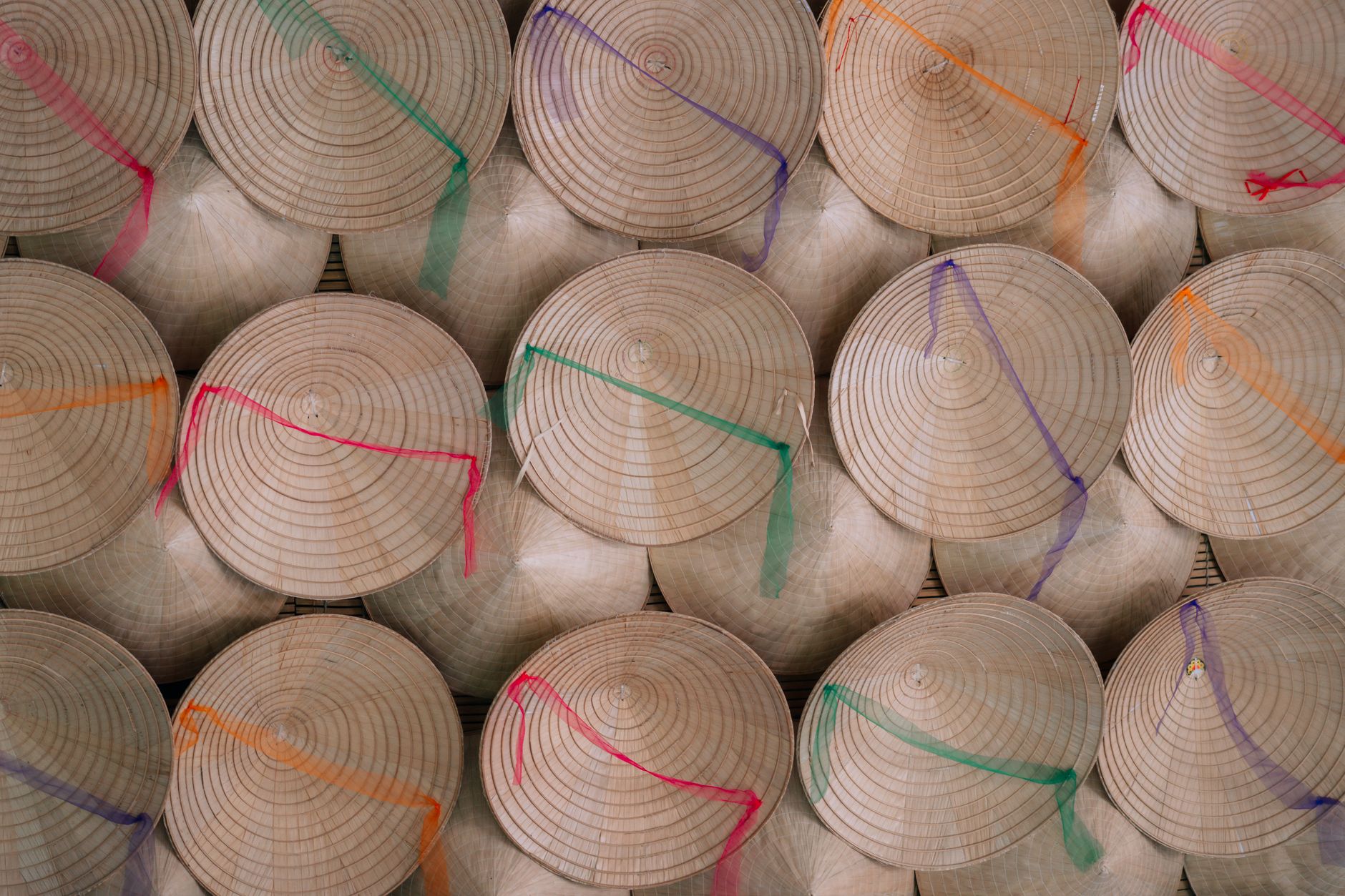
Non bai tho poem hats are the highlight. Hold one up to the light to see the poem and silhouette sandwiched between the leaf layers. Also here: Phuoc Tich pottery, Ke Mon silver and gold jewellery, bamboo and rattan work, incense and cajeput oil. Origin labels cannot always be verified, so buy from vendors who can explain where a piece was made.
The fabric floor and ao dai tailoring
Bolts of fabric hang in tight rows, with tailors at sewing machines. The process is simple: buy fabric by the metre, get measured, and collect in 24-48 hours. Synthetic fabric is sometimes sold as silk ("lua to tam"), so ask directly and accept that a low price usually means a blend.
The wet market at the back
Fish, meat, live crabs, herbs, wet floors and the Dong Ba canal edge. This is the rawest and most local part of the market, and the part most tourists skip. Wear closed shoes and watch for motorbikes and carts.
What to eat at Dong Ba Market
The food court is not a curated food hall. It is a working canteen for market traders and shoppers, which is exactly why the Hue classics here are cheap and correct.
| Dish | What it is | Local price range | Where in the market | Note |
|---|---|---|---|---|
| Bun bo Hue | Spicy beef noodle soup with lemongrass and pork knuckle | 20,000-35,000 VND (about US$0.75-1.35 / €0.65-1.15) | Food court, morning | Best before 9:00 |
| Banh beo | Small steamed rice cakes with shrimp and scallion oil | from about 5,000 VND per bowl | Food court | Order several |
| Banh nam, banh bot loc | Flat steamed rice cake with shrimp; clear tapioca dumpling with shrimp and pork | 5,000-15,000 VND per portion | Food court | Usually sold together |
| Nem lui | Grilled pork skewers wrapped in rice paper with herbs | about 50,000 VND (about US$1.90 / €1.65) for two | Food court | Grill it yourself at the table |
| Banh khoai | Crispy Hue pancake with shrimp, pork and bean sprouts | 15,000-25,000 VND | Food court | Eat with the peanut sauce |
| Banh canh Nam Pho | Thick rice noodle soup with crab and pork | 20,000-35,000 VND | Food court | A breakfast dish |
| Che Hue | Sweet soup with beans, jelly and coconut | 10,000-20,000 VND | Food court, afternoon | Best as a break |
| Com hen | Baby clam rice | Better on Con Hen islet | Not really a market dish | Take the sampan instead |
Prices are last known values as of October 2026, and they change. Choose busy stalls with high turnover, and be cautious with raw herbs and shellfish if your stomach is sensitive. Vegetarian travellers should ask for "an chay," which most stalls will understand even if they cannot always serve it.
Ask the price before sitting down at the food court. A quoted 80,000 VND for bun bo is a tourist price, not a local one.
What to buy, what to pay and what you cannot take home
Hue specialties worth carrying home
Me xung sesame candy, tra cung dinh herbal tea at about 50,000-60,000 VND per bag, lotus seeds, poem conical hats (plain hats are cheaper than poem hats, so check prices on site), Phuoc Tich ceramics, Ke Mon silver, and ao dai fabric at about 100,000-500,000 VND per metre. Prices are last known as of October 2026.
Bargaining without souring the day
Packaged food is fixed-price. Hats, fabric and souvenirs are haggling zones. Start below the asking price, but drop the cliché "offer 50%" rule: it annoys vendors and wastes time. Compare two or three stalls first, and remember that stalls deeper inside are often cheaper than those at the entrances. Avoid browsing and haggling without buying at a stall that has just opened. The "mo hang" first-sale superstition means a vendor who makes no sale at the start of the day believes the whole day will go badly.
Packing fermented and dried goods for flights and customs
This is the practical problem nobody warns you about.
- Liquid sauces: hand-luggage liquid limits apply, and some carriers refuse strong-smelling fermented products in the cabin.
- Packing: ask for vacuum sealing, and double-bag anything fermented in checked luggage.
- Import rules: meat, seafood and fermented animal products are restricted or must be declared in Australia, New Zealand, the United States and many other countries. Check your own country's rules before buying.
- Safe choices: sealed confectionery and tea are the easy picks.
| Item | Origin village | Typical price | Bargain or fixed | Travel or customs caution |
|---|---|---|---|---|
| Me xung | Hue | 30,000-60,000 VND per pack | Fixed | Safe in checked luggage |
| Tra cung dinh | Hue | about 50,000-60,000 VND per bag | Fixed | Safe, light, easy gift |
| Lotus seeds | Tinh Tam area | varies by grade | Fixed | Safe |
| Poem conical hat | Phu Cam and others | check on site | Bargain | Crushable, pack flat |
| Phuoc Tich ceramics | Phuoc Tich village | varies | Bargain | Heavy, wrap well |
| Ke Mon silver | Ke Mon village | varies | Bargain | Keep in hand luggage |
| Ao dai fabric | various | 100,000-500,000 VND per metre | Bargain | Check for synthetic blends |
| Mam ruoc, tom chua | fishing villages near Hue | 20,000-50,000 VND per jar | Fixed | Vacuum seal, checked luggage, declare where required |
How Dong Ba compares with other markets
| Market | City | Character | Tourist share | Best for | Worth it if... |
|---|---|---|---|---|---|
| Dong Ba | Hue | Food and specialty market with a riverside wharf | Moderate | Fermented sauces, Hue sweets, hats, fabric | You want a working market with real local trade |
| An Cuu | Hue | Neighbourhood market, south bank | Very low | Everyday produce, no crowds | You have already seen Dong Ba |
| Tay Loc | Hue | Small market inside the Citadel | Very low | A quick look near the Imperial City | You are walking the Citadel's back streets |
| Dong Xuan | Hanoi | Huge wholesale and textile market | Moderate | Fabric, wholesale goods, chaos | You enjoy overwhelming markets |
| Ben Thanh | Ho Chi Minh City | Central market, heavily touristic | High | Convenience, souvenirs | You are nearby and short on time |
| Hoi An Central Market | Hoi An | Small, with a food hall geared to visitors | High | A tidy introduction to central Vietnamese food | You want comfort over authenticity |
Dong Ba's specific strengths are the fermented sauces, the royal-capital specialties, a real local customer base, and a riverside setting that no other market in this list has.
Practical information
Opening hours and entrance fee
Entrance is free. Published opening hours vary: 3:00-20:00, 6:00-18:00 and 7:00-19:00. The realistic pattern, last known as of October 2026: the wet market runs from pre-dawn, most indoor stalls operate about 6:30-18:00, the food court mainly until early afternoon, and some outdoor food appears on the riverside in the evening. The market is open daily, but stalls close for the first days of Tet. Motorbike parking costs about 5,000 VND.
Getting there from the city centre
| Mode | From | Distance | Time | Approximate cost | Tips |
|---|---|---|---|---|---|
| Walk | Pham Ngu Lao, Le Loi, Chu Van An hotel area | about 1.5 km | 15-25 min | free | Cross Truong Tien Bridge, turn right onto Tran Hung Dao |
| Walk | Ngo Mon Gate, Imperial City | 1.5-2 km | 20-25 min | free | Exit via Dong Ba Gate |
| GrabBike or Be | South-bank hotels | 1.5-2 km | 5-8 min | 15,000-25,000 VND | Cheapest motorised option |
| Grab car | South-bank hotels | 1.5-2 km | 5-10 min | 30,000-60,000 VND | Good in rain |
| Taxi (Xanh SM, Mai Linh) | City centre | varies | 5-15 min | 50,000-100,000 VND | Metered |
| Cyclo | Riverside | short | 10-20 min | agree first | Fix price and duration before boarding |
| City bus | routes reported as 8, 9, 10, 12, 13 | stops about 200 m away | varies | a few thousand to about 10,000 VND | Confirm the stop location on site |
| Taxi | Phu Bai Airport | 15-17 km | 30-45 min | 200,000-300,000 VND | Best for arrivals with luggage |
| Taxi | Hue Railway Station | about 2.8 km | 10-15 min | 40,000-70,000 VND | Easy at any hour |
All fares are last known as of October 2026.
How long to allow
A quick look takes 45 minutes. A standard visit with breakfast takes 1.5-2 hours. With tailoring, a fitting and a Con Hen crossing, allow half a day.
Rules, etiquette and photography
There is no dress code. Ask before photographing vendors and accept a refusal; some ask for a purchase. Do not block aisles with a tripod. Drones are not appropriate in this dense, central heritage zone. Do not touch food you are not buying.
Safety, scams and health
- Pickpockets in crowded aisles: carry a crossbody bag.
- Self-appointed "helpers" who guide you and take a commission.
- Food court overcharging: ask the price before sitting.
- Cyclo price disputes: agree the fare in writing or with numbers shown on a phone.
- Physical hazards: slippery wet-market floors and motorbikes inside the aisles.
- Heat: late-morning temperatures inside reach the mid-30s °C in May-August.
- Accessibility: wheelchair access is poor, with stairs, crowding and wet floors. Check whether a lift exists on site before relying on one.
Best time to visit
| Time slot | What is happening | Crowds | Good for | Avoid if |
|---|---|---|---|---|
| Before 6:00 | Wharf unloading, wet market opening | Very low | Photographers | You want breakfast |
| 6:30-8:00 | Wet market, food court, best light | Low | Breakfast, photos, produce | You dislike smells |
| 9:00-11:00 | Tour groups arrive | High | Shopping | You want calm |
| 11:00-14:00 | Heat peaks, food court thins | Medium | A quick lunch | You want the full market |
| After 15:00 | Calmer shopping | Low | Fabric, hats, gifts | You want the food court |
Weekdays are calmer than weekends. On season: the dry and hot period runs roughly March to August, while September to December brings rain and typhoons, with October and November the flood peak. In major flood years the riverside and Tran Hung Dao can flood and some stalls close, so check the weather and flood warnings before setting out. Since this article publishes in late October, that warning is not theoretical.
Tet 2027 falls on Saturday 6 February 2027. The market is at its most spectacular and most crowded from around Kitchen Gods day (about 30 January 2027) to New Year's Eve on 5 February 2027. Expect closures or skeleton service for the first days of Tet, with stalls reopening gradually. The following Tet falls in late January 2028.
Who will love it, who may be disappointed, and the verdict
Who will love it: food lovers, street photographers, travellers curious about daily life, and anyone buying an ao dai with 48 hours to spare.
Who may be disappointed: those expecting a curated crafts bazaar, visitors sensitive to smells, crowds or hygiene, anyone who has just seen Ben Thanh or Dong Xuan and expects something radically different, and rainy-day visitors who find half the outdoor zones shut.
Verdict: worth 1-2 hours on any Hue stay of two days or more, best as an early breakfast stop before the Imperial City. On a single rushed day, the Citadel comes first. Fit Dong Ba in only because it is on the way.
Insider tips most visitors miss
- Hold the poem hat to the light before buying, to check the poem is actually there.
- Take the sampan to Con Hen for com hen instead of eating it in the market.
- Go up a floor for a looking-down view over the stalls. Check on site where this is possible.
- Buy packaged specialties at the end of your walk so you are not carrying smells around.
- Give the ao dai tailor your hotel address and the fitting time in writing.
- Carry small notes (10,000-50,000 VND). Many stalls do not take cards, though QR bank transfers are increasingly common.
- Learn three phrases: "xin chao" (hello), "bao nhieu tien?" (how much?) and "cam on" (thank you).
What to combine within walking distance
| Place | Distance from market | Walk time | Pairs well because |
|---|---|---|---|
| Truong Tien Bridge | adjacent | 2 min | Lit at night, best photo of the market facade |
| Phu Van Lau and Nghinh Luong Dinh pavilions | about 600 m west | 8 min | Riverbank setting in front of the Citadel |
| Dong Ba (Chanh Dong) Gate | about 500 m | 7 min | The historic gate the market is named after |
| Imperial City, Ngo Mon Gate | 1.5-2 km | 20-25 min | The essential Hue sight |
| Museum of Royal Antiquities | within about 2 km | 25 min | Context for the Nguyen court |
| Gia Hoi old quarter, Chi Lang Street | across Gia Hoi Bridge | 10 min | Chinese assembly halls and old shophouses |
| Dieu De National Pagoda | about 1 km | 12 min | Quiet stop along the Dong Ba canal |
| Con Hen islet | by sampan | 5-10 min crossing | The proper place for com hen |
| Nguyen Dinh Chieu walking street | across the river | 20 min | Evening food and strolling |
A workable route: dawn at the market, then Dong Ba Gate, then the Citadel, then lunch and back across Truong Tien Bridge.
FAQ
Q: Is Dong Ba Market worth visiting? Yes, for 1-2 hours, especially early morning, when the wet market and food court are at their best. Skip it if you are sensitive to smells or looking for a curated crafts boutique. Pair it with the Imperial City, which is 1.5-2 km away.
Q: What are Dong Ba Market's opening hours, and is there an entrance fee? Entrance is free. As of October 2026, the last known pattern is a wet market from pre-dawn, most stalls about 6:30-18:00, and a food court mostly until early afternoon. Hours vary by stall and change around Tet.
Q: Is Hue Imperial City worth visiting, and can I combine it with Dong Ba Market? Yes, the Citadel is Hue's essential sight. The market is 1.5-2 km away, and the easiest link is the route through Dong Ba Gate. Do the market at dawn, then the Citadel before the midday heat.
Q: Is Dong Xuan Market in Hanoi worth visiting if I have already seen Dong Ba? They are different. Dong Xuan is a huge wholesale and textile market, while Dong Ba is more food- and specialty-focused, with a riverside setting. You can skip one without missing a radically new experience, unless you are a market enthusiast.
Q: What are the most famous markets in Vietnam? Dong Xuan in Hanoi, Ben Thanh in Ho Chi Minh City, Dong Ba in Hue, Hoi An Central Market, the Cai Rang floating market in Can Tho and the Bac Ha Sunday market in Lao Cai. Each has a distinct character: wholesale, urban, food-focused, visitor-friendly, floating, or mountain minority.
Q: Is Vietnam cheap for shopping, and are prices at Dong Ba fair? Generally yes, especially for food, tea, hats and tailoring. Entrance-area stalls and food court vendors may quote tourists higher prices, so ask before ordering and compare stalls. Benchmark: bun bo at 20,000-35,000 VND (about US$0.75-1.35 / €0.65-1.15).
Q: Can I take fermented shrimp paste or dried seafood home on a plane? Liquids fall under hand-luggage limits, and strong-smelling fermented products are best vacuum-sealed and packed in checked luggage. Many countries restrict or require declaration of meat and seafood products, so check your own country's rules, or choose sealed sweets and tea instead.
Q: Is Dong Ba Market open during Tet? It is at its busiest in the week before Tet, roughly 30 January to 5 February 2027, ahead of Lunar New Year on 6 February 2027. Most stalls close for the first days of the new year and reopen gradually.

Your questions and tips
A question, an update, an experience to share? Our team reads every message before it is published.
No comments yet. Ask the first question or share a tip!