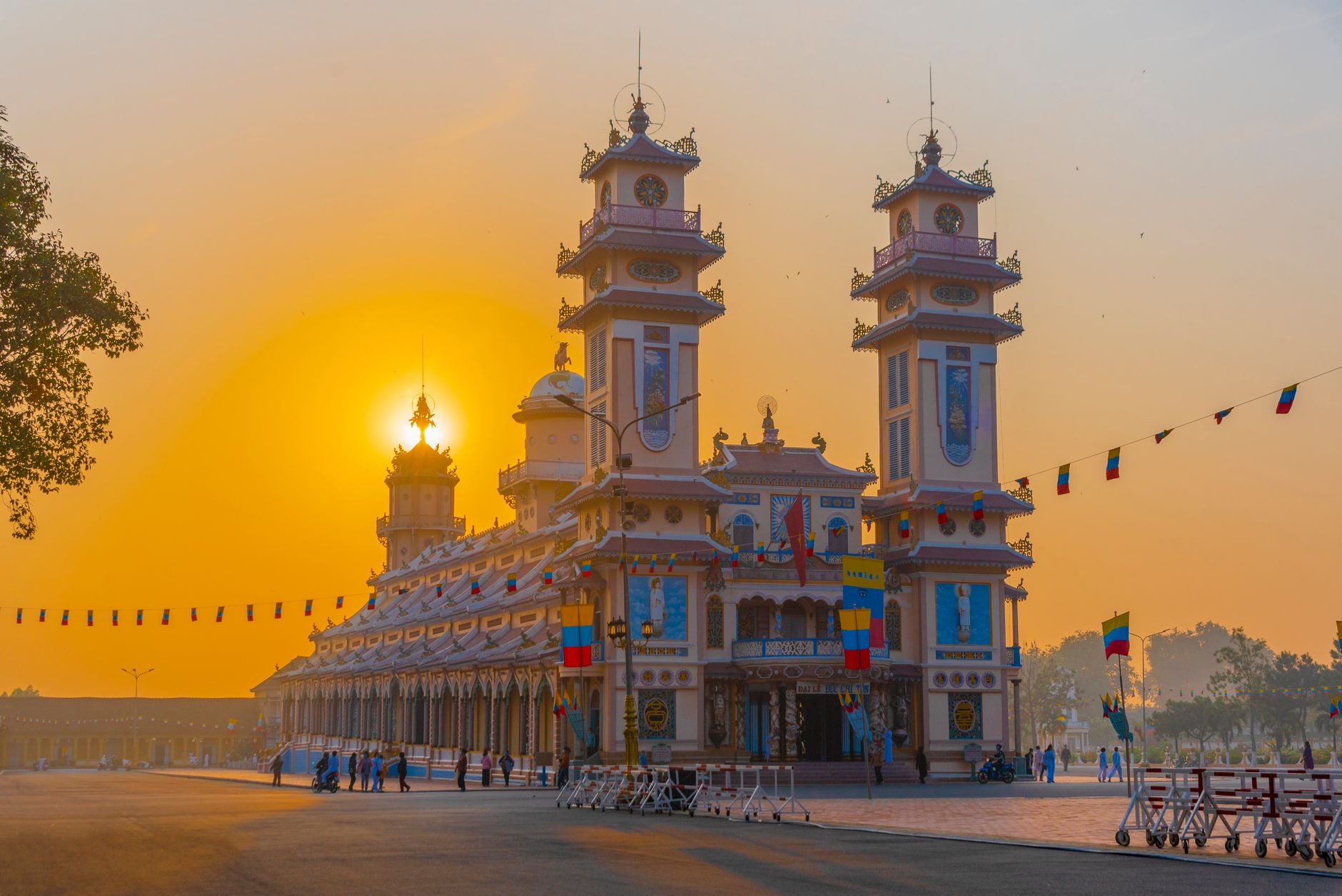
This is the center of Cao Dai, a religion that began in Vietnam in the 1920s and now claims millions of followers. It is a faith that mixes Buddhism, Taoism, Confucianism, Christianity and even elements of Islam and Hinduism into a single syncretic system. Its saints include Victor Hugo, Joan of Arc, Sun Yat-sen and the Vietnamese poet Nguyen Binh Khiem. Its supreme being is represented as a left eye inside a triangle, radiating light.
For travelers, Cao Dai offers something no other destination in Vietnam provides: a living, working religion that is entirely homegrown, visually overwhelming and still largely unknown outside the country. A visit to the Holy See is a half-day journey from Ho Chi Minh City that pairs naturally with the Cu Chi Tunnels for a full day of southern Vietnam's strangest and most compelling sights.
The origins of Cao Dai: a faith born in colonial Saigon
Cao Dai emerged during a period of intense social and spiritual upheaval. Vietnam in the 1920s was under French colonial rule. Traditional Confucian structures were collapsing. New religious movements were springing up across the country, and spiritism, the practice of communicating with the dead, was fashionable among both Vietnamese intellectuals and French colonials.
The founding story of Cao Dai centers on a series of séances conducted in Saigon and the nearby town of Phu My between 1920 and 1926. A group of civil servants and intellectuals claimed to receive messages from a supreme being they called Cao Dai, which translates roughly as "High Tower" or "High Palace", a name for God in Taoist tradition. The spirit communications instructed them to establish a new religion that would unite the world's faiths under one divine authority.
The religion was officially founded in 1926 in Tay Ninh province. It grew rapidly, partly because it offered a Vietnamese answer to the foreign religions that had arrived with colonialism. By 1930, Cao Dai claimed over a million followers. The movement built its Holy See in Tay Ninh between 1933 and 1955, a construction project that employed thousands of workers and continues to be expanded and renovated today.
The theology is complex. Cao Dai teaches that the history of religion is a history of divine revelation, with each major faith representing a partial message from God. Buddha, Jesus, Muhammad, Lao Tzu and Confucius are all seen as messengers of the same supreme being. The religion's symbol, the Divine Eye, represents God's all-seeing nature. Its hierarchy mirrors Catholicism, with a pope, cardinals and archbishops, though the position of pope has remained vacant since the death of the first holder in 1934.
The religion also has a strong Vietnamese nationalist component. Several early leaders were involved in anti-colonial movements. During the 1940s and 1950s, Cao Dai even maintained its own army, which controlled significant territory in southern Vietnam and fought against both the French and the Viet Minh. The religion was suppressed after 1975, when the communist government restricted religious practice. It has since regained legal status and continues to operate openly, though it remains under state oversight.
What to expect at the Tay Ninh Holy See
The Holy See complex covers over a square kilometer in the center of Tay Ninh city. The main temple building, known as the Great Temple, is the focal point. Its architecture is unlike anything else in Vietnam. The facade combines elements of a Catholic cathedral, a Buddhist pagoda and a French town hall, while the interior is a riot of color and symbolism.
Entering through the main gate, visitors pass between two seven-headed cobra statues. The cobra, a symbol of protection in Buddhist tradition, is rendered here in a style that looks almost Art Deco. The path leads to a wide courtyard where rows of concrete seats face the temple. This area fills with worshippers during major ceremonies.
The interior of the Great Temple is the payoff. A long central nave runs from the entrance to the altar, divided by rows of pillars wrapped in blue and yellow dragons. The ceiling is painted with stars and clouds, representing the heavens. At the far end, a giant globe sits above the main altar, painted with the Divine Eye. The globe is surrounded by elaborate carvings and fresh flowers.
Visitors can walk along the upper balconies that run the length of the nave on both sides. From here, the view down onto the ceremony floor is extraordinary. The balconies also hold displays of religious objects, including musical instruments, ceremonial fans and photographs of Cao Dai leaders.
The temple is not a museum. It is an active place of worship. Cao Dai services are held four times daily, at 6:00, 12:00, 18:00 and 24:00. The noon service is the most popular with visitors, when the temple fills with worshippers in white robes, with officials wearing colored robes depending on their rank. Blue for followers of Taoism, yellow for Buddhism, red for Confucianism. The service involves chanting, bowing and the slow, rhythmic ringing of bells.
Photography is permitted from the balconies but not on the main floor during services. Visitors should remain quiet and respectful. The service lasts about 30 minutes, after which the temple empties quickly.
Pro tip: Arrive at least 45 minutes before noon. The temple opens to visitors early, and the balconies fill up fast. The best viewing spots are directly above the main altar, where you can see the full procession of officials entering and leaving.
How to get to Tay Ninh
Tay Ninh city sits about 96 kilometers northwest of Ho Chi Minh City. The journey takes roughly two hours by road, depending on traffic. Most visitors visit as part of an organized day trip, but independent travel is straightforward.
The most common independent option is the public bus from Ben Thanh bus station in District 1, Ho Chi Minh City. Buses to Tay Ninh run frequently throughout the day and cost around 100,000 VND ($4) each way. The journey takes two to two and a half hours. From the Tay Ninh bus station, the Holy See is a short taxi or xe om (motorbike taxi) ride away.
Private cars with drivers can be arranged through hotels and travel agencies in Ho Chi Minh City. Expect to pay between 1,500,000 and 2,500,000 VND ($60 to $100) for a full day trip, including waiting time at the temple. This is the most flexible option and allows you to combine the Holy See with other sights in the area.
Many travelers combine Tay Ninh with the Cu Chi Tunnels, which lie roughly halfway between Saigon and Tay Ninh. A combined tour typically leaves Ho Chi Minh City around 8:00, visits Cu Chi in the morning, arrives at the Holy See in time for the noon service, and returns to the city by late afternoon.
The Mekong Delta itinerary guide offers another possibility: Tay Ninh is close to the upper reaches of the delta, and some travelers combine a visit with a longer Mekong journey. However, for most visitors, the day trip from Saigon is the most practical option.
Visitor etiquette at the Holy See
Cao Dai is a serious religion with strict rules of conduct. Visitors who follow basic etiquette will find the experience smooth and rewarding. Those who ignore the rules will attract stares and possibly a gentle correction from temple officials.
Dress modestly. Shoulders and knees must be covered for both men and women. This applies to the entire temple complex, not just the main building. Lightweight, loose clothing is ideal for the heat. A long skirt or trousers and a shirt with sleeves will cover the basics.
Remove hats and sunglasses when entering the temple building. Shoes are worn inside, unlike in many Asian temples, so there is no need to remove them. Turn off your phone or set it to silent. The service is a sacred ritual, not a performance.
During the noon service, visitors must remain on the upper balconies. Do not descend to the main floor, where worshippers are conducting their prayers. Do not walk in front of the temple entrance during the service, as this blocks the view of the altar. Do not touch the religious objects or the worshippers.
Photography is allowed from the balconies, but flash photography is prohibited. The temple is dimly lit, and the flash of a camera is disruptive. Video recording is generally permitted but should be done discreetly. Do not take photos of worshippers without their permission. The photography etiquette guide offers broader advice on respectful shooting in Vietnam.
Warning: The noon service is the busiest time. Some visitors treat it like a tourist show, talking loudly and jostling for photo positions. Do not be that person. Stand still, stay quiet and observe. The worshippers are not performers.
After the service, visitors may descend to the main floor and walk through the nave. This is the best time to see the details of the altar and the globe up close. Again, be respectful. Some worshippers remain in the temple for private prayer.
For broader guidance on respectful behavior in sacred spaces, the temple etiquette guide covers similar rules for Buddhist pagodas, which mostly apply here as well.
Beyond the Holy See: what else to see in Tay Ninh
The Holy See is the main attraction, but Tay Ninh province has a few other sights worth considering if you have time.
Ba Den Mountain, known as the Black Lady Mountain, rises 986 meters above the surrounding plain, about 15 kilometers from the Holy See. It is the highest mountain in southern Vietnam. A cable car carries visitors to the summit, where a large Buddhist complex has been built in recent years. The views across the flat farmland of the region are spectacular on clear days. The mountain is also an important pilgrimage site, with several temples and pagodas on its slopes.
The Cao Dai Tay Ninh Museum, located within the Holy See complex, displays artifacts related to the religion's history. Exhibits include photographs, documents, ceremonial objects and robes worn by officials. The museum is small but informative. English explanations are limited, so the visit is best for those with some prior knowledge of the religion.
The surrounding town of Tay Ninh is not a tourist destination in its own right. It is a provincial capital with a functional center, some decent restaurants and not much in the way of sights. Most visitors come for the temple and leave the same day. For those who want to stay overnight, there are a few basic hotels near the Holy See, but the options are limited. Ho Chi Minh City is close enough that an overnight stay is rarely necessary.
How Cao Dai fits into a broader Vietnam itinerary
A visit to Tay Ninh works best as a day trip from Ho Chi Minh City. The city is the natural base for exploring southern Vietnam, and the Ho Chi Minh City travel guide can help with planning. The combination of Cu Chi in the morning and Tay Ninh at noon is a classic full-day tour that covers two very different aspects of southern Vietnamese history and culture.
For travelers with more time, Tay Ninh can be combined with a longer journey through the Mekong Delta. The province is on the northern edge of the delta region, and some routes pass through or near it. However, most visitors find it easier to visit Tay Ninh as a separate day trip from Saigon.
The religion itself is not limited to Tay Ninh. Cao Dai temples exist throughout southern Vietnam, including several in Ho Chi Minh City itself. The most accessible is the Temple of the Congregation of the Divine Eye, located in District 3. It is smaller and less elaborate than the Holy See but offers a more intimate look at Cao Dai practice without the crowds. Services are held at the same four daily times.
For those interested in Vietnam's religious diversity, Cao Dai is one piece of a larger picture. The country is officially atheist but is home to a remarkable range of faiths, including the syncretic Hoa Hao Buddhism of the Mekong Delta and the indigenous Cham Hindu and Muslim communities of the central coast. The Buddhism and pagodas guide covers the dominant tradition, while a visit to Tay Ninh reveals a distinctly Vietnamese interpretation of spirituality.
Practical information for visiting Cao Dai
| Item | Details |
|---|---|
| Location | Hoa Thanh town, Tay Ninh province, 96 km from Ho Chi Minh City |
| Opening hours | Daily, 6:00 to 18:00 (temple grounds); services at 6:00, 12:00, 18:00, 24:00 |
| Admission | Free |
| Dress code | Shoulders and knees covered; no hats or sunglasses inside |
| Best time to visit | Noon service (arrive by 11:15); weekday mornings are quieter |
| Transport from Saigon | Public bus 100,000 VND ($4); private car 1,500,000 to 2,500,000 VND ($60 to $100) |
| Time needed | 2 to 3 hours at the temple; 6 to 8 hours for a day trip from Saigon |
| Nearby sights | Ba Den Mountain, Cu Chi Tunnels, Cao Dai museum |
The weather in Tay Ninh follows the same pattern as the rest of southern Vietnam. The dry season runs from November to April, with the hottest months being March and April. The rainy season runs from May to October, with heavy afternoon downpours. The rainy season guide offers advice on planning around the weather. The temple is fully covered, so rain does not disrupt the service, but the journey from Saigon can be slower in wet conditions.
Tay Ninh is not a major culinary destination, but the town has a few local specialties worth trying. Banh trang phoi suong, a type of rice paper that is dried overnight in the dew, is a local product that makes a good souvenir. The town also produces a distinctive style of grilled pork skewers, served with rice paper and fresh herbs. For a full meal, the restaurants near the Holy See serve standard Vietnamese fare at reasonable prices.
The bigger picture: why Cao Dai matters
Cao Dai is often described as a curiosity, a colorful side show on the tourist trail. That framing misses the point. The religion is a serious faith with millions of adherents, a complex theology and a significant history. It emerged from the specific conditions of colonial Vietnam and grew into one of the most successful new religious movements of the 20th century.
Its survival through the wars and political upheavals of the last century is remarkable. The religion was suppressed after 1975, its leaders imprisoned and its property confiscated. Yet it re-emerged in the 1990s and continues to operate today. The Holy See remains a functioning center of worship, not a preserved relic.
For the traveler, Cao Dai offers a window into a Vietnam that is often invisible. The country's official narrative emphasizes communism and national unity, but the reality is more complex. Cao Dai is a reminder that Vietnam has always been a place of cultural synthesis, where foreign influences are absorbed and transformed into something distinctly local.
The Divine Eye watches over the temple, but it also watches over a faith that has adapted and endured. A visit to Tay Ninh is not just a photo opportunity. It is a chance to witness a living religion in action, and to understand a little more about how Vietnam sees itself.
FAQ
Q: Is the Tay Ninh Holy See worth visiting? Yes. The temple is architecturally unique and the noon service is a genuinely impressive spectacle. It is one of the most unusual religious sites in Vietnam and pairs well with the Cu Chi Tunnels for a full day trip from Saigon.
Q: How long do I need at the Holy See? Plan for two to three hours. Arrive around 11:15 to explore the grounds before the noon service. The service runs about 30 minutes, and afterward you can walk through the main hall and visit the small museum.
Q: Can I visit the Holy See independently without a tour? Yes. Public buses run from Ben Thanh bus station in Ho Chi Minh City to Tay Ninh, taking about two and a half hours. The temple is a short taxi ride from the Tay Ninh bus station. The journey is straightforward but requires some patience with local transport.
Q: What is the dress code for visiting the Cao Dai temple? Covered shoulders and knees are required for both men and women. Hats and sunglasses must be removed inside. There is no need to remove shoes. The temple is strict about these rules, so dress appropriately.
Q: Is photography allowed inside the temple? Yes, from the upper balconies during services. Flash photography is prohibited. On the main floor, photography is allowed when no service is in progress. Do not take photos of worshippers without permission.
Q: What is the best day of the week to visit? Any day works. The noon service happens daily. Weekdays are less crowded than weekends, when domestic tourists from Saigon visit in larger numbers. Vietnamese public holidays and religious festivals draw large crowds.
Q: Can I see Cao Dai temples in Ho Chi Minh City? Yes. Several Cao Dai temples operate in the city, including one on Nguyen Trai street in District 3. The District 3 temple is smaller than the Holy See but offers a more intimate experience. Services are held at the same times.