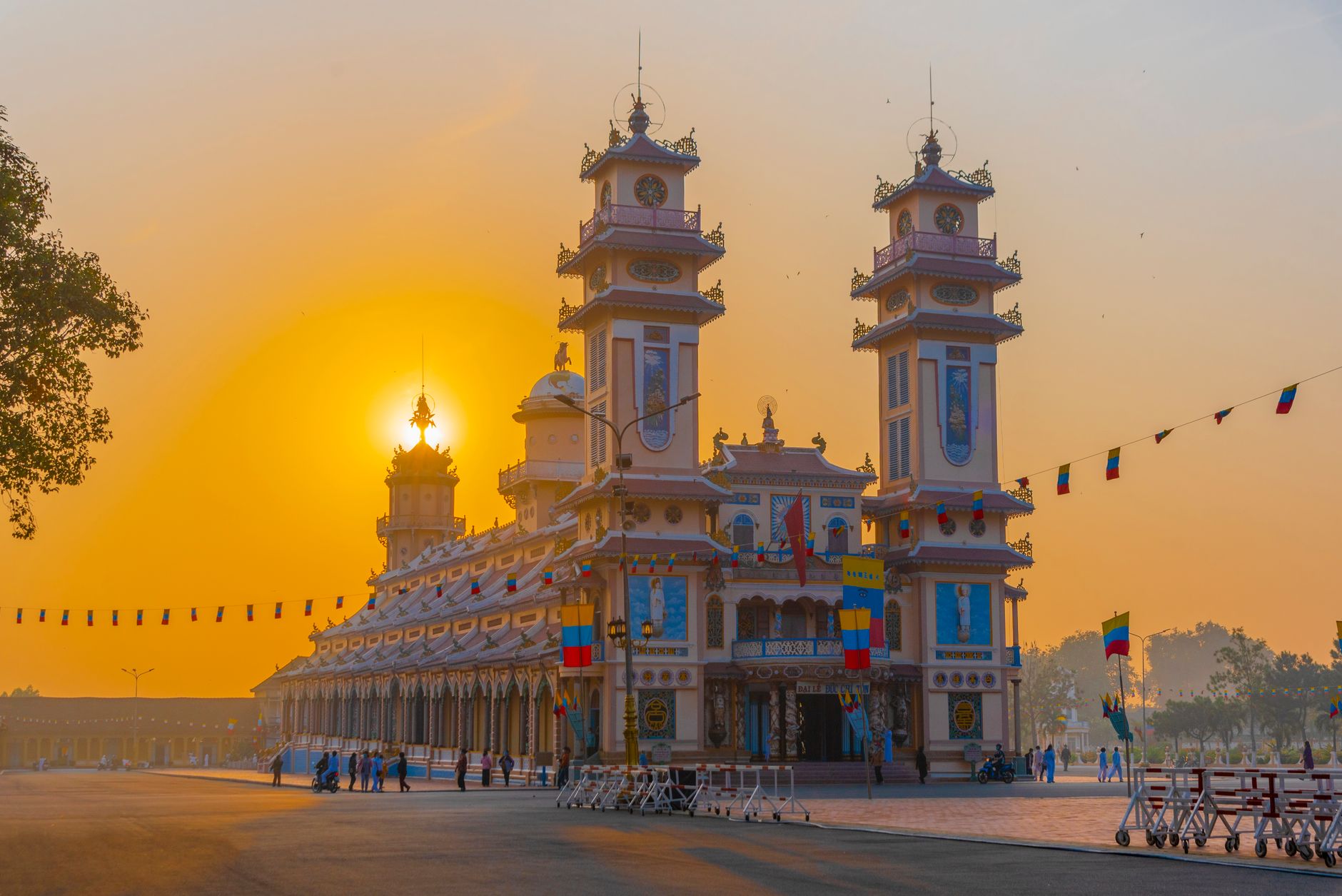
This guide covers the story behind the building and walks through it spot by spot. It also gives a practical core you can plan around: hours, the free entry, transport fares, dress code, festival dates. Enough to decide whether the 200 km round trip from Ho Chi Minh City is worth it, and how to do it better than the tour buses.
The Cao Dai Holy See at a glance
The Vietnamese name is Toa Thanh Tay Ninh. The main temple itself is Den Thanh. The complex sits in Long Hoa ward, Tay Ninh province, roughly 5 km from the old Tay Ninh city centre and about 90 to 100 km from downtown Ho Chi Minh City.
A note on addresses: in July 2025 Tay Ninh province merged with Long An, district level was abolished, and Hoa Thanh town was split into wards. Maps, hotel cards and street signs have not all caught up. If a driver looks confused, give the Vietnamese name Toa Thanh Tay Ninh rather than a street address.
Entry is free as of October 2026. The grounds open early and stay accessible into the evening, but the temple interior follows the ceremony schedule and the discretion of the white-robed wardens. Prayers run at 0:00, 6:00, 12:00 and 18:00. Budget 1 to 1.5 hours for the temple with a prayer, or 2.5 to 3 hours if you add the Mother Goddess temple, a walk around the outer grounds and Long Hoa market next door.
The story of the Holy See: how a séance became a religion and a religion built a city
Table-turning, spirit writing and the Divine Eye
Caodaism grew out of the French spiritism craze that swept Cochinchina in the 1920s. Colonial officials, clerks and intellectuals held séances in Saigon drawing rooms, and the practice crossed into Vietnamese circles quickly.
The spiritual origin story centres on Ngo Van Chieu (also recorded as Ngo Minh Chieu), a colonial administrator posted to Phu Quoc. Around 1921, by the standard account, he received a vision of a left eye radiating light. He began receiving messages through a spirit-writing practice and later returned to Saigon.
In 1925, three men began holding regular séances in Saigon: Pham Cong Tac, Cao Quynh Cu and Cao Hoai Sang. They used two techniques. One was table-turning, xay ban, where participants rest their hands on a table that raps out letters. The other was co but, spirit writing with a beaked basket held by two mediums, which traces characters on a sand-covered board.
The movement declared itself to the Governor of Cochinchina on 7 October 1926. The founding ceremony followed in November at Tu Lam Tu, the Go Ken pagoda in Tay Ninh. The full name of the religion is Dai Dao Tam Ky Pho Do, the Great Way of the Third Universal Salvation.
Building without blueprints
Construction began in 1933. The plans, according to church accounts, came through spirit writing rather than an architect's drafting table. Volunteer labour built the temple, including members of the celibate Pham Mon group, and Pham Cong Tac took direct charge of the work from 1936.
Work stopped in 1941 when French troops occupied the site and Pham Cong Tac was exiled to Madagascar. He returned in 1946 and building resumed. The temple was inaugurated in early 1955, on the ninth day of the first lunar month.
The claim that the structure is reinforced with bamboo instead of steel circulates widely on site and online. It is repeated, not documented. Treat it as a story you will hear, not a fact you should repeat.
Published dimensions vary wildly, from roughly 97 m to 140 m long. The plan here is to avoid quoting a figure rather than pick one at random.
Armies, exile and survival
The Cao Dai church raised its own army in the 1940s and switched alliances more than once, working with the Japanese, the French and various nationalist forces as the situation shifted.
In 1955 the church clashed with Ngo Dinh Diem's government. Pham Cong Tac fled to Cambodia, died in Phnom Penh in 1959, and his remains were brought back to Tay Ninh in 2006. After 1975 the state confiscated land and restricted the church. The Tay Ninh church was legally re-registered in 1997 under a new charter. Some adherents still dispute that charter. The Holy See you visit today operates inside that settlement.
Legends you will hear on site
Two stories come up repeatedly with guides.
The first is that French forces buried explosives under the temple and never detonated them. The claim traces to a 1950s letter cited in Paris Match. It is unverified.
The second concerns the vacant pope's throne. Lonely Planet and its many copies say the seat has been empty since 1933. Acting pope Le Van Trung is generally recorded as dying in 1934, which does not fit. The faith also regards the Tang poet Li Bai (Ly Thai Bach) as its spiritual pope. Ask at the temple if you are curious, and treat any confident answer with caution.
How to read the building: a five-minute decoder of Caodaism
Caodaism is a syncretic faith. It takes Buddhism, Taoism, Confucianism, Christianity and the cult of spirits and folds them into one hierarchy, with the Supreme Being at the top.
The Divine Eye. The left eye of God, the central symbol of the faith and the thing you see above the main portico and inside the sanctuary. It is the left eye specifically, corresponding to the yang side in the tradition's reading.
The three colours. Yellow for Buddhism, blue for Taoism, red for Confucianism. They appear on the ceiling, on the banners and on the robes of the three clergy branches.
White robes. Worn by lay followers and by the faithful who attend ceremonies, a mark of lay status rather than rank.
The Three Saints. Victor Hugo, Sun Yat-sen and Nguyen Binh Khiem, the "Third Alliance" of spirits who are said to have guided the new faith. A French novelist, a Chinese revolutionary and a Vietnamese poet-scholar, all in one line-up.
The five branches. Buddhism, Taoism, Confucianism, Christianity and spirit worship, each with its own line of saints and its own place in the hierarchy.
Vegetarian days. Many adherents keep a vegetarian diet for part of each lunar month, commonly ten days. This is why the food stalls near the temple lean vegetarian.
The name. "Cao Dai" literally means high tower or highest palace, a title for the Supreme Being. It is not the name of the building, though everyone uses it that way.
What you see on site, spot by spot
Arriving: the gates, the avenues and the Dai Dong Xa esplanade
The complex sits inside a walled inner grounds, the Noi O, often cited at about 1 km². Numbered gates pierce the wall. Tour buses and most Grab drivers use the main approach off the highway rather than the smaller side gates, so check with your driver before you set off and confirm the gate on arrival rather than guessing from a map.
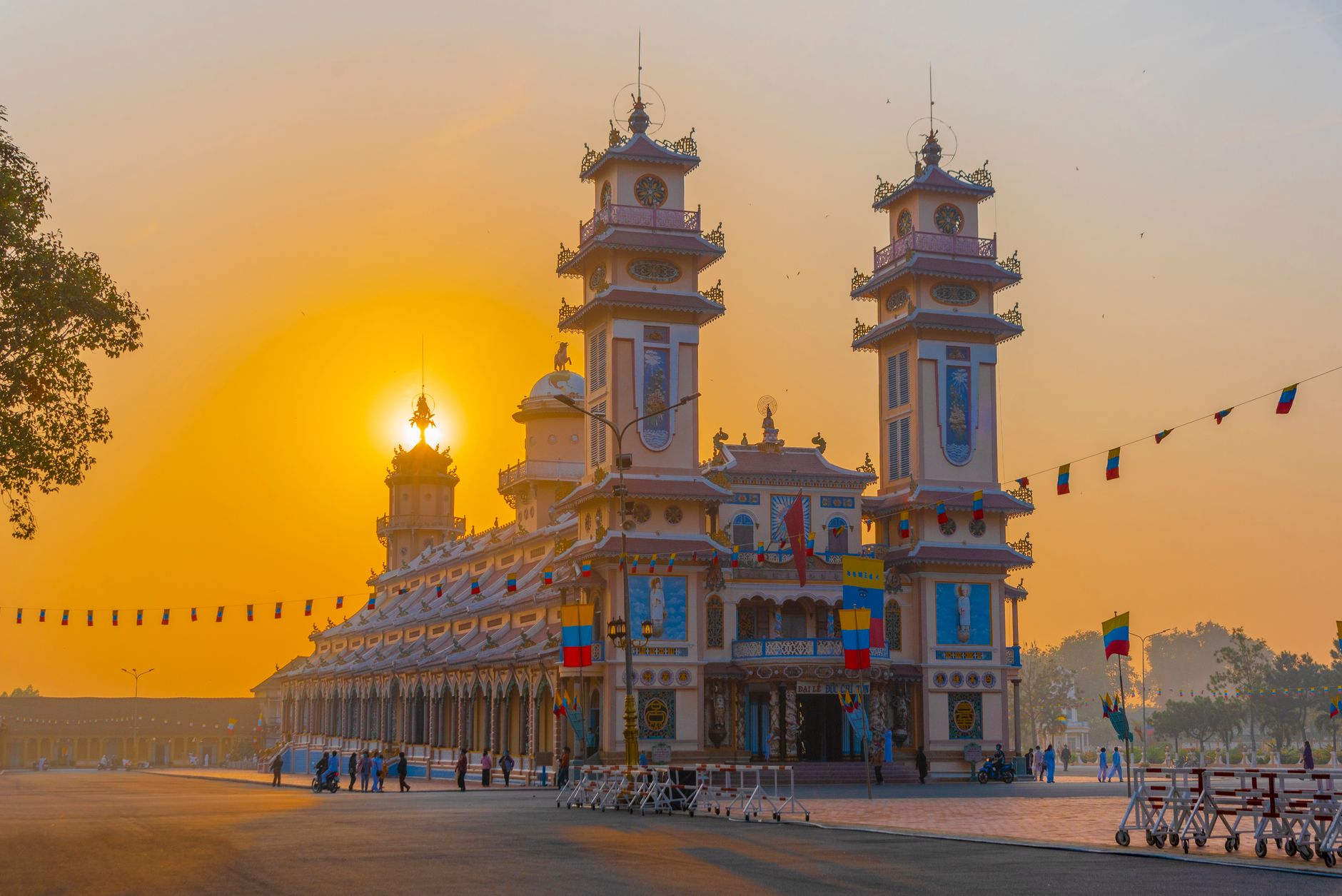
Inside, tree-lined avenues run toward the temple. The wide esplanade in front, the Dai Dong Xa, is where festivals spill out. It is also the only place to get the full façade in one frame. Stand back near the far edge for the shot.
The façade, the two towers and the Hiep Thien Dai
The front section is the Hiep Thien Dai. Two towers flank the entrance, one holding the bell and one the drum. Men enter on the right, women on the left, and the same division applies inside.
Above the portico sits the Divine Eye, framed in a lotus. Look for the Ho Phap statue group honouring Pham Cong Tac, and the seven-headed cobra motifs drawn from Khmer and Cham iconography. This is where you remove your shoes. Carry a bag.
The Three Saints mural
Just inside, a mural shows the three saints of the Third Alliance. Victor Hugo holds a quill. Sun Yat-sen holds an ink stone. Nguyen Binh Khiem holds a brush. The words they are writing are usually given as "God and humanity" for Hugo and "Love and justice" for Sun Yat-sen.
Why a French romantic poet? Because Caodaism's founders were French-educated and saw European literature as one more channel for divine instruction. Hugo's séance writings were well known in Saigon spiritist circles.
The nave of nine levels (Cuu Trung Dai)
The nave rises in nine steps, one for each rank in the celestial hierarchy. Twenty-eight columns wrap in dragon reliefs. The ceiling is painted sky blue with clouds and stars.
Pulpits stand along the sides like minbars in a mosque. The central aisle is reserved for clergy in procession. Visitors walk the side colonnades, not the middle.
The sanctuary and the cosmic globe (Bat Quai Dai)
Eight dragon columns ring the sanctuary. At the centre, a large globe covered in stars carries the Divine Eye. The star count is commonly given as 3,072, though the figure is repeated rather than sourced.
Seven chairs sit at the far end: one for the pope, three for the heads of the legislative bodies, three for the heads of the faith branches. The pope's chair has been empty for decades.
Faint figures of saints line the sanctuary: Sakyamuni, Laozi, Confucius, Guanyin, Quan Cong, Ly Thai Bach, Khuong Tu Nha and Jesus. The exact line-up is worth checking against a temple guide rather than trusting a tour script.
The upstairs gallery
Stairs lead to a gallery that runs the length of the nave. This is the visitor vantage point during prayer, and the only place to see the full length of the hall toward the globe. It fills early. Arrive 30 to 40 minutes before the noon prayer for a front spot.
Beyond the main temple: what most visitors skip
Most tours never leave the main hall. The grounds hold more.
Den Tho Phat Mau, the Temple of the Mother Goddess, is a separate and much quieter sanctuary within the complex. Bao An Tu is the temporary temple used during the construction years. Ho Phap Duong is another side building. The site where Pham Cong Tac's remains rest is also within the grounds.
Which of these side buildings are open on any given day is not consistently published. Ask a warden at the main temple before wandering. Do not assume a closed door means you can open it.
The prayer ceremonies: what actually happens
Four prayers run daily, named for the traditional hours: Ty at 0:00, Meo at 6:00, Ngo at 12:00 and Dau at 18:00. Each is usually cited at around 45 minutes, though the length varies. Verify on the day.
The ceremony is a procession by rank and colour. Clergy file in wearing yellow, blue or red robes depending on their branch. A live orchestra plays traditional string instruments from a side gallery. A choir of young attendants, the dong nhi, kneels and prostrates. Incense rises. The whole thing has a choreography that takes a few minutes to read.
Lonely Planet reports that prayers are suspended during Tet. That has not been independently confirmed here. If you are visiting around Tet, check locally before building a day around a ceremony.
Visitors may watch from the gallery. Do not walk the central aisle, do not talk during prayer, and do not photograph worshippers' faces close up. Follow the wardens.
The noon prayer is the busiest and the most photographed. The 6 pm prayer is calmer, shorter on tourists and closer to what the faith actually feels like in practice.
| Prayer | Time | Crowd | Atmosphere | Practical for day-trippers? |
|---|---|---|---|---|
| Ty | 0:00 | Very small | Quiet, devotional | No |
| Meo | 6:00 | Small | Cool, calm | Only if staying overnight |
| Ngo | 12:00 | Largest, tour buses | Photogenic but crowded | Yes |
| Dau | 18:00 | Moderate | Devotional, warm light | Yes, if staying in Tay Ninh |
How it compares, and who it is (and is not) for
Compared with other Cao Dai temples and nearby sights
There are Cao Dai temples all over southern Vietnam. The Cau Kho temple in Ho Chi Minh City is small and local. Da Nang has its own Cao Dai congregation, a different branch with a different liturgy. Phu Quoc has a temple tied to the faith's origin story.
Tay Ninh is different in scale, in the sanctuary globe, and in its role as the administrative centre of the faith. It is the only one that functions as a pilgrimage destination in its own right.
Nearby, Ba Den mountain offers something else entirely: a Buddhist pilgrimage site with pagodas, a cable car and views over the plain. It is about 15 km from the Holy See and 986 m high, the tallest peak in southern Vietnam.
Who will love it
Readers interested in religion, colonial history and how ideas travel. Architecture and colour photographers, since the pastel façade, the dragon columns and the sky-blue ceiling are unusually photogenic. Anyone curious about how Vietnam absorbed and reworked Western and Chinese ideas into something new.
Who may be disappointed
Travellers expecting ancient heritage. This is a 1930s to 1950s concrete building, not a 10th-century pagoda. Crowd-averse visitors at noon will find the gallery packed and the esplanade hot. Anyone unwilling to spend 5 to 6 hours on the road for about an hour on site will resent the trip. People who struggle in heat should note that you walk barefoot or in socks on tiles and cross a sun-baked esplanade.
The verdict
Worth the detour if the visit is built around a prayer and paired with something else: Cu Chi on the way, or an overnight in Tay Ninh with Ba Den at dawn. A poor use of a short trip if done as a rushed noon-only tour with no context. The building rewards twenty minutes of reading beforehand more than any guidebook paragraph.
Insider tips: timing, season and avoiding the crowds
Attend the 18:00 prayer if you are staying overnight, or the 6:00 prayer if you are up early. Both see far fewer tour groups and far more actual worshippers.
If you go at noon, arrive by 11:20 to 11:30. Tour buses converge between about 11:00 and 12:45, and the gallery fills from the front.
The December to April dry season is the most reliable window. April is the hottest month, often around 35°C. May to November brings afternoon storms, which rarely affect the noon prayer but do soak the esplanade.
Avoid weekends and Vietnamese public holidays if you can. Domestic pilgrim groups arrive in large numbers.
Carry socks for the tiled floor and a plastic bag for your shoes. The marble is hot at midday and cold in the early morning, and there is nowhere obvious to leave footwear.
Most visitors miss the outer elevations. Walk the full perimeter of the temple for the side views, then cross to the Mother Goddess temple.
Festivals and upcoming dates
All dates follow the lunar calendar, so treat the Gregorian dates below as approximate and confirm close to the time.
Founding anniversary (Dai Le Khai Dao), 15th day of the 10th lunar month. Next around 23 November 2026, then around 13 November 2027.
Feast of the Supreme Being, 9th day of the first lunar month. Next around 14 February 2027, since Tet falls on 6 February 2027.
Feast of the Mother Goddess (Hoi Yen Dieu Tri Cung), 15th day of the 8th lunar month. Next around 15 September 2027.
| Festival | Lunar date | Next Gregorian dates | What happens | Warning |
|---|---|---|---|---|
| Dai Le Khai Dao | 15th day, 10th lunar month | ~23 Nov 2026, ~13 Nov 2027 | Founding anniversary, large ceremonies | Tens of thousands of pilgrims, road congestion |
| Feast of the Supreme Being | 9th day, 1st lunar month | ~14 Feb 2027 | New year ceremony, full clergy procession | Accommodation shortages in Tay Ninh |
| Hoi Yen Dieu Tri Cung | 15th day, 8th lunar month | ~15 Sep 2027 | Mother Goddess feast, side temple focus | Pickpocket risk in dense crowds |
Practical information
Tickets and opening hours
Entry is free as of October 2026. Donation boxes are optional and there is no published tariff. The grounds are generally accessible from early morning into the evening. Temple interior access is tied to ceremony schedules and the wardens' discretion. No official published visiting hours could be confirmed, so plan around a prayer rather than a clock.
Parking, last known and changeable: roughly 5,000 VND (about 0.20 USD) for a motorbike and 20,000 to 30,000 VND (about 0.80 to 1.15 USD) for a car.
Dress code and etiquette
Shoulders and knees covered. Hats off. Shoes off at the steps. Men enter on the right, women on the left. Never walk the central nave. Stay silent during prayer. Follow the white-robed wardens' instructions without argument.
| Rule | Detail | Why it matters |
|---|---|---|
| Dress | Shoulders and knees covered | Required at the door |
| Shoes | Removed at the temple steps | Marble floor, no exceptions |
| Entry side | Men right, women left | Applies at every doorway |
| Central aisle | Closed to visitors | Reserved for clergy procession |
| Photography | No flash, no close-ups of worshippers | Wardens enforce this |
| Drones | Authorisation required | Do not fly casually |
Photography and drones
Objects and architecture are generally fine to photograph. Worshippers should not be photographed close up without permission, and the gallery is the accepted vantage point. No flash. Drones require Vietnamese authorisation and permission from the church, so do not fly one casually.
Facilities and accessibility
Toilets, shoe areas, water vendors and vegetarian food stalls are all on site. The gallery and interior involve stairs, and the central aisle is off-limits, so wheelchair access is limited.
How long to allow
1 to 1.5 hours for the main temple with a prayer. 2.5 to 3 hours with the Mother Goddess temple, a walk around the grounds and Long Hoa market.
How to get there
From Ho Chi Minh City
| Mode | Duration | Cost (VND / USD) | Drop-off | Best for |
|---|---|---|---|---|
| Limousine van or bus | 2.5 to 3 hours | 120,000 to 200,000 (5 to 8 USD) | Confirm with driver; Tay Ninh bus station is the default | Budget travellers |
| Grab car one way | 2.5 to 3 hours | 900,000 to 1,400,000 (35 to 55 USD) | Gate of your choice | Small groups |
| Private car with driver | Full day | 1,800,000 to 2,800,000 (70 to 105 USD) | Flexible | Families, combined itineraries |
| Motorbike | 3 to 4 hours | Fuel only | Self-park | Experienced riders only |
Highway 22 carries heavy truck traffic and has a poor safety record. Motorbike only if you are an experienced rider in Vietnam and comfortable with trucks overtaking close.
Ask your limousine driver before departure whether they can drop at or near the Holy See rather than at Tay Ninh bus station. Some will, for a small extra, but it is not guaranteed.
Organised day tours typically combine Cu Chi with the noon prayer. That is the standard format and it works, though it means you see the temple at its most crowded.
From Tay Ninh town centre or the bus station
Grab car: roughly 50,000 to 80,000 VND (about 2 to 3 USD), 10 to 15 minutes. Grab bike or xe om: less, but agree the price before setting off. Walking is not practical from the old city centre, though it is easy from hotels and the market in Long Hoa itself.
All fares above are last known as of October 2026 and change often.
What to combine nearby
Long Hoa market sits right beside the grounds, with vegetarian food and local snacks. It is the obvious lunch stop.
Ba Den mountain, about 15 km away, is the highest peak in southern Vietnam at 986 m, with pagodas and a cable car. Cable car fares change often; check at the ticket office.
On the road back to Ho Chi Minh City, Trang Bang is worth a stop for dew-dried rice paper (banh trang phoi suong) and banh canh Trang Bang, a thick noodle soup. The Cu Chi tunnels fit naturally on the same route.
Suggested plans
Day trip: Cu Chi in the morning, then the noon prayer, then back to the city by late afternoon.
Overnight: the 18:00 prayer, Ba Den at dawn, Long Hoa market for breakfast, then back.
Frequently asked questions
Q: When was Caodaism founded in Tay Ninh? The movement declared itself to the French authorities on 7 October 1926 and held its founding ceremony in November 1926 at the Go Ken pagoda in Tay Ninh. The spiritual origin is usually dated to a vision on Phu Quoc around 1921. The Holy See temple itself was inaugurated in 1955.
Q: What does "Cao Dai" mean in English? It translates literally as high tower or highest palace, a name for the Supreme Being. The full name of the religion is Dai Dao Tam Ky Pho Do, the Great Way of the Third Universal Salvation.
Q: Is there an entrance fee to the Cao Dai Holy See? No. Entry is free as of October 2026. Only parking and optional donations cost money. No official tariff is published, so this could change without notice.
Q: What time is the best ceremony to watch? The noon prayer is easiest on a day trip but the most crowded. The 6 pm prayer is calmer and more devotional if you stay in Tay Ninh overnight. Arrive 30 to 40 minutes early for a gallery spot.
Q: Is the Cao Dai Holy See the tallest building in Tay Ninh? No. Its towers are modest compared with modern buildings, and its significance lies in scale and status rather than height. The province's high point is Ba Den mountain at 986 m, about 15 km away.
Q: Can I visit the Holy See as a day trip from Ho Chi Minh City? Yes, but expect 5 to 6 hours on the road for about 1 to 2 hours on site. Pair it with Cu Chi or Trang Bang, or stay overnight to add the evening prayer and Ba Den mountain.
Q: What should I wear and can I take photos? Cover shoulders and knees, remove hat and shoes, and enter on the side matching your gender. Architecture photos are fine. Photograph worshippers only from the gallery and never with flash.
Q: Is the Holy See open during Tet? Lonely Planet reports that prayers are suspended during Tet. The grounds and temple may still draw many domestic visitors. If you are visiting around Tet, check locally before building a day around a ceremony.