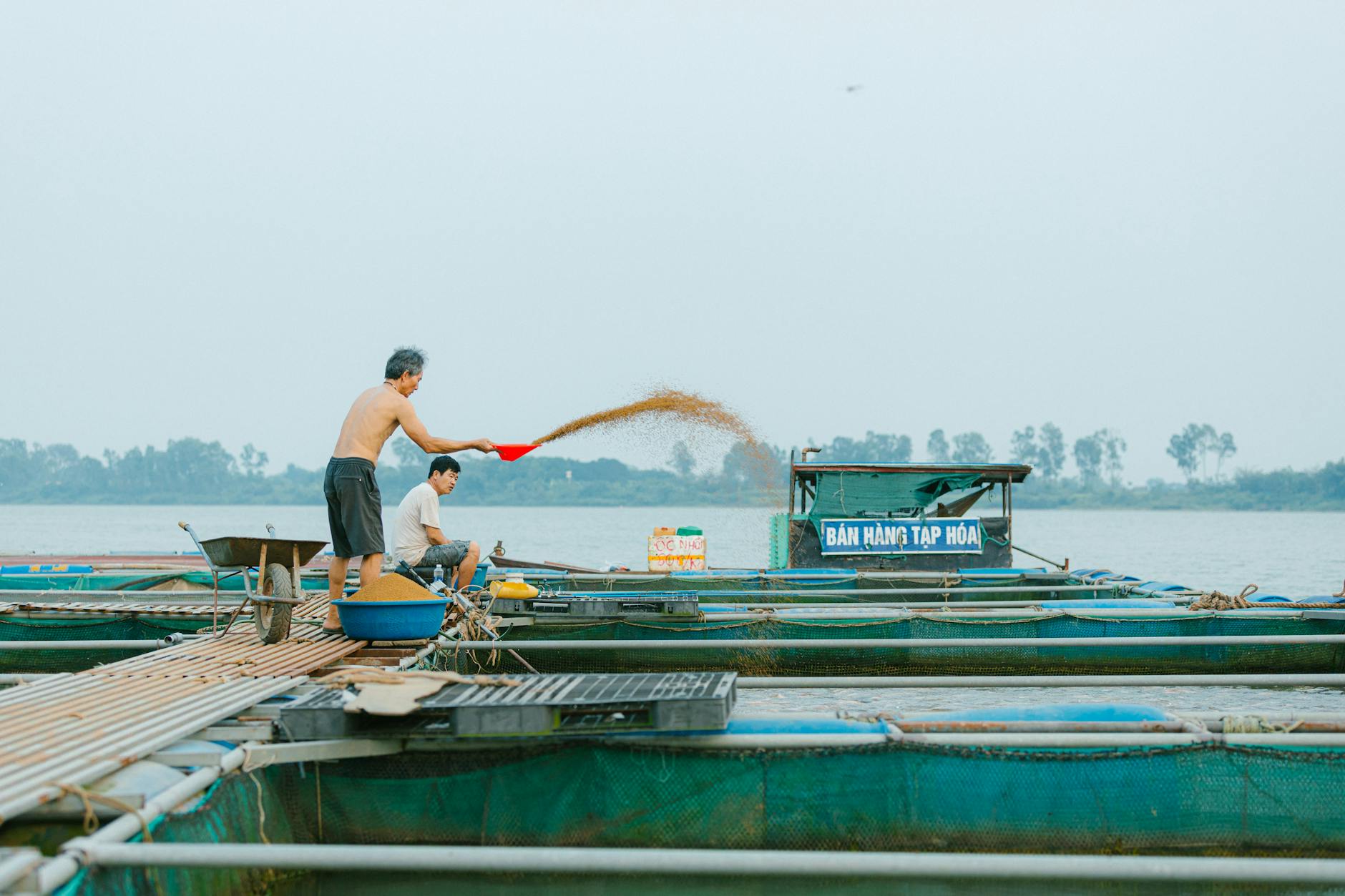
What is Cai Beo fishing village and why visit
Cai Beo fishing village sits 1.5 kilometers southeast of Cat Ba town. It is a 5-minute boat ride from Beo Pier. Roughly 400 families live here on floating houses tethered to the limestone karsts of Lan Ha Bay.
The village is widely considered Vietnam's oldest fishing settlement. Archaeological evidence found here dates back 4,000 to 7,000 years. French archaeologist Madeleine Colanim discovered the site in 1938. Excavations revealed ancient kitchen sites, stone tools, ceramic shards, and animal bones.
What makes Cai Beo different from other floating villages is authenticity. This is not a tourist reconstruction. People still live here. They still fish, raise fish in cages, and send their children to school by boat. The village has electricity from mainland cables and some modern conveniences. But the core of daily life remains tied to the water.
For travelers, Cai Beo offers a rare glimpse into a maritime culture that has existed for millennia. It is small enough to visit in an hour or two. It is close enough to Cat Ba town to require no major logistical effort. And it sits in Lan Ha Bay, which is quieter and less crowded than Halong Bay.
How to get to Cai Beo fishing village from Hanoi
The journey from Hanoi to Cai Beo takes 3.5 to 4 hours. Multiple bus companies run this route daily.
Bus options from Hanoi:
| Company | Duration | Cost (VND) | Cost (USD) | Comfort Level |
|---|---|---|---|---|
| Cat Ba Express | 3.5-4 hours | 250,000-350,000 | 10-15 | Good, air-conditioned |
| Good Morning Bus | 3.5-4 hours | 280,000-380,000 | 12-16 | Good, includes ferry |
| Daichi | 3.5-4 hours | 250,000-350,000 | 10-15 | Standard, reliable |
All buses depart from Hanoi's Old Quarter. They include the ferry crossing from Hai Phong to Cat Ba Island. The bus drops passengers near Beo Pier on request. Otherwise, it ends at Cat Ba town center, a 10-minute walk or short taxi ride from the pier.
A 7:30 AM departure from Hanoi arrives at Cat Ba town around 11:00 to 11:30 AM. This gives you the afternoon to visit the village.
Pro tip: Book your return bus ticket in advance. Afternoon buses from Cat Ba to Hanoi fill up quickly, especially on weekends.
For travelers arriving by other means, see our guide on how to get around Cat Ba Island.
Getting from Cat Ba town to the village by boat
From Beo Pier, you need a boat to reach Cai Beo. Private motorboats are the standard option.
Boat options from Beo Pier:
| Type | Capacity | Cost (VND) | Cost (USD) | Duration | Flexibility |
|---|---|---|---|---|---|
| Private motorboat | 4-6 passengers | 800,000-1,200,000 | 33-50 | 5 minutes | High, stop anywhere |
| Shared tour boat | 15-30 passengers | Included in tour | Included in tour | Varies | Low, fixed route |
| Kayak | Not permitted | N/A | N/A | N/A | N/A |
Private boats are preferable. They are small enough to navigate the narrow channels between floating houses. They let you stop at individual homes or fish farms. The driver will wait while you explore.
The round trip cost of VND 800,000 to 1,200,000 covers the boat and driver for up to 2 hours. Negotiate the price before boarding. Some drivers include the Lan Ha Bay entrance fee in their price. Others add it separately. Confirm this upfront.
You can combine the boat trip with a visit to Monkey Island Cat Ba. Most drivers will agree to this for an additional fee.
Entrance fees and permits
The only fee for visiting Cai Beo is the Lan Ha Bay entrance fee.
| Item | Cost (VND) | Cost (USD) | Notes |
|---|---|---|---|
| Lan Ha Bay entrance fee | 80,000 | 3.30 | Per person, paid at Beo Pier |
| Village-specific fee | None | None | No separate charge as of 2026 |
There is no additional village entrance fee as of 2026. This may change. Entrance fees in Vietnam have increased in recent years.
Some boat operators include the entrance fee in their price. Others add it separately. Ask before you agree on a price.
History and archaeological significance
Cai Beo is not just a pretty floating village. It is one of the most important archaeological sites in northern Vietnam.
French archaeologist Madeleine Colanim discovered the site in 1938. She found evidence of a prehistoric settlement that predates the Dong Son culture. Excavations in the following decades revealed two ancient kitchen sites, 137 stone tools, 1,424 ceramic shards, and 568 animal bones.
The name "Cai Beo" means "huge coastal bay" in Vietnamese. This reflects its historical role as a sheltered harbor for prehistoric people. The site shows continuous human habitation from the Neolithic period through the Metal Age.
During the Vietnam War, the area was heavily bombed by US aircraft. In 1972, Vietnamese archaeologists returned to the site and found additional fishing nets and stone tools. These artifacts are now displayed at the Cat Ba Museum.
The actual excavation site is not open to casual visitors. You cannot dig or handle artifacts. But the museum in Cat Ba town has a small collection worth seeing.
Note: The Cat Ba Museum is located in Cat Ba town center. It is open daily from 8 AM to 5 PM. Admission is free.
What life is like in the floating village today
The romantic image of traditional fishing villages ignores the reality of change. Cai Beo in 2026 is not what it was 20 years ago.
About 400 families live here. Water depth averages 4 meters (13 feet). Houses are built on bamboo rafts or concrete pontoons. Electricity comes from mainland cables. Fresh water is delivered by boat.
Fish farming is the main economic activity. Families raise groupers, snappers, and sea bass in submerged cages. Squid fishing with light bulbs at night is still practiced but less common. Tourism provides supplementary income for some families.
Children attend school on the mainland. They commute by boat every morning and afternoon. Younger generations often move to Cat Ba town or further away for work. The village population is aging.
The reality includes limited fresh water, reliance on generators, and the constant maintenance required for floating structures. Life here is hard work. It is not a picturesque escape from modernity.
Tourism has changed the economy. Some families now charge visitors for photo opportunities or sell snacks from their homes. This is not exploitation. It is adaptation. Visitors should understand that what they see is a living community adjusting to new realities, not a preserved museum piece.
Things to do in Cai Beo fishing village
Take a boat tour through the village
The main activity is simply floating through the village. Your boat will pass floating fish farms, colorful houseboats, and floating restaurants. Private motorboat tours allow stopping at individual homes.
If you visit a family home, a small gift of VND 100,000 (USD 4) is customary. This is not mandatory but appreciated.
Visit fish farms and learn about aquaculture
Local families raise fish in submerged cages. You can see the feeding process and learn about the economics of fish farming. This is observation only. Do not touch or feed the fish.
Join a fishing trip with local fishermen
Available through guided tours only. Rod fishing or net casting. Life jackets are provided. Suitable for families with children. Duration is typically 1 to 2 hours.
Eat at a floating restaurant
Fresh seafood caught that day. Grilled fish, steamed clams, squid, jellyfish salad. Open-air setting with sunset views. Prices are higher than mainland restaurants. Expect VND 200,000 to 400,000 (USD 8 to 17) per person for a meal.
Photography and scenic appreciation
The village at sunrise or late afternoon offers the best light. Floating houses against limestone karsts create dramatic compositions. Early morning before 9 AM has fewer tourist boats.
Visit the archaeological site (limited access)
The actual excavation site is not open to casual visitors. Some artifacts are displayed at the Cat Ba Museum in town. This section manages expectations. Tourists cannot dig or handle artifacts.
Best time to visit Cai Beo fishing village
Seasonal breakdown:
| Season | Weather | Crowds | Sea Conditions | Photography |
|---|---|---|---|---|
| May to September | Warm, some rain | Moderate | Calm | Good, clear water |
| October to April | Cool, clear skies | Low to moderate | Occasional rough seas | Excellent |
| July to August | Hot, humid | Peak crowds | Calm | Good but crowded |
Daily timing:
- Sunrise (5:30 to 6:30 AM): Most peaceful experience. Fewer boats. Best light.
- 9:30 AM or 1:30 PM: Avoid the worst crowds.
- Late afternoon (after 3 PM): Good light. Fewer tour boats.
Avoid midday between 10 AM and 1 PM if possible. This is when most tour boats arrive from Halong Bay.
How to visit responsibly
Cai Beo is a real community. Treat it with respect.
- Do not touch or feed fish in the cages.
- Ask permission before photographing people. A smile and a nod usually works.
- The VND 100,000 gift when visiting a home is not mandatory but appreciated.
- Do not leave trash. There is no waste management system in the village.
- Avoid single-use plastics. Bring a reusable water bottle.
- Respect that this is a real community, not a theme park.
Safety and practical concerns
- Life jackets are required on boats. Check they are available and in good condition.
- Motion sickness is common on the boat ride from Cat Ba. Bring medication if you are prone to it.
- Sun protection is essential. Sunscreen, hat, sunglasses.
- Mosquito repellent is needed at dawn and dusk. See our guide on mosquitoes, dengue and malaria in Vietnam.
- Floating houses have uneven walkways. Wear sturdy footwear.
- No medical facilities in the village. The nearest clinic is in Cat Ba town.
For general safety information, read our Vietnam safety assessment.
Comparing Cai Beo with other floating villages in the region
| Village | Location | Size | Accessibility | Best for |
|---|---|---|---|---|
| Cai Beo | Lan Ha Bay (Cat Ba) | 400 families | 5 min from Beo Pier | History, authenticity |
| Cua Van | Halong Bay | ~150 families | 20 km from mainland | Scenic beauty, cultural center |
| Vung Vieng | Bai Tu Long Bay | ~100 families | 25 km from mainland | Peace, pearl farming |
| Ba Hang | Halong Bay | Small | Near Thien Cung Cave | Easy access from cruises |
Cai Beo is the best choice for travelers based on Cat Ba Island. It is the oldest and most authentic. Cua Van is more scenic but requires a longer boat ride. Vung Vieng is quieter but harder to reach. Ba Hang is convenient for cruise passengers but feels more touristy.
Estimated costs for a visit
| Item | Cost (VND) | Cost (USD) | Notes |
|---|---|---|---|
| Bus Hanoi to Cat Ba (round trip) | 500,000-700,000 | 21-30 | Per person |
| Private boat from Beo Pier (round trip) | 800,000-1,200,000 | 33-50 | For 4-6 people |
| Lan Ha Bay entrance fee | 80,000 | 3.30 | Per person |
| Meal at floating restaurant | 200,000-400,000 | 8-17 | Per person |
| Gift for family visit | 100,000 | 4 | Optional |
| Total per person (with 3 others sharing boat) | 500,000-800,000 | 21-33 | Excluding transport to Cat Ba |
Common questions about Cai Beo fishing village
Q: Is kayaking allowed in Cai Beo?
Kayaking is prohibited in the village area due to fish farm equipment and narrow channels. Kayaking is available elsewhere in Lan Ha Bay.
Q: Can you stay overnight in the village?
No. There are no homestays or guesthouses in the floating village. Overnight options are on cruise boats in Lan Ha Bay or hotels in Cat Ba town. See our guide on Lan Ha Bay cruise from Cat Ba.
Q: Is the village suitable for children?
Yes, with supervision. The boat ride is short. Fishing activities are child-friendly. Life jackets are essential.
Q: How much time should you spend here?
One to two hours is sufficient for most visitors. A half-day trip combining the village with Monkey Island is popular.
Q: What are the floating towns in Vietnam?
The most well-known floating fishing villages in northern Vietnam include Cai Beo on Cat Ba Island (Lan Ha Bay), Cua Van and Ba Hang in Halong Bay, and Vung Vieng in Bai Tu Long Bay. Each has its own character and accessibility.
Q: Which is the oldest fishing village in Vietnam?
Cai Beo fishing village on Cat Ba Island is considered the oldest. Archaeological evidence of human settlement dates back 4,000 to 7,000 years.
Q: Is Cai Beo fishing village worth visiting?
Yes, for travelers interested in authentic maritime culture and archaeology. The village offers a rare glimpse into life on the water. It is a small destination. One to two hours is sufficient unless combined with other Lan Ha Bay activities.
Q: What is the best time of day to visit Cai Beo?
Early morning before 9 AM or late afternoon after 3 PM for fewer crowds and better light. Avoid midday when tour boats arrive in large numbers.