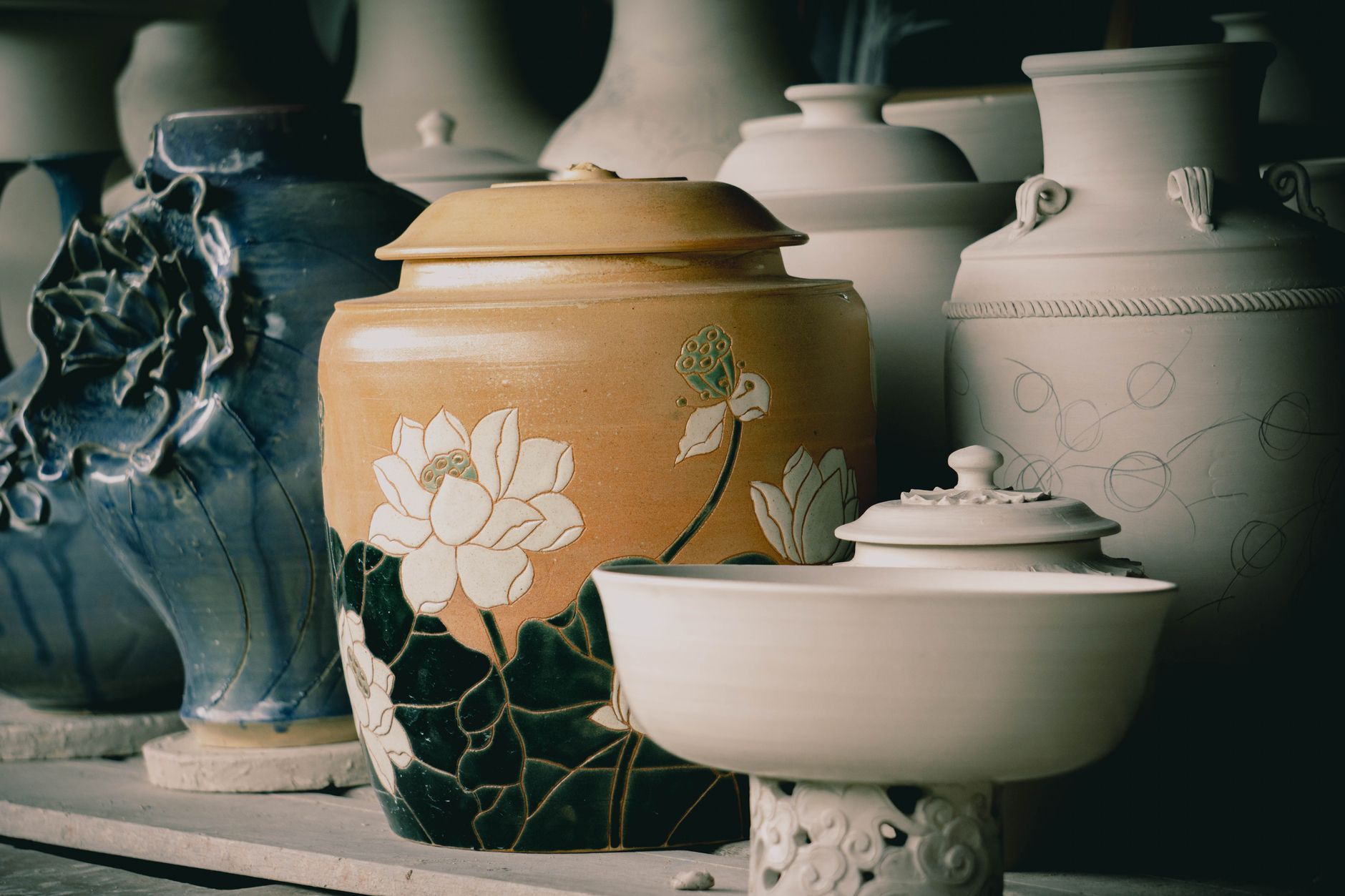
For more than 700 years, this small commune has produced the ceramics that grace Vietnamese homes, temples, and tea tables. The name itself comes from the two professions that founded it: "bat" means bowl, and "trang" means yard. Bowl yard. The name has stuck because the craft never left.
A history written in clay
The origins of Bat Trang trace to the Tran Dynasty in the 1300s. According to village records, potters from the nearby Red River Delta migrated here after their original homes flooded. They chose this spot deliberately. The river provided transport, the surrounding fields offered clay, and the location sat close enough to the imperial capital at Thang Long (now Hanoi) to supply the royal court.
By the 15th century, Bat Trang ceramics had become the standard for Vietnamese royalty. The Le Dynasty commissioned large stoneware jars, roof tiles, and ritual objects. The village's signature glaze, a deep celadon green, became instantly recognizable across the region.
The 17th and 18th centuries brought trade. Japanese merchants, Dutch traders, and Chinese junks all stopped at the Red River ports to load Bat Trang ceramics. Pieces traveled as far as Japan, where tea masters prized the thick, rustic bowls. The village adapted its designs for export, creating blue-and-white wares that echoed Chinese styles but carried distinctly Vietnamese motifs.
The French colonial period changed everything again. Industrial production methods arrived, and Bat Trang faced competition from European factories. The village survived by shifting toward architectural ceramics. Roof tiles, floor tiles, and decorative elements for the new French buildings in Hanoi all came from Bat Trang's kilns. This period also saw the introduction of the dragon-shaped kiln, a long, sloping structure that could fire hundreds of pieces at once.
The war years were hard. Ceramic production dropped, and many families abandoned the craft for more practical work. But the village never fully stopped. After 1986, when Vietnam's Doi Moi economic reforms opened the country to markets, Bat Trang roared back. Today, over 80 percent of the village's 20,000 residents work in ceramics in some capacity.
Walking the village lanes
Bat Trang is not a museum. It is a working community, and the streets reflect that. Motorcycles loaded with clay slabs weave between shops. Elderly women sit on low stools, painting floral patterns on teapots with fine brushes. The air smells of damp earth and coal smoke from the kilns.
The main street, Bat Trang 1, runs through the center of the village. This is where most of the showrooms cluster. Behind the polished displays, however, lie the real workshops. A quick turn down any side alley reveals the production areas: open-air sheds where workers shape clay on spinning wheels, drying racks stacked with greenware, and the iconic kilns themselves.
Most workshops welcome visitors. A polite smile and a nod usually suffice as an invitation. Photography is generally fine, but always ask first. Some families have become accustomed to tourists and will happily explain their process. Others prefer to work in peace. Respect the boundary.
The village also has a small ceramic museum, located in a restored traditional house near the center. It costs 20,000 VND ($0.80) to enter. The collection includes archaeological finds from the village's early period, examples of royal ceramics, and contemporary works by local artists. It takes about 30 minutes to walk through and provides useful context for the shopping that follows.
Getting your hands dirty: pottery classes
The best way to understand Bat Trang is to try making something yourself. Several workshops offer hands-on classes for visitors. The experience typically lasts 60 to 90 minutes and includes instruction from a local potter.
Van Ho Pottery, one of the most established workshops, offers classes for 150,000 VND ($6) per person. The process starts with a demonstration. The potter takes a lump of clay, centers it on the wheel with practiced ease, and pulls it into a cylinder. Then it is your turn.
Expect to fail. The wheel spins faster than it looks, and the clay has its own ideas about shape. The instructors are patient. They will rescue your collapsing cylinder, reshape it, and hand it back. After a few attempts, most visitors manage something vaguely bowl-shaped.
After shaping, you can decorate your piece. The workshop provides paints and brushes. This is where personalities emerge. Some visitors paint intricate dragons. Others write their names in wobbly Vietnamese script. A few simply smear paint and call it abstract art.
Your finished piece gets fired and glazed. The entire process takes about a week. If you are leaving Hanoi before then, the workshop can ship internationally for an additional fee. Shipping to the United States or Europe costs around 500,000 to 800,000 VND ($20 to $32), depending on size.
For those who want a quicker souvenir, many shops sell "seconds" at steep discounts. These are pieces with minor flaws, a slightly off-center spout or a hairline crack in the glaze. They cost 30 to 50 percent less than perfect pieces and function just fine.
What to buy and how to shop
Bat Trang offers ceramics at every price point. A simple bowl costs 10,000 VND ($0.40). A hand-painted tea set with a dragon motif runs 500,000 to 1,500,000 VND ($20 to $60). Large decorative vases can reach 5,000,000 VND ($200) or more.
The key is knowing what you are looking at. Mass-produced items, made with molds and transfer-printed patterns, fill the front shelves of most shops. These are fine for everyday use but lack the character of handcrafted pieces. Look for slight irregularities in shape and glaze. Those imperfections signal human hands.
Hand-painted items carry higher prices but also higher quality. The painting style in Bat Trang ranges from traditional blue-and-white to more contemporary designs. The village has also gained a reputation for its "worm" glaze, a textured surface that resembles the tracks of worms in wet sand. This distinctive finish appears on high-end pieces and makes a memorable souvenir.
Shopping in Bat Trang requires negotiation, but the rules are simple. The initial asking price usually includes a 20 to 30 percent markup. Offer about 70 percent of the quoted price and go from there. Both sides expect a bit of back-and-forth. Keep it friendly and smile. If the seller refuses your offer, walk away slowly. They will often call you back.
For serious buyers, visit the workshops rather than the showrooms. The prices are lower, and the selection is more interesting. Many families sell directly from their production areas. You might find pieces that never made it to the display shelves.
| Item | Showroom price | Workshop price | Quality notes |
|---|---|---|---|
| Simple bowl | 15,000-30,000 VND ($0.60-$1.20) | 10,000-20,000 VND ($0.40-$0.80) | Mass-produced, mold-made |
| Hand-painted teapot | 300,000-800,000 VND ($12-$32) | 200,000-500,000 VND ($8-$20) | Check glaze consistency |
| Decorative vase (30 cm) | 800,000-2,000,000 VND ($32-$80) | 500,000-1,500,000 VND ($20-$60) | Inspect for firing cracks |
| Worm glaze bowl | 200,000-500,000 VND ($8-$20) | 150,000-350,000 VND ($6-$14) | Signature Bat Trang finish |
| Tea set (6 pieces) | 1,000,000-3,000,000 VND ($40-$120) | 700,000-2,000,000 VND ($28-$80) | Hand-painted sets cost more |
Getting there and practical logistics
Bat Trang sits across the Red River from central Hanoi, in Gia Lam district. The most straightforward way to reach it is by bus 47, which departs from Long Bien station near the Old Quarter. The journey takes about 45 minutes and costs 8,000 VND ($0.30). Get off at the Bat Trang stop, which is clearly marked.
A Grab car from the Old Quarter costs 150,000 to 250,000 VND ($6 to $10) each way. The ride takes 30 to 45 minutes depending on traffic. For a more adventurous option, rent a motorbike and follow the signs across Chuong Duong Bridge. The route is straightforward, and parking at the village costs 10,000 VND ($0.40).
The village is compact enough to explore on foot. Most visitors spend two to three hours browsing shops and visiting workshops. Those taking a pottery class should budget four hours total.
Weekday mornings are the best time to visit. The workshops are fully staffed, the kilns are active, and the crowds are thin. Weekends bring tour buses from Hanoi, and the main street can get congested. The village is also worth visiting during Tet, when ceramic decorations for the holiday flood the market.
Beyond the ceramics
Bat Trang offers little beyond pottery, but that is its charm. The village is refreshingly single-minded. There is no fake "traditional village" performance, no staged cultural show. Just people making ceramics, as they have for centuries.
A few food stalls line the main street, serving simple Vietnamese fare. The breakfast options include banh cuon (steamed rice rolls) and pho. A bowl of noodle soup costs 30,000 to 50,000 VND ($1.20 to $2). The food is honest and filling, perfect for a half-day trip.
For those interested in Vietnamese traditional art, Bat Trang offers a tangible connection to centuries of craft. The village sits at the intersection of function and beauty, where everyday objects become carriers of culture. That is worth more than any museum display.
Planning around the weather
Bat Trang is an all-weather destination. The workshops operate under covered roofs, and the showrooms are enclosed. Rain does not stop production. The village is a good option on days when Hanoi's rainy season makes outdoor sightseeing miserable.
Summer months (May to September) bring heat and humidity. The kilns add their own warmth, making the workshops noticeably hotter than the streets. Visit early in the morning or late in the afternoon to avoid the worst of it. Winter (November to February) is cooler and more comfortable, though the village gets busier around Tet when locals stock up on holiday ceramics.
The village pairs well with other destinations in the area. Van Phuc silk village sits about 10 kilometers away and makes a natural second stop. The two villages cover different crafts but share a similar atmosphere. A full day trip covering both is feasible with a private car or motorbike.
For visitors planning longer journeys, Bat Trang works as a half-day add-on to any Hanoi itinerary. It is close enough to the city that it does not require extensive planning. The village also fits neatly into a weekend getaway from Hanoi, especially when combined with other Red River Delta attractions.
The future of an ancient craft
Bat Trang faces the same pressures as any traditional craft village in Vietnam. Younger generations are moving to Hanoi for office jobs. Cheap factory ceramics from China undercut local prices. The village has responded by moving upmarket, emphasizing quality and design over volume.
Contemporary artists have established studios in Bat Trang, pushing the craft in new directions. Their work appears in galleries in Hanoi and Ho Chi Minh City. The village has also embraced tourism, not as a primary industry but as a complement to production. The pottery classes, the workshops, the open kilns all serve to connect visitors with the process.
The result is a village that feels authentic because it is. Bat Trang has not become a theme park version of itself. The ceramics are still made for real use, in real kilns, by real craftspeople. Visitors are guests in a working community, not spectators at a performance.
That authenticity is the village's greatest asset. In a country where tourist attractions sometimes feel manufactured, Bat Trang offers something genuine. Seven hundred years of craft, still alive, still evolving, still shaped by human hands.
FAQ
Q: How do I get to Bat Trang from Hanoi? Take bus 47 from Long Bien station for 8,000 VND ($0.30), about 45 minutes. A Grab car costs 150,000 to 250,000 VND ($6 to $10) each way. Motorbike rental is also possible, with parking available at the village entrance.
Q: How much does a pottery class cost in Bat Trang? Most workshops charge 100,000 to 200,000 VND ($4 to $8) per person for a 60 to 90 minute session. This includes materials, instruction, firing, and glazing. Shipping your finished piece internationally costs extra.
Q: What is the best day to visit Bat Trang? Weekday mornings are ideal. The village is quieter, workshops are fully staffed, and you can browse without crowds. Weekends bring tour buses from Hanoi, especially during peak season from November to March.
Q: Can I buy ceramics directly from the workshops? Yes. Many families sell directly from their production areas at prices 20 to 40 percent lower than showrooms. Walk down the side alleys off the main street and look for open doors with drying racks outside.
Q: Is Bat Trang suitable for children? The pottery classes work well for kids aged 6 and up. The hands-on nature of the activity keeps them engaged. The village streets are safe and walkable, though watch for motorcycles in the narrow lanes.
Q: How long should I spend in Bat Trang? Two to three hours is enough to browse the shops and visit a workshop. Add another hour if you take a pottery class. The village makes a good half-day trip from Hanoi, especially when combined with nearby Van Phuc silk village.
Q: Are the ceramics in Bat Trang good quality? Quality varies widely. Mass-produced items are fine for everyday use. Hand-painted pieces with the signature worm glaze represent the village's best work. Inspect pieces for cracks, check glaze consistency, and buy from workshops rather than showrooms for the best value.