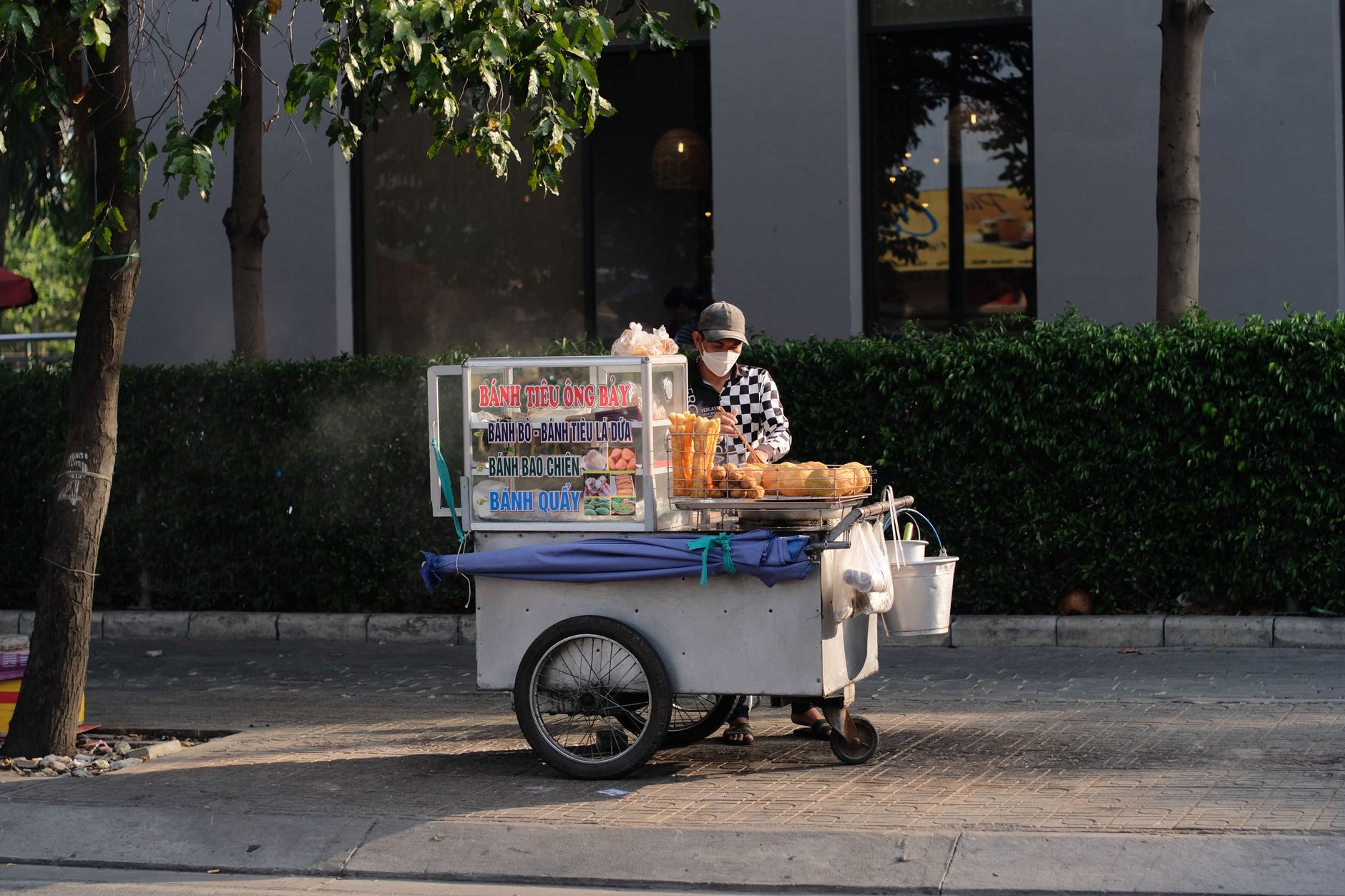
Forget cereal, toast, or eggs benedict. The Vietnamese morning meal is a savory, aromatic, and profoundly satisfying affair. It happens on the sidewalk, on a child-sized plastic stool, with a bowl of broth that has simmered since midnight. It costs less than a dollar. And it is one of the great culinary experiences in Southeast Asia.
This guide covers what locals actually eat for breakfast, how to order, what to pay, and where to find the best versions across Vietnam. No hotel buffets here. Just real street food, eaten the way Vietnamese people have eaten it for generations.
Pho: the 6am ritual
Pho is not just a dish. It is a national institution. In Vietnam, pho is primarily a breakfast food. The best bowls are consumed before 8am, when the broth is freshest and the beef is at its most tender.
A proper pho breakfast starts with the broth. Beef bones, charred onion, ginger, star anise, cinnamon, and clove simmer for eight to twelve hours. The result is a clear, amber liquid that tastes of depth rather than fat. Vendors begin heating their stocks around 4am. By 6am, the first customers arrive.
Two main versions exist. Pho bo (beef pho) is the classic. You choose your cuts: tai (rare slices), chin (brisket), nam (flank), or gau (fatty brisket). Pho ga (chicken pho) is lighter, with shredded chicken and a clearer broth. Northern pho (Hanoi style) uses wider noodles and a more restrained broth. Southern pho (Saigon style) adds more herbs, bean sprouts, and hoisin sauce.
How to order: Walk up, sit down, and say "Mot pho bo tai" (one beef pho with rare meat). The vendor will ask "Lon hay nho?" (big or small). Go big. It costs 40,000 to 60,000 VND ($1.60 to $2.40).
Pro tip: Do not dump all the herbs and lime into the bowl at once. Taste the broth first. Add condiments gradually. The broth is the star. Respect it.
Where to eat: In Hanoi, head to Pho Thin at 13 Lo Duc Street. In Saigon, Pho Hoa at 260C Pasteur Street has served the same recipe since 1968. For a deeper dive into Vietnamese noodle soups beyond pho, read Beyond Pho: 15 Vietnamese Noodle Soups You've Never Heard Of.
Banh mi: the portable morning sandwich
Banh mi is Vietnam's most famous street food export. But the version tourists eat for lunch is not how locals start their day. Morning banh mi is simpler. It is faster. And it is often eaten on the back of a motorbike while weaving through traffic.
The morning banh mi cart appears at dawn. A woman sets up a glass case on a bicycle. Inside are baguettes, pate, cold cuts, pickled carrots and daikon, cucumber slices, cilantro, and chili. She pulls a baguette from a basket, slices it lengthwise, and spreads a generous layer of pork pate. She adds the cold cuts, the pickles, the herbs. A splash of soy sauce. A squirt of Sriracha. Wrapped in newspaper and handed over in thirty seconds.
The baguette itself has a story. It arrived with French colonizers in the 19th century. Vietnamese bakers adapted it, using rice flour to create a lighter, airier interior with a paper-thin, shatteringly crisp crust. For more on this colonial legacy, see French colonial heritage in Vietnam: architecture, history and where to find it.
How to order: Point at the ingredients you want. Say "Khong ot" (no chili) if you cannot handle heat. Standard banh mi costs 15,000 to 30,000 VND ($0.60 to $1.20).
Where to eat: Banh Mi Huynh Hoa at 26 Le Thi Rieng Street in Saigon is legendary. Expect a queue. In Hanoi, Banh Mi 25 at 25 Hang Ca Street serves an excellent version. For a full breakdown of regional styles, read Banh Mi Guide: The 7 Best Types of Vietnamese Sandwich and Where to Eat Them.
Xoi: sticky rice with everything
Xoi (sticky rice) is the breakfast of workers. It is dense, filling, and cheap. A portion costs 10,000 to 25,000 VND ($0.40 to $1.00). It keeps you full until lunch without fail.
The base is glutinous rice steamed until tender and chewy. Vendors serve it in a banana leaf or a small Styrofoam box. Toppings vary by region. The most common is xoi man (savory sticky rice) topped with shredded chicken, Chinese sausage, fried shallots, and a dusting of dried shrimp. Xoi thit kho comes with caramelized pork belly and a slice of Vietnamese pork roll. Xoi ga has shredded chicken and a drizzle of chicken fat.
In the northern mountains, xoi is often colored with natural dyes. Red from gac fruit. Purple from black sticky rice. Green from pandan leaf. These colorful versions are common at markets in places like Bac Ha and Dong Van. For more on these markets, see Complete Guide to Bac Ha, Vietnam: Market, Ethnic Groups, and Authentic Experiences (2026).
How to order: "Mot xoi man" gets you one portion of savory sticky rice. The vendor will ask if you want it with or without toppings. Say "Co het" (with everything) for the full experience.
Where to eat: Xoi Yen at 35B Nguyen Huu Huan Street in Hanoi is a local institution. In Saigon, Xoi Ba Chieu at 254B Nguyen Trai Street serves a legendary version with pork floss and pate.
Banh cuon: the steamed rice rolls
Banh cuon is the delicate breakfast. Thin sheets of rice batter are steamed on a cloth stretched over a pot of boiling water. The batter sets in seconds. The vendor uses a bamboo stick to lift the translucent sheet, places it on a plate, and fills it with seasoned ground pork and wood ear mushrooms. The roll is folded, topped with fried shallots, and served with a side of Vietnamese sausage (cha lua) and fresh herbs.
The dipping sauce is the key. Nuoc cham (fish sauce with lime, sugar, garlic, and chili) is diluted and sweetened. It should be salty, sour, sweet, and spicy in equal measure. A bowl of banh cuon costs 30,000 to 50,000 VND ($1.20 to $2.00).
Banh cuon has Chinese origins but became thoroughly Vietnamese over centuries. The technique of steaming rice batter on cloth is unique to northern Vietnam. For more on how food traditions evolve, see What is traditional Vietnamese art? A complete guide for travelers.
How to order: "Mot dia banh cuon" (one plate of banh cuon). Add "Them cha lua" (add pork roll) if you want extra protein.
Where to eat: Banh Cuon Ba Hanh at 15B Cao Thang Street in Saigon. In Hanoi, Banh Cuon Gia Truyen at 14 Hang Ga Street has been serving the same recipe since 1995.
Ca phe sua da: the mandatory morning coffee
No breakfast in Vietnam is complete without coffee. Ca phe sua da (iced milk coffee) is the default. Strong, dark, bitter robusta coffee drips through a small metal filter (phin) into a glass. At the bottom, a layer of sweetened condensed milk waits. When the drip finishes, you stir the two together and pour over ice.
The result is a drink that is simultaneously bitter and sweet, hot and cold. It delivers a caffeine jolt that makes Vietnamese mornings bearable in the tropical heat. A glass costs 15,000 to 25,000 VND ($0.60 to $1.00).
For a full guide to Vietnam's coffee culture, including egg coffee, coconut coffee, and salt coffee, read Vietnamese Coffee Decoded: Ca Phe Sua Da, Egg Coffee, Coconut & Salt Coffee.
Pro tip: Do not ask for milk coffee without specifying "sua" (condensed milk). "Ca phe den" is black coffee. "Ca phe sua" comes with condensed milk. "Ca phe sua da" is iced milk coffee. Ordering "ca phe sua nong" gets you a hot version.
How to eat like a local: the etiquette of the morning meal
Breakfast in Vietnam follows unspoken rules. Learn them. They make the experience smoother and more respectful.
Sit on the small stool. The plastic stool is not a compromise. It is the standard. Your knees will be higher than your hips. Your back will be straight. This position is designed for quick eating. Do not complain. Adapt.
Eat fast. Breakfast is not a lingering affair. Locals finish their bowl in ten minutes. The vendor needs the stool for the next customer. Eat, pay, leave.
Pay before you leave. Some vendors expect payment after eating. Others want it upfront. Watch what locals do. When in doubt, ask "Bao nhieu?" (how much) and pay after finishing.
Use chopsticks and spoon. The chopsticks are for noodles. The spoon is for broth. Do not lift the bowl to your mouth. That is considered less refined in Vietnam.
Do not tip. Tipping is not expected at street food stalls. Locals do not do it. If you insist, round up to the nearest 5,000 VND. For a full guide, read Tipping in Vietnam 2026: When It's Insulting, When It's Expected.
Breakfast across Vietnam: a regional guide
| City | Signature breakfast | Price range | Where to go |
|---|---|---|---|
| Hanoi | Pho bo, banh cuon, xoi | 20,000-50,000 VND | Old Quarter streets |
| Saigon | Banh mi, com tam, hu tieu | 15,000-40,000 VND | District 1 sidewalks |
| Hue | Bun bo Hue | 30,000-50,000 VND | Around Dong Ba Market |
| Hoi An | Cao lau, mi quang | 25,000-45,000 VND | Old Town alleys |
| Da Nang | Mi quang, banh xeo | 20,000-40,000 VND | Son Tra district |
| Nha Trang | Bun cha ca | 25,000-50,000 VND | Beachfront stalls |
| Can Tho | Hu tieu, banh mi | 15,000-35,000 VND | Floating markets |
What about hotel breakfast?
Hotel breakfast in Vietnam is a different experience. The buffet spreads in mid-range and luxury hotels offer pho, banh mi, fresh fruit, pastries, and made-to-order omelets. They are convenient. They are comfortable. They are also expensive. A hotel breakfast can cost 150,000 to 400,000 VND ($6 to $16). For that price, you could eat street breakfast for a week.
The trade-off is simple. Hotel breakfast is efficient and reliable. Street breakfast is authentic and cheap. For short stays, choose one or two street breakfasts and use the hotel buffet on departure days. For longer stays, eat street breakfast every morning. Your wallet and your taste buds will thank you.
Breakfast and Vietnamese culture
The morning meal in Vietnam reveals something about the culture. It is communal but not social. Strangers share a table without exchanging words. The focus is on the food, not the conversation. It is fast but not rushed. The vendor takes time to prepare each bowl with care. The customer eats with full attention.
Breakfast is also a matter of habit. Vietnamese people eat the same breakfast for years, sometimes decades. The same vendor. The same bowl. The same stool. This consistency is a form of comfort in a rapidly changing country.
For travelers, joining this ritual offers a window into daily life. It is one of the few moments when the pace of tourism matches the pace of local existence. Sit down. Eat. Watch the city wake up.
Warning: Street food is safe in Vietnam if you follow basic rules. Eat at stalls with high turnover. Watch for clean chopsticks and fresh ingredients. Avoid raw vegetables washed in tap water. For a complete guide, read Vietnamese Street Food Safety: How to Eat Everywhere Without Getting Sick.
Frequently asked questions
Q: What time do Vietnamese people eat breakfast? Most locals eat between 6am and 8am. Pho vendors start serving at 5am. Banh mi carts appear around 6am. By 9am, many breakfast stalls have closed or switched to lunch items.
Q: Is it safe to eat street food for breakfast in Vietnam? Yes, if you choose busy stalls. High turnover means fresh ingredients. Look for stalls where locals queue. Avoid pre-prepared food that has been sitting out. Hot broth kills bacteria. For more specific advice, read What to eat in Vietnam to not get sick: A practical guide for travelers.
Q: How much does breakfast cost in Vietnam? Street breakfast costs 15,000 to 50,000 VND ($0.60 to $2.00). A coffee adds 15,000 to 25,000 VND ($0.60 to $1.00). Hotel breakfast costs 150,000 to 400,000 VND ($6 to $16).
Q: Do I need to speak Vietnamese to order breakfast? No, but learning a few phrases helps. "Mot pho bo" (one beef pho). "Khong ot" (no chili). "Bao nhieu?" (how much?). Pointing and smiling works too. For more on communication, read Nod, Smile, and Swipe: How to Survive Vietnam Without Speaking Vietnamese.
Q: What is the best breakfast in Hanoi versus Saigon? Hanoi excels at pho bo, banh cuon, and xoi. Saigon is better for banh mi, com tam (broken rice), and hu tieu (pork and seafood noodle soup). Both cities offer excellent versions of all dishes.
Q: Can I find vegetarian breakfast options in Vietnam? Yes, but they are less common. Look for xoi with mushrooms, banh cuon without pork, or banh mi with tofu. Buddhist temples often serve vegetarian breakfast. For more on plant-based eating, read Which City Has the Strongest Vegan Presence in Vietnam? Complete 2026 Guide.
Q: What is the most popular breakfast drink in Vietnam? Ca phe sua da (iced milk coffee) is the clear winner. Trung nguyen coffee is the most common brand. In Hanoi, egg coffee (ca phe trung) is a specialty. For a full guide, read Vietnamese Coffee Decoded: Ca Phe Sua Da, Egg Coffee, Coconut & Salt Coffee.