Why Vietnamese Noodle Culture Goes Far Beyond Pho
Vietnam's noodle diversity stems from three forces: rice cultivation (which produced countless noodle shapes), Chinese immigration (especially Teochew and Cantonese traders who settled in the south), and stark regional differences in climate and produce. The north favors clean, herbal broths. Central Vietnam leans toward bold, chili-forward flavors and thicker noodles. The south embraces sweetness, coconut, and seafood.
Most travelers stop at pho and bun cha. Skipping the rest means missing half the country's soul.
Ordering tip: In Vietnam, noodle shops typically specialize in ONE dish. If a place serves pho, bun bo Hue, and hu tieu all on the same menu, walk away. The best bowls come from kitchens that have made the same soup for 30 years.
The Central Vietnam Lineup: Bold, Bright, and Underrated
Central Vietnamese cooks treat noodles like a canvas for chili oil, fermented shrimp paste, and turmeric. These bowls hit harder than their northern counterparts.
1. Mi Quang (Quang Nam Province)
Less a soup than a noodle dish with a small puddle of intensely concentrated broth. Wide turmeric-yellow rice noodles are topped with shrimp, pork, quail eggs, peanuts, and a shard of crispy rice cracker (banh trang me). The broth is bone-deep and almost gravy-like.
- Where: Mi Quang Ba Mua in Da Nang, or any roadside stand in Hoi An's Cam Ha district
- Price (2026): 40,000–60,000 VND ($1.60–$2.40)
- How to order: "Mot to mi Quang tom thit" (one bowl with shrimp and pork)
2. Bun Bo Hue
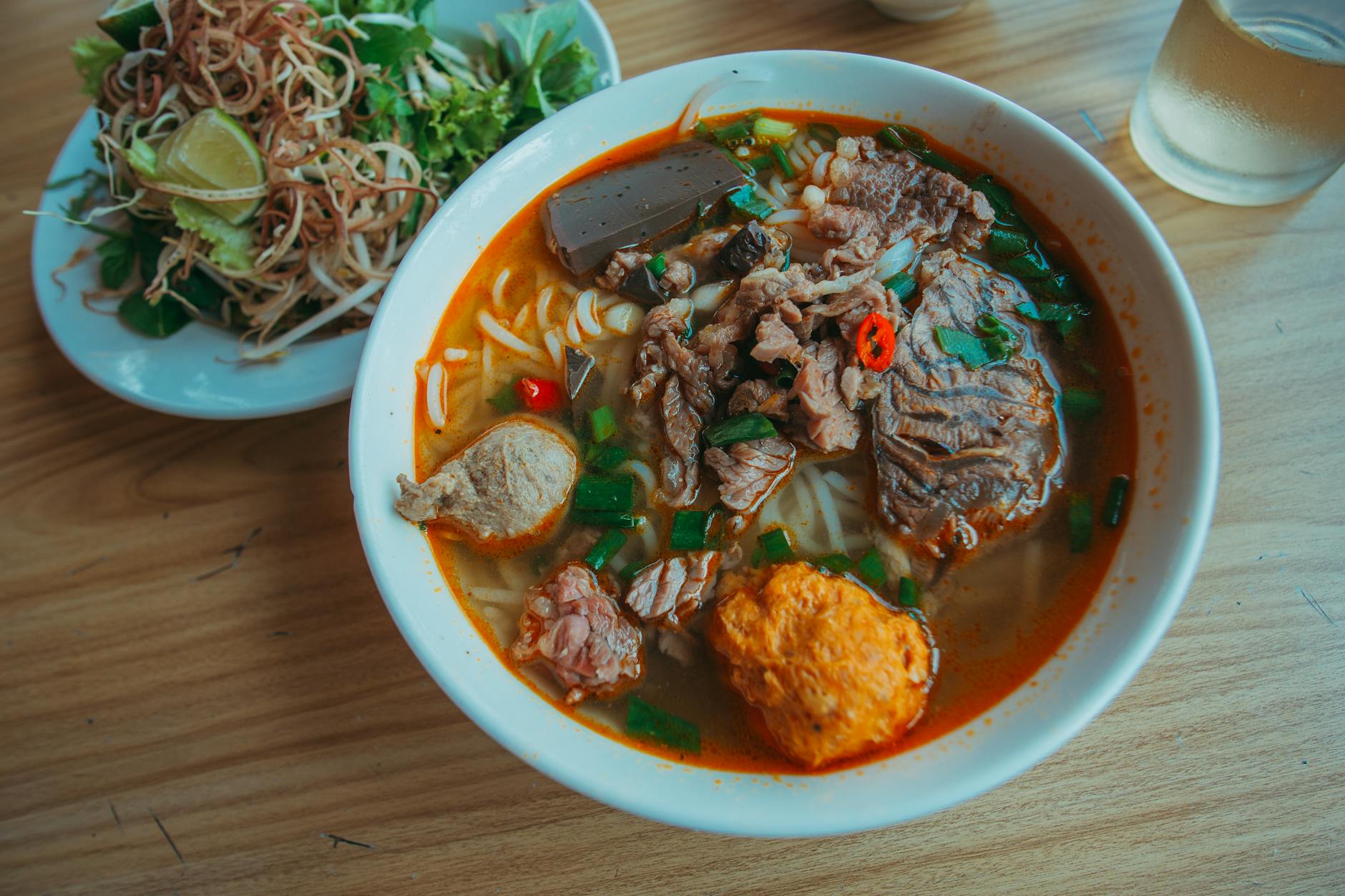
The imperial city's signature: a lemongrass-and-shrimp-paste broth stained red with annatto oil, loaded with thick round rice noodles, beef shank, pork knuckle, and a slice of congealed pig's blood (optional). Spicier and more aromatic than pho.
- Where: Quan Cam in Hue, or Bun Bo Ba Thi on Nguyen Du Street
- Price (2026): 50,000–80,000 VND ($2–$3.20)
3. Cao Lau (Hoi An only)
A culinary unicorn. Cao lau noodles are reportedly made only with water from the ancient Ba Le well and lye from local cajeput wood ash. The result: chewy, almost soba-like noodles topped with char siu-style pork, herbs, crispy croutons, and just a few spoonfuls of broth.
- Where: Thanh Cao Lau on Thai Phien Street, Hoi An Ancient Town
- Price (2026): 35,000–50,000 VND ($1.40–$2)
4. Bun Cha Ca (Da Nang/Nha Trang)
A clear, sweet-savory broth featuring fish cakes (cha ca) made from mackerel or other coastal fish, with bun (round rice vermicelli). Light, beach-town food at its finest.
- Where: Bun Cha Ca 109 on Nguyen Chi Thanh, Da Nang
- Price (2026): 35,000–45,000 VND ($1.40–$1.80)
5. Mi Quang Ech (Frog Mi Quang)
A variant featuring marinated frog legs instead of shrimp and pork. Popular in Quang Nam villages. The frog is fried then simmered in the broth.
- Where: Specialty stalls in Tam Ky town
- Price (2026): 60,000–90,000 VND ($2.40–$3.60)
Southern Bowls: Sweet, Seafood-Heavy, and Chinese-Influenced
The Mekong Delta and Saigon are where Vietnamese cooking meets the Teochew and Cantonese diasporas. Expect sweeter broths and more pork-forward flavors.
6. Hu Tieu Nam Vang
Vietnam's answer to Phnom Penh noodle soup, brought back by Vietnamese refugees from Cambodia. Clear pork-bone broth, dried shrimp, quail eggs, slices of pork liver, shrimp, and chewy clear noodles (or egg noodles on request).
- Where: Hu Tieu Nam Vang Ty Lum in District 5, Ho Chi Minh City
- Price (2026): 55,000–80,000 VND ($2.20–$3.20)
- How to order: Ask for "kho" (dry, broth on the side) for a more textured experience
7. Hu Tieu My Tho
From My Tho in the Mekong Delta. Drier noodles, a slightly sweeter broth, and almost always served with bean sprouts, garlic chives, and a wedge of lime.
- Where: Hu Tieu Chu Tho 44 in My Tho
- Price (2026): 40,000–60,000 VND ($1.60–$2.40)
8. Banh Canh Cua
Thick, slippery tapioca-and-rice-flour noodles in a goldenrod-colored broth thickened with crab roe. Topped with crab claws, pork knuckle, and quail eggs. Comfort food in soup form.
- Where: Banh Canh Cua 14 on Nguyen Phi Khanh, District 1, HCMC
- Price (2026): 70,000–120,000 VND ($2.80–$4.80)
9. Banh Canh Trang Bang
A Tay Ninh province specialty. Pork-bone broth, the same thick udon-like noodles, served with sliced pork, fresh herbs, and a side of pickled vegetables. Often eaten with banh trang phoi suong (dewy rice paper) wrapped around the meat.
- Where: Hoang Ty on Vo Van Tan, HCMC
- Price (2026): 60,000–90,000 VND ($2.40–$3.60)
10. Mi Vit Tiem (Braised Duck Egg Noodle Soup)
Cantonese-origin. A whole braised duck leg sits atop springy egg noodles in a five-spice-and-medicinal-herb broth that tastes faintly of star anise and lily flowers. Rich, restorative, often eaten when sick.
- Where: Hai Ky Mi Gia in District 5, HCMC (open since the 1960s)
- Price (2026): 90,000–140,000 VND ($3.60–$5.60)
11. Hu Tieu Sa Tế
A Teochew specialty rarely found outside HCMC's Chinatown. Beef and offal in a peanutty, chili-laden broth flavored with sa te (Vietnamese satay paste). Spicy, nutty, completely different from anything else on this list.
- Where: Quynh Hu Tieu Sa Te on Trieu Quang Phuc, District 5
- Price (2026): 70,000–95,000 VND ($2.80–$3.80)
Northern and Hybrid Bowls Worth Hunting Down
12. Bun Rieu Cua
A tomato-based broth stained orange with annatto, packed with freshwater crab paste (rieu cua), fried tofu, congealed blood, and sometimes snails. Sour, savory, and addictive when topped with shrimp paste and lime.
- Where: Bun Rieu Co Beo near Hoan Kiem Lake, Hanoi
- Price (2026): 45,000–65,000 VND ($1.80–$2.60)
13. Bun Thang
The fussiest noodle soup in Vietnam. A clear chicken-and-dried-shrimp broth, topped with finely julienned omelette, chicken, pork sausage, and shredded chicken — all arranged like a colorful pinwheel. Originally a Hanoi Lunar New Year dish.
- Where: Bun Thang Ba Duc on Cau Go, Hanoi Old Quarter
- Price (2026): 60,000–80,000 VND ($2.40–$3.20)
14. Bun Oc
Snail noodle soup. A tart, tomato-tinged broth filled with freshwater snails, fried tofu, and herbs. Bracingly sour from vinegar and unripe star fruit.
- Where: Bun Oc Ba Luong in Hai Ba Trung district, Hanoi
- Price (2026): 40,000–55,000 VND ($1.60–$2.20)
15. Bun Thit Nuong (Technically Dry, But Counts)
A purist will object — there's no broth. But bun thit nuong is essentially deconstructed soup: rice vermicelli, grilled lemongrass pork, pickled carrots, herbs, peanuts, fried shallots, and a small bowl of nuoc cham poured over the top. Eaten across Vietnam but most associated with the south.
- Where: Bun Thit Nuong Chi Tuyen on Cong Quynh, HCMC
- Price (2026): 50,000–70,000 VND ($2–$2.80)
At-a-Glance: Regional Comparison Table
| Soup | Region | Noodle Type | Broth Profile | Heat Level | Price Range (2026) |
|---|---|---|---|---|---|
| Mi Quang | Central | Wide rice, yellow | Concentrated, minimal | Medium | 40k–60k VND |
| Bun Bo Hue | Central | Thick round rice | Lemongrass, shrimp paste | Hot | 50k–80k VND |
| Cao Lau | Hoi An | Chewy, soba-like | Almost none | Mild | 35k–50k VND |
| Bun Cha Ca | Coastal Central | Round vermicelli | Light, sweet-savory | Mild | 35k–45k VND |
| Hu Tieu Nam Vang | South | Clear or egg | Sweet pork-bone | Mild | 55k–80k VND |
| Hu Tieu My Tho | Mekong | Chewy rice | Light, slightly sweet | Mild | 40k–60k VND |
| Banh Canh Cua | South | Thick tapioca | Thick, crab-rich | Mild | 70k–120k VND |
| Mi Vit Tiem | South | Egg noodles | Five-spice, medicinal | Mild | 90k–140k VND |
| Hu Tieu Sa Te | South (Chinatown) | Rice noodles | Peanut-chili | Hot | 70k–95k VND |
| Bun Rieu Cua | North | Round vermicelli | Tomato, crab paste | Medium | 45k–65k VND |
| Bun Thang | Hanoi | Fine vermicelli | Clear chicken | Mild | 60k–80k VND |
| Bun Oc | Hanoi | Round vermicelli | Sour, tomato | Medium | 40k–55k VND |
How to Order in Vietnamese Noodle Shops
Most family-run shops have minimal English. A few phrases go a long way:
- "Mot to" — one bowl
- "Khong cay" — no chili
- "It cay" — less chili
- "Khong rau thom" — no herbs (if you're cautious about raw greens)
- "Tinh tien" — the bill, please
Condiments are standard: chili paste, lime, fish sauce, garlic vinegar, fresh herbs, and sliced chilies. Add them in stages, not all at once. The broth is meant to be tasted plain first.
Hygiene tip: Crowded shops with high turnover are safer than empty ones. If locals are eating raw herbs from the communal plate, the herbs are fine. If you're nervous, skip raw bean sprouts and stick to cooked components.
Best Cities for a Noodle Crawl
Hanoi — Best for bun rieu, bun thang, bun cha, bun oc. The Old Quarter and the area around West Lake have the highest concentration of specialty shops.
Hue — Pilgrimage city for bun bo Hue. Skip the tourist-facing restaurants in the citadel area; head to local neighborhoods like Phu Cat.
Hoi An / Da Nang — Cao lau, mi Quang, bun cha ca all within 30 km. Da Nang's Con Market area has excellent breakfast noodle stalls from 6–9 AM.
Ho Chi Minh City — The widest variety. District 5 (Cho Lon) for Chinese-influenced bowls, District 1 for upscale versions, and District 4 for late-night street food.
My Tho / Can Tho — Mekong Delta noodles like hu tieu My Tho and banh canh in their purest form.
Timing tip: Most noodle shops open by 6 AM and sell out by 11 AM. The best bowls are breakfast bowls. Many close permanently by 1 PM. Plan accordingly.
Common Mistakes Travelers Make
- Treating all noodle soups as pho variants. Mi Quang and pho have almost nothing in common.
- Adding hoisin and sriracha to everything. Those condiments belong specifically to southern-style pho. Adding them to bun bo Hue or bun rieu is culinary heresy.
- Asking for a fork. Chopsticks plus the porcelain spoon are the standard. Hold the spoon in your left hand to scoop broth.
- Skipping the herbs. That plate of mint, perilla, sawtooth coriander, and bean sprouts isn't decoration. Tear and add as you eat.
- Eating too slowly. Vietnamese noodle soups are designed to be consumed in 10–15 minutes, while the broth is hot and the noodles haven't bloated.
Frequently Asked Questions
Q: How much should one budget per day for noodle meals in Vietnam? A: A reasonable noodle budget in 2026 is 150,000–250,000 VND ($6–$10) per day for three meals, even at the better-known specialty shops. Tourist-zone restaurants charge 2–3 times more for inferior versions.
Q: Are Vietnamese noodle soups gluten-free? A: Most are, since they use rice or tapioca noodles. The exceptions are mi vit tiem and certain hu tieu variants that use egg noodles. Soy sauce in some broths may contain wheat, so celiacs should still ask.
Q: Which noodle soup is best for someone who can't handle spice? A: Cao lau, bun thang, hu tieu Nam Vang, and bun cha ca are all mild by default. Bun bo Hue and hu tieu sa te should be avoided or ordered "khong cay."
Q: Can vegetarians find good versions of these soups? A: Vegetarian versions (chay) exist mainly for bun rieu and pho. Most specialty shops cook with meat-based broths. Look for restaurants near Buddhist temples or marked "Com Chay" for vegetarian noodles, especially on the 1st and 15th of each lunar month.
Q: Is it rude to slurp? A: No. Slurping is normal and signals enjoyment. Lifting the bowl to drink the last of the broth is also acceptable in casual settings.
Q: How spicy is bun bo Hue compared to Thai food? A: Moderately spicy by Southeast Asian standards. The chili is usually applied as a separate oil at the table, so the base broth itself is manageable. Diners control the final heat level.
Q: What's the single best noodle soup to try first? A: Mi Quang in Hoi An or Da Nang. It's accessible, distinctive, photogenic, and shows immediately how different Vietnamese noodles can be from pho. After that, work outward by region.
Final Thoughts
Vietnam's noodle culture is one of the most diverse on earth, and pho is just the entry point. A traveler willing to step into a plastic-stool shop at 7 AM and point at a steaming bowl will discover a country that's been quietly perfecting these recipes for centuries. Eat regionally. Eat early. Eat where the locals line up. And resist the urge to add hoisin to everything.