This guide demystifies the country's most iconic coffee drinks, explains the robusta-arabica debate Vietnam keeps winning on its own terms, and shows visitors how to navigate a cafe menu with confidence in 2026.
The Foundation: Why Vietnamese Coffee Tastes Different
Vietnamese coffee's distinctive profile comes down to three factors: the bean, the roast, and the brew method.
Roughly 95% of Vietnam's coffee production is robusta, grown primarily in the Central Highlands around Buon Ma Thuot, Dak Lak, and Lam Dong. Robusta contains nearly twice the caffeine of arabica and produces a bolder, more bitter, less acidic cup — qualities perfectly suited to being cut with sweet condensed milk. Arabica, grown at higher elevations near Da Lat and Son La, plays a smaller role but is gaining ground in specialty cafes.
The traditional roast goes darker than Western preferences, sometimes finished with butter, sugar, or even a splash of fish sauce or rice wine during the roasting process — old-school techniques still used by family roasters that produce a glossy, almost chocolatey bean.
Then there is the phin: a small aluminum or stainless steel filter that sits atop a glass. Hot water is poured over coarsely ground coffee, which drips slowly — typically four to six minutes — producing a concentrated, syrupy liquid stronger than espresso but less astringent.
Tip: If you order coffee in Vietnam expecting it quickly, you will wait. The slow drip is part of the ritual. Order, talk, watch the street, and let the phin do its work.
Ca Phe Sua Da: The National Drink
Ca phe sua da — iced coffee with condensed milk — is the drink most foreigners associate with Vietnam, and rightly so. The recipe is deceptively simple: a generous spoonful of sweetened condensed milk sits at the bottom of the glass, robusta coffee drips onto it from a phin, the mixture is stirred until uniform, then poured over a tall glass of ice.
The condensed milk story is worth telling. During French colonial rule in the 19th century, fresh dairy was scarce and expensive in Vietnam's tropical climate. Condensed milk — shelf-stable, sweet, and creamy — became the practical substitute. What began as compromise turned into culinary signature. Today, brands like Ong Tho and Longevity are sold in every grocery and used in nearly every Vietnamese cafe.
How to order like a local:
- Ca phe sua da — iced coffee with milk
- Ca phe den da — iced black coffee (still sweetened, usually with sugar)
- Ca phe sua nong — hot coffee with milk
- Bac xiu — a southern specialty, more milk than coffee, beloved by older Saigonese
Expect to pay 25,000–45,000 VND (1–1.80 USD) at a neighborhood cafe in 2026, or up to 75,000 VND (3 USD) at trendy spots in District 1 or Hoan Kiem.
Egg Coffee: Hanoi's Wartime Invention
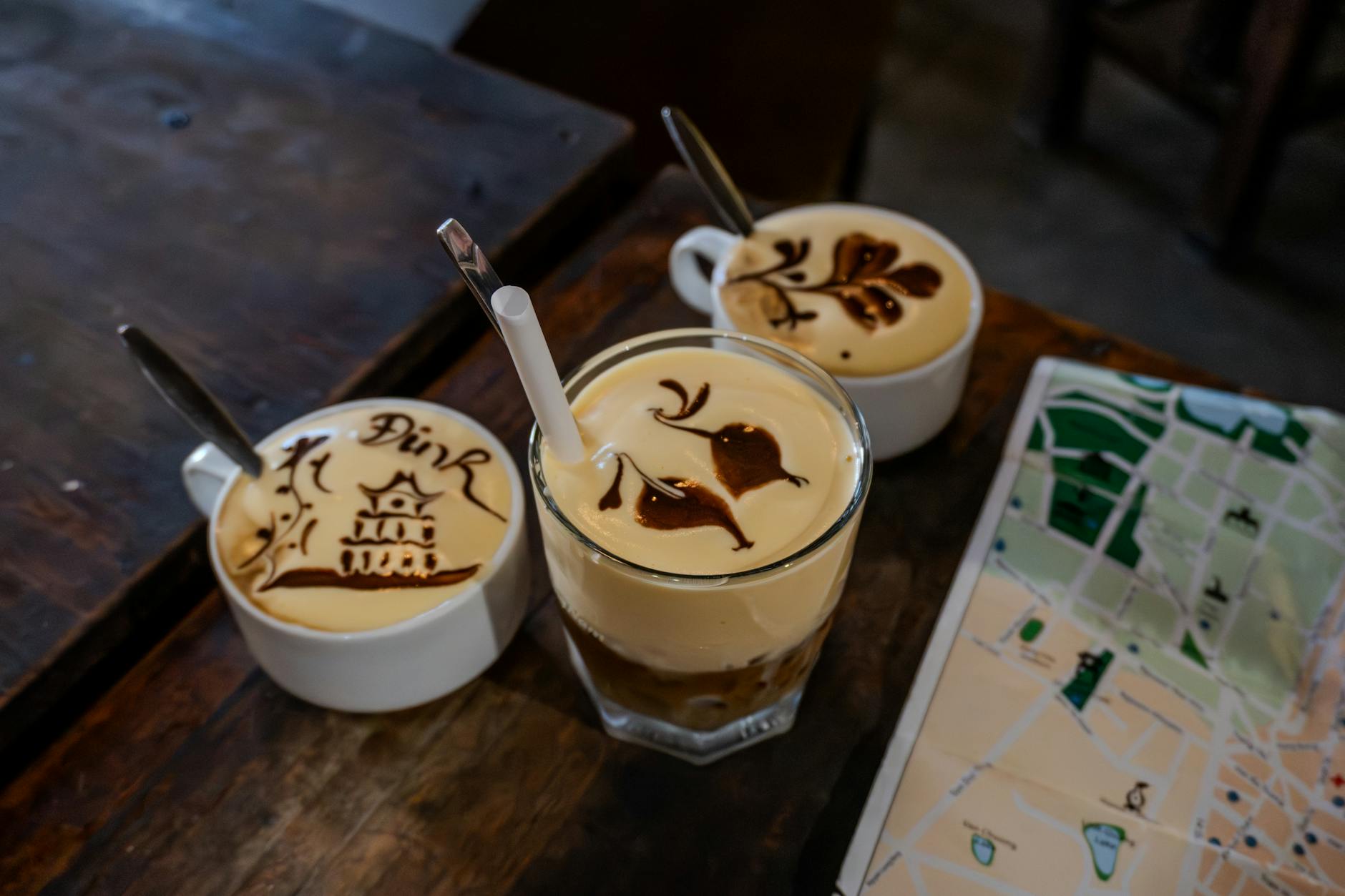
Ca phe trung — egg coffee — was created in 1946 at Hanoi's Cafe Giang by Nguyen Van Giang, a bartender at the colonial-era Sofitel Metropole. Milk shortages during the French Indochina War forced improvisation: whipped egg yolks beaten with sugar and condensed milk became a substitute foam, ladled over strong black coffee.
The result resembles a warm tiramisu in a cup — silky, custard-like, eggy in a faintly vanilla way rather than savory. It is served in a small cup placed inside a bowl of hot water to keep the foam stable.
Where to drink it in Hanoi:
- Cafe Giang (39 Nguyen Huu Huan): the original, run by the founder's son. Cramped, atmospheric, authentic.
- Cafe Dinh (13 Dinh Tien Hoang): overlooks Hoan Kiem Lake from a hidden upstairs balcony.
- Loading T Cafe (Chan Cam Street): elegant French colonial setting, slightly higher prices.
Expect 35,000–60,000 VND (1.40–2.40 USD) for a proper egg coffee.
Tip: Egg coffee is safe — the yolks are whisked vigorously with sugar, which partially cooks them, and reputable cafes use fresh eggs daily. Stick to established places rather than street stalls if uncertain.
Coconut Coffee: The Modern Crowd-Pleaser
Ca phe cot dua — coconut coffee — is a relative newcomer, popularized in the early 2010s by the Cong Caphe chain, which now has locations across Vietnam and abroad. The drink layers strong robusta over a blended coconut milk slushie, creating something between a coffee and a dessert.
Coconut coffee is sweeter, lighter, and more approachable than traditional preparations — it has become the gateway drink for visitors who find straight Vietnamese coffee too intense. Variations now include coconut smoothie coffee, coconut affogato, and frozen coconut espresso.
Recommended spots:
- Cong Caphe (nationwide) — the originators, military-themed decor
- The Note Coffee (Hanoi) — covered wall-to-wall in handwritten notes
- Shin Coffee (Ho Chi Minh City) — specialty-focused, excellent coconut variations
Prices run 45,000–70,000 VND (1.80–2.80 USD).
Salt Coffee: Hue's Quiet Export
Ca phe muoi — salt coffee — originated in Hue, Vietnam's former imperial capital, around 2010. The story credits a small cafe called Ca Phe Muoi on Nguyen Luong Bang Street, where a pinch of salt was added to fermented milk and coffee to balance the bitterness of dark robusta.
The salt does not make the drink taste salty. Instead, it suppresses bitterness, amplifies sweetness, and adds a savory roundness reminiscent of salted caramel. In the past three years, salt coffee has exploded from regional curiosity to nationwide trend, with chains and independent cafes adopting it in cities far from Hue.
The traditional preparation uses fermented condensed milk (which adds a yogurt-like tang), salt, and freshly dripped coffee, served over ice. Modern versions sometimes substitute regular condensed milk and a salt foam on top.
Where to try it:
- Ca Phe Muoi (10 Nguyen Luong Bang, Hue) — the original
- Salted Coffee shops across Hanoi and Saigon — quality varies wildly
Expect 30,000–55,000 VND (1.20–2.20 USD).
Quick Comparison: Vietnam's Signature Coffees
| Drink | Origin | Flavor Profile | Sweetness | Best For |
|---|---|---|---|---|
| Ca phe sua da | Nationwide (Saigon-strong) | Bold, chocolatey, smooth | High | Hot afternoons, first-timers |
| Ca phe den da | Nationwide | Bitter, intense, clean | Low–medium | Purists, caffeine seekers |
| Bac xiu | Southern Vietnam | Creamy, mild, milk-forward | High | Coffee skeptics, breakfast |
| Egg coffee | Hanoi | Custardy, rich, warm | High | Cool weather, dessert lovers |
| Coconut coffee | Hanoi (Cong Caphe) | Tropical, slushie-like | Very high | Hot weather, sweet tooth |
| Salt coffee | Hue | Balanced, savory-sweet | Medium | Adventurous palates |
Robusta vs Arabica: The Vietnamese Reality
Western coffee culture has long dismissed robusta as inferior — harsh, rubbery, fit only for instant coffee and cheap espresso blends. Vietnamese coffee culture politely disagrees.
Robusta's higher caffeine, lower acidity, and bold body are exactly what makes traditional Vietnamese preparations work. When sweetened with condensed milk and brewed slowly through a phin, robusta delivers a smoothness and chocolate-cocoa depth that arabica simply cannot replicate in the same context. The drink is engineered around the bean.
That said, Vietnam's specialty arabica scene is genuinely thriving in 2026. Producers in Cau Dat (near Da Lat), Son La, and Khe Sanh are growing bourbon, typica, and catimor varieties at elevations above 1,500 meters. Specialty roasters like The Workshop (Saigon), Tracoffee, Shin Coffee, and 43 Factory Coffee Roaster (Da Nang) showcase single-origin Vietnamese arabica brewed as pour-over, V60, or espresso.
| Factor | Vietnamese Robusta | Vietnamese Arabica |
|---|---|---|
| Caffeine content | High (2.2–2.7%) | Lower (1.2–1.5%) |
| Acidity | Low | Medium-high |
| Body | Heavy, syrupy | Lighter, complex |
| Best brewed as | Phin with condensed milk | Pour-over, espresso |
| Typical price | 25,000–60,000 VND/cup | 70,000–150,000 VND/cup |
Tip: Do not be the tourist who insists on arabica everywhere. Order ca phe sua da with robusta when you want tradition; order arabica pour-over at a specialty cafe when you want nuance. They are different drinks for different moods.
Best Coffee Cities and Cafes
Hanoi
The spiritual home of egg coffee and old-school phin culture. Wander the Old Quarter and you'll find hundred-year-old cafes tucked into alleys.
- Cafe Giang, Cafe Dinh, Loading T — classic egg coffee
- Tranquil Books & Coffee — quiet, literary
- Blackbird Coffee — modern specialty
Ho Chi Minh City (Saigon)
Faster, sweeter, more experimental. Saigonese drink the strongest ca phe sua da in the country.
- The Workshop (Ngo Duc Ke) — pioneering specialty roaster
- Shin Coffee — heritage and innovation
- Vietnam House Coffee — central, reliable
- Bosgaurus Coffee Roasters — serious about origin
Da Nang & Hoi An
- 43 Factory Coffee Roaster (Da Nang) — design-forward, excellent arabica
- The Espresso Station (Hoi An) — small, friendly, well-pulled shots
- Phin Coffee (Hoi An) — garden setting, traditional drinks
Da Lat
The arabica heartland. Visit a working farm and roastery if possible.
- La Viet Coffee — farm-to-cup operation, tours available
- An Cafe — flower-filled garden cafe
Hue
- Ca Phe Muoi — the salt coffee original
- Trung Nguyen Legend — for the chain experience done well
How to Order Like a Local
A few phrases go a long way. Pronunciation is approximate.
- Cho toi mot ca phe sua da — "One iced milk coffee, please" (cho-toy moht ka-fe soo-a da)
- Khong duong — without sugar
- It duong — less sugar
- Mang di — to take away
- Tinh tien — the bill
Most cafes outside major tourist areas do not have English menus. Pointing works. Smiling works better.
Tip: Vietnamese coffee is significantly stronger than Western coffee. One ca phe sua da in the afternoon can ruin a night's sleep. Pace accordingly, especially in the first days of a trip.
Coffee Culture: More Than a Drink
Vietnamese coffee culture is built around sitting. Plastic stools on the sidewalk, iced jasmine tea served free alongside the coffee, hours passing while traffic roars by — this is the default mode. Cafes function as offices, classrooms, dating venues, business negotiation rooms, and refuges from the heat.
The morning ritual starts early — many cafes open by 6:00 AM, and businesspeople routinely meet for coffee before work. Afternoons bring the ca phe sua da surge. Evenings shift toward fruit smoothies and the younger crowd in air-conditioned modern cafes.
Chains worth knowing: Highlands Coffee (the Starbucks of Vietnam, reliable and ubiquitous), Trung Nguyen Legend (founded by Vietnam's "coffee king," tradition-focused), Phuc Long (strong tea program too), and Cong Caphe (military aesthetic, coconut coffee fame).
Frequently Asked Questions
Is Vietnamese coffee stronger than espresso? Per ounce, a phin-brewed Vietnamese coffee is comparable to espresso in caffeine concentration, but a typical serving is larger and uses high-caffeine robusta. Net caffeine intake from one ca phe sua da often exceeds a single espresso shot.
Can I drink egg coffee if I'm worried about raw eggs? The yolks are whisked at length with hot sugar and meet very hot coffee, which partially cooks them. Reputable cafes use fresh eggs daily. Travelers with compromised immune systems or pregnancy concerns should consult their doctor or skip it.
What's the best Vietnamese coffee to bring home as a gift? Whole-bean specialty arabica from La Viet (Da Lat), Shin Coffee, or 43 Factory travels well and impresses. For tradition, a tin of Trung Nguyen Creative 8 or ground robusta with a small phin filter makes a complete gift kit. Budget 200,000–500,000 VND (8–20 USD) for quality beans.
Is salt coffee actually salty? No. The salt is subtle and functions like salt on caramel — it suppresses bitterness and enhances sweetness without making the drink taste savory.
Do Vietnamese cafes serve decaf? Rarely outside specialty third-wave shops in major cities. Most traditional cafes do not stock it. If avoiding caffeine, order fresh fruit juice or a sinh to (fruit smoothie) instead.
Why is there always a glass of tea with my coffee? Free iced jasmine or weak green tea (tra da) is a hospitality standard at virtually every Vietnamese cafe and many restaurants. It cleanses the palate between sips of strong coffee. Drink it freely — refills are usually free too.
Is it rude to ask for less sugar? Not at all. Saying it duong (less sugar) or khong duong (no sugar) is common and respected. Vietnamese coffee is traditionally very sweet, and many locals also customize their orders.
Should I tip at coffee shops? Tipping is not expected at traditional Vietnamese cafes. At Western-style specialty shops, leaving small change or rounding up is appreciated but not required.
Vietnamese coffee rewards curiosity. Skip the international chains, sit on a low plastic stool, watch the phin drip, stir the condensed milk slowly, and understand why a country built on robusta refuses to apologize for it.