Sapa at a glance: how the area is laid out
Sapa town sits on a ridge at roughly 1,500–1,600 m. Almost every accommodation decision follows from that one fact, because everything else is either above you, below you, or a drive away.
Cat Cat lies directly below town to the west and southwest, about 2–3 km on foot down steep steps. The Muong Hoa valley runs southeast, with Lao Chai about 7–8 km from town and Ta Van about 9–10 km. Fansipan (3,143 m) rises to the west and is reached by cable car from the valley side. Sun Plaza's funicular in the town centre connects to the cable car station. Topas Ecolodge and Ban Ho lie roughly 18–25 km out, a 45–60 minute drive.
A note on addresses. Vietnam's 2025 administrative reorganisation merged Lao Cai and Yen Bai provinces and abolished district-level units. Booking pages and maps may show new ward or commune names alongside old ones such as Sa Pa town, Ta Van and Lao Chai. Check the map pin, not the address line.
The 30-second answer. Town centre for one night, families, limited mobility and Fansipan. The ridge and edges of town for views plus convenience. Ta Van for a first valley stay. Lao Chai and Y Linh Ho for quiet, trek-first trips. Cat Cat and Sin Chai for valley drama close to town. Topas and Ban Ho as a destination retreat, not a sightseeing base.
Season, fog and cold: why the month changes the answer
Most guides give you "best months" for sightseeing. What matters more is what the season means for the room you book.
December to February is cold, damp and often foggy. Nights can fall close to 0°C, with occasional frost and rare snow. Many wooden or bamboo homestays have only electric blankets. Ask specifically for a heater or a two-way air conditioner (heat pump, "điều hòa hai chiều"), and whether the bathroom has hot water and heat. Laundry and boots will not dry. Paying a premium for a view room is a gamble when fog can sit for days.
March to May is the good-value shoulder. Milder weather, planting season, though haze from field burning can reduce visibility in early spring. Water-filled terraces usually appear from around May.
June to August brings rain and mud. The terraces are at their greenest, but village footpaths to homestays become slippery. Landslide risk on mountain roads is real after heavy rain. Typhoon Yagi in September 2024 caused deadly landslides in Lao Cai province. Book flexible rates and check road status before valley transfers.
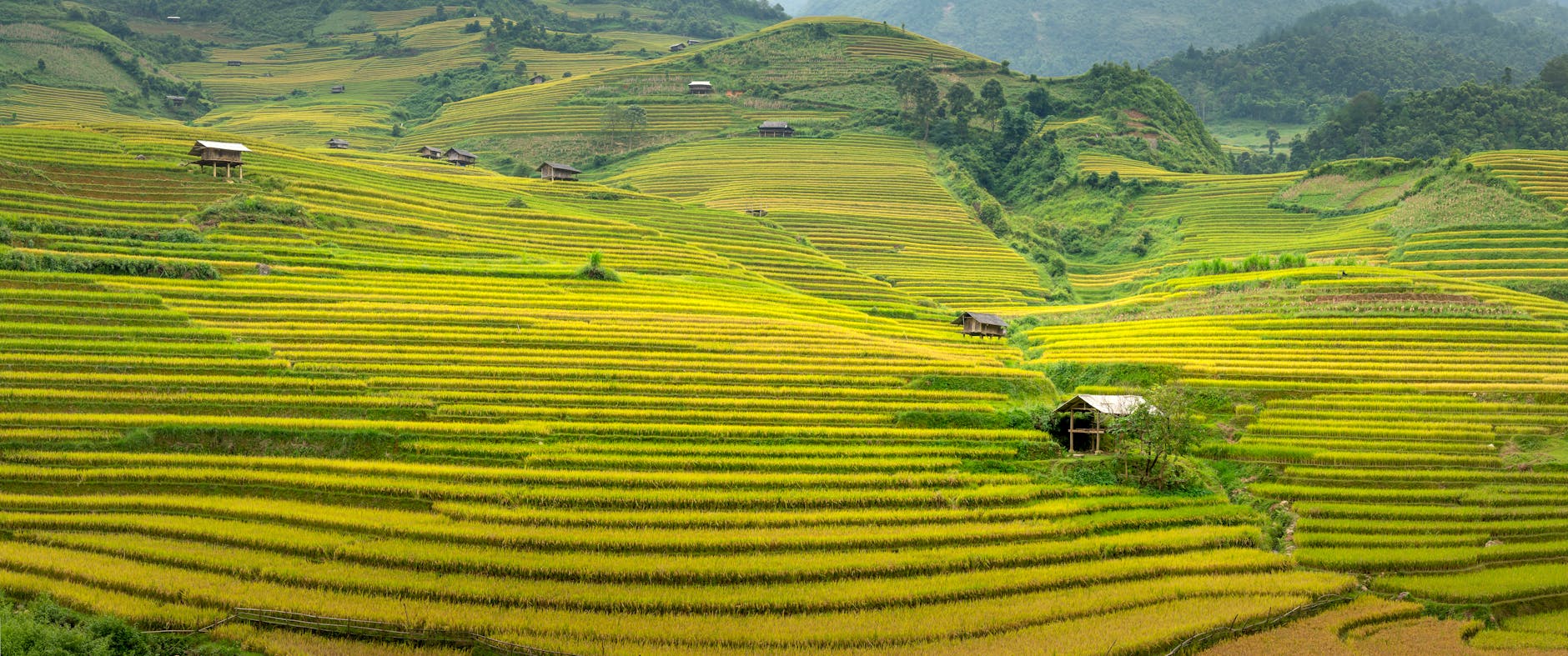
September to early November is peak terraces and peak demand. Harvest gold usually peaks in mid to late September, varying year to year. Book view rooms and valley bungalows early, and expect weekend prices to rise.
Domestic visitors from Hanoi fill the town on Friday and Saturday nights all year. The next Tet falls on 6 February 2027, and the surrounding week is very busy, with prices sometimes doubling or more. Other national peaks are 30 April–1 May and 2 September. Cold snaps also draw crowds hoping for snow.
| Months | Weather and visibility | Terraces | What to confirm when booking | Crowds and prices |
|---|---|---|---|---|
| Dec–Feb | Cold, damp, frequent fog | Bare, brown | Heater type, bathroom heat, hot water | Low midweek, busy in cold snaps |
| Mar–May | Milder, spring haze | Water-filled from about May | Balcony orientation, fan or AC | Good value |
| Jun–Aug | Rain, mud, landslide risk | Vivid green | Flexible cancellation, road access | Moderate |
| Sep–early Nov | Clearest skies | Golden harvest | View room, valley bungalow | Peak, weekend spikes |
| Tet and holidays | Cold to mild | Varies | Book months ahead | Very high, prices double |
Night train or limousine: how your arrival should shape where you sleep
Transport and accommodation are usually covered separately. In Sapa they are the same decision, because arrival time and drop-off point decide whether a valley homestay or a town hotel makes sense on night one.
The night train to Lao Cai departs Hanoi around 21:30–22:00 and arrives around 05:30–06:30 after roughly 8 hours. A 35 km shuttle or taxi to Sapa then takes about an hour. You arrive at dawn, hours before check-in. Choose a hotel that offers early check-in or bag storage and breakfast, or go straight into a guided trek with luggage sent ahead to a valley homestay. Fares vary between standard berths and private carriages attached to the same trains.
Limousine vans and sleeper buses take around 5–6 hours via the Noi Bai–Lao Cai expressway, with daytime and overnight departures. Some pick up from Hanoi's Old Quarter or Noi Bai airport. Most drop at operator offices in town, so a central or lake-area hotel is walkable. For a valley stay, arrange a car transfer in advance. Do not attempt dark village paths with a suitcase on arrival.
Some guides mention a high-speed train from Hanoi to Sapa. No such service operates in 2026. A new Lao Cai–Hanoi–Hai Phong standard-gauge line is under construction and years from opening.
For departure, early buses and afternoon train shuttles favour a town base for the final night. Valley-to-Lao Cai transfers add time and cost.
| Mode | Typical schedule | Door-to-door | Drop-off point | Best first-night base |
|---|---|---|---|---|
| Night train | Departs Hanoi 21:30–22:00, arrives Lao Cai 05:30–06:30 | About 9 hours | Lao Cai station, then shuttle | Town hotel with early check-in |
| Limousine van, daytime | Morning to early afternoon departures | 5–6 hours | Operator office in town | Town centre or ridge |
| Sleeper bus, overnight | Evening departure, dawn arrival | 6–7 hours | Operator office in town | Town hotel, or trek-in to Ta Van |
| Private car from Hanoi | Flexible | 5–6 hours | Your hotel door if in town | Any, including valley with prior arrangement |
Sapa town centre: around the lake, the Stone Church and Cau May
This is the convenience base, and it is worth being honest about what convenience buys you here.
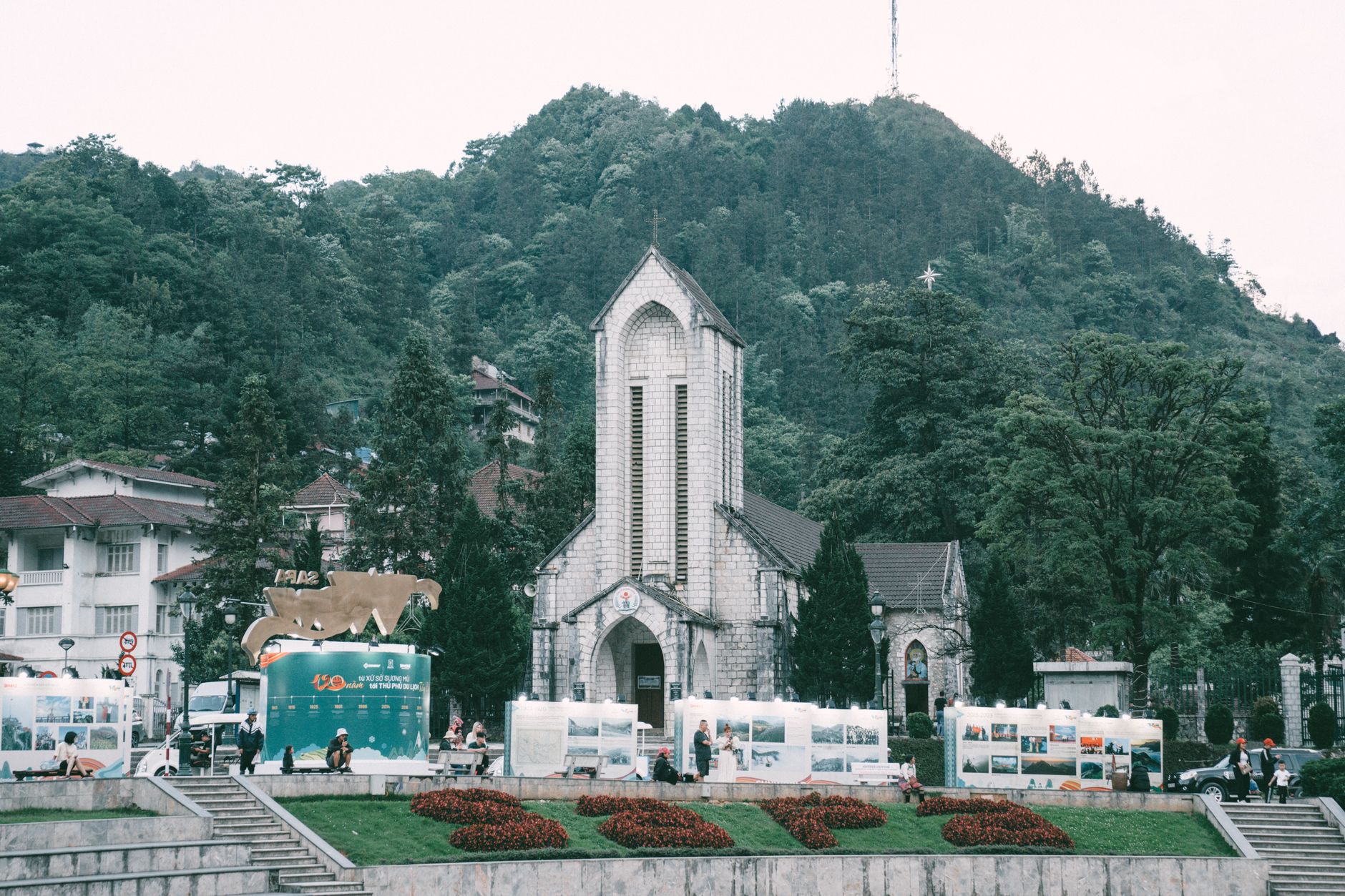
The Stone Church, the square, Sapa lake, Cau May and Xuan Vien streets, and Sun Plaza with the Fansipan funicular form the core. Restaurants, ATMs, pharmacies, bus offices and trekking guides are all walkable.
It suits one-night visitors, families with small children, older travellers, people prioritising Fansipan, and anyone arriving or leaving at odd hours.
At the luxury end, Hotel de la Coupole – MGallery is a Bill Bensley design with a heated indoor pool, and BB Sapa Resort & Spa (formerly Victoria Sapa) has a garden setting and heated pool. Mid-range options include Bamboo Sapa Hotel, Amazing Sapa Hotel, KK Sapa Hotel and Sapa Horizon Hotel. Hostels and family guesthouses cluster around Cau May and the lake.
The drawbacks are real. Heavy construction and concrete. Weekend noise from the square, karaoke and bars. Many "mountain view" rooms face other buildings. Narrow vertical hotels often have stairs and no lift. Persistent selling by vendors, including children, is common. Buying from children during school hours is discouraged, and it is fair to say so plainly rather than pretend it is not happening.
Some guides present "Sapa Lake" as a separate budget district. It is the northern part of the centre, slightly calmer but not cheaper by default.
Price bands: dorm beds 150,000–300,000 VND ($6–12); basic private rooms 400,000–700,000 VND ($15–27); mid-range 900,000–2,000,000 VND ($35–77); luxury from about 3,500,000 VND ($135) and well above in peak periods.
The quieter edges of town: the Muong Hoa ridge, the Fansipan side and the hillsides
This is the "views without leaving town" zone, and published sources label it inconsistently. Some call Muong Hoa a neighbourhood south of town, when Muong Hoa is the valley name and also a street.
Along Muong Hoa street and the ridge above the valley, you get valley-facing balconies 5–20 minutes' walk from the square. Pao's Sapa Leisure Hotel has curved architecture and an indoor pool, and Bamboo Sapa Hotel sits at the town end.
The western edge facing Fansipan, around Thac Bac and Dong Loi, includes Pistachio Hotel Sapa, known for its infinity pool facing the Hoang Lien range, and Chau Long Sapa Hotel, which looks across toward Cat Cat and Fansipan.
Hilltop resorts include Silk Path Grand Sapa Resort & Spa, above town with gardens, a heated pool and family facilities, and Sapa Jade Hill Resort & Spa, with wooden bungalows about 2 km out. Verify the exact position and road access of the latter before booking.
This zone suits couples, photographers, and first-timers who want a view but also restaurants within reach.
The honest drawbacks: steep walks with patchy pavements and motorbike traffic. "10 minutes to the centre" often means uphill in the rain. Only certain room categories face the valley. Fog makes the view premium pointless on bad days.
Mid-range view rooms run 1,000,000–2,500,000 VND ($38–96). Resort and boutique properties run 2,500,000–6,000,000 VND ($96–230) and above.
Cat Cat and Sin Chai: valley scenery a short walk from town
Cat Cat needs a reality check. It is a Black Hmong village turned ticketed attraction, with an entrance fee of around 150,000 VND for adults (verify the current price). Expect costume rentals, photo props, cafés, staged performances and a waterfall. Staying "near Cat Cat" does not mean a quiet village experience.
Beyond it, Sin Chai Ecolodge sits in a secluded side valley with trekking and cooking activities, and is the calmer option on these slopes.
This area suits travellers who want dramatic slopes and a short taxi or motorbike ride to town, and those with two nights who want a taste of the valley without a long transfer.
The drawbacks are steep. Very steep roads and stone steps make the walk back to town after dinner hard work. Daytime crowds gather around the ticketed route. Taxis may stop at the road while the property sits below it.
Simple guesthouses cost 600,000–1,000,000 VND ($23–38). View-focused lodges run 1,500,000–3,000,000 VND ($58–115) and above.
Ta Van: the easiest valley village base
Ta Van is the default first valley stay, and it rewards a bit of care in choosing within it.
The setting is Giay, Hmong and Dao communities along the Muong Hoa river, with the hamlets of Giang Ta Chai and Su Pan nearby. It is 20–30 minutes by car from town depending on road conditions. Many guided day treks from Sapa end here, which suits a "trek in, sleep over" plan. You get family homestays, bungalow clusters, small lodges with dinner, and a handful of cafés. Sapa Clay House is among the better-known properties, though you should verify its exact location.
It suits first-time valley sleepers, trekkers, and couples or friends who want terraces with fallback options nearby.
One distinction matters more than any other. Traditional homestays often mean a shared loft with mattresses, curtains, a shared bathroom and family dinner. "Homestay" on booking platforms often means a private bungalow with an ensuite. Ask which you are getting.
The drawbacks: rapid building in the valley, plus some outside-owned lodges marketed as family homestays. Dim, muddy lanes after dark. Roosters and dogs at dawn. No ATM, so bring cash. Taxi returns to town for dinner add up quickly.
Prices are mixed between per-person and per-room, so read carefully. Basic homestays cost 150,000–350,000 VND ($6–13) per person, often with dinner. Private bungalows run 500,000–1,500,000 VND ($19–58). Upscale lodges run 1,500,000–3,500,000 VND ($58–135).
Lao Chai and Y Linh Ho: quieter, trek-first stays
This is the second-visit or quiet-seeker option. Lao Chai and Y Linh Ho are Black Hmong villages on the classic Sapa–Y Linh Ho–Lao Chai–Ta Van trekking line, about 7–8 km from town. There is a ticket point on the Lao Chai–Ta Van route (verify the current fee).
Laxsik Ecolodge offers private bungalows with more structure than a homestay. Eco Palms House has bungalows with rice-field views. Hmong Mountain Retreat sits on the slopes above the valley road. Simple family homestays exist too, many bookable only in person or through a guide.
It suits hikers, slow travellers, and people who value silence over choice.
The drawbacks: fewer places to eat, so dinner is effectively at your lodging. Wi-Fi, hot water and power can be unreliable in storms. Access is often by footpath with luggage. The trail through Lao Chai can feel busy with tour groups and vendors in the middle of the day.
Basic homestays cost 150,000–300,000 VND ($6–12) per person. Private rooms run 400,000–1,200,000 VND ($15–46). Ecolodges run roughly 1,500,000–4,000,000 VND ($58–155).
Remote valley retreats: Topas Ecolodge and beyond
These are destination stays, not sightseeing bases.
Topas Ecolodge has stone bungalows on a hilltop facing the Hoang Lien range, about 18 km and 45–60 minutes from town, with two infinity pools, one heated. Half-board and transfer packages are common. Indicative rates run roughly 5,000,000–10,000,000 VND ($190–385) and above per night in peak periods, so check what is included. Topas Riverside Lodge, toward Ban Ho, is a smaller river-valley sister property with deeper rural quiet.
It suits honeymoons, special occasions, and travellers who want two nights doing very little.
The drawbacks: you eat where you sleep. Every outing to town or Fansipan costs a long transfer. The winding road can mean motion sickness. In heavy rain or fog the setting is the product, and you may not see it. It is not worth it for a single night after a late arrival.
Sapa areas compared, and how to split your stay
| Area | Distance/time to centre | Price band per night (VND/USD) | Best for | Car access and luggage | Winter comfort | Main drawback |
|---|---|---|---|---|---|---|
| Town centre | Walkable | 150,000–3,500,000+ ($6–135+) | One night, families, Fansipan | Full car access | Heated hotels available | Noise, construction, few real views |
| Ridge and edges | 5–20 min walk | 1,000,000–6,000,000 ($38–230) | Couples, photographers | Car access, some steps | Good in resorts | Steep walks, view depends on room and fog |
| Cat Cat and Sin Chai | 2–3 km, steep | 600,000–3,000,000 ($23–115) | Valley scenery near town | Road, then steps | Mixed | Steep, crowded daytime |
| Ta Van | 20–30 min drive | 150,000–3,500,000 ($6–135) | First valley stay, treks | Car to village edge | Cold in wooden homestays | Building, muddy lanes, no ATM |
| Lao Chai and Y Linh Ho | 7–8 km, often on foot | 150,000–4,000,000 ($6–155) | Quiet, hiking | Often footpath only | Cold, power cuts possible | Few dining options |
| Topas and Ban Ho | 18–25 km, 45–60 min | 5,000,000+ ($190+) | Honeymoons, retreats | Car access | Good | Isolated, expensive transfers |
One night is rushed. Two nights is the practical minimum. Three nights adds a weather buffer for Fansipan or a clear-sky view day.
Split-stay templates work better than a single base for most first-timers.
| Nights | Arrival type | Suggested split | Why it works |
|---|---|---|---|
| 2 | Night train, dawn arrival | Town night 1, Ta Van night 2 | Early check-in, then trek in with a daypack |
| 2 | Limousine, afternoon | Town night 1, valley night 2 | Easy first evening, valley on a full day |
| 3 | Any | Town, Ta Van, town | Valley experience plus a weather buffer and easy departure |
| 2 | Winter | Heated town or ridge hotel both nights, valley as a day trip | Avoids cold, damp wooden rooms |
On luggage: most town hotels store bags. Send only a daypack into the valley. Some homestays arrange motorbike luggage transfer for a fee.
Booking checklist and honest warnings
Ask these before you book. Is there heating, and of what type? Is the bathroom private, and does it have hot water? Can a car reach the door? How many steps are there? Is the view from the room itself or only the terrace? Is dinner served, and at what cost? Is the price per person or per room? Does the property take card payment, or cash only?
On safety, motorbike rental is not recommended for inexperienced riders. The roads are steep, foggy and wet, with vans and trucks. Check that your insurance covers riding and that you hold a valid licence for Vietnam. Do not walk valley roads after dark without a torch. Check landslide and road-closure news in the rainy season. Fansipan on foot requires a guide.
On health, Sapa's altitude rarely causes altitude sickness. The fast cable car rise to about 3,143 m can cause breathlessness, and the summit is much colder. Air quality can drop during the burning season.
On respectful stays: ask before photographing people. Agree trekking prices with village guides upfront. Prefer homestays that are genuinely family-run. Do not buy from children selling during school hours.
FAQ
Q: Where is the best place to stay when visiting Sapa? It depends on trip length and season. The town centre or the ridge suits one night, families and Fansipan. Ta Van is the best first valley night. Lao Chai or Topas suit quiet. A split stay, one town night and one valley night, is the safest choice for most first-timers.
Q: Is Sapa considered high altitude? The town sits at about 1,500–1,600 m, so altitude sickness is unlikely, but it is markedly cooler than Hanoi. The Fansipan cable car climbs to about 3,143 m quickly, which can cause breathlessness, and the summit can be near freezing in winter.
Q: Why is Sapa so famous? The Muong Hoa valley rice terraces, Hmong, Red Dao and Giay communities, Fansipan as the highest peak in Indochina, and its history as a French hill station from the 1920s. The town has grown rapidly and is now heavily built up.
Q: Which is better, Hanoi or Sapa? They serve different purposes. Hanoi for city life, food and history. Sapa for mountains, trekking and village stays. Most itineraries combine them, allowing at least two nights in Sapa to justify the 5–8 hour journey each way.
Q: Is it worth staying in a homestay in Ta Van or Lao Chai in winter? Yes, for one night, if heating and hot water are confirmed in writing. Otherwise wooden houses can be very cold and damp from December to February. A heated town or ridge hotel is a sensible base around it.
Q: Can a car reach valley homestays, and what about luggage? Many cannot. Cars stop at the road and the last stretch is a footpath or steps. Leave large bags at a town hotel, or arrange the motorbike luggage transfer many homestays offer.
Q: How far in advance should accommodation in Sapa be booked? Weeks ahead for September–October terrace season and for weekends. Much earlier for the Tet period around 6 February 2027 and the 30 April–1 May holiday. Midweek in shoulder months is often bookable a few days out.





Your questions and tips
A question, an update, an experience to share? Our team reads every message before it is published.
No comments yet. Ask the first question or share a tip!