Rong May Glass Bridge at a glance
Status, October 2026: published sources report the site has stopped operating. One operator states closure "since 1 October 2026 until further notice." A travel guide reviewed on 6 October 2026 cites a Lai Chau authorities press statement dated 18 September 2026, issued after reports that the tourist area had stopped operating. No confirmed reopening date appears in the sources available.
| Item | Figure | How consistent sources are |
|---|---|---|
| Location | Just beyond the summit of O Quy Ho Pass, Lai Chau side, off National Road 4D | Consistent |
| Distance from Sapa town | 17 to 18 km, 30 to 45 minutes by car | Consistent |
| Altitude above sea level | About 2,200 m | Most sources agree; one booking page says 2,800 m |
| Elevator climb | About 300 m total, part inside the rock | Some sources give 70 m for the tunnel section only |
| Opening date | 16 November 2019 | Consistent |
| Last published hours | 07:00 to 17:30 or 18:00 daily, last entry 30 to 60 minutes before closing | Minor variation between sources |
| Last published adult price | 500,000 VND at the counter, 475,000 VND online | Older guides show 400,000 VND |
The 2,200 m figure is altitude above sea level, not the drop beneath your feet. The glass deck projects about 60 m from the cliff, and the elevator climbs roughly 300 m. Those are very different numbers, and published guides blur them constantly.
Current status and how to check it
Before driving up the pass, check three things. First, the attraction's own ticketing site, vecaukinhrongmay.com, which is the operator's booking channel. Second, the Lai Chau provincial tourism portal, which carries official notices. Third, and most reliably, ask your Sapa hotel to phone that morning. A receptionist who speaks Vietnamese will get a straight answer in two minutes.
Sales platforms may keep listing tickets when a site is shut. A live listing is not proof of operation. Treat any booking page as a price reference, not a status check.
Where it is, and why "Sapa glass bridge" is misleading
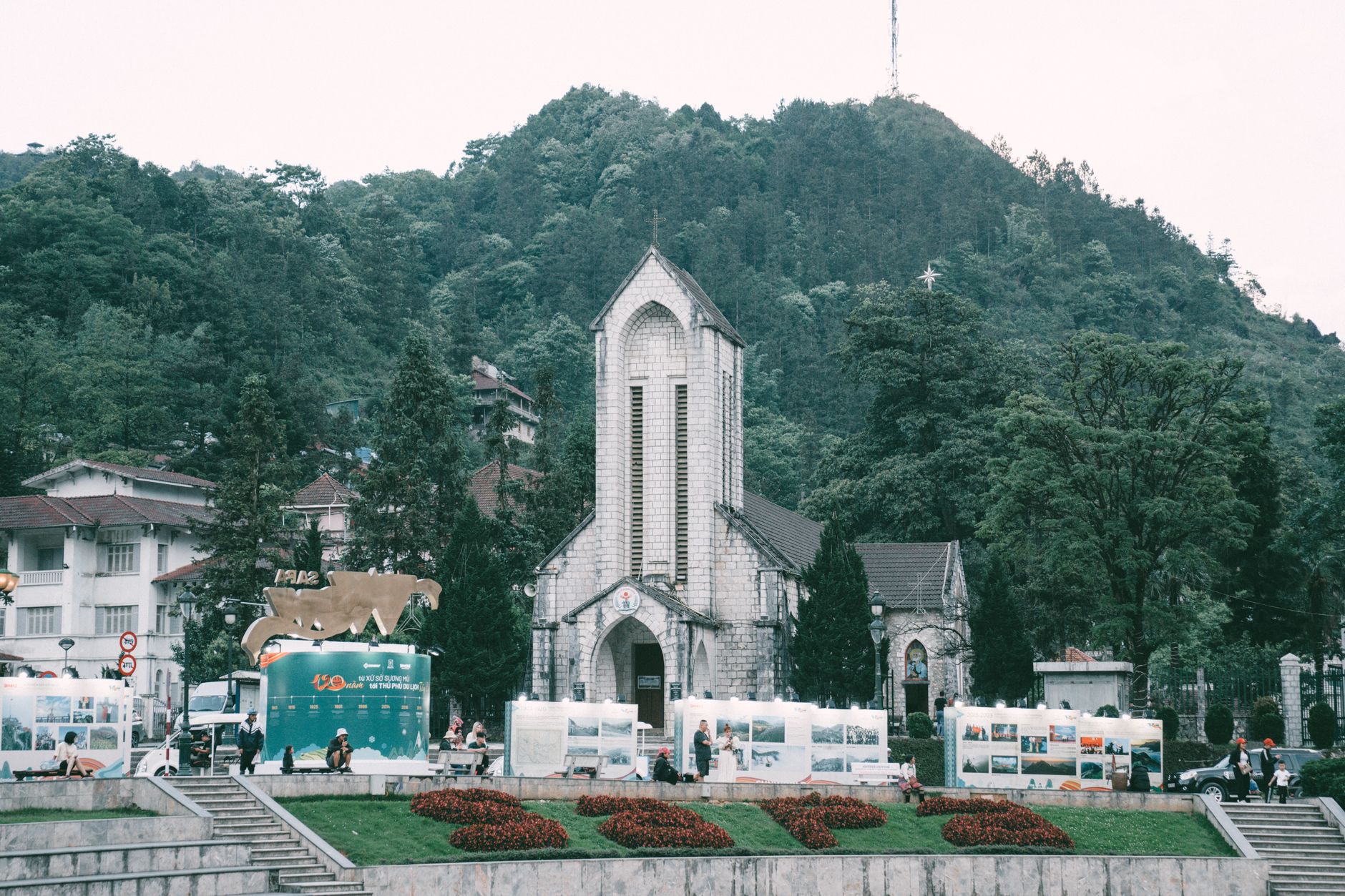
The route is simple to describe and easy to get wrong in practice. From Sapa's Stone Church and town square, National Road 4D (QL4D) runs west past Silver Waterfall (Thac Bac), climbs through Hoang Lien National Park, and crosses the top of O Quy Ho Pass, also called Tram Ton Pass, at the provincial line between Lao Cai and Lai Chau. Rong May sits just beyond the summit, on the Lai Chau side.
Two consequences matter for planning. Return transport from the far side of the pass is the main logistical trap: taxis and ride-hailing cars based in Sapa may not want the extra climb, and there is nothing at the gate to hail. And the weather on the Lai Chau side can differ sharply from Sapa town, which sits 600 to 700 m lower and often under a different cloud layer.
Administratively, the picture changed in 2025. Vietnam abolished district-level government on 1 July 2025 and merged communes, so "Tam Duong District," still used by many guides, no longer exists as a unit. Lai Chau province was not merged, so the site remains in Lai Chau. Sapa itself is now part of the enlarged Lao Cai province, which absorbed Yen Bai in 2025. Some guides place Rong May in "Lao Cai Province," which is wrong, and one widely read guide describes Lai Chau as "formerly part of Lao Cai," which reverses the relationship. The current commune name, formerly Son Binh commune, is worth confirming on site.
The story of the place
O Quy Ho, one of the "four great passes"
O Quy Ho belongs to the "tu dai dinh deo," the four great passes of northern Vietnam, alongside Ma Pi Leng in Ha Giang, Pha Din between Dien Bien and Son La, and Khau Pha in Yen Bai. At roughly 50 km, it is often described as the longest of the four. It crosses the Hoang Lien Son range, the granite spine that holds Fansipan, at 3,143 m the highest peak in Indochina.
The name carries a legend, repeated in Vietnamese sources and worth flagging as folklore rather than history. The story ties "O Quy Ho" to a lovers' tale and to the call of a bird, a lament carried on the wind over the saddle. Nobody can date it, and that is rather the point.
The pass has a reputation earned by weather rather than marketing. Fog thick enough to reduce visibility to a car length is routine. Frost appears on winter mornings, and snow has fallen in December and January, which is remarkable at tropical latitudes and draws Vietnamese visitors north in coats they otherwise never wear.
From mountain road to adventure complex
"Rong May" means "Dragon Cloud," an image of cloud coiling along the ridges the way a dragon coils around a peak. The dragon sits deep in Vietnamese origin myth, so the name does double work: it describes the weather and claims a place in the national story.
Published sources name Hoang Lien Son Group JSC as the investor behind a three-phase plan worth over 3,500 billion VND (about US$133 million). Treat that figure as reported rather than audited. The site opened on 16 November 2019, marketed as housing Vietnam's first outdoor glass-cabin elevator.
Part of Vietnam's glass-bridge boom
Rong May belongs to a wave of engineered attractions that Vietnamese provinces built to pull domestic tourists. The Golden Bridge with its giant stone hands opened at Ba Na Hills near Da Nang in 2018 and became the country's most photographed structure. Bach Long, a glass-bottomed bridge in Moc Chau, Son La, opened in 2022 at about 632 m long and was recognised by Guinness as the world's longest glass-bottomed bridge at the time.
That context explains why older guides still call Rong May "the longest glass bridge in Indochina." The claim has been overtaken, and the site's real draw was never length. It was altitude and the elevator.
What you experience, step by step
Gate, ticket hall and security
You arrive at a roadside car park off QL4D, with the pass switchbacks visible below and the cliff above. The ticket counter, bag check and turnstiles sit in a low building. At weekends and on Vietnamese holidays the queue starts outside. Separate adventure-game tickets go on sale at the same counter, so decide before you reach the front whether you want them.
The tunnel and the glass elevator
Published figures describe a walk or short ride into the mountain through a tunnel section given as 70 to 80 m, then an elevator climb of about 300 m in total, part of it inside the rock before the cabin breaks out along the cliff face with three glass sides. The ascent takes about 1.5 minutes. Cabins are published as carrying up to 30 people, with a throughput of about 1,200 people per hour.
Many first-hand accounts rate the elevator above the bridge itself. It is the moment not to spend looking at a phone.
Stand at the outward-facing glass, not the cliff side. The cliff side gives you rock; the outward side gives you the whole Hoang Lien Son range opening up as you climb.
The glass skywalk
Shoe covers are handed out free at the top. Heels and hard or spiked soles are not allowed, which protects the surface and keeps the deck from scratching into a haze.
The structure as published: a cantilevered glass walkway projecting roughly 60 m from the cliff, described variously as U-shaped or branching in several directions. The glass is three tempered layers, about 7 cm in total. Railings are metal and not fully glazed, which matters for photography and for nerves.
Some figures conflict. Total walkway length appears as about 300 m. Deck width is given as 1.5 m by one source and 5 m by others, a gap large enough that the narrower figure may describe a single arm. One published cap limits the bridge to 500 people at once.
What you actually see depends entirely on the day. The switchbacks of QL4D lie far below, tight enough to count. The Hoang Lien Son ridges run away in layers. On clear days the Fansipan massif stands above them. On cloud days you get either a sea of clouds below the deck, which is what everyone hopes for, or a total whiteout in which the glass shows you nothing but milk.
The cliffside walkway and solid terraces
One published description gives a solid walkway of about 200 m as the alternative for people who do not want to stand on glass. Viewing terraces and a café area round out the top station. This is where non-thrill-seekers in a group can wait comfortably while others queue for the cantilever.
The adventure zone
Sources from 2025 and 2026 list a zipline, a sky bike (a bicycle suspended on a cable), a cliff swing marketed as the "death swing," a log bridge and a rope ladder. The last published price was 150,000 VND per game (about US$5.70 / €4.90).
Some guides also list bungee jumping at about 1,000,000 VND and paragliding at about 900,000 VND. Those figures appear in older guides, and current availability on site is unclear. Note that Sapa's established tandem paragliding launches elsewhere, from Hang Da village toward Lao Chai in the Muong Hoa valley, so do not book a flight expecting it to leave from the bridge.
Going down: elevator or trail
Some guides describe a walking trail, an "ecological road," between base and top. Older one-way trail and elevator tickets were 200,000 VND for adults and 100,000 VND for children, with about 3 hours uphill and less coming down. Treat this option as historical and confirm on site.
Is it safe? Height, glass and the viral videos
Published safety data covers laminated tempered glass in three layers, staff controlling numbers on each section, and closures in wind, rain and lightning.
The 2022 "cracked glass" clips that circulated widely appear, according to one guide, to have been linked to a prank or an effect panel at another site, and local authorities reportedly found no cracks at Rong May. Attribute that rather than assert it.
Personal risk factors are worth naming plainly. Vertigo, heart conditions and pregnancy are reasons to skip the thrill rides, and the altitude is real: at about 2,200 m the site sits 600 to 700 m above Sapa town and runs typically 3 to 5°C colder.
Road safety on O Quy Ho deserves more attention than the bridge. Fog, trucks, steep grades and wet hairpins cause far more incidents on this pass than any glass panel.
Rong May versus the alternatives nearby
| Place | Altitude | Cost | Time needed | What you get | Who it suits |
|---|---|---|---|---|---|
| Rong May Glass Bridge | About 2,200 m | 500,000 VND adult (last published) | 1 to 1.5 hours | Glass skywalk, glass elevator, adventure games | Thrill-seekers, families with teens,Group travellers |
| Tram Ton "Heaven's Gate" viewpoint | Near pass summit | Free or small fee | 20 to 30 minutes | Ridge panorama, road views | Anyone who wants the view without the ticket |
| Fansipan by Sun World cable car | 3,143 m | Substantially higher | Most of a day | Roof of Indochina, temples, crowds | Travellers with a full day and a bigger budget |
| Bach Long glass bridge, Moc Chau | Lower setting | Separate ticket | Half day | Longer glass deck | Readers on the Northwest loop |
| Village walks: Cat Cat, Ta Van, Lao Chai | Valley floor | Small entry fees | Half day | Hmong and Dao culture, terraces | Travellers who came for culture |
The honest comparison is with Tram Ton. If you only want the ridge panorama, the viewpoint near the pass summit gives it to you for free or close to it. Fansipan is higher and grander but cannot be combined with Rong May in a relaxed single day. Village walks serve a different purpose entirely, and many European travellers get more from a half day in Ta Van than from any engineered attraction on the pass.
Who will love it, who may be disappointed, and the verdict
Rong May works for fans of engineered thrills, families with teenagers, and Vietnamese and Asian group travellers, for whom the site is a genuine domestic-tourism favourite. It also works for anyone flexible enough to chase clear weather on the day.
It disappoints travellers who dislike commercial, man-made attractions. It disappoints anyone on a fixed day in the rainy season from May to September, when whiteouts are common and the ticket buys you fog. It disappoints budget travellers who compare 500,000 VND with the free Tram Ton views and do the arithmetic.
The verdict comes down to three conditions. Worth the detour if the site is operating, if the forecast gives you a fighting chance of visibility, and if the elevator-and-glass thrill itself appeals. Otherwise, drive the pass, stop at Silver Waterfall and Tram Ton, and skip the ticket. The drive is the attraction.
Insider tips: timing, crowds and etiquette
Best season and hour
October to March brings the best chances of a cloud sea, along with real cold. September to November often has the clearest air. December and January can put frost or snow on the pass. May to September is greenest but foggiest and wettest.
By hour, 07:00 to 09:00 gives you clouds below the deck. 14:00 to 16:00 gives clearer views once morning mist burns off. No hour or month guarantees either.
Avoiding the crowds
Go on a weekday and take the first elevator slot. Avoid Vietnamese holiday peaks: the Christmas and New Year week in late December 2026, Tet with the first day falling on 6 February 2027 and crowds for about a week around it, and Reunification Day with Labour Day from 30 April to 1 May 2027. Hanoi weekenders fill Sapa on Saturdays, so a Sunday morning is calmer than a Saturday one.
What most visitors miss
Looking out through the elevator rather than filming the floor. Pausing at the tip of the cantilever instead of rushing across it for a photo. The view straight down onto the pass switchbacks, which is the thing the glass is actually for. And a cloth for lens fog, which will otherwise ruin half your shots at this altitude.
Etiquette and rules
Shoe covers on, no running. Do not block the flow at photo spots. Keep tripods compact. Drones only with site approval. A phone strap is worth having in wind that can take a hat off. Follow staff instructions during weather holds without arguing; they are the reason the structure has a clean safety record.
Practical information
Tickets and opening hours
All figures below are last published values from 2025 and 2026, before the reported suspension, dated as of October 2026.
Hours were about 07:00 to 17:30 or 18:00 daily, with last entry 30 to 60 minutes before closing.
| Ticket type | Price (VND) | Approx. USD / EUR | Conditions | Date of figure |
|---|---|---|---|---|
| Adult, elevator and glass bridge, counter | 500,000 | US$19 / €16 | Single use, date-specific | 2025 to 2026 |
| Adult, online | 475,000 | US$18 / €15.50 | Booked in advance | 2025 to 2026 |
| Child 1 m to 1.4 m | 300,000 | US$11 / €10 | With adult | 2025 to 2026 |
| Child under 1 m | Free | Free | With adult | 2025 to 2026 |
| Adventure game, each | 150,000 | US$5.70 / €4.90 | Per activity | 2025 to 2026 |
| Adult, older tariff | 400,000 | US$15 / €13 | Superseded | Older guides |
Published booking conditions say tickets are valid only on the date booked and are single use, and that unused tickets can be refunded if cancelled before 17:00 on the ticket date. Bring cash in VND; card acceptance at roadside stops on the pass is limited.
How to get there from Sapa
| Mode | Time from Sapa | Last known cost | Return difficulty | Best for | Risks |
|---|---|---|---|---|---|
| Taxi or private car | 30 to 45 minutes | 250,000 to 400,000 VND one way; 500,000 to 700,000 VND round trip with waiting | Low if agreed in advance | Most visitors | Driver may not want the Lai Chau sector; agree before departure |
| Ride-hailing | 30 to 45 minutes | Variable | Very high | Nobody, on this route | Patchy availability; almost impossible to hail back |
| Motorbike rental | 45 to 60 minutes | 100,000 to 200,000 VND per day | Medium | Experienced riders | Licence requirements; insurance often void without one |
| Passing bus to Lai Chau | 30 to 45 minutes | Local fare | High | Very confident budget travellers | Return depends on flagging a passing vehicle |
| On foot | Several hours | Free | Not realistic | Nobody | 17 to 18 km of mountain road with traffic |
For taxis, agree in advance on waiting time and whether the Lai Chau sector is included in the fare. For motorbikes, Vietnam recognises the 1968-convention International Driving Permit, and travel insurance is often void without a valid licence.
How long to allow
1 to 1.5 hours covers the elevator, bridge and photos. 3 to 4 hours adds the adventure games and a break. A half day covers it combined with Silver Waterfall and Tram Ton. Do not schedule it on your arrival day from Hanoi; the pass deserves better than jet lag.
What to wear and bring
Trousers rather than skirts, because of wind. Closed shoes with grip. A warm layer year-round. A rain layer from May to September. Hair tied back.
Combining Rong May with nearby stops
Going west on QL4D from Sapa, the natural order is Silver Waterfall (Thac Bac) with its small fee, last known around 20,000 to 30,000 VND; Love Waterfall in Hoang Lien National Park, a forest walk of about 2 km with a fee that varies; the Tram Ton Heaven's Gate viewpoint and the Fansipan trailhead ranger station; then Rong May.
If the pass is fogged in during the morning, do the waterfalls first and decide on Rong May on the spot. That is the main argument for buying at the counter rather than online on uncertain days.
Frequently asked questions
Q: Is Rong May Glass Bridge open now? As of October 2026, published sources report that the site stopped operating, with one reporting closure from 1 October 2026 until further notice and no reopening date announced. Check the attraction's ticketing site, the Lai Chau tourism portal, or ask your hotel to phone on the morning of your visit. A ticket listing that is still live online does not prove the site is open.
Q: How high is the glass bridge in Sapa? The walkways sit at about 2,200 m above sea level, a figure most sources agree on. The 2,800 m figure seen on one booking page is not supported elsewhere. The drop beneath the deck is far smaller than the altitude: the elevator climbs about 300 m, and the glass projects about 60 m from the cliff.
Q: Is Rong May Glass Bridge actually in Sapa? No. It sits just over the top of O Quy Ho Pass, on the Lai Chau side, 17 to 18 km from Sapa town on National Road 4D. It is sold as the "Sapa glass bridge" because nearly every visitor comes from Sapa.
Q: Where is the bridge with giant hands located in Vietnam? That is the Golden Bridge (Cau Vang) at Ba Na Hills, near Da Nang in central Vietnam, opened in 2018. It is about 800 km from Rong May and has no glass floor. It belongs to the same wave of photogenic engineered attractions, which is why the two get confused.
Q: What happened to the glass bridge in China? Several Chinese glass attractions have had widely reported incidents. One example is a 2021 case in Jilin province in which strong winds blew out panels, leaving a visitor clinging to the railing. Some provinces later closed or inspected dozens of glass attractions. Those events shaped how operators now manage wind closures and visitor numbers. No comparable structural incident has been reported at Rong May in the sources reviewed.
Q: What is the world's highest glass bridge? Records change often and depend on what is measured: height above the ground below, or altitude above sea level. Chinese bridges such as the one over Zhangjiajie's Grand Canyon, about 300 m above the valley floor, are usually cited for height above ground. Rong May's 2,200 m is altitude, a different measure, so it should not be called the world's highest without that qualifier.
Q: Can you walk up instead of taking the elevator? Older guides describe a trail of about 3 hours uphill, sold at 200,000 VND for adults. Its current availability is unclear and should be confirmed on site. Walking from Sapa itself is not realistic: 17 to 18 km of steep mountain road with traffic.
Q: Is it worth it if I am afraid of heights? The solid cliffside walkway and terraces let you enjoy the view without standing on glass, but the glass elevator is hard to avoid unless the trail is open. If heights genuinely distress you, the free Tram Ton viewpoint nearby offers a comparable ridge panorama.

Your questions and tips
A question, an update, an experience to share? Our team reads every message before it is published.
No comments yet. Ask the first question or share a tip!