What follows is a full guide: the history, what you actually see on site, how to get there, when to go, and an honest verdict on whether it deserves more than a snapshot.
The story behind the cathedral
The French began building in 1863, shortly after Saigon became the administrative centre of their new colony of Cochinchina. The first structure was a small wooden church on the banks of the Saigon River. It was too modest for a growing colonial city, and termites did what termites do. A second wooden church followed and was damaged. By 1876 the colonial administration decided on something permanent.
The current building was designed by architect Jules Bourard and largely overseen by Bishop Isidore Colombert. Construction ran from 1877 to 1880. The consecration took place on Easter Sunday, 11 April 1880, with Bishop Colombert presiding and a crowd that reportedly filled the square.
The materials are the part that surprises people. The red bricks were made in Toulouse and shipped to Saigon. The stained glass came from Chartres. The ironwork and the original roofing tiles came from France. Vietnamese labourers assembled it all, and the total cost was around 2.5 million French francs at the time, a substantial sum.
Two facts about the brick. First, the distinctive reddish-pink colour is original. It has never been painted or coated, which is unusual for a building this old in a tropical climate. Second, the reason it has held up is the absence of moss. The dry and wet seasons in southern Vietnam do not create the constant damp that encourages growth, so the surface stays clean.
The two bell towers were added later, between 1895 and 1900, bringing the facade to its current 60.5-metre height. Six bronze bells were installed, weighing a combined 28.5 tonnes. In 1959 the Vatican elevated the church to basilica status, and a statue of Our Lady of Peace was installed in the square in front. The statue was later removed in 2005 after reports that it had shed tears; it now sits in the cathedral grounds.
The building has survived French colonial rule, the Vietnam War, and decades of change. It remains an active Catholic parish with regular Masses, which is the single most important thing to remember when you visit.
What you actually see, spot by spot
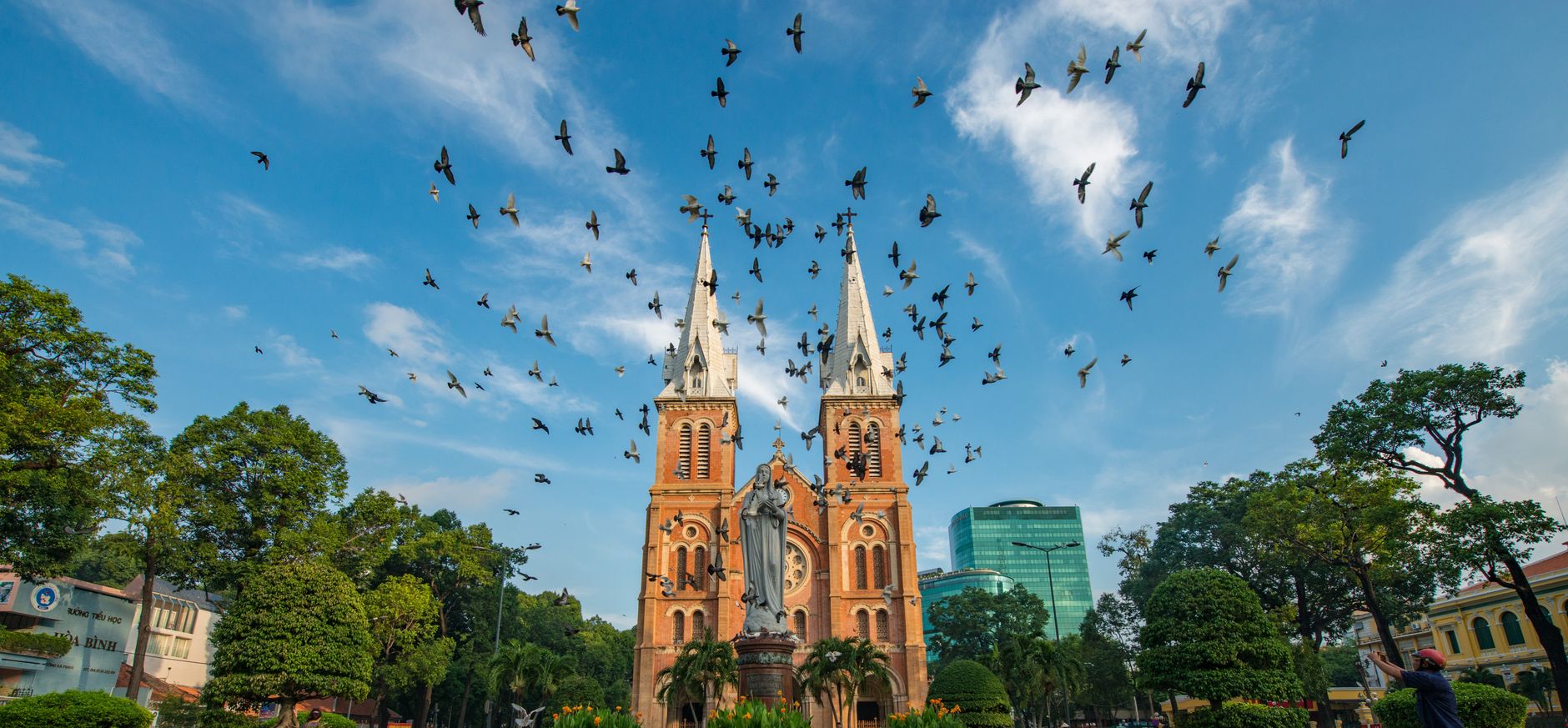
Start outside. The best approach is from the Paris Commune Square roundabout, walking toward the facade from the southeast. This gives you the full frontal view with both towers in frame.
The facade and the towers. Look at the brickwork up close. The pattern is not uniform; there are subtle tonal differences where different batches of Toulouse brick were used. The rose window above the main entrance is 12 metres in diameter and is best seen from a few metres back, since the angle steepens as you approach.
The square and the statue. The white statue of Our Lady of Peace in the small garden in front of the cathedral is the standard photo subject. It faces the roundabout. Early morning light hits it from the side, which is why photographers arrive before 9am.
The side and rear. Most visitors never walk around the building. Do it. The rear apse has a different, quieter character, and the garden behind the cathedral is a genuine pocket of calm away from the roundabout noise. The side chapels have their own small stained-glass windows.
Inside, when open. Entry is through the main doors when Mass is not in progress. The interior is high-vaulted, with rows of columns and stained glass along both sides. The light through the glass in the late afternoon is the best of the day. The atmosphere is quiet and functional; this is a working church, not a museum. Photography inside is generally tolerated when no service is running, but flash and tripods are not.
If the main doors are closed, do not assume the cathedral is shut for the day. Check the side entrance on the left, which is sometimes used when the main doors are locked.
The Central Post Office next door. This is not part of the cathedral, but it is 50 metres away and built in the same French colonial period, with a vaulted iron roof and old maps painted on the walls. Most visitors combine the two.
How it compares to nearby landmarks
Saigon has several colonial-era buildings within a short walk. The cathedral is the most visually striking, but it is not the only one worth your time.
| Landmark | Distance from cathedral | Entry | Time needed | Best for |
|---|---|---|---|---|
| Notre-Dame Cathedral | 0 km | Free | 20 to 40 min | Architecture, photos, history |
| Central Post Office | 50 m | Free | 15 to 20 min | Colonial interior, souvenirs |
| Independence Palace | 700 m | 65,000 VND (about $2.50) | 1 to 1.5 hrs | Vietnam War history |
| War Remnants Museum | 1.2 km | 40,000 VND (about $1.60) | 1.5 to 2 hrs | War photography, context |
| Saigon Opera House | 600 m | Free outside, tickets for shows | 15 min | Architecture, evening shows |
The cathedral is the fastest of these to visit and the easiest to photograph. Independence Palace and the War Remnants Museum take longer and demand more emotional energy. A realistic half-day in District 1 covers all four.
If your interests lean toward markets and street life rather than colonial architecture, Ben Thanh Market: the complete guide to Saigon's landmark market is a 15-minute walk away and a different kind of Saigon experience entirely.
Practical information
Opening hours. The cathedral is generally open to visitors from 8am to 11am and 2pm to 4pm, but these hours are not fixed and change during religious seasons. It is closed to tourists during Mass. Sunday Masses run in the morning and evening, and the cathedral is busiest then. During Christmas and Easter, tourist access is restricted or suspended entirely. Last verified in early 2026.
Entrance fee. Free. There is no ticket booth for the cathedral itself. Anyone asking for an entry fee at the gate is not official.
Dress code. This is an active place of worship. Cover shoulders and knees. No beachwear, no tank tops, no shorts above the knee. Hats should be removed inside. This is enforced more strictly during services.
The dress code is not a suggestion. Visitors in singlets and short shorts have been turned away at the door, particularly on Sundays.
Photography. Allowed outside at any time. Inside, allowed when no service is running, without flash. Do not photograph people at prayer. Tripods and drones require permission and are generally not permitted.
Accessibility. The main entrance has steps. The square and surrounding pavements are uneven in places. Wheelchair access inside the cathedral is limited.
Getting there from the city centre
The cathedral sits at 01 Công xã Paris, District 1, on the Paris Commune Square roundabout. It is walkable from most of central District 1.
On foot. From Dong Khoi Street, the walk is about 10 minutes. From Ben Thanh Market, 15 to 20 minutes. From the backpacker area around Bui Vien and Pham Ngu Lao, 20 to 25 minutes. The walk is flat and mostly shaded in the early morning.
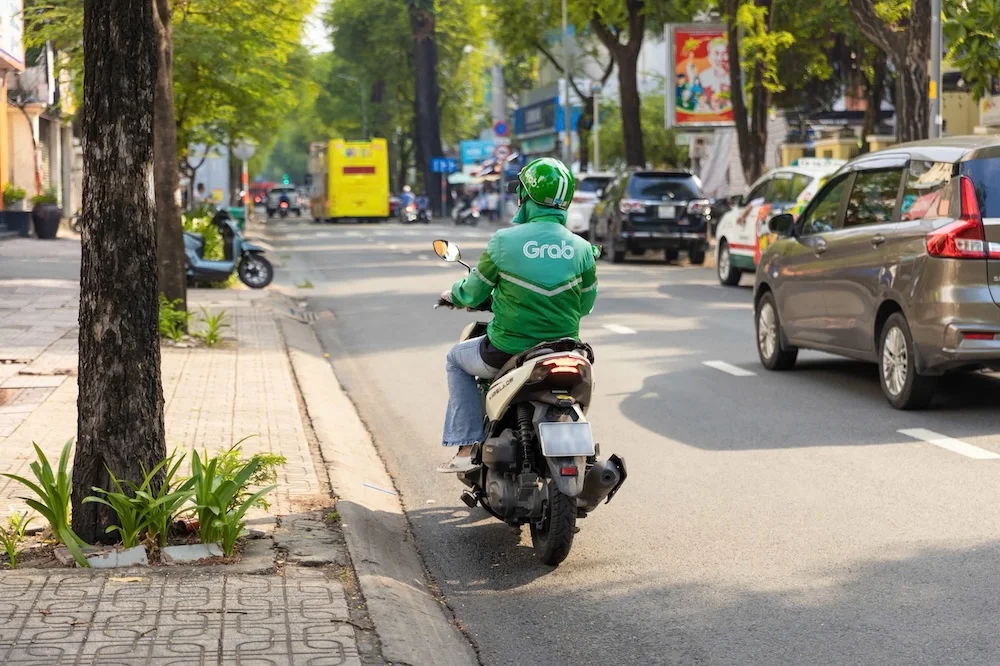
By Grab. A GrabCar from District 1 to the cathedral costs roughly 30,000 to 60,000 VND ($1.20 to $2.40) depending on distance and surge. A GrabBike is roughly 15,000 to 30,000 VND ($0.60 to $1.20). This is the simplest option if you are coming from further out, such as District 3 or District 7. For a full breakdown of when to use each, see Grab Bike vs Grab Car in Vietnam: price and when to use each.
By taxi. Use Mai Linh or Vinasun. A metered trip from central District 1 runs about 40,000 to 70,000 VND ($1.60 to $2.80). Avoid unmarked taxis waiting near the cathedral; they are a known overcharging risk. See Taxis in Vietnam: Mai Linh, Vinasun, Xanh SM and how to spot a fake taxi.
By bus. Several city buses stop near the cathedral, including routes along Dong Khoi and Le Duan. Fares are 6,000 to 7,000 VND ($0.25 to $0.30). Buses are cheap but slow in traffic.
By metro. Saigon Metro Line 1 has a station at Ben Thanh, roughly a 15-minute walk from the cathedral. For how the metro has changed getting around, see Saigon Metro Line 1 one year on: what it actually changed for travelers.
When to go and how to avoid the crowds
Best hour. Arrive between 7am and 9am. The light is soft, the temperature is manageable, and the tour buses have not yet arrived. By 10am the square is full and the heat is building.
Best season. The dry season, roughly December to April, gives the most reliable conditions. The wet season, May to November, brings afternoon downpours that clear quickly but can soak a visit. For how to plan around the rain, see Visiting Vietnam in the rainy season: how to plan around the monsoon.
Avoid. Sunday mornings and evenings, Christmas Eve and Christmas Day, Easter, and the Tet holiday period. During Tet, the cathedral area is busy with local visitors and some roads close. For context on closures across the country, see Traveling in Vietnam during Tet: a survival guide to closures, transport and food.
How long to allow. Twenty to forty minutes for the cathedral alone. Two to three hours if you combine it with the post office, Independence Palace and the War Remnants Museum.
What to combine nearby
The cathedral is the anchor of a walkable District 1 cluster.
- Central Post Office, 50 metres away, free, 15 to 20 minutes.
- Independence Palace, 700 metres, 65,000 VND (about $2.50), 1 to 1.5 hours. See Independence Palace in Ho Chi Minh City: tickets, opening hours and what to see.
- War Remnants Museum, 1.2 kilometres, 40,000 VND (about $1.60), 1.5 to 2 hours. See War Remnants Museum Ho Chi Minh City: a visitor's guide.
- Dong Khoi Street, the main shopping and café strip, runs from the cathedral toward the river.
- Ben Thanh Market, 15 to 20 minutes on foot, for food and souvenirs.
For a wider look at what else the city offers beyond this cluster, see Ho Chi Minh City things to do: beyond Ben Thanh and the war sites and Visiting Ho Chi Minh City: the complete travel guide to Saigon.
If you are planning day trips out of the city, Best day trips from Ho Chi Minh City: an honest 2026 guide covers the Mekong Delta, Cu Chi and the coast.
Who will love it, and who may not
You will love it if you have an interest in colonial architecture, church history, or photography. The brickwork alone justifies the stop. It is also a genuinely peaceful place to sit for ten minutes in the middle of a noisy city.
You may be disappointed if you expect a grand European cathedral interior. It is smaller inside than the facade suggests, and the stained glass is modest compared to Chartres or Cologne. It is also not a museum; there are no exhibits, no audio guide, no interpretive panels. If you are short on time and indifferent to churches, a photo from the square is enough.
Worth the detour? Yes, but as part of a District 1 walking route, not as a standalone trip. It is free, central, and takes less than an hour. Skipping it while in Saigon would be strange. Building a day around it would be excessive.
FAQ
Q: Is Notre-Dame Cathedral in Ho Chi Minh City free to enter? Yes. There is no entrance fee for the cathedral. It is an active church, and donations are welcome but not required.
Q: What are the opening hours in 2026? Roughly 8am to 11am and 2pm to 4pm, but hours vary and the cathedral closes during Mass. Last verified in early 2026. Check locally on the day.
Q: What should I wear? Cover your shoulders and knees. No tank tops, no short shorts, no beachwear. Remove hats inside. This is enforced.
Q: Can I take photos inside? Yes, when no service is running, without flash or tripods. Do not photograph people praying.
Q: How do I get there from District 1? Walk if you are within 2 kilometres. Otherwise use Grab (30,000 to 60,000 VND, about $1.20 to $2.40) or a metered Mai Linh or Vinasun taxi.
Q: How long should I spend there? Twenty to forty minutes for the cathedral. Two to three hours if you combine it with the Central Post Office, Independence Palace and War Remnants Museum.
Q: Is it wheelchair accessible? Access is limited. The main entrance has steps, and the surrounding pavements are uneven. The square itself is reachable.
Q: When is the best time to visit? Early morning, 7am to 9am, on a weekday in the dry season (December to April). Avoid Sundays and religious holidays.
Your questions and tips
A question, an update, an experience to share? Our team reads every message before it is published.
No comments yet. Ask the first question or share a tip!