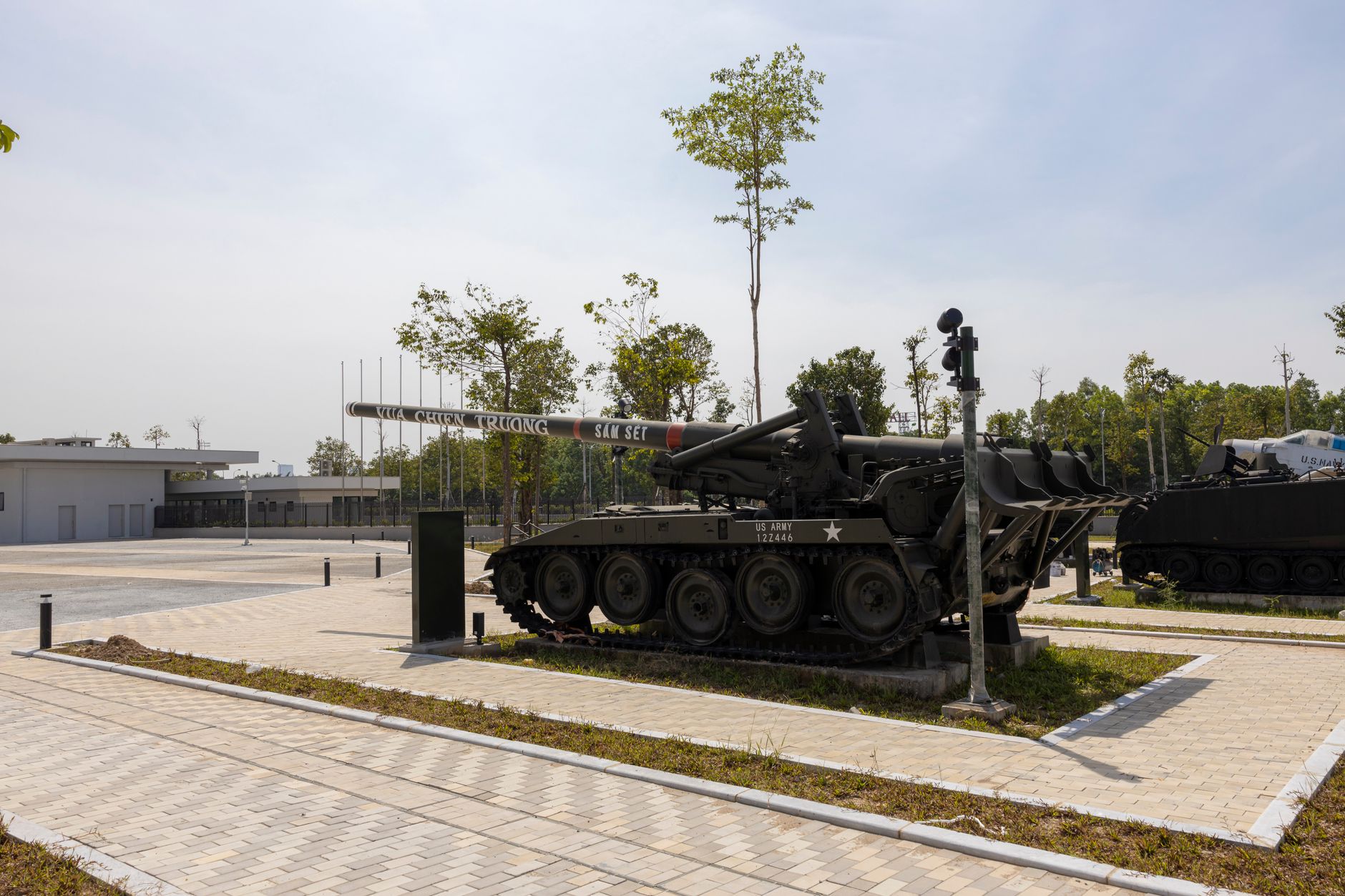
In February and March of that year, the Chinese army launched a punitive invasion along Vietnam's northern border. Cao Bang was one of the main battlefields. Entire villages were destroyed. Thousands of civilians and soldiers perished. Today, memorials, vestiges, and local stories offer curious travelers a deep dive into this painful chapter of Vietnamese history.
This article is not a general travel guide to Cao Bang. It is designed for those who want to understand what happened in 1979 and where to see the traces of this war today.
Geopolitical context: why China attacked
To understand the 1979 war, one must go back to the late 1970s. After Vietnam's reunification in 1975, relations between Hanoi and Beijing rapidly deteriorated.
Vietnam allied with the Soviet Union, China's rival. In December 1978, the Vietnamese army invaded Cambodia to overthrow the Khmer Rouge regime, an ally of China. Beijing saw this as a direct provocation.
On February 17, 1979, about 200,000 Chinese soldiers crossed the border at several points, from Lao Cai in the west to Quang Ninh in the east. The official goal was to "punish" Vietnam and "teach it a lesson." The reality was more complex: to test the new Chinese army, weaken Soviet influence in the region, and show that Beijing would not tolerate Vietnamese hegemony in Indochina.
Cao Bang, located just 30 kilometers from the Chinese border, was hit first. Chinese divisions advanced quickly along Route 3 and Route 4, targeting Cao Bang city and the Ta Lung border post.
The battle of Cao Bang: a fierce defense
The defense of Cao Bang was led by the 3rd Division of the People's Army of Vietnam, supported by local militias and border guard units. The Chinese had overwhelming numerical superiority, but the Vietnamese knew the terrain.
The most intense fighting took place around Victory Hill (Doi Chien Thang), which overlooks the city. Vietnamese soldiers held their position there for several days under intense artillery bombardment. Local witnesses recall that shells fell every minute, shredding trees and churning the earth.
On February 24, the Chinese entered Cao Bang. The city was largely destroyed. Administrative buildings, schools, the hospital, and hundreds of houses were razed. The Chinese officially withdrew on March 5, 1979, after announcing their "successful withdrawal." In reality, the Vietnamese army had launched a counter-offensive that pushed them back.
The human toll remains unclear. Official Vietnamese estimates speak of 20,000 to 30,000 deaths on the Vietnamese side, the majority being civilians. On the Chinese side, figures range from 10,000 to 27,000 dead. What is certain is that Cao Bang paid a heavy price.
Local memory: silence and resilience
Today, in Cao Bang, the 1979 war is not a topic locals bring up spontaneously. Older generations speak of it with restraint. Younger people, born after 1990, have heard about it at school or from their grandparents.
In villages around the city, the scars are visible. Some houses rebuilt after 1979 still bear bullet impacts. Military cemeteries, like the one in Vinh Quang commune, line up rows of white nameless graves.
The Vietnamese government has long maintained an official narrative: the war was a "Chinese aggression" repelled by the heroic people. Monuments and museums reflect this version. But personal stories are more nuanced. A veteran met near Cao Bang market confides: "We didn't want to fight our neighbors. But we defended our land. That's all."
For the traveler, this silent memory demands respect. Do not force questions. Observe. Listen. The places speak for themselves.
Sites to visit: memorials, vestiges, and museums
Several sites help understand the conflict and its consequences. Here are the main ones, ranked by historical interest.
Cao Bang Museum
Located in the city center, the Cao Bang Provincial Museum devotes an entire room to the 1979 border war. Visitors can see period photographs, uniforms, captured weapons, unexploded shells, and official documents. Explanatory panels are in Vietnamese and English.
Practical tip : Allow 45 minutes for this room. The museum is closed on Mondays. Free entry.
Victory Hill (Doi Chien Thang)
This hill, located 2 kilometers east of the center, was the most symbolic resistance point. A white stone memorial topped with a red star has been erected there. From the top, the view of the Bang River valley is striking. It is easy to see why the defenders chose this position.
Access is via a staircase of 300 steps. The site is not crowded. Bring water and a hat.
Ta Lung Border Post
15 kilometers north of Cao Bang, the Ta Lung border post was one of the first entry points for Chinese troops. Today, it is an active international border crossing, with trucks passing between Vietnam and China. Remains of bunkers and trenches are still visible on both sides of the road.
Caution : The border area is monitored. Do not take photos of military installations. Stay on marked paths.
Ma Phuc Pass
On Route 3, between Cao Bang and the border, Ma Phuc Pass was the scene of fierce fighting. The hairpin turns, overlooking deep gorges, made the advance of Chinese armored vehicles difficult. Bullet impacts are still visible on the rock walls. A small monument commemorates the soldiers who fell here.
Vinh Quang Heroes' Cemetery
10 kilometers south of Cao Bang, this military cemetery is carefully maintained. Incense sticks often burn on the graves. Soldiers' names are engraved on white steles. It is a place of contemplation, not a tourist attraction.
Comparison table: memory sites
| Site | Type | Access | Visit Time | Highlight |
|---|---|---|---|---|
| Cao Bang Museum | Indoor museum | City center, on foot | 1 hour | Period photos and weapons |
| Victory Hill | Outdoor memorial | 2 km from center, stairs | 30 minutes | Panoramic view |
| Ta Lung Border Post | Ruins + active post | 15 km by taxi or motorbike | 20 minutes | Visible bunkers |
| Ma Phuc Pass | Natural site with traces | Route 3, 20 km | 15-minute stop | Bullet impacts on rock |
| Vinh Quang Cemetery | Military cemetery | 10 km south, Route 3 | 20 minutes | Contemplation |
Practical tips for travelers
Getting to Cao Bang from Hanoi is straightforward. Night buses depart from Giap Bat bus station. Allow 8 hours for the journey and about 250,000 VND (9 USD). For more comfort, a private car costs between 1,500,000 and 2,000,000 VND (55-75 USD).
Once there, renting a motorbike is the best way to visit the sites. The terrain is hilly but the roads are in good condition. If you prefer not to drive, local taxis can be negotiated by the day.
Safety tip : The border region is sensitive. Avoid approaching military installations. Always keep your passport on you.
The best time to visit Cao Bang is from October to April. Temperatures are cool, skies are clear, and roads are passable. Avoid June to August, when rains make some paths muddy and slippery.
Why this past still matters
The 1979 war is not just a chapter of regional history. It reshaped relations between Vietnam and China for decades. Today, the two countries are major trading partners, but mistrust persists.
For the traveler, understanding this conflict means grasping why Cao Bang remained away from mass tourism for so long. It also means measuring the resilience of the locals, who rebuilt their homes, schools, and lives without forgetting.
One last stop, if time allows: Cao Bang market on Sunday morning. The Tay, Nung, and H'Mong minorities sell vegetables, fabrics, and rattan items there. Nothing reminds of the war. It is life taking over.
Frequently asked questions
Q: Is the 1979 war taught in Vietnamese schools? Yes, it is part of the history curriculum. Textbooks present it as a defensive war against Chinese aggression.
Q: Can visitors explore the bunkers near the border? Some bunkers are accessible, but the border area is monitored. It is not recommended to approach them without a guide.
Q: Is a special permit required to visit Cao Bang? No, no permit is needed for foreign tourists. A valid passport is sufficient.
Q: Are there local guides who speak English? Yes, a few guides in Cao Bang city offer historical tours. Inquire at the hotel or the tourism office.
Q: How long does it take to see all the memory sites? Two days are enough. One day for the city and its surroundings, another for Ta Lung and Ma Phuc Pass.
Q: Do locals willingly talk about 1979? With reserve. Elderly people may talk if asked respectfully. Avoid insisting.
Q: Are there risks of tensions at the border today? Relations are calm. Border crossings are open and cross-border trade is active. No danger for tourists.