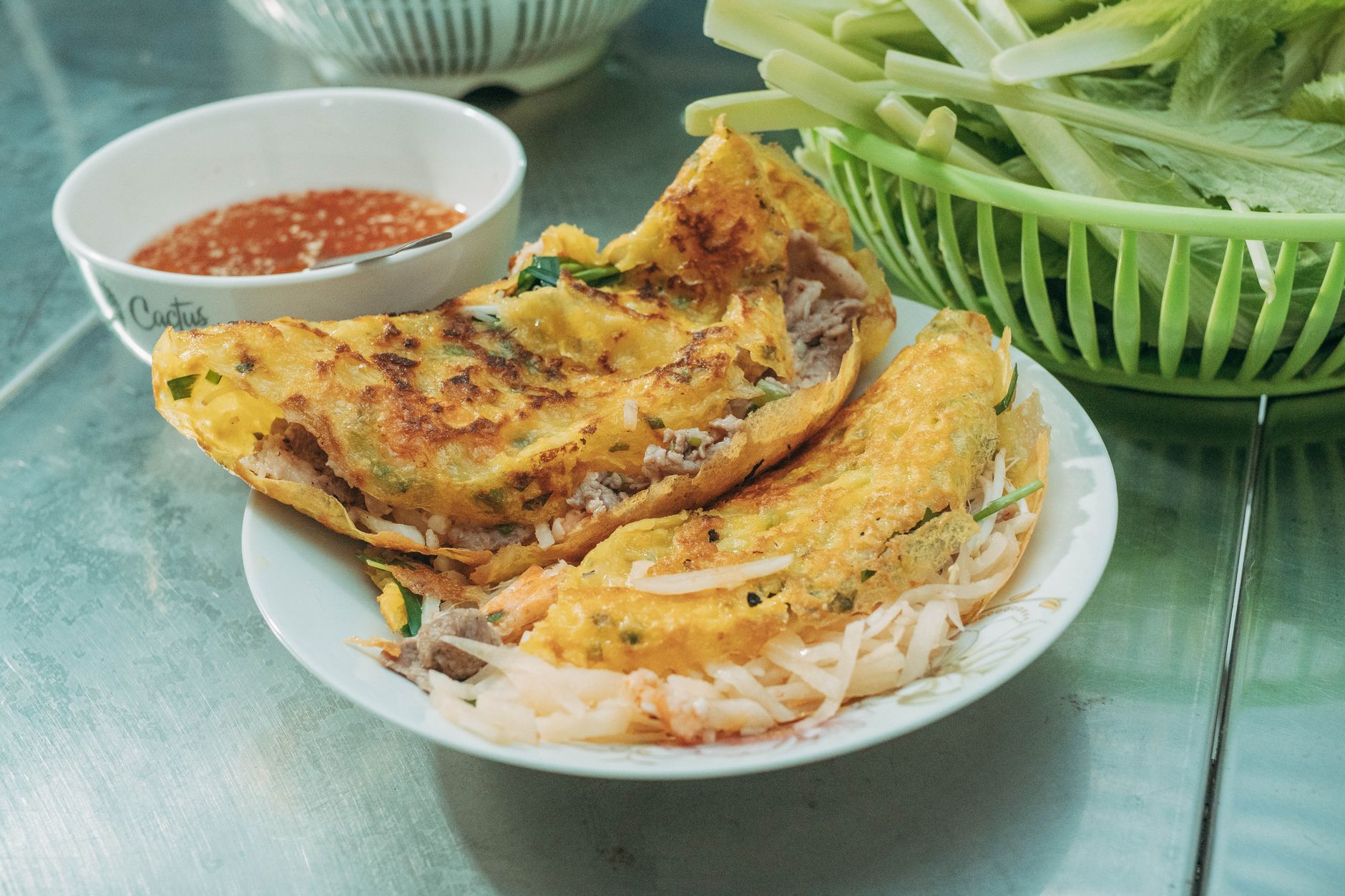
This is the moment that confuses most travelers. Unlike phở or bún chả, bánh xèo requires active participation. You do not just eat it. You build it. And if you do it wrong, the whole thing falls apart.
This guide covers exactly how to eat Vietnam's iconic sizzling pancake, the regional variations you will encounter from north to south, and where to find the best versions in each city.
What is bánh xèo and why it matters for travelers
Bánh xèo translates roughly to "sizzling pancake." The name comes from the sound the batter makes when it hits the hot oiled pan. The batter is made from rice flour and turmeric, which gives the pancake its signature yellow color. Fillings typically include pork belly, shrimp, and bean sprouts, though variations exist across regions.
The pancake is cooked in a small cast-iron pan over high heat. The batter spreads thin, becomes crispy around the edges, and is folded in half before serving. It arrives at the table looking like a golden half-moon.
What makes bánh xèo different from other Vietnamese dishes is the eating ritual. You tear off a piece, wrap it in lettuce or rice paper with herbs, dip it in sauce, and eat it with your hands. It is messy, interactive, and deeply satisfying once you get the technique right.
For travelers, understanding how to eat bánh xèo transforms the experience from confusing to memorable. It also helps you avoid the common mistake of eating it with chopsticks like a regular pancake.
The three regional styles of bánh xèo
Most guides mention two styles: central and southern. But a three-way breakdown gives you more precise guidance as you travel between cities. The differences are not subtle. Batter composition, filling ingredients, wrapper type, and dipping sauce all change depending on where you order.
Bánh xèo Miền Trung (Central Vietnam style)
This is the style found in Hue, Da Nang, and Hoi An. The pancakes are small, about the size of your hand. The batter uses rice flour only with no coconut milk, producing a paler, ivory color. Fillings are minimal: one prawn, a few thin pork slices, and bean sprouts.
Central-style bánh xèo is served with rice paper wrappers and fermented shrimp paste (mắm nêm) for dipping. You do not soak the rice paper. You use it dry to wrap the pancake, which keeps everything crisp. A typical serving includes 2 to 4 small pancakes.
Bánh xèo Miền Tây (Mekong Delta / Southern style)
This is the style most tourists encounter in Ho Chi Minh City and the Mekong Delta. The pancakes are large, thin, and bright yellow. The batter includes coconut milk and turmeric, creating a creamy fragrance and rich golden color.
Fillings are generous: pork belly, shrimp, mung beans, jicama, and sometimes duck or coconut pith (củ hủ dừa). These pancakes are wrapped in lettuce leaves, not rice paper. The dipping sauce is nước chấm, a sweet and sour fish sauce.
Bánh xèo Đà Nẵng style (a distinct central sub-variation)
Da Nang's version sits between Hue and HCMC. The pancakes are smaller than southern pancakes but slightly larger than Hue's. The key difference is texture. Da Nang style is extra crispy because the batter is deep-fried rather than pan-fried.
Fillings often include squid in addition to pork and shrimp. The pancake is served with both rice paper and lettuce, so you can choose your wrapper. The dipping sauce is always mắm nêm, though some restaurants serve a blended version with nước chấm.
| Region | Size | Batter | Filling | Wrapper | Dipping Sauce | Price Range |
|---|---|---|---|---|---|---|
| Central (Hue) | Small, hand-sized | Rice flour only, no coconut milk | 1 prawn, thin pork, bean sprouts | Dry rice paper | Mắm nêm (fermented shrimp paste) | 18,000-40,000 VND ($0.75-$1.70) |
| Da Nang | Medium | Rice flour, deep-fried | Pork, shrimp, squid, bean sprouts | Rice paper and lettuce | Mắm nêm or mixed sauce | 25,000-50,000 VND ($1.05-$2.10) |
| Southern (HCMC) | Large, thin | Rice flour with coconut milk | Pork belly, shrimp, mung beans, jicama | Lettuce leaves | Nước chấm (sweet fish sauce) | 30,000-75,000 VND ($1.25-$3.15) |
How to eat bánh xèo: Step-by-step guide
The biggest gap in most guides is a clear, practical eating guide. Here is exactly how to eat bánh xèo depending on the regional style.
Southern style (lettuce wrap)
- Tear off a bite-sized piece of the pancake with your hands or chopsticks.
- Place it on a lettuce leaf. Use a large leaf that can hold the filling.
- Add herbs: mint, cilantro, and Vietnamese perilla are standard.
- Wrap tightly like a burrito. Fold the sides in first, then roll from the bottom.
- Dip in nước chấm. Add pickled carrots or daikon on top if available.
- Eat in one or two bites. The lettuce keeps your hands clean.
Central style (rice paper wrap)
- Take a sheet of rice paper. Do not soak it in water.
- Place herbs and a piece of bánh xèo on top of the dry rice paper.
- Roll tightly, tucking in the sides as you go.
- Dip in mắm nêm or nước chấm. Start with a small amount of mắm nêm if you are new to it.
- Eat immediately before the wrapper softens from the moisture of the filling.
Pro tip: For central-style bánh xèo, the rice paper should remain crisp. If you soak it first, the whole wrap becomes soggy and falls apart.
Common mistakes travelers make
- Overstuffing the wrap. Too much filling causes the wrapper to break. Use small pieces.
- Soaking rice paper for central-style bánh xèo. It should stay dry and crisp.
- Dipping the pancake directly into sauce. This makes it soggy. Always wrap first, then dip.
- Using fork and knife. Bánh xèo is a hands-on dish. Eating it with utensils is awkward and misses the point.
The dipping sauce: Why it matters and regional differences
The dipping sauce is not an afterthought. It defines the dish. And it changes completely depending on where you are.
Nước chấm (sweet and sour fish sauce)
Standard in the south. Made from fish sauce, lime juice, sugar, garlic, and chili. It is thin, tangy, and slightly sweet. The acidity cuts through the richness of the coconut milk in southern-style pancakes.
Mắm nêm (fermented shrimp paste)
Standard in central Vietnam. Thick, pungent, and intensely salty. It is served with sliced pineapple, green mango, or star fruit to balance the strong flavor. First-time travelers should start with a small amount. Mắm nêm is an acquired taste.
Warning: Mắm nêm contains shellfish. People with shellfish allergies should ask before ordering. Some restaurants can substitute nước chấm on request.
Mixed dipping sauce (Da Nang specialty)
Some Da Nang restaurants serve a blend of nước chấm with a small amount of mắm nêm added for depth. This is a good option for travelers who want to try the central flavor profile without the full intensity.
The herb basket: What each leaf does
When the herb basket arrives, you will see a pile of leaves you may not recognize. Here is what each one does.
| Herb (Vietnamese) | Herb (English) | Flavor | Essential? |
|---|---|---|---|
| Xà lách | Lettuce | Neutral, crunchy base | Yes |
| Húng lủi | Mint | Cooling, fresh | Yes |
| Tía tô | Vietnamese perilla | Purple leaves, slightly spicy | Yes |
| Diếp cá | Fish mint | Strong, acquired taste | Optional |
| Ngò rí | Cilantro | Fresh, citrusy | Yes |
| Khế | Star fruit | Sour | Used with mắm nêm |
| Chuối xanh | Green banana | Astringent | Used with mắm nêm |
| Thơm | Pineapple | Sweet | Used with mắm nêm |
Use the herbs to balance the flavors. If the pancake is rich, add more mint and cilantro. If the sauce is salty, add star fruit or green banana.
Where to eat bánh xèo in Ho Chi Minh City
Bánh Xèo Nga (District 1)
Classic southern style. The pancakes are large, thin, and crispy. The filling includes pork, shrimp, and mung beans. The nước chấm is well-balanced. Expect a wait during lunch. Prices start at 35,000 VND ($1.50) per pancake.
Co Ba Vung Tau (District 3)
Vung Tau style, which means extra thin and extra crispy. The batter uses less flour and more water, creating a delicate texture. The filling includes coconut pith (củ hủ dừa) for added crunch. Prices from 40,000 VND ($1.70).
Amitabha Restaurant (District 1)
Vegetarian bánh xèo for non-meat eaters. Located near the Jade Emperor Pagoda. The filling uses mushrooms, tofu, and bean sprouts. The batter is made without eggs. Prices from 30,000 VND ($1.25).
Bánh Xèo 7 Tới (Binh Thanh)
Local favorite with huge portions. Each pancake is the size of a dinner plate. The filling is generous with pork belly and whole shrimp. Prices from 45,000 VND ($1.90). Go early; they close by 8 PM.
Where to eat bánh xèo in Da Nang and Hoi An
Bánh Xèo Mien Trung (Da Nang)
Authentic central style with mắm nêm included. The pancakes are medium-sized and extra crispy. Squid is a standard addition. Prices from 30,000 VND ($1.25).
Ba Duong (Da Nang)
Famous for extra crispy pancakes. The batter is deep-fried to a golden brown. The restaurant has been open for over 30 years. Prices from 35,000 VND ($1.50). Expect a line at dinner.
Ba Le Well (Hoi An)
Tourist-famous but still good. The set menu format includes bánh xèo, fresh spring rolls, and herbs. Prices are higher at 75,000 VND ($3.15) per serving.
Co Anh (Hoi An)
Local spot with cheaper prices and fewer crowds. The pancakes are smaller but perfectly crispy. Prices from 25,000 VND ($1.05).
Where to eat bánh xèo in Hue
Hue's version is the smallest and simplest. Few travelers know where to find it.
Bánh Xèo Huyền (Hue)
Family-run restaurant near the Imperial Citadel. The pancakes are hand-sized and pale yellow. The mắm nêm is house-made and pairs well with green banana and star fruit. Prices from 20,000 VND ($0.85).
Quán Bánh Xèo Bà Đỏ (Hue)
The oldest bánh xèo restaurant in Hue. Operating since 1975. The recipe has not changed. The pancakes are small, crisp, and served with a generous herb basket. Prices from 25,000 VND ($1.05).
Vegetarian and vegan bánh xèo
Many travelers seek vegetarian options. Dedicated vegetarian restaurants (quán chay) almost always have bánh xèo chay on the menu.
Typical fillings include mushrooms, tofu, and bean sprouts. Some restaurants add mock meat made from wheat gluten or soy protein. The batter is usually the same as the standard version, but some places use vegetable oil instead of pork fat.
Warning: Some restaurants use pork fat to fry the pancakes even when the filling is vegetarian. Always ask "có dầu mỡ không?" (does it have animal fat?) if this matters to you.
Look for restaurants with "chay" in the name. In Ho Chi Minh City, Amitabha and Hum Vegetarian are reliable options. In Da Nang, Tam Da Chay serves a good bánh xèo chay.
Bánh xèo vs. similar dishes (so you don't confuse them)
Bánh khọt: Mini, thick, round pancakes made with coconut milk. Cooked in special mini pans. They are about the size of a silver dollar and served with the same herbs and sauce as bánh xèo. The texture is creamier and less crispy.
Bánh căn: Tiny, egg-shaped pancakes from central Vietnam. Made with rice flour and topped with a quail egg. Cooked in small clay molds over charcoal. Completely different texture and eating method.
Bánh cuốn: Steamed rice rolls filled with minced pork and mushrooms. Served with fried shallots, cucumber, and fish sauce. It is not a pancake and does not involve wrapping. Many travelers confuse the two because both involve rice batter.
Practical tips for eating bánh xèo on a trip
- Expect to share. Bánh xèo is a communal dish. A single person typically orders 2 to 3 pancakes.
- Price range: 18,000 to 75,000 VND ($0.75 to $3.00) per pancake. A full serving costs 50,000 to 150,000 VND ($2.00 to $6.00).
- Best time to eat: Lunch or early dinner. Many bánh xèo stalls close by 8 PM.
- Hygiene: Choose busy stalls with high turnover. The oil is fresher and the ingredients move faster.
- Language: Say "Một phần bánh xèo" (one serving of bánh xèo). To order vegetarian, say "bánh xèo chay."
- Allergies: Mắm nêm contains shellfish. Ask for nước chấm instead if needed.
The history and cultural significance of bánh xèo
The origins of bánh xèo are debated. Some food historians trace it to Champa influence, noting the use of turmeric and rice flour in Cham cuisine. Others point to Chinese immigrants who adapted their own crispy pancakes using local ingredients.
What is known is that bánh xèo was historically eaten as a rice substitute on the 2nd and 16th days of each lunar month. These are Buddhist observance days when many Vietnamese eat vegetarian or lighter meals. The pancake provided sustenance without using rice.
Today, bánh xèo is a symbol of Vietnamese ingenuity. Simple ingredients like rice flour, turmeric, and bean sprouts are transformed into something extraordinary. The dish requires skill to cook properly and participation to eat correctly. It is not passive consumption. It is an interaction.
FAQ
Q: How do you eat a Vietnamese pancake? A: Tear the pancake into bite-sized pieces, wrap each piece in lettuce or rice paper with herbs, then dip in the accompanying sauce. Use your hands, not chopsticks or fork.
Q: Is bánh xèo a Vietnamese pancake? A: Yes, but it is savory, not sweet. Made from rice flour and turmeric, filled with pork, shrimp, and bean sprouts, and eaten with greens and dipping sauce.
Q: How to eat Vietnamese pancake with rice paper? A: Place a piece of bánh xèo and herbs on a dry sheet of rice paper. Roll tightly, tucking in the sides, and dip immediately. Do not soak the rice paper first; it should stay crisp.
Q: How is bánh cuốn traditionally served? A: Bánh cuốn is a different dish: steamed rice rolls filled with minced pork and mushrooms, served with fried shallots, cucumber, and fish sauce. It is not a pancake and does not involve wrapping.
Q: What is the difference between bánh xèo and bánh khọt? A: Bánh khọt are small, thick, round pancakes made with coconut milk, cooked in special mini pans. Bánh xèo are large, thin, and folded. Both are crispy but differ in size, texture, and cooking method.
Q: Can you eat bánh xèo without meat? A: Yes. Many restaurants offer vegetarian bánh xèo (bánh xèo chay) with mushrooms, tofu, and bean sprouts. Look for restaurants with "chay" in the name.
Q: What does mắm nêm taste like? A: Mắm nêm is fermented shrimp paste. It is intensely salty, pungent, and fishy. Central Vietnamese love it; many foreigners find it challenging. Start with a small amount mixed with nước chấm.
Q: How much does bánh xèo cost in Vietnam? A: Prices range from 18,000 VND ($0.75) for street stalls to 75,000 VND ($3.00) for restaurants. A typical serving of 2 to 4 pancakes costs 50,000 to 150,000 VND ($2.00 to $6.00).