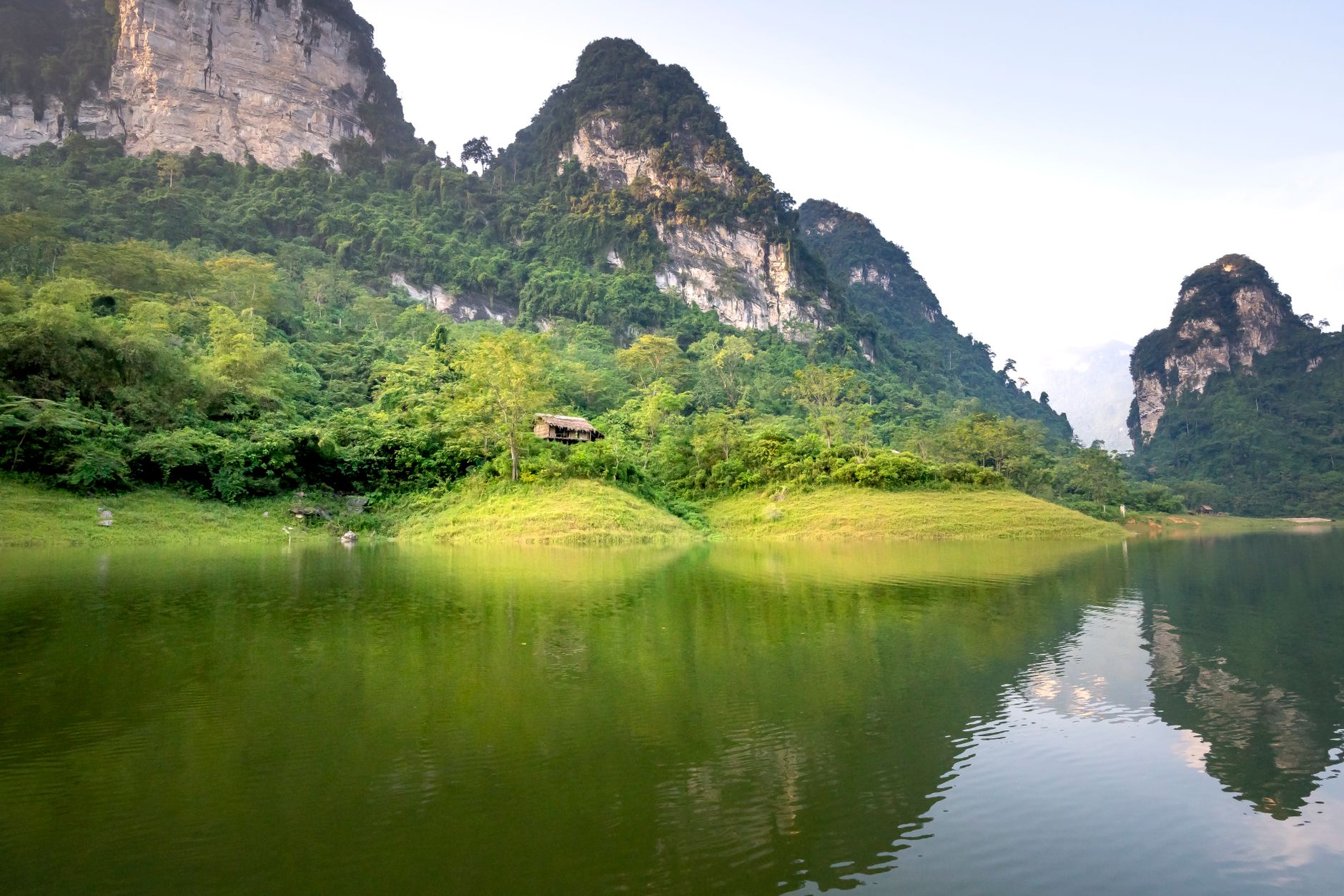
Ba Bể at a glance
Where it is now. Since 1 July 2025, Bắc Kạn province has been merged into Thái Nguyên province, and the district level of government has been abolished. Ba Bể is therefore in Thái Nguyên, not "Bắc Kạn" as most travel guides still state. Google Maps, bus companies and older signage may still show Bắc Kạn, Ba Bể District or Nam Mẫu commune, so expect to see both names on your journey. The new commune name for the lake area is being finalised by provincial authorities; check locally before you book, because it affects which bus stop you ask for.
Vietnamese names. Vườn quốc gia Ba Bể is the national park; Hồ Ba Bể is the lake. "Pé" means lake in Tày, which explains the name "three lakes": the basins Pé Lầm, Pé Lù and Pé Lèng.
Official status.
- National park since 10 November 1992 (Decision 83/1992/QĐ-TTg).
- ASEAN Heritage Park since 2004.
- Ramsar Wetland of International Importance since 2011, Vietnam's third Ramsar site. Almost no English-language travel page mentions this.
- National scenic site in 1996, with an upgrade to special national site commonly dated 2012.
What it is not. Ba Bể is not a UNESCO World Heritage Site and not a UNESCO Global Geopark. Some websites claim geopark status, which is incorrect. A UNESCO proposal was floated in 1997, but there has been no inscription.
Why the numbers online don't match
Published sources give park areas of 7,610 ha, 10,000 ha and more than 23,000 ha. Lake widths range from 400 m to 2 km, and depths from 29 to 35 m. One guide claims the karst is "two billion years old".
The confusion comes from mixing core zone with buffer zone, and dry-season with wet-season water levels. The figures that hold up:
- Park and Ramsar site: about 10,048 ha.
- Lake: about 8 km long, roughly 500 ha of surface, up to about 35 m deep, sitting at around 145–150 m elevation.
- Rock age: the limestone is hundreds of millions of years old, not billions.
Cite the Ramsar Sites Information Service and the park management board (Ban quản lý Vườn quốc gia Ba Bể) if you need to check anything before you go.
Is Ba Bể worth the trip? Honest expectations
Ba Bể is quiet lake-and-village scenery. It is not Hà Giang, and it does not pretend to be. There are no dramatic high-mountain passes, no viewpoint that stops traffic. What you get is water, forest, caves and village life at a slow pace.
Wildlife sightings of large animals are rare. The park is better for birds, butterflies and forest walks. The Tonkin snub-nosed monkey appears in some sources, but visitors should not expect to see one. One guide lists a "primate protection center" here; that is Cúc Phương's Endangered Primate Rescue Center, several hundred kilometres south.
Weekends and Vietnamese public holidays bring motorboat traffic and crowded wharves. Weekdays are markedly calmer, and the lake at 7am on a Tuesday is a different place from the lake at 10am on a Saturday.
The lakeshore has a growing number of homestays and new construction. Pác Ngòi is no longer an "untouched" village, though it remains pleasant and is by far the most convenient base.
Who it suits: slow travellers, families with older children, photographers, anyone combining the northeast loop towards Cao Bằng, and people who want a lake instead of a trek.
Who should skip it: anyone with only two or three days in Vietnam, anyone expecting alpine scenery, and anyone unwilling to sit in a car for five hours each way.
When to go
Weather and water levels determine which activities are possible. Most guides reduce this to a single "November to April" line, which hides the fact that the same month can be perfect for a boat trip and useless for a waterfall.
Seasons and what changes on the lake
Rainy season (May to September). Heavy rain, a risk of flash floods and landslides on access roads, and leeches on trails. Boat access through Puông Cave can be suspended when the Năng River runs high. Đầu Đẳng waterfall is at its most powerful. Typhoon Yagi flooded much of the northeast in September 2024, which shows how quickly storm systems can change conditions here.
Autumn (late September to November). Generally the best balance: dry weather, clear skies and golden rice around harvest.
Winter (December to February). Cold, damp and misty. Night temperatures can fall to around 5–10°C, and many homestays have no heating, so pack layers. Early-morning fog on the lake is atmospheric and worth the shiver.
Spring (March to April). Mild weather, but waterfalls run lower and the lake can be hazy.
Festivals and crowd calendar
The Lồng Tồng festival is the Tày "going to the fields" ceremony. Ba Bể's version, with dugout and boat racing plus folk games, is held around the 8th to 10th day of the first lunar month. Tết 2027 falls on 6 February 2027, so the festival should land around 13–15 February 2027. Confirm exact dates locally in January.
Peak domestic periods to avoid if you want quiet: Tết week, 30 April and 1 May, the 2 September national holiday, and summer school holidays (June to August) on weekends.
| Month | Weather | Waterfall / cave status | Crowds |
|---|---|---|---|
| Jan–Feb | Cold, misty, 5–10°C at night | Đầu Đẳng low; Puông open | Low, except Tết |
| Mar–Apr | Mild, hazy | Waterfalls low | Moderate |
| May–Aug | Hot, heavy rain | Đầu Đẳng strong; Puông may close | High on weekends |
| Sep | Storm risk, clearing late | Đầu Đẳng strong | Low to moderate |
| Oct–Nov | Dry, clear, golden rice | Both at their best | Moderate |
| Dec | Cold, foggy mornings | Low water | Low |
How to get there from Hanoi
This is the section that decides whether the trip works. Many guides either skip it or give wrong figures, such as "2–3 hours" on one major booking site.
The route is about 230–250 km: the Hanoi–Thái Nguyên expressway (CT07), then QL3 north towards Phủ Thông, then QL279 to Chợ Rã, then the provincial road (ĐT258) to the park. Realistically allow 4.5–5 hours by car, longer in rain or traffic.
Bus and shuttle
Buses and limousine vans run to Chợ Rã, the town about 15–18 km from the lake. They leave from Mỹ Đình station or offer door-to-door pickup in the Old Quarter. Expect about 5.5–6.5 hours and 200,000–300,000 VND (US$8–12).
An alternative is a bus to the former Bắc Kạn town, about 60 km short of the lake, then a local taxi.
The last leg from Chợ Rã to the lake is by xe ôm or taxi, at roughly 150,000–250,000 VND (US$6–10). Many homestays arrange pickup if you message them the day before.
Private car and motorbike
A private car with driver typically costs 2.5–3.5 million VND (US$95–135) one way. Verify current quotes, since fuel prices move.
By motorbike, plan for 5–7 hours with stops. Check the legal requirements in the safety section below, and watch for trucks on QL3 and tight mountain curves on QL279.
| Mode | Departure point | Duration | Cost (VND / USD) | Best for |
|---|---|---|---|---|
| Limousine van | Old Quarter pickup or Mỹ Đình | 5.5–6.5 h | 200,000–300,000 / US$8–12 | Solo travellers, couples |
| Public bus | Mỹ Đình station | 6–7 h | 150,000–250,000 / US$6–10 | Tight budgets |
| Private car | Your hotel | 4.5–5 h | 2.5–3.5 m / US$95–135 | Families, groups of 3–4 |
| Motorbike | Self-ride | 5–7 h | Fuel plus rental | Confident riders doing a loop |
Continuing beyond Ba Bể
Many travellers slot Ba Bể into a loop rather than returning to Hanoi. To Cao Bằng city is about 3–4 hours, then on to Bản Giấc waterfall. To Hà Giang is a long day, routed via Na Hang in Tuyên Quang. Some riders ferry motorbikes by boat downstream past Đầu Đẳng towards Na Hang; treat this as a seasonal, informal option and confirm it locally before relying on it.
Fees, opening hours and how the boat system works
Park entry runs around 45,000–70,000 VND (US$1.70–2.70) per person. Sources conflict, so confirm the posted rate when you arrive. The fee is collected at a checkpoint on the access road, and you should keep the ticket.
Sites are open roughly 07:00 to 17:00, and boats run in daylight only.
Boats leave from the main wharves, such as the park centre wharf and Bó Lù. They are priced per boat, not per person, and seat roughly 10–15 people. Prices are posted by route at the wharf.
Solo travellers save real money by asking their homestay to group them with other guests. A boat to Puông Cave and Ao Tiên costs the same whether one person or twelve are aboard.
Indicative boat prices run from about 450,000 to 1,200,000 VND (US$17–46) per boat, depending on route length. Before boarding, check that life jackets are present and that they fit.
| Route | Stops included | Duration | Price per boat (VND / USD) |
|---|---|---|---|
| Short loop | Puông Cave, Ao Tiên, An Mã island | 2–3 h | 450,000–600,000 / US$17–23 |
| Standard loop | Above plus Pò Giả Mải and village stops | 3–4 h | 700,000–900,000 / US$27–35 |
| Extended | Above plus Đầu Đẳng waterfall | 4–5 h | 1,000,000–1,200,000 / US$38–46 |
The lake by boat: the main stops
The standard boat loop is what most visitors come for. Departing around 07:30 gives the calmest water and the fewest boats. By mid-morning the wharf is busy and the lake surface is chopped up by wakes.
Puông Cave (động Puông)
The Năng River flows through a limestone tunnel roughly 300 m long and up to about 30 m high, home to a large bat colony. A Mạc dynasty general used the area as a base in the 16th century. Boat passage may close at high water in the rainy season, which is worth asking about before you pay.
Ao Tiên (Fairy Pond)
A small enclosed pond reached by a short, steep climb of about 10–15 minutes from the landing. Wear proper shoes; flip-flops are a bad idea on wet rock.
Pò Giả Mải (Widow's Island) and An Mã Island
The widow legend explains the island's name and ties into the lake's origin myth, which is worth hearing from a local guide rather than reading on a sign. An Mã island has a temple and is connected to the festival.
Đầu Đẳng waterfall
A series of cascades where the Năng River drops over rock steps, near the boundary with Tuyên Quang. It is impressive in the wet season and much weaker in the dry months. Adding it extends the boat trip to roughly 4–5 hours in total.
Beyond the boat: treks, caves, kayaking and cycling
Village walks. The Pác Ngòi to Bó Lù to Cốc Tộc route is mostly flat paths and quiet roads, about 4–6 km. It is easy to do self-guided.
Hua Mạ Cave. On the road side of the lake, with a steep stair climb to the entrance and a lit interior a few hundred metres long. Entry is around 45,000 VND (US$1.70); verify on arrival. Allow 1–1.5 hours.
Forest and long-distance treks. Longer loops exist, such as the roughly 20 km route with about 500 m of elevation gain listed on AllTrails. Guided multi-day treks to Dao and Hmong hamlets can be arranged through the park or your homestay. Use a park ranger or a licensed local guide: trails are poorly signed and phone coverage is patchy. Leeches are a real nuisance in the wet season. One international booking platform lists a "Cat Ba Bay" view from a Ba Bể summit, which is a different destination entirely and suggests copy-pasted tour text.
Kayaking and cycling. Kayaks are rented from lakeside homestays, typically about 100,000–200,000 VND (US$4–8) per hour or per session. Bicycles are available for the village roads. Read the swimming warning below before you head out.
Night walks. Be realistic: these mainly show insects, frogs and spiders. The chance of seeing mammals is low.
| Site | Access | Time needed | Effort | Fee | Seasonal caveat |
|---|---|---|---|---|---|
| Puông Cave | Boat | 30–45 min | Low | Included in boat | May close at high water |
| Ao Tiên | Boat plus foot | 45–60 min | Moderate climb | Included in boat | Slippery after rain |
| An Mã Island | Boat | 30 min | Low | Included in boat | Busy at festival |
| Đầu Đẳng waterfall | Boat | 1–1.5 h | Low | Included in extended boat | Weak in dry season |
| Hua Mạ Cave | Road | 1–1.5 h | Steep stairs | ~45,000 VND | Slippery steps when wet |
| Village walk | Foot | 2–3 h | Low | Free | Muddy May–September |
Tày villages, homestays and local culture
Culture is the core of a Ba Bể stay, not decoration. The Tày, Dao and Hmong communities live around the lake, and the Tày stilt house (nhà sàn) is the defining building: raised on wooden posts, with a living floor above and animals or storage below.
Then singing, with the đàn tính lute, is the region's signature art form. "Practices of Then by Tày, Nùng and Thái ethnic groups" was inscribed on UNESCO's Representative List of Intangible Cultural Heritage in 2019. If a homestay offers an evening of Then singing, it is worth accepting.
Etiquette matters more than most guides admit. Remove shoes in stilt houses. Ask before photographing people, especially at markets. Rice wine toasts are customary, but declining politely is fine and nobody will be offended. Avoid pressuring locals into staged performances; a real evening around a table beats a choreographed one.
The Chợ Rã market is the main local market, and periodic village markets run on rotating days. Confirm market days locally, since they follow the lunar calendar in places.
Where to stay and what to eat
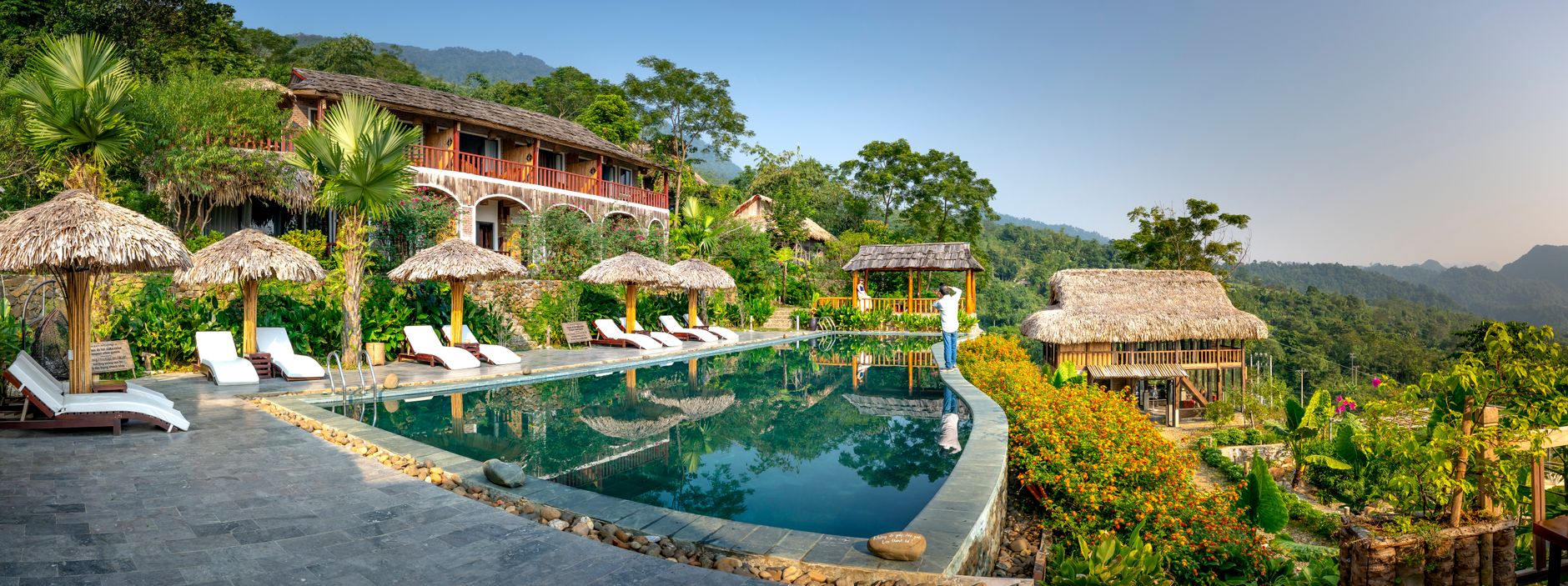
Pác Ngòi is the most developed homestay cluster and the most convenient for boats. Bó Lù and Cốc Tộc are quieter. A few simple hotels operate in Chợ Rã, and a small number of lakeview lodges have opened in recent years.
Indicative prices: a homestay dorm mattress runs 150,000–250,000 VND (US$6–10), a private homestay room 400,000–900,000 VND (US$15–35), and set meals about 100,000–200,000 VND (US$4–8) per person. Book ahead for weekends, when Hanoians arrive in numbers.
Thin walls, shared bathrooms and roosters at dawn are normal in homestays. If that is not what you want, book one of the lakeview lodges instead and accept the higher price.
| Type | Location | Price range (VND / USD) | Pros | Cons |
|---|---|---|---|---|
| Homestay dorm | Pác Ngòi | 150,000–250,000 / US$6–10 | Cheapest, sociable, boat access | Shared bathroom, thin walls |
| Private homestay room | Pác Ngòi, Bó Lù, Cốc Tộc | 400,000–900,000 / US$15–35 | Local food, village setting | Little heating in winter |
| Simple hotel | Chợ Rã | 350,000–700,000 / US$13–27 | Reliable, near ATMs and market | 15–18 km from the lake |
| Lakeview lodge | Lakeshore | 1.2–2.5 m / US$46–96 | Views, comfort, quiet | Limited availability |
Dishes to try: fried or grilled lake fish, khâu nhục (Tày braised pork belly), roast pork, xôi ngũ sắc (five-colour sticky rice), cơm lam (bamboo-tube rice), bamboo shoots, rau ngót rừng (wild sweet leaf) and corn wine.
Menus offering "thịt thú rừng" (wild animal meat) involve illegal wildlife trade. Refuse it, and do not photograph it approvingly.
Suggested itineraries
Day trip from Hanoi. Not recommended. It means about 10 hours of driving for 3–4 hours on site.
One night (minimum). Morning departure, afternoon village walk, early boat loop the next day, return to Hanoi by evening.
Two nights (recommended). Add Đầu Đẳng, Hua Mạ Cave, kayaking at sunset and a slower village day.
Three nights. Add a guided forest trek, or continue onward to Cao Bằng or Bản Giấc.
Safety, health and legal points
Water. The lake is deep and cold in winter, and there are no lifeguards. Drownings happen at Vietnamese lakes and rivers every year. Wear life jackets on boats and kayaks. Do not swim after drinking rice wine.
Roads. Landslide and flash-flood risk on QL279 and local roads during heavy rain. Check the forecast and local news before travelling, and do not ride or drive after dark on mountain roads.
Motorbike legality. Foreigners need a valid licence plus an International Driving Permit under the 1968 convention. Travel insurance is often void if the rider is unlicensed.
Health. Mosquito repellent is essential, since dengue is present in northern Vietnam. Leeches are common on wet-season trails. Medical care near the lake is basic: the nearest district-level centre is in Chợ Rã, and serious cases go to Thái Nguyên city or Hanoi.
Rules. Homestays register guests' passports with local police, which is a legal requirement, so hand yours over when asked. Drone flying in Vietnam requires a permit. Collecting plants, buying wildlife products and fishing in protected zones are prohibited.
Budget and practical checklist
A backpacker should budget about 600,000–900,000 VND (US$23–35) per day on the ground. Mid-range travellers should plan on 1.5–2.5 million VND (US$58–96), excluding transport from Hanoi.
| Item | Backpacker (VND) | Mid-range (VND) |
|---|---|---|
| Accommodation | 150,000–250,000 | 400,000–900,000 |
| Food and drink | 200,000–300,000 | 400,000–700,000 |
| Boat share | 60,000–100,000 | 100,000–150,000 |
| Entry and sites | 50,000–100,000 | 100,000–150,000 |
| Kayak or bike | 50,000–100,000 | 100,000–200,000 |
| Daily total | 600,000–900,000 | 1,500,000–2,500,000 |
ATMs are in Chợ Rã, not by the lake. Carry cash for boats, fees and homestays. Mobile data generally works around the lake and villages but is patchy on trails. Pack a rain jacket, warm layers from November to March, grip shoes for Ao Tiên and cave steps, a headlamp, and leech socks in the wet season.
FAQ
Q: Which province is Ba Bể Lake in? Ba Bể Lake is in Thái Nguyên province, following the merger of Bắc Kạn into Thái Nguyên on 1 July 2025. Most maps, tour pages and older signs still say Bắc Kạn, so travellers may see both names.
Q: How far is Ba Bể from Hanoi? About 230–250 km by road via the Thái Nguyên expressway, QL3 and QL279. Allow 4.5–5 hours by private car or 5.5–6.5 hours by bus, which is why at least one overnight stay is advised.
Q: How much is the entrance ticket? Park entry is around 45,000–70,000 VND (US$1.70–2.70) per person; confirm the current posted rate. Boats are the bigger cost, charged per boat at roughly 450,000–1,200,000 VND (US$17–46) depending on route.
Q: What is Ba Bể Lake like? It is a long, narrow lake about 8 km long, made of three linked basins, ringed by forested limestone cliffs and Tày stilt-house villages. The experience is calm and scenic: boat trips, caves, short climbs and village life rather than adrenaline.
Q: Can Ba Bể be visited as a day trip from Hanoi? It is technically possible but not worthwhile. Round-trip driving takes about 10 hours and leaves only a rushed boat ride. One night is the minimum and two nights is ideal.
Q: Is it safe to swim or kayak on the lake? Kayaking with a life jacket is generally fine in calm conditions. Swimming carries real risk: the lake is deep and cold in winter, and there are no lifeguards. Avoid both after drinking alcohol, during storms or after dark.
Q: When is the Ba Bể lake festival? The Lồng Tồng festival, with boat racing, is usually held around the 8th to 10th day of the first lunar month, which should be about 13–15 February 2027. Exact dates are announced locally, and homestays fill up quickly that week.
Q: Is Ba Bể a UNESCO site? No. It is an ASEAN Heritage Park (2004) and a Ramsar wetland site (2011), and it was proposed to UNESCO in the 1990s without inscription. Separately, the Then singing tradition practised by local Tày communities is on UNESCO's intangible heritage list (2019).


Your questions and tips
A question, an update, an experience to share? Our team reads every message before it is published.
No comments yet. Ask the first question or share a tip!