Pho Thin Lo Duc at a glance
| Item | Detail |
|---|---|
| Address | 13 Lò Đúc, Hai Bà Trưng ward, Hanoi |
| Address in Vietnamese | Phở Thìn, 13 Lò Đúc, phường Hai Bà Trưng, Hà Nội |
| Hours | Roughly 6:00 to 20:30 or 21:00 daily |
| Signature dish | Phở tái lăn (stir-fried beef pho) |
| Price per bowl | About 70,000 to 90,000 VND (US$2.70 to 3.40), observed October 2026 |
| Payment | Cash at the counter before you sit |
| Time needed | 20 to 30 minutes including a short wait |
| Directions | Directions |
The address format changed when Vietnam removed the district level on 1 July 2025. Older listings still show "Phạm Đình Hổ ward, Hai Bà Trưng district". Both work with drivers, but the Vietnamese line above is the one to show on your phone.
Which Pho Thin? Lo Duc, Bo Ho and the branches abroad
"Pho Thin" refers to two unrelated Hanoi shops plus a scattering of overseas restaurants of varying legitimacy. This is the single biggest source of confusion in every listing online, so start here.
| Name | Location | Founded | Style | Link to 13 Lo Duc |
|---|---|---|---|---|
| Pho Thin Lo Duc | 13 Lò Đúc, Hai Bà Trưng ward, Hanoi | 1979 | Stir-fried beef (tái lăn) | Original |
| Pho Thin Bo Ho | 61 Đinh Tiên Hoàng, Hoan Kiem | Commonly dated to the 1950s | Boiled beef (tái, chín, nạm) | None |
| Licensed franchises abroad | Japan, Australia, South Korea, United States (including Westminster, California and Falls Church, Virginia) | From the late 2010s | Stir-fried beef | Licensed use of the name |
| Unrelated namesakes | Various, including some in the United States | Various | Various | Unclear or none |
Pho Thin Lo Duc (the subject of this guide)
Founded in 1979 by Nguyễn Trọng Thìn, the shop still runs at the same address under the family's next generation. Its fame rests on one technique: the beef is stir-fried in a hot wok with garlic rather than blanched in broth.
Pho Thin Bo Ho (a different shop)
At 61 Đinh Tiên Hoàng, on the east side of Hoan Kiem Lake, this shop takes its name from the lake ("Bờ Hồ" means lakeside). It is commonly dated to the 1950s, when it began as a street cart, though the founding date and founder's name deserve checking against the family's own account before you cite them. It serves the classic boiled-beef style with a clearer broth and has no family or business link to Lo Duc.
Franchises in Vietnam and overseas
The Lo Duc brand licensed outlets abroad from the late 2010s, with Tokyo widely reported as one of the first, followed by Australia, South Korea and the United States. Some US restaurants named Pho Thin trace themselves to the Bo Ho family instead. Others appear to use the name with no stated link to either Hanoi shop. Branches bearing the words "13 Lò Đúc" also exist elsewhere in Vietnam.
The only place that serves the original bowl is 13 Lo Duc. A branch with the same name, even one with the same sign, is a different kitchen.
How to know you are at the right door
Look for the street number 13 on the facade, a small stainless-steel sign reading "Phở Thìn 13 Lò Đúc" rather than a large shop sign, and the cooking itself: big broth cauldrons and a stir-fry station right at the entrance, with the dining room behind. Several look-alike shops on nearby streets use the word "Thìn", so check the number before you sit down.
A short history of the shop
1979 falls in Vietnam's subsidy era, when private food businesses faced tight restrictions and opening a private pho shop was a notable act in itself. According to the family's own account, the founder worked as a painter before turning to noodles, and the brand still tells that story. Treat it as the family's telling rather than documented biography.
The technique is the real legacy. Mr. Thìn's contribution was to stir-fry the beef rather than blanch it in broth, and the shop popularised the style rather than necessarily inventing it. The result is a bowl that tastes unlike anything else in the city, and it made the shop a reference point for Hanoi pho.
Today the business has passed to the next generation, and overseas expansion began in the late 2010s. The original address remains the family's, and the queue outside it remains the proof.
How pho tai lan differs from other Hanoi pho
The technique
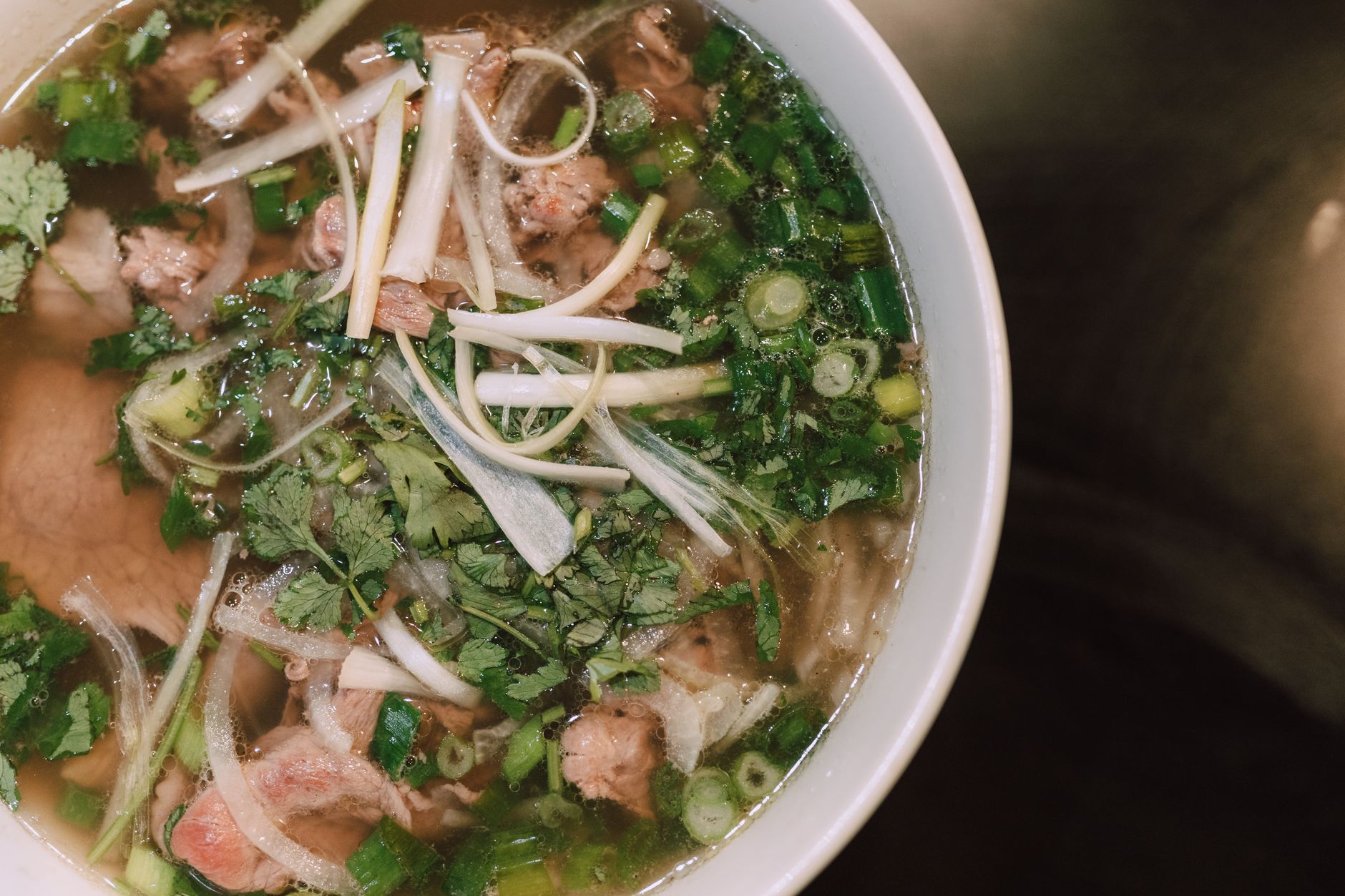
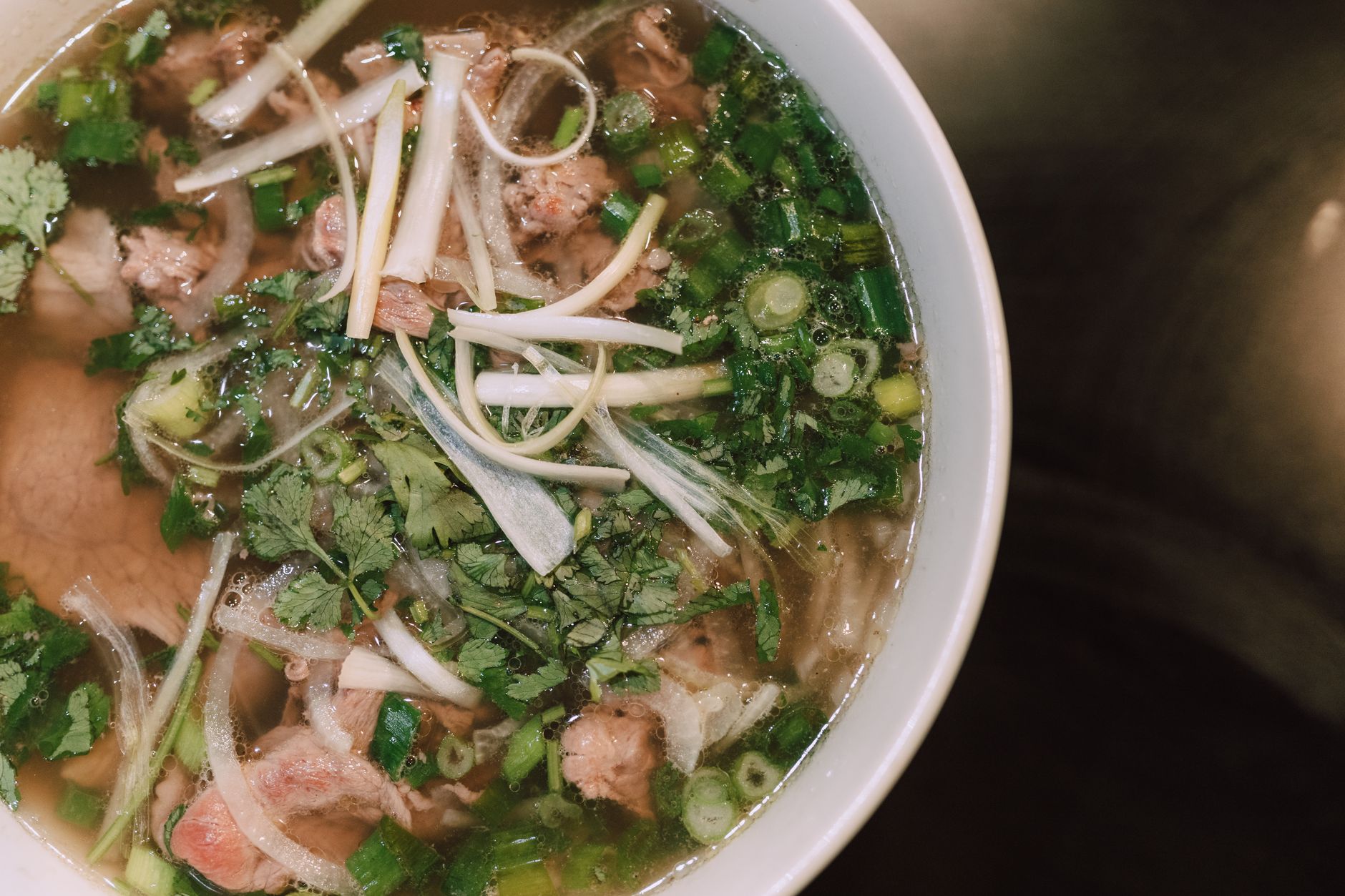
Thin strips of beef go into a very hot wok with oil, crushed garlic and, by several accounts, ginger. They are tossed for seconds, come out seared outside and pink inside, and land on fresh flat rice noodles before the broth is ladled over. That brief contact with high heat gives a smoky, garlicky note that boiled-beef pho simply does not have.
Broth and fat
The broth is beef-bone based and richer than most, with a visible layer of fat on the surface. Expect it to be noticeably more savoury and less delicate than the clear broth at Pho Thin Bo Ho or Pho Gia Truyen on Bat Dan.
Toppings and condiments
Bowls are buried under chopped spring onion. On the table you will find lime, fresh chilli, chilli sauce and garlic vinegar (giấm tỏi). If you know southern or overseas pho, reset your expectations: Hanoi pho does not come with a plate of basil and bean sprouts, and hoisin is not standard.
Hanoi pho styles compared
| Style | How the meat is cooked | Broth character | Where to try it |
|---|---|---|---|
| Tái lăn | Stir-fried with garlic | Rich, fatty, smoky | Pho Thin, 13 Lo Duc |
| Tái | Raw beef blanched by hot broth | Clear, beefy | Pho Thin Bo Ho, Bat Dan |
| Chín | Well-done brisket | Clear, gentle | Most neighbourhood shops |
| Nạm | Flank, slow-cooked | Clear, slightly sweet | Pho Lam, 7 Nam Ngư |
| Gầu | Fatty brisket | Rich | Market stalls and local shops |
| Gà | Poached chicken | Light, clean | Pho Ga Nguyet, 5B Phủ Doãn |
Who will love it and who may not
Fans of bold, garlicky, fatty flavours will finish the bowl and want another. Anyone who prefers a light, clear broth or very rare beef should read the alternatives section below and pick a different shop. That is not a criticism of either style, just a matter of what you came for.
Menu and prices
Published accounts contradict each other. Some say the shop serves a single dish; others list pho nạm, chín, gầu and đặc biệt. Check the board on site and report what you actually see, in a named month.
The core order is phở tái lăn, with or without a raw or poached egg (trứng), plus quẩy (fried dough sticks) to dip. Drinks are iced tea (trà đá) and soft drinks.
| Item | VND | USD | Month observed |
|---|---|---|---|
| Bowl of tái lăn | 70,000 to 90,000 | 2.70 to 3.40 | October 2026 |
| Extra egg | A few thousand dong | Under 0.20 | October 2026 |
| Quẩy (dough sticks) | A few thousand dong | Under 0.20 | October 2026 |
| Trà đá | 5,000 to 10,000 | 0.20 to 0.40 | October 2026 |
| Soft drink | 10,000 to 20,000 | 0.40 to 0.75 | October 2026 |
A bowl was reported at 60,000 VND in the late 2010s, so the current range reflects several years of drift. This sits above the typical neighbourhood bowl at around 40,000 to 60,000 VND. You are paying for the technique and the name, and it is worth saying so plainly.
How ordering works, step by step
- Queue at the counter by the cauldrons.
- Order and pay immediately.
- Find a seat inside. Sharing tables is normal.
- Your bowl arrives within a few minutes.
- Season at the table and leave when finished. Tables turn over quickly.
Useful phrases
| Vietnamese | Pronunciation hint | Meaning |
|---|---|---|
| Một bát tái lăn | mot baht tie lahn | One bowl of stir-fried beef pho |
| Thêm trứng | tem troong | Add an egg |
| Ít hành / không hành | eet hanh / khom hanh | Less / no spring onion |
| Cho tôi quẩy | cho toy quay | Dough sticks, please |
| Bao nhiêu tiền? | bao nyew tien | How much? |
Little English is spoken. Pointing and holding up fingers works fine.
Payment
Bring cash in small notes, roughly 10,000 to 100,000 VND. Vietnamese bank QR transfers are now common in Hanoi eateries, but foreign cards are rarely accepted at shops like this, so confirm on site before relying on a card. No tipping is expected.
Count your change before you leave the counter. It is not rudeness, it is normal practice at busy shops.
Getting there
The shop sits on the southern edge of the French Quarter, in the low-numbered stretch of Lo Duc near its northern end. That is about 1.3 km from the south end of Hoan Kiem Lake and about 1.2 km from the Opera House.
| Starting point | Mode | Approx. time | Approx. cost |
|---|---|---|---|
| Old Quarter | Motorbike (Grab or Xanh SM) | 10 to 15 min | 20,000 to 40,000 VND (US$0.75 to 1.50) |
| Old Quarter | Car (Grab or taxi) | 15 to 25 min | 50,000 to 80,000 VND (US$1.90 to 3.05) |
| Hoan Kiem Lake | Walk | 20 to 25 min | Free |
| Hanoi station | Motorbike | 5 to 10 min | 15,000 to 25,000 VND (US$0.55 to 0.95) |
| Opera House | Walk | 15 to 20 min | Free |
Ride-hailing apps work well, and Xanh SM electric taxis are a reliable alternative. Show the Vietnamese address on screen to the driver. If you walk, Hanoi pavements are often blocked by parked motorbikes, so take care crossing the big junctions on Tran Hung Dao and Hang Bai.
If you ride your own motorbike, sidewalk parking attendants charge a small fee, around 5,000 VND. Keep the ticket.
Opening hours, queues and the best time to go
The shop runs roughly 6:00 to 20:30 or 21:00, daily. Verify the closing time on site, since it drifts.
| Time slot | Crowd level | Typical wait | Notes |
|---|---|---|---|
| 6:00 to 7:00 | Light | Under 5 min | Best light, coolest air |
| 7:00 to 9:00 | Heavy | 10 to 15 min | Breakfast rush |
| 9:30 to 11:00 | Light | Under 5 min | Best window overall |
| 11:30 to 13:00 | Heavy | 10 to 15 min | Lunch rush |
| 14:00 to 17:00 | Light | Under 5 min | Hot inside in summer |
| 18:00 to 19:30 | Heavy | 10 to 15 min | Dinner rush |
Queues move fast because tables turn over quickly. A 5 to 15 minute wait at peak is typical rather than an hour. Weekends and public holidays are busier.
Expect the shop to close for several days around Tết. The next Tết falls on 6 February 2027, so anyone visiting from late January to mid-February 2027 should check before going.
Hanoi's hot, humid months, roughly May to September, make the kitchen-front dining room very warm. December to February is the most comfortable time for a steaming bowl.
What to expect inside: honest caveats
The setting is small and crowded, with stainless-steel tables, wooden benches or low stools, and framed old photos and press clippings on the wall. The room sits behind an open fire and boiling cauldrons, so it can be very hot. Cleanliness is basic street-food standard, and napkins and lime peels on the floor are normal at busy pho shops.
On health: the beef is seared but pink inside. Pregnant travellers and anyone avoiding undercooked meat should ask whether well-done beef (chín) is available that day. The broth is prepared in bulk, so nothing can be removed from it. Garlic and spring onion are central to the dish, and there is nothing for vegetarians.
Accessibility is limited. Expect a step at the entrance, tight seating and no adapted toilet. Children are welcome, though smaller portions are not guaranteed. Overall risk is low, but keep phones and wallets secure in crowded queues, as in any busy spot.
Other classic pho addresses nearby
| Name | Address | Style | Distance from 13 Lo Duc | Best for |
|---|---|---|---|---|
| Pho Thin Bo Ho | 61 Đinh Tiên Hoàng | Boiled beef, clear broth | About 1.4 km | Classic lake-side bowl |
| Phở Gia Truyền | 49 Bát Đàn, Old Quarter | Clear broth, boiled beef | About 2 km | Pay-first system, morning queues |
| Phở 10 Lý Quốc Sư | Near St Joseph's Cathedral | Broad menu | About 1.8 km | First-timers |
| Phở Lâm | 7 Nam Ngư | Nạm (flank) | About 1.5 km | Historic shop |
| Phở Gà Nguyệt | 5B Phủ Doãn | Chicken pho | About 1.6 km | Contrast with beef |
| Phở Sướng | Trung Yên alley, Old Quarter | Beef, local style | About 1.8 km | Tiny alley shop |
Verify addresses and hours before setting out, since small shops change schedules without notice.
Combining Pho Thin with a French Quarter walk
Cho Hom market is about 700 m away, a local wet and fabric market worth 20 minutes. Bun Cha Huong Lien at 24 Lê Văn Hưu, where Barack Obama and Anthony Bourdain ate in May 2016, is about 1 km. The Opera House and Trang Tien street are about 1.2 km, and Hoa Lo Prison museum about 1.8 km. Lo Duc street itself takes its name from a former foundry ("lò đúc" means casting furnace) and is lined with older shophouses.
A sensible morning: pho at 13 Lo Duc around 9:30, Hoa Lo Prison museum before lunch, then bun cha at Huong Lien. All distances are walking, and all are worth checking on the day.
FAQ
Q: Is Pho Thin Lo Duc the same as Pho Thin Bo Ho? No. They are unrelated shops. Lo Duc (13 Lò Đúc, since 1979) is known for stir-fried beef. Bo Ho (61 Đinh Tiên Hoàng, by Hoan Kiem Lake) serves classic boiled-beef pho with a clearer broth, and both are worth trying if you have two mornings.
Q: Does Pho Thin use MSG? The shop does not publish its recipe. Seasoning powders including MSG (bột ngọt) are widespread in Hanoi pho kitchens. Because the broth is made in large batches, it cannot be adjusted per bowl, so travellers who avoid MSG strictly should assume it may be present.
Q: What is the best pho in Hanoi? There is no single answer because Hanoi pho styles differ. For stir-fried and garlicky, go to Pho Thin Lo Duc. For clear and classic, Bat Dan or Pho Thin Bo Ho. For flank cuts, Pho Lam. For chicken, Pho Ga Nguyet.
Q: Where did Anthony Bourdain eat in Hanoi? His best-known Hanoi meal was bun cha with Barack Obama at Bun Cha Huong Lien, 24 Lê Văn Hưu, in May 2016. It is about 1 km from Pho Thin Lo Duc, so the two combine easily. There is no record of him filming at Pho Thin.
Q: Where did Obama eat in Hanoi? At the same Bun Cha Huong Lien, during his May 2016 visit. The shop now offers a "combo Obama" of bun cha, a seafood spring roll and a beer.
Q: How much does a bowl at Pho Thin cost? About 70,000 to 90,000 VND (US$2.70 to 3.40) as of October 2026, with extras like an egg or quẩy costing a few thousand dong more. Confirm the price on the board when you order.
Q: Can I pay by card, and do I need to book? No booking is taken or needed; you queue, order and pay at the counter. Bring cash in small notes. Vietnamese QR bank transfer is common, but foreign cards are rarely accepted.
Q: Is the beef safe if it is still pink? The beef is seared at very high heat and served medium-rare. That is standard for Hanoi pho, and high turnover means fresh stock. Pregnant travellers or anyone avoiding undercooked meat should ask whether well-done beef (chín) is available.
Your questions and tips
A question, an update, an experience to share? Our team reads every message before it is published.
No comments yet. Ask the first question or share a tip!