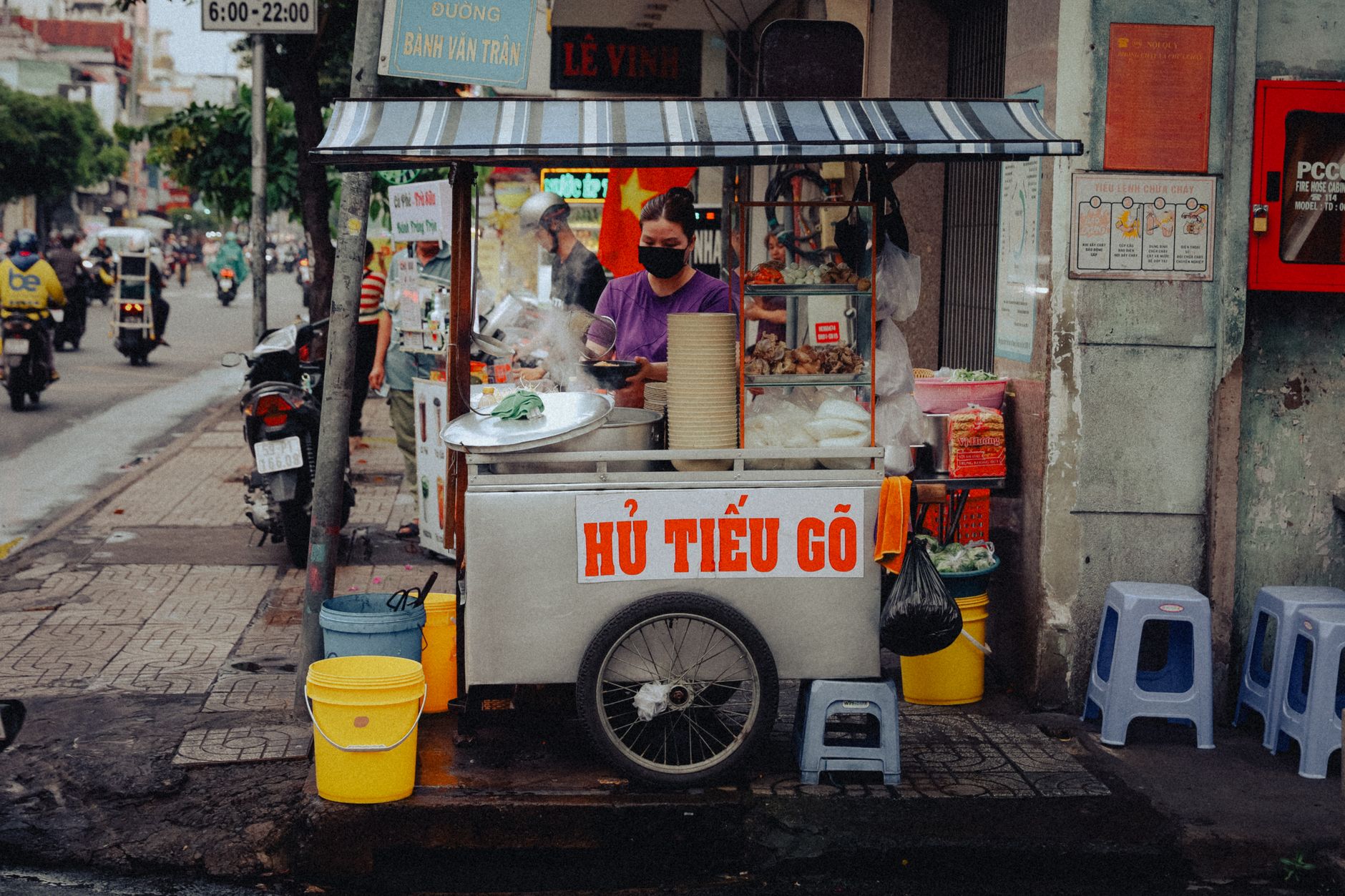
This is the noodle soup of the south. It has Chinese-Cambodian roots, a clear pork broth sweetened with dried seafood, and chewy tapioca noodles that have no equivalent in pho. It comes in three major regional styles, two serving formats, and enough topping combinations to keep a traveler busy for weeks.
This guide breaks down the three main versions, explains why the dry version deserves just as much attention as the soup, and points to the specific stalls in Saigon where locals queue. Not the tourist-friendly spots. The ones with 20-year family histories and bowls that cost less than a dollar.
What is hu tieu and why is it not pho?
Hu tieu (pronounced "hoo tee-u") is a southern Vietnamese noodle dish with a pork-based broth. It is served either as a soup or dry with broth on the side. The noodles are most commonly made from tapioca starch, which gives them a translucent, chewy texture that is nothing like the flat rice noodles in pho.
The confusion between the two dishes is understandable. Both are Vietnamese noodle soups. Both are eaten for breakfast. Both come with herbs and lime. But the differences run deep.
Pho uses beef bones and charred onion for a savory, umami-rich broth. Hu tieu uses pork bones simmered with dried squid and dried shrimp for a broth that is clear, sweet, and light. Pho is served with beef slices that cook in the hot broth. Hu tieu comes with a mix of pork, shrimp, squid, offal, and sometimes wontons. Pho uses flat rice noodles. Hu tieu uses tapioca stick noodles, though some versions use rice noodles or egg noodles.
The cultural roots are different too. Pho comes from northern Vietnam, influenced by French colonial tastes for beef. Hu tieu comes from the Mekong Delta, brought by Teochew Chinese immigrants who passed through Cambodia. It is a southern dish through and through.
The Chinese-Cambodian roots of hu tieu
The story of hu tieu begins not in Vietnam but in Phnom Penh. In the 19th and early 20th centuries, Teochew Chinese immigrants from the Chaoshan region of Guangdong province settled in Cambodia. They brought with them a noodle soup called kuy teav, made with pork broth and rice noodles.
Phnom Penh became a culinary crossroads. The Teochew cooks adapted their recipe to local ingredients. They added dried shrimp and squid to the broth for depth. They developed a topping set that included pork, offal, and seafood. The dish spread through the Mekong Delta as Chinese-Vietnamese communities moved south and east.
When the dish crossed into Vietnam, it changed again. Vietnamese cooks added more variety to the toppings. They introduced the dry version. They developed regional styles in My Tho, Sa Dec, and other delta towns. The result was hu tieu, a dish that shares DNA with Cambodian kuy teav but has become something distinctly Vietnamese.
Today, the best hu tieu in Vietnam is still found in areas with strong Chinese-Vietnamese communities. District 5 in Ho Chi Minh City, also known as Cholon, is the epicenter. The Teochew influence remains visible in the cooking methods, the use of dried seafood, and the preference for clear, sweet broths.
Hu tieu Nam Vang: the Phnom Penh style that defines the category
Hu tieu Nam Vang is the most iconic version. "Nam Vang" is the Vietnamese name for Phnom Penh, and this style stays closest to the original Cambodian-Chinese recipe.
The broth is the star. It is made by simmering pork bones for seven to eight hours with dried squid and dried shrimp. The result is a clear, golden liquid that tastes sweet from the pork and deep from the seafood. There is no fish sauce in the broth. The sweetness comes from the bones and the grilled vegetables, not from sugar.
The toppings are generous. A standard bowl includes sliced lean pork, pork offal (liver, kidney, or intestines), shrimp, quail eggs, and a scoop of seasoned ground pork. The bowl is topped with fried garlic and chopped Chinese celery. Some versions add wonton dumplings.
The garnish plate includes Chinese celery, Chinese chives, bean sprouts, lettuce, and lime wedges. Pickled garlic is often available on the side. It adds a sharp, vinegary contrast to the sweet broth.
This is the benchmark version. If a traveler tries only one style, this should be it.
Hu tieu My Tho: the Mekong Delta's pride
Hu tieu My Tho comes from the town of My Tho in Tien Giang province, about 70 kilometers south of Ho Chi Minh City. It is different from Nam Vang in several key ways.
The noodles are thinner and saltier. My Tho's climate allows for natural sun-drying of the noodles, which gives them a firmer texture and a slightly different flavor. The broth is lighter and less sweet than Nam Vang, with a more pronounced pork flavor.
The most distinctive feature of My Tho style is the addition of lettuce leaves directly into the bowl. The lettuce wilts slightly in the hot broth and adds a fresh, crunchy element. Daikon or white carrot pickles are used as a garnish, a detail unique to My Tho.
Hu tieu My Tho also has a sub-variant called hu tieu satay (sa tế). This version uses a thick, reddish broth made with lemongrass, satay sauce, and peanut butter. The broth is spicy, rich, and completely different from the clear broth versions. It is a meal for cooler evenings, not tropical mornings.
Hu tieu Sa Dec: the underrated third style
Hu tieu Sa Dec is the least known of the three major versions. It comes from the flower village of Sa Dec in Dong Thap province, about 140 kilometers southwest of Ho Chi Minh City.
Local cooks claim that Sa Dec's water pH produces uniquely fine noodles. The noodles are slightly larger than My Tho noodles and less chewy than Nam Vang noodles. They have a soft, delicate texture that absorbs the broth well.
The broth is similar to Nam Vang but lighter. The topping set is simpler, usually just sliced pork and shrimp without the offal or quail eggs. The garnish is minimal: a few herbs and a wedge of lime.
Sa Dec style is harder to find outside the delta. In Ho Chi Minh City, only a handful of shops specialize in it. For travelers who want to try it, the best option is to visit Sa Dec itself, where the dish is served at small family stalls along the river.
Dry vs. soup: understanding hu tieu kho and hu tieu nuoc
Many first-time visitors are confused when they order hu tieu and receive a bowl of noodles with a separate bowl of broth. This is hu tieu kho, the dry version.
Hu tieu kho (dry) comes with noodles and toppings in one bowl and hot broth on the side. The noodles are tossed in a sauce made from soy sauce, hoisin sauce, and a reduction of the pork broth. The sauce coats the noodles and adds a savory, slightly sweet flavor. The broth is drunk separately, like a consommé.
Hu tieu nuoc (soup) has everything in one bowl. The noodles sit in the broth, and the toppings float on top. This is the version that looks like a standard noodle soup.
Locals often prefer the dry version. The noodles stay chewier because they are not sitting in liquid. The broth stays clean and sweet because it is not mixed with the noodle starch. The sauce on the noodles adds an extra layer of flavor that the soup version lacks.
Pro tip: If you order dry, you still get the broth on the side. You are not missing out on anything. You are getting two experiences in one meal.
The noodles: tapioca, rice, or egg
The noodle type is one of the most important decisions a hu tieu cook makes. Three types are common.
Tapioca stick noodles (hu tieu dai) are the gold standard. They are made from tapioca starch, which gives them a translucent, slightly sticky appearance when cooked. They are chewy and springy, with a texture that holds up well in both dry and soup versions. This is the noodle that defines hu tieu.
Flat rice noodles (banh pho) are sometimes used. They are the same noodles used in pho. They give a softer, more delicate texture. Some cooks use them when they want a lighter bowl.
Thin Chinese egg noodles (mi) are a third option. They are made from wheat flour and eggs. They are firmer and more elastic than tapioca noodles. Some shops serve a mix called hu tieu mi, with both tapioca and egg noodles in the same bowl.
The choice of noodle changes the entire experience. Tapioca noodles are the most distinctive. Rice noodles are the softest. Egg noodles are the firmest. Travelers should ask which noodle a shop uses before ordering.
The broth: what makes hu tieu taste different from pho
The broth is where hu tieu separates itself from pho most clearly.
Pho broth is made from beef bones, charred onion, ginger, and spices like star anise and cinnamon. It is savory, rich, and slightly cloudy from the marrow. The flavor is deep and complex.
Hu tieu broth is made from pork bones, dried squid, and dried shrimp. It is simmered for seven to eight hours, then strained until clear. Grilled red onions and white carrots add sweetness. The result is a broth that is light, sweet, and clean.
Fish sauce, a staple in most Vietnamese soups, is notably absent from hu tieu broth. The saltiness comes from the dried seafood and the soy-based sauce used in the dry version.
The broth is designed for the tropical heat. It is light enough to drink on its own without feeling heavy. It wakes up the palate without overwhelming it.
Toppings: what to expect and how to customize
A standard bowl of hu tieu comes with a variety of toppings. The exact set depends on the style and the shop.
The basics include sliced lean pork, shrimp, and a scoop of seasoned ground pork. Pork ribs are common in My Tho style. Pork offal (liver, kidney, intestines) is standard in Nam Vang style. Quail eggs and wonton dumplings are frequent additions. Squid appears in some versions. Fried garlic and crispy pork lard are used as garnishes.
For travelers who do not want offal, the phrase is "không đồ lòng" (kohng doh long). Most shops will substitute extra pork or shrimp.
The garnish plate typically includes Chinese celery, Chinese chives, bean sprouts, lettuce, and chrysanthemum greens. Lime wedges and fresh chilies are always on the table.
Where locals queue for hu tieu in Ho Chi Minh City
The following stalls are not on every tourism blog. They are places where Saigonese have been eating for decades. They have high turnover, clear broths, and consistent quality.
Hu Tieu Nam Vang Thanh Dat — 316 Nguyen Thuong Hien, District 1 Specializes in Nam Vang style. The broth is exceptionally clear and sweet. Locals order the dry version with extra fried garlic. Prices: 40,000 to 55,000 VND ($1.60 to $2.20).
Hu Tieu Nhan Quan — 123 Nguyen Van Nghi, District 1 A 24-hour shop that serves both Nam Vang and My Tho styles. The satay version is popular at night. Prices: 35,000 to 50,000 VND ($1.40 to $2.00).
Hu Tieu My Tho Thanh Xuan — 62 Ton That Thiep, District 1 Specializes in My Tho style with the characteristic lettuce and daikon pickles. The broth is lighter than Nam Vang. Prices: 45,000 to 60,000 VND ($1.80 to $2.40).
Hu Tieu Sa Dec — 18/12 Tran Binh Trong, District 5 One of the few shops in Saigon serving Sa Dec style. The noodles are noticeably softer. Prices: 35,000 to 50,000 VND ($1.40 to $2.00).
Hu Tieu Mi Hoanh Thanh — 264 Nguyen Trai, District 5 Serves the mixed noodle version with both tapioca and egg noodles. The wontons are handmade. Prices: 40,000 to 55,000 VND ($1.60 to $2.20).
How to eat hu tieu like a local
The process is simple but specific.
Start with the broth. If you ordered dry, sip the broth first to appreciate its clarity. If you ordered soup, taste the broth before adding anything else.
Add herbs and lime to taste. The Chinese celery and chives should be torn, not cut. Add bean sprouts if you want crunch.
Use the pickled garlic if it is available. It cuts through the sweetness of the broth.
Dip meats into the soy sauce with chili on the side. Do not pour the sauce into the bowl. That is for the dry version only.
Do not add hoisin or sriracha. That is pho behavior. Hu tieu has its own condiment logic.
Eat the noodles quickly. Tapioca noodles soften as they sit. The best texture is in the first five minutes.
Hu tieu vs. kuy teav: what you would actually get in Cambodia
If you cross the border into Cambodia, you will find kuy teav. It is the ancestor of hu tieu, but the two are not identical.
Cambodian kuy teav uses more offal and less variety of toppings. The broth is simpler, often just pork bones without the dried seafood. The noodles are always rice noodles, never tapioca. The garnish is a side of lime and fresh herbs, not the elaborate Vietnamese garnish plate.
Which is better? They are different dishes for different contexts. Kuy teav is a leaner, more rustic experience. Hu tieu is a more complex, more varied dish. Both are excellent in their own right.
The Gordon Ramsay moment: what it means and what it does not
In 2012, Gordon Ramsay visited the Cai Rang floating market in the Mekong Delta. He ate a bowl of hu tieu from a boat. He called it "the greatest dish I have ever had."
The quote appears in every article about hu tieu. It is genuine. Ramsay was not paid to say it. He was genuinely impressed.
But travelers should not expect a life-changing bowl at every stall. Ramsay ate at a specific boat with a specific cook on a specific day. The dish he had was exceptional. Not every bowl of hu tieu will be.
The quote is a conversation starter, not a quality guarantee. Use it to start a discussion with a local vendor. Do not use it as a benchmark for every bowl you eat.
Is hu tieu safe to eat? Practical health notes for travelers
Street food in Vietnam is generally safe, but travelers should take precautions.
The broth is boiled for hours. It is safe. The noodles are cooked to order. They are safe. The pork and shrimp are cooked fresh. They are safe if the stall has high turnover.
The risks come from offal and raw herbs. Offal needs to be cooked through. Raw herbs may carry bacteria if not washed properly. Travelers with sensitive stomachs should skip the offal and stick to cooked vegetables.
Choose stalls with queues. A long line means high turnover, which means fresh ingredients. Avoid places where ingredients sit out uncovered.
Prices are consistent. Street stalls charge 25,000 to 55,000 VND ($1 to $2.20). Sit-down shops charge 55,000 to 90,000 VND ($2.20 to $3.60). If a bowl is cheaper than 20,000 VND, something is off.
When and where to eat hu tieu beyond Saigon
Hu tieu is a southern dish. It is rare in Hanoi and the north. Travelers heading north should not expect to find it easily.
In the Mekong Delta, hu tieu is everywhere. My Tho has the best My Tho style. Can Tho has good Nam Vang style. Sa Dec has the underrated Sa Dec style.
The Cai Rang floating market near Can Tho is a popular spot for hu tieu from boats. It is touristy, but the food can still be excellent. Arrive early, before 8:00 AM, to avoid the crowds and get the freshest bowls.
For travelers who want to eat hu tieu outside Vietnam, look for Vietnamese restaurants in cities with large Vietnamese communities. Los Angeles, San Jose, Sydney, and Paris all have shops that serve decent versions. They will not be as good as the ones in Saigon, but they will scratch the itch.
Comparison table: hu tieu styles
| Style | Broth character | Noodle type | Key toppings | Signature garnish | Best for |
|---|---|---|---|---|---|
| Nam Vang | Clear, sweet, dried seafood depth | Tapioca stick | Pork, shrimp, offal, quail eggs, ground pork | Fried garlic, Chinese celery | First-time eaters |
| My Tho | Light, salty, pork-forward | Thin, sun-dried tapioca | Pork ribs, shrimp, lettuce | Daikon pickles, lettuce in bowl | Those who prefer lighter broths |
| Sa Dec | Clear, light, delicate | Soft, fine tapioca | Sliced pork, shrimp | Minimal herbs | Texture-focused eaters |
Comparison table: hu tieu vs. pho vs. bun bo Hue
| Dish | Broth base | Noodle type | Key flavors | Toppings | Regional origin |
|---|---|---|---|---|---|
| Hu tieu | Pork with dried squid and shrimp | Tapioca stick | Sweet, clear, light | Pork, shrimp, offal, wontons | Southern Vietnam |
| Pho | Beef with charred onion and spices | Flat rice | Savory, umami, rich | Beef slices, meatballs | Northern Vietnam |
| Bun bo Hue | Beef with lemongrass and shrimp paste | Thick round rice | Spicy, sour, pungent | Beef shank, pork hock, blood cubes | Central Vietnam |
Comparison table: dry vs. soup hu tieu
| Serving style | What is in the bowl | What is on the side | Noodle texture | Best for |
|---|---|---|---|---|
| Hu tieu kho (dry) | Noodles and toppings tossed in sauce | Hot broth | Chewy, coated in sauce | Those who want two experiences |
| Hu tieu nuoc (soup) | Noodles, toppings, and broth together | Nothing | Softer, more hydrated | Those who want a standard soup |
FAQ
Q: What is the difference between hu tieu and pho? A: Hu tieu uses a pork-based broth that is clear and sweet, not beef-based and savory like pho. It features chewy tapioca noodles, not flat rice noodles. Toppings include shrimp, squid, offal, and wontons, not just beef slices. The broth contains dried squid and shrimp for umami, and fish sauce is absent.
Q: What is hu tieu noodle soup? A: Hu tieu is a southern Vietnamese noodle soup or dry noodle dish with Chinese-Cambodian roots. It features a clear pork bone broth simmered with dried seafood, chewy tapioca or rice noodles, and toppings like sliced pork, shrimp, offal, and fried garlic. It is served as a soup or dry with broth on the side.
Q: What is the difference between hu tieu My Tho and Nam Vang? A: Hu tieu Nam Vang has a clearer, sweeter broth with dried squid and shrimp, and includes ground pork, quail eggs, and shrimp as standard toppings. Hu tieu My Tho uses thinner, saltier noodles from natural drying, adds lettuce directly to the bowl, and is garnished with daikon pickles.
Q: What is Anthony Bourdain's favorite Vietnamese soup? A: Anthony Bourdain loved bun bo Hue, the spicy beef noodle soup from central Vietnam. The viral quote about hu tieu being "the greatest dish" belongs to Gordon Ramsay, who said it during a visit to the Cai Rang floating market in 2012.
Q: Is hu tieu served dry or with soup? A: Both. Hu tieu kho comes with noodles and toppings tossed in a savory sauce, with hot broth served on the side. Hu tieu nuoc has everything in one bowl. Many locals prefer dry because the noodles stay chewier and the broth remains clean.
Q: What noodles are used in hu tieu? A: Three types are common: chewy tapioca stick noodles, flat rice noodles, and thin Chinese egg noodles. Some shops serve a mix called hu tieu mi. Tapioca noodles are translucent and slightly sticky when cooked.
Q: Where can I eat hu tieu in Ho Chi Minh City? A: Look for stalls in District 1, District 3, and District 5 (Cholon). Specific recommendations include Hu Tieu Nam Vang Thanh Dat (316 Nguyen Thuong Hien), Hu Tieu Nhan Quan (123 Nguyen Van Nghi), and Hu Tieu My Tho Thanh Xuan (62 Ton That Thiep). Prices range from 25,000 to 90,000 VND.
Q: Is hu tieu gluten-free? A: Not necessarily. Tapioca noodles are gluten-free, but many shops also use wheat-based egg noodles or mix them in. The broth may contain soy sauce. Travelers with celiac disease should ask for tapioca noodles only and confirm no soy sauce is added.