What is Vietnamese fish sauce (nuoc mam) and how is it different from dipping sauce
Vietnamese fish sauce, called nuoc mam, is the fermented liquid extracted from anchovies and salt. It is the backbone of Vietnamese cooking. Think of it like soy sauce in Japan or China. It adds saltiness and depth to stir-fries, marinades, soups, and dipping sauces.
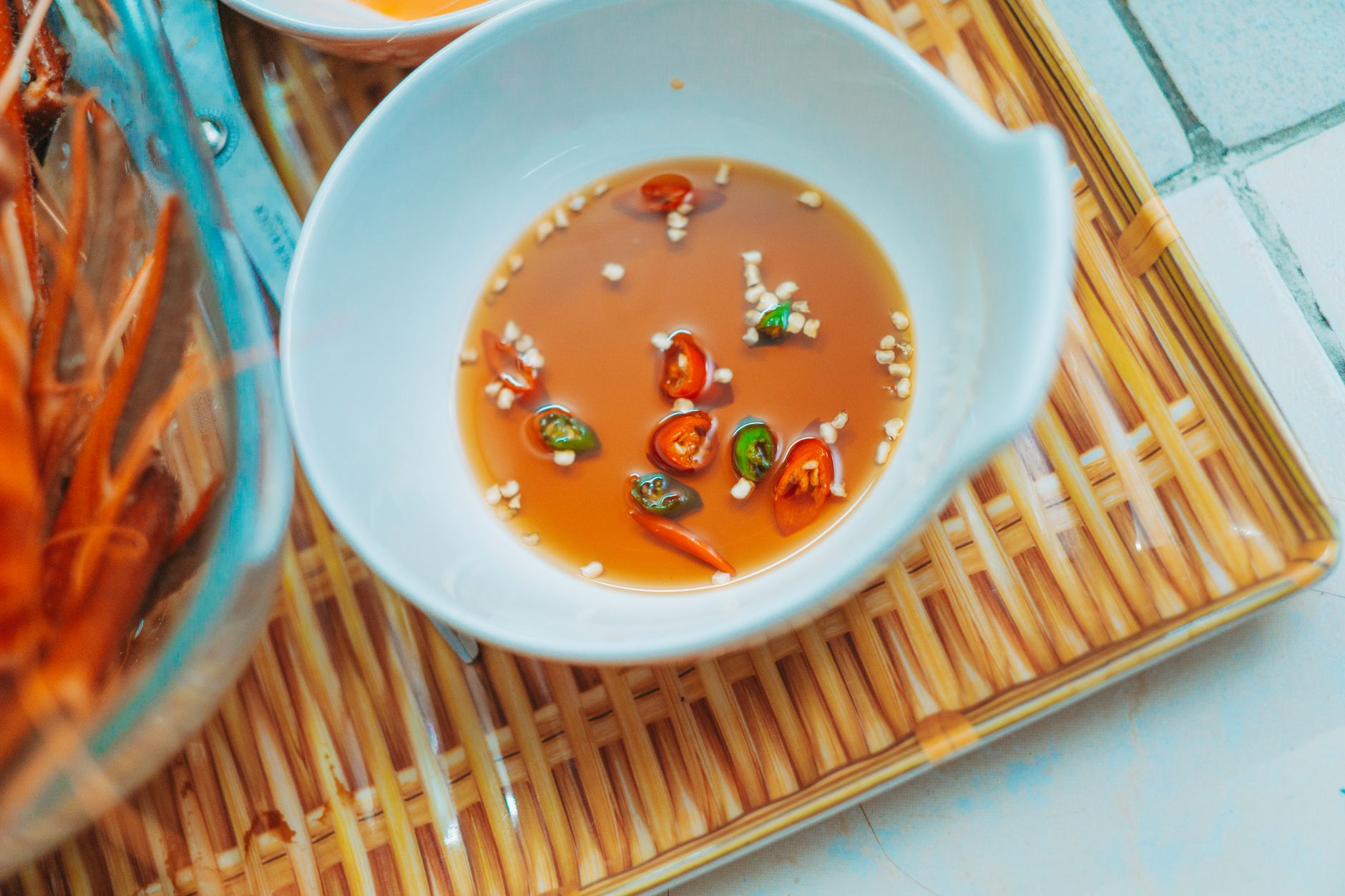
Nuoc cham is something else entirely. It is a prepared table sauce made by mixing nuoc mam with water, sugar, lime juice, garlic, and fresh chili. The result is a balanced sweet, sour, salty, and spicy liquid. Restaurants serve nuoc cham in small bowls alongside spring rolls, banh xeo (crispy pancakes), and grilled meats.
The confusion is understandable. Both come from the same base ingredient. But you cook with nuoc mam. You dip with nuoc cham. Pouring straight bottled fish sauce onto your food will result in an overwhelmingly salty and fishy taste. Locals do not do that.
How Phu Quoc fish sauce is made: from anchovy to bottle
Phu Quoc, an island off the southern coast of Vietnam in Kien Giang province, holds a protected geographical indication for its fish sauce. This means only fish sauce produced on the island using traditional methods can be labeled as Phu Quoc fish sauce. The process has remained largely unchanged for generations.
It starts with the anchovy. Specifically, the white anchovy (Stolephorus indicus) found in the waters around Phu Quoc. These small fish are caught at night, brought to shore, and mixed with sea salt within hours. The ratio is roughly three parts fish to one part salt. The mixture is layered into tall wooden barrels, called lu, made from either jackfruit wood or boi loi wood. These barrels are not sealed. They are covered with a bamboo mat and weighted down with stones.
The barrels sit in open-air sheds for 12 to 18 months. The sun and tropical heat drive the fermentation process. Over time, the fish breaks down, and a brown liquid drains from a spigot at the bottom of the barrel. This first extraction is called nuoc mam cot, or first-press fish sauce. It is the highest quality, richest in flavor, and commands the highest price.
After the first extraction, the remaining fish solids are mixed with more salt and water to produce a second, milder extraction. This is labeled nuoc mam long or nuoc mam nhi. It is used for everyday cooking.
Pro tip: The best Phu Quoc fish sauce is aged for at least 12 months. Some premium producers age their sauce for 24 months or longer. The older the sauce, the deeper and more complex the flavor.
What the degree number on a fish sauce bottle actually means
Walk into any supermarket in Vietnam and you will see bottles labeled with numbers like 40°N, 35°N, or 25°N. These numbers are not a measure of saltiness or spiciness. They measure total nitrogen content, expressed as grams of nitrogen per liter.
Nitrogen comes from the protein in the anchovies. More nitrogen means more protein, which generally translates to a richer, more savory flavor. The scale works like this:
| Degree (N) | Protein content | Best use | Typical price per 750ml |
|---|---|---|---|
| 40°N and above | Over 40g protein per liter | Dipping sauces, finishing dishes, premium gifting | 150,000-300,000 VND ($6-12) |
| 30-39°N | 30-40g protein per liter | All-purpose cooking and dipping | 80,000-150,000 VND ($3-6) |
| 25-29°N | 25-30g protein per liter | Everyday cooking, marinades | 40,000-80,000 VND ($1.50-3) |
| Below 25°N | Under 25g protein per liter | Budget cooking only | 20,000-40,000 VND ($0.80-1.50) |
For everyday cooking, a 30°N bottle works fine. For a dipping sauce where the fish sauce flavor is front and center, look for 40°N or higher. The difference is noticeable. A 40°N sauce is thicker, darker, and has a rounder, less harsh saltiness.
Warning: Some cheap bottles artificially boost nitrogen content by adding chemical nitrogen. Check the ingredient list. It should say only "anchovies and salt." If it lists anything else, put it back.
How to read a fish sauce label: brands, regions, and quality tiers
The fish sauce aisle can be overwhelming. Dozens of brands, different regions, and varying price points. Here is a breakdown of the most common brands and what they are good for.
| Brand | Region | Degree | Price range (750ml) | Best for | Where to buy |
|---|---|---|---|---|---|
| Three Crabs (Ba Con Cua) | Phan Thiet | 30-35°N | 60,000-100,000 VND ($2.50-4) | All-purpose cooking and dipping | Any supermarket |
| Red Boat | Phu Quoc | 40°N | 250,000-350,000 VND ($10-14) | Premium dipping, finishing | Specialty stores, Phu Quoc |
| Hon Phan Thiet | Phan Thiet | 30°N | 50,000-80,000 VND ($2-3) | Everyday cooking | Any supermarket |
| Viet Nhat (Phu Quoc) | Phu Quoc | 40°N | 180,000-250,000 VND ($7-10) | Dipping, gifting | Phu Quoc, online |
| Khai Hoan | Phu Quoc | 40-45°N | 200,000-400,000 VND ($8-16) | Premium, aged | Phu Quoc factory shop |
The two main producing regions are Phan Thiet (Binh Thuan province) and Phu Quoc. Phan Thiet produces the majority of Vietnam's fish sauce. It is reliable and affordable. Phu Quoc produces smaller quantities of higher-end sauce. Both are good, but Phu Quoc commands higher prices due to its protected status and longer aging.
For a gift, buy a Phu Quoc brand with 40°N or higher. For your own kitchen, a mid-range Three Crabs or Hon Phan Thiet at 30°N will serve you well.
Nuoc cham: the table sauce you will actually use every day
Nuoc cham is the sauce that appears on every restaurant table in Vietnam. It is the dip for spring rolls, the sauce for grilled pork, and the dressing for noodles. The base formula is simple but the ratios vary by region and personal preference.
The standard recipe: 1 part fish sauce, 1 part sugar, 2 parts water, and 1 part lime juice. Add minced garlic and fresh chili to taste. Southern Vietnam prefers a sweeter version with more sugar. Northern Vietnam makes it more savory with less sugar and more fish sauce. Central Vietnam adds more chili for heat.
When you sit down at a restaurant, the server may bring a small bowl of nuoc cham already prepared. If not, you can make your own at the table. Every table has a bottle of fish sauce, a jar of sugar, a plate of lime wedges, and a bowl of fresh chilies and garlic. Mix to your taste.
Pro tip: If the restaurant serves a bowl of watery, pale brown liquid, it is likely a diluted version. Ask for "nuoc cham man" (salty dipping sauce) or "nuoc cham ngot" (sweet dipping sauce) depending on your preference.
The full lineup of Vietnamese table condiments
Beyond nuoc cham, a Vietnamese table may hold several other sauces. Here is what they are and what to do with them.
| Name (Vietnamese) | Name (English) | Main ingredients | Flavor profile | Classic pairing |
|---|---|---|---|---|
| Nuoc cham | Dipping fish sauce | Fish sauce, water, sugar, lime, garlic, chili | Sweet, sour, salty, spicy | Spring rolls, grilled meats, noodles |
| Tuong den | Hoisin sauce | Soybean paste, sugar, garlic, spices | Sweet, thick, savory | Pho, banh cuon |
| Tuong ot | Chili sauce | Chilies, vinegar, sugar, garlic | Spicy, tangy | Pho, bun bo Hue |
| Muoi tieu chanh | Salt, pepper, lime | Salt, white pepper, lime juice | Salty, sour, peppery | Grilled seafood, boiled chicken |
| Nuoc mam gung | Ginger fish sauce | Fish sauce, ginger, sugar, lime | Spicy, gingery, savory | Boiled chicken, seafood |
| Tuong ot tuong den mix | Chili hoisin mix | Chili sauce + hoisin sauce | Sweet and spicy | Banh trang nuong (Vietnamese pizza) |
| Tuong dat (peanut sauce) | Peanut sauce | Peanut butter, hoisin, coconut milk | Rich, nutty, sweet | Spring rolls, satay |
| Nuoc me | Tamarind sauce | Tamarind, sugar, fish sauce, chili | Sour, sweet, tangy | Fried fish, spring rolls |
Tuong den (hoisin sauce) is often served alongside pho. Dip the beef slices into it. Tuong ot (chili sauce) is a common table condiment for noodle soups. Muoi tieu chanh is the default dip for grilled seafood. Mix a pinch of salt and white pepper with a squeeze of lime. That is it.
Vietnamese dipping sauce etiquette: what locals do at the table
Using sauces correctly in Vietnam is simple but has a few rules.
Do not pour sauce directly onto your food. This is the most common mistake tourists make. Instead, dip each bite into the sauce bowl. This keeps the main dish unaltered and allows you to control the amount of sauce per bite.
Do not double-dip. If you are sharing a communal sauce bowl, take a bite, then dip again. This is standard in Vietnam. However, if you are eating with a group of strangers, it is polite to spoon some sauce into your own small bowl.
Do not dip into the bottle. The bottle on the table is for pouring into your bowl, not for dipping directly.
It is acceptable to ask for extra chili or garlic. Restaurants expect this. Say "cho them ot" (add more chili) or "cho them toi" (add more garlic).
If the sauce is too salty, add a squeeze of lime. If it is too sweet, add a splash of fish sauce. The table is your mixing station.
How to buy fish sauce in Vietnam and bring it home legally
Buying fish sauce in Vietnam is easy. Bringing it home requires some planning.
Where to buy: Supermarkets like Co.opmart, Big C, or Lotte Mart have the widest selection and the best prices. Local markets sell fish sauce in bulk, but the quality and labeling are inconsistent. On Phu Quoc, visit the factory shops of Hung Thanh or Khai Hoan for premium bottles and free tastings.
What size to buy: For travel, 500ml or 750ml bottles are practical. Larger 1-liter bottles are heavier and more likely to leak. Glass bottles are better than plastic for flavor, but plastic is safer for checked luggage.
Customs regulations (2026):
| Country | Liquid limit (checked luggage) | Agricultural restrictions | Duty-free allowance | Risk of seizure |
|---|---|---|---|---|
| United States | No specific limit for personal use | Must be for personal use, commercially packaged | Up to $800 total | Low if sealed and labeled |
| European Union | No specific limit for personal use | Must be for personal use | Up to €430 total | Low |
| United Kingdom | No specific limit for personal use | Must be for personal use | Up to £390 total | Low |
| Australia | No specific limit for personal use | Must be for personal use, commercially packaged | Up to AUD $900 | Low |
| Japan | No specific limit for personal use | Must be for personal use | Up to ¥200,000 total | Low |
| South Korea | No specific limit for personal use | Must be for personal use | Up to $800 total | Low |
Packing tips: Wrap the bottle in a plastic bag, then wrap it in clothing or bubble wrap. Place it in the center of your checked luggage, surrounded by soft items. Do not pack it in carry-on luggage. The liquid limit for carry-on is 100ml per container.
Warning: Some customs officers may ask about the bottle. Say "fish sauce for personal use" or "nuoc mam." Do not say "fermented fish product." That sounds suspicious.
How to store fish sauce at home (and how long it lasts)
Fish sauce is a fermented product. It does not spoil easily, but it does change over time.
Unopened bottles last 2 to 3 years in a cool, dark place. Once opened, the sauce will last 6 to 12 months at room temperature. Refrigeration extends this to up to 2 years.
The sauce will darken over time. This is normal. The color change comes from oxidation, not spoilage. The flavor will become more intense and slightly more pungent.
Refrigeration is not necessary for fish sauce. The high salt content acts as a natural preservative. However, refrigeration slows oxidation and preserves the flavor longer.
How to tell if fish sauce has gone bad: It develops a foul, rotten smell (different from the normal fishy aroma), mold grows on the surface, or the texture becomes thick and sludgy. If any of these happen, throw it out.
Regional fish sauce traditions across Vietnam
Three regions produce the majority of Vietnam's fish sauce. Each has distinct characteristics.
Phu Quoc (Kien Giang province): The most famous. Uses white anchovies, a 3:1 fish-to-salt ratio, and ages for 12 to 18 months. The result is a dark, rich, complex sauce with a high nitrogen content (40°N and above). Visitors can tour factories like Hung Thanh and Khai Hoan. Tours are free and last 30 to 45 minutes.
Phan Thiet (Binh Thuan province): The largest producer by volume. Uses a mix of anchovy species, a 2:1 fish-to-salt ratio, and ages for 6 to 12 months. The sauce is lighter in color and milder in flavor. Most bottles labeled "Phan Thiet" are reliable for everyday use.
Nha Trang (Khanh Hoa province): Smaller production volume. Uses a different anchovy species (Encrasicholina punctifer) and a shorter aging period of 4 to 8 months. The sauce is lighter and saltier. Less commonly exported but worth trying if you visit Nha Trang.
Common myths about Vietnamese fish sauce
Myth: All fish sauce smells terrible. Quality fish sauce has a clean, savory aroma. It smells like the sea, not like rotten fish. The foul smell comes from cheap, poorly made sauce or sauce that has gone bad.
Myth: Fish sauce is unhealthy. Traditional fish sauce contains only anchovies and salt. No additives, no MSG. It is high in sodium (about 1,000-1,500mg per tablespoon), so use it in moderation. But it also provides protein and B vitamins.
Myth: Vegetarians can use fish sauce. No. Fish sauce is made from anchovies. It is not vegetarian or vegan. Look for mushroom sauce or soy sauce as alternatives.
Myth: The brown liquid in the bottle is the same as what is on the table. No. The bottle is pure fish sauce. The bowl on the table is nuoc cham, which has been diluted and sweetened. Do not dip directly into the bottle.
Practical vocabulary: ordering and asking about sauces in Vietnamese
| English | Vietnamese | Pronunciation |
|---|---|---|
| Fish sauce | Nuoc mam | nuhk mam |
| Dipping sauce | Nuoc cham | nuhk cham |
| Chili sauce | Tuong ot | tung oot |
| Not spicy | Khong cay | khom kai |
| A little spicy | It cay | it kai |
| Sweet | Ngot | ngot |
| Salty | Man | mun |
| Add more chili | Cho them ot | chaw tem oot |
| Add more garlic | Cho them toi | chaw tem toy |
FAQ
Q: What is the difference between nuoc mam and nuoc cham? Nuoc mam is pure fermented fish sauce, the bottled ingredient used in cooking. Nuoc cham is a prepared dipping sauce made by mixing nuoc mam with water, sugar, lime, garlic, and chili. You cook with nuoc mam. You dip with nuoc cham.
Q: What does the degree number on fish sauce mean? The degree, such as 40°N, measures total nitrogen content. Nitrogen comes from protein in the anchovies. Higher degree generally means richer flavor and higher quality. 40°N is premium. 25-30°N is standard for cooking.
Q: Can I bring fish sauce home from Vietnam? Yes, in checked luggage. Most countries allow fish sauce for personal use with no specific liquid limit. The US, EU, UK, Australia, Japan, and South Korea permit it. Do not pack it in carry-on. Seal the bottle in a plastic bag.
Q: How long does fish sauce last after opening? Unopened, 2-3 years in a cool, dark place. Opened, 6-12 months at room temperature or up to 2 years in the refrigerator. The sauce darkens over time but remains safe.
Q: Is fish sauce the same as the brown liquid on restaurant tables? No. The bottle on the table is pure nuoc mam. The small bowl served alongside your food is nuoc cham, which has been diluted and sweetened. Do not dip directly into the bottle.
Q: Which fish sauce brand should I buy? For dipping sauces, a mid-range brand like Three Crabs or Hon Phan Thiet works well. For premium quality, look for Phu Quoc brands with 40°N or higher. Avoid the cheapest bottles for table use.
Q: Is fish sauce healthy? Traditional fish sauce contains only anchovies and salt. No additives or MSG. It is high in sodium but provides protein and B vitamins. Use it as a seasoning, not a beverage.
Q: Can I visit a fish sauce factory in Phu Quoc? Yes. Several producers on Phu Quoc offer free tours, including Hung Thanh and Khai Hoan. Tours last 30-45 minutes and end with a tasting. No appointment needed for most.