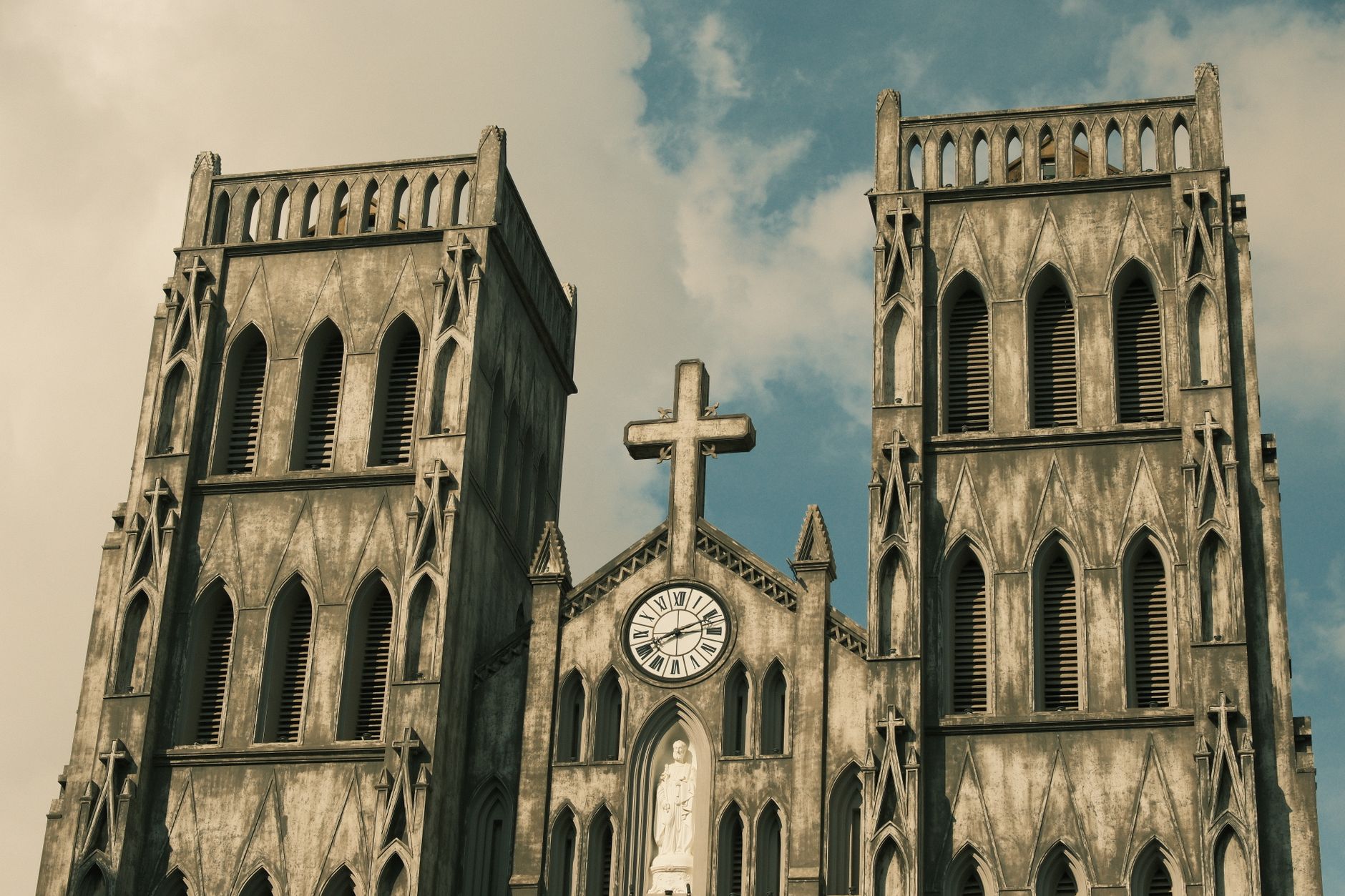
This guide covers what stood on the site for eight centuries before the cathedral, what to look for once you are inside, when the doors actually open, how mass and Christmas Eve work, and whether the place deserves more than a passing stop. The Vietnamese names are Nhà thờ Lớn Hà Nội ("Big Church") and Nhà thờ Chính tòa Thánh Giuse. Locals and maps also call it Hanoi Cathedral.
St Joseph's Cathedral at a glance
| Item | Detail |
|---|---|
| Vietnamese names | Nhà thờ Lớn Hà Nội, Nhà thờ Chính tòa Thánh Giuse |
| Status | Seat of the Archdiocese of Hanoi |
| Address | 40 Nhà Chung street, Phường Hoàn Kiếm, Hanoi |
| Completed | Christmas 1886 |
| Style | Neo-Gothic, twin bell towers, rose window |
| Commonly cited dimensions | 64.5 m long, 20.5 m wide, towers about 31.5 m high |
| Entry | Free |
| Time needed | 20 to 40 minutes |
| Distance from Hoàn Kiếm Lake | About 300 m west |
| Coordinates | Approximately 21.0287 N, 105.8489 E |
A note on the address: the July 2025 administrative reform abolished Hanoi's districts, so the ward is now Phường Hoàn Kiếm. Older maps and guidebooks still say "Hàng Trống ward, Hoàn Kiếm district". Both refer to the same few streets.
A brief history: from Báo Thiên pagoda to Hanoi's mother church
The story of this site begins more than 800 years before the first stone of the cathedral was laid. Understanding that older history is what turns a photo stop into a place worth thinking about.
Báo Thiên tower and pagoda
Báo Thiên pagoda and its tower, the Đại Thắng Tư Thiên tháp, were built under Emperor Lý Thánh Tông around 1057. The tower is traditionally counted among the "four great treasures of An Nam" (An Nam tứ đại khí), a grouping of monumental bronze and stone works from the Lý and Trần dynasties.
Traditional accounts describe the tower collapsing and being damaged repeatedly over the centuries, with storms and the Ming occupation both blamed in different versions. The pagoda itself survived until the early 1880s, when the French demolished what remained to clear the site for the cathedral. Name echoes survive in the neighbourhood: Bảo Khánh street, Lý Quốc Sư street and the Lý Quốc Sư pagoda a few minutes away.
Bishop Puginier and the construction
The cathedral was commissioned by Bishop Paul-François Puginier of the Paris Foreign Missions Society. Funding came partly from lotteries organised by the mission. Construction began in 1884 using local labour and local materials. Bricks were reportedly bound with a traditional mortar mixed with paper pulp, a detail worth confirming on site if you join a guided walk.
The inauguration took place at Christmas 1886, two years after the 1884 Patenôtre treaty formalised the French protectorate over Tonkin. The building is therefore both a religious monument and a colonial one, and the two facts sit together without contradiction.
Colonial Hanoi and the Nhà Chung quarter
The mission complex shaped the streets around it. Nhà Chung means "common house", referring to the mission buildings that once occupied the block. The archbishop's residence still stands next door to the cathedral, visible from the street but not open to visitors.
War, partition and the communist era
In 1954, after the Geneva Accords, hundreds of thousands of northern Catholics moved south. The cathedral stayed open as a parish through the partition and the war years. Joseph-Marie Trịnh Như Khuê, Archbishop of Hanoi, became Vietnam's first cardinal in 1976.
Recent decades
In 2008, prayer vigils were held over the former Apostolic Delegation land at 42 Nhà Chung, which authorities later turned into a public garden and library. In 2023, Vietnam and the Holy See agreed on a resident papal representative in Hanoi, a step in a long diplomatic process. Today the cathedral remains the liturgical heart of Hanoi's Catholic community, which numbers several hundred thousand people across the archdiocese.
History timeline
| Year | Event |
|---|---|
| c. 1057 | Báo Thiên pagoda and tower built under Lý Thánh Tông |
| 11th to 19th c. | Tower damaged and rebuilt; pagoda survives on the site |
| Early 1880s | French demolish the remaining pagoda |
| 1884 | Construction of the cathedral begins under Bishop Puginier |
| 1886 | Cathedral inaugurated at Christmas |
| 1954 | Partition; cathedral remains an active parish |
| 1976 | Trịnh Như Khuê becomes Vietnam's first cardinal |
| 2008 | Prayer vigils at 42 Nhà Chung over the former delegation land |
| 2023 | Vietnam and the Holy See agree on a resident papal representative |
Architecture: a Paris-style Gothic church built with Vietnamese hands
The neo-Gothic model
The building is routinely compared to Notre-Dame de Paris, and the resemblance is real: two square bell towers, pointed arches, a rose window above the main portal and ribbed vaults inside. The comparison is one of style, not scale. Notre-Dame's towers are about 69 m high, more than twice the height of the towers here.
Materials and the weathered facade
The facade looks grey-black and mottled because of humidity, mould and decades of urban pollution on the plaster. That patina is now part of the building's identity in photographs. Do not expect a freshly restored European cathedral. Do expect a building that looks its age, in a way that suits the street around it.
Vietnamese touches
Look for red and gold woodwork around the altar in a style reminiscent of Vietnamese temple lacquer, Vietnamese inscriptions on the interior fittings, and the Virgin Mary statue in the forecourt. These are the details that distinguish this church from a European import.
What you see on site, spot by spot
This walkthrough follows the order a visitor actually experiences the place.
1. The approach along Nhà Thờ street
Walking west from Hoàn Kiếm Lake, the towers appear framed by shopfronts at the end of the street. This is the classic first view and the one worth slowing down for. The small square in front is where five streets converge: Nhà Thờ, Lý Quốc Sư, Nhà Chung, Ấu Triệu and Chân Cầm. Expect constant motorbike traffic.
2. The forecourt and Virgin Mary statue
The statue stands on a pedestal inside the railings. Locals stop to pray here on their way past, even when the church itself is closed. Watch for a moment before you start photographing.
3. The facade and bell towers
Notice the rose window, the cross at the gable top and the open bell chambers in the towers. If you arrive shortly before a mass, you will hear the bells ring across the square.
4. Getting inside: the side door
When the main doors are shut, entry is usually through a smaller door or gate on the left as you face the facade. This is the single most useful practical detail in this guide. Ask at the gate if it looks closed; the door situation changes and staff are used to the question. There is a donation box inside.
Arriving 15 minutes before a weekday evening mass is the most reliable way to find the interior open and the main doors unlocked.
5. The nave
Tall ribbed vaults, dim light and air noticeably cooler than the street. Wooden pews run down the centre and the Stations of the Cross line the walls. The scale is modest by European standards, and that is part of the experience.
6. The altar and sanctuary
The sanctuary woodwork is gilded and red-lacquered, closer in feel to a Vietnamese temple than to a French parish church. Visitors stay behind the barriers, which is normal in an active place of worship.
7. The stained glass
The windows are said to have been made in France. They glow best from inside on a bright late morning, when the sun is high enough to push through the upper panes. Ask on site about any windows replaced after war damage before repeating a specific claim.
8. Leaving: the archbishop's residence and Bà Đá pagoda
The archbishop's residence is visible from the street only. A few steps away at 3 Nhà Thờ street stands Bà Đá pagoda (Linh Quang tự), a small Buddhist pagoda that most visitors walk straight past. Given that a Buddhist pagoda once stood on the cathedral's own site, it is a striking contrast to end on.
Mass, Christmas and the living church
Mass schedule
| Day | Visiting window (side door) | Mass times (last known, as of October 2026) | Notes |
|---|---|---|---|
| Monday to Friday | Roughly 8:00-11:00 and 14:00-17:00 | Around 5:30 and 18:15 | Interior closes to sightseers during mass |
| Saturday | Roughly 8:00-11:00 and 14:00-17:00 | Early morning and evening | Times shift for feast days |
| Sunday | Forecourt only during services | Several masses from dawn to evening | Expect crowds and full pews |
Masses are in Vietnamese. Times change for feast days, and no official tourist-facing schedule is posted online. Check the noticeboard at the gate or the Archdiocese of Hanoi website (tonggiaophanhanoi.org) before planning around a specific time. Do not assume an English-language mass exists unless you see it confirmed on site.
Attending as a visitor or non-Catholic
Sit at the back and arrive about 10 minutes early. Put phones on silent and take no photos during the liturgy. Do not take communion unless you are Catholic. If you need to leave early, leave quietly. A weekday evening mass is the easiest way to see the interior lit with the main doors open.
Christmas Eve and other peak dates
The next Christmas Eve falls on Thursday 24 December 2026. The square and surrounding streets fill from late afternoon, and by evening tens of thousands of people are packed around the cathedral. Nativity decorations go up through December.
If you want the decorations without the crush, visit in the morning on the days before Christmas. On the night itself, arrive on foot, keep valuables zipped and expect to move at crowd speed.
Other dates to know: Easter falls on 28 March 2027, and Tết (Lunar New Year) falls on 6 February 2027. Special masses are held for both, and many nearby cafés close for several days around Tết.
Practical information: opening hours, entry and rules
All figures below are last known as of October 2026.
Opening hours and entrance fee
Entry is free. The commonly reported visiting windows are roughly 8:00 to 11:00 and 14:00 to 17:00, Monday to Saturday, through the side entrance. These hours vary and are not officially posted for tourists. The interior closes to sightseers during mass. The forecourt and facade can be seen at any hour.
Dress code and etiquette
Cover shoulders and knees, and remove hats inside. Keep your voice low. No eating or drinking inside. Sarongs are not provided, so carry a light scarf in the hot months. Beachwear and very short shorts may get you turned away at the door.
Photography, drones and photo shoots
Photos without flash are generally tolerated outside mass. Professional and wedding shoots are common on the square, but inside they need permission. Flying a drone requires a licence in Vietnam and is restricted in central Hanoi. Doing so without a permit risks confiscation and fines.
Accessibility and facilities
There are steps at the entrances and uneven paving on the square. There are no public toilets on site, so use a nearby café. Motorbike parking on the surrounding sidewalks costs around 5,000 to 10,000 VND (about 0.20 to 0.40 USD).
How to get there
Exchange rates used here are about 26,000 VND per USD and 30,000 VND per EUR at the time of writing.
On foot
| From | Distance | Walking time |
|---|---|---|
| West shore of Hoàn Kiếm Lake (Lê Thái Tổ street) | About 300 m along Nhà Thờ street | 5 minutes |
| Heart of the Old Quarter (Hàng Gai, Hàng Bông) | About 700 to 900 m | 10 to 12 minutes |
| Hỏa Lò prison | About 1 km | 15 minutes |
Crossing the square takes nerve. Walk at a steady pace and do not run; motorbikes will flow around you.
Grab, Xanh SM and taxis
| From | Mode | Distance | Approx. cost |
|---|---|---|---|
| Hanoi railway station (Lê Duẩn) | Grab bike | About 2 km | 15,000 to 25,000 VND (0.60 to 1.00 USD) |
| Tây Hồ (West Lake) | Grab car | About 5 to 6 km | 70,000 to 110,000 VND (2.70 to 4.20 USD) |
| Ba Đình / Temple of Literature | Grab car | About 3 km | 40,000 to 60,000 VND (1.50 to 2.30 USD) |
| Nội Bài airport | Taxi or ride-hail | About 28 km | 300,000 to 400,000 VND (12 to 15 USD), 45 to 60 minutes |
Use the app price or the meter rather than agreeing a flat fare on the street.
Bus and from Nội Bài airport
City buses cost around 7,000 to 9,000 VND per ride, but none stops at the door, so expect a short walk from Hoàn Kiếm-area stops. Airport express bus 86 runs towards the Hoàn Kiếm area; the last known fare is around 45,000 VND.
From Friday to Sunday, 19:00 to midnight, the streets around Hoàn Kiếm Lake close to vehicles. Ride-hail drivers will drop you a few streets away, so set the drop-off at the cathedral square itself or nearby Lý Quốc Sư.
Best time to visit and insider tips
Best hour
Early morning, 6:00 to 7:30, brings locals on the square, soft light and almost no tourists. Late afternoon brings café crowds and buzz. Shortly before the weekday evening mass is your best chance of seeing the interior through the main doors. The facade appears to face roughly east down Nhà Thờ street, which would put morning light on it; check the orientation on site before planning a photo.
Best season
October to December and March to April are the most comfortable months. June to August brings heat around 35°C plus sudden downpours. December brings the Christmas decorations, and crowds on the 24th.
Where to stand for the classic photo
Mid-way down Nhà Thờ street, for the towers framed by shopfronts. Upper-floor cafés facing the facade give a view above the motorbikes. Cafés change often, so pick by the view rather than the name.
What most visitors miss
Bà Đá pagoda. The bells before mass. The lacquered altar detail. The fact that a side entrance exists at all. And the trà chanh (iced lemon tea) sidewalk culture on Nhà Thờ street, which peaked with Hanoi students in the early 2010s. Police periodically clear the sidewalk seating, so the plastic stools may vanish without notice.
Scams and real risks
Pickpockets in crowds, especially at Christmas. Fruit-basket "photo" vendors who then ask for money. Shoe-shine upselling. Traffic on the square.
How it compares with other churches in Hanoi and northern Vietnam
| Church | Location / distance | Built | Style | Entry | Best for |
|---|---|---|---|---|---|
| St Joseph's Cathedral | 40 Nhà Chung, city centre | 1886 | Neo-Gothic | Free | Central location, colonial history, ease of access |
| Cửa Bắc church | Phan Đình Phùng, about 2 km | 1930s | Western and Indochinese blend, attributed to Ernest Hébrard | Free | Quieter visit and more original architecture |
| Hàm Long church | South of the lake | Early 20th c. | Smaller neighbourhood church | Free | Seeing a working local parish |
| Phát Diệm cathedral | Ninh Bình province, about 120 km | Late 19th c. | Sino-Vietnamese pagoda style in stone and ironwood | Small fee | A day trip and the clearest example of Catholicism adapting to Vietnam |
| Notre-Dame cathedral, Ho Chi Minh City | District 1, HCMC | 1880 | Red-brick neo-Romanesque | Free | Checking access status first, as long-running restoration continues |
Cửa Bắc is the better choice for anyone who wants architecture over convenience. Phát Diệm is the one worth a day trip. Saigon's Notre-Dame has been under restoration since 2017, so check access before building a plan around it.
Who will love it, who may be disappointed: the verdict
Who will love it: architecture and colonial-history enthusiasts, Catholic travellers wanting to attend mass, photographers in the early morning, and anyone staying in the Old Quarter, because it is free and five minutes from the lake.
Who may be disappointed: travellers expecting a European-scale cathedral, since the interior is modest and dim. Visitors arriving at midday when the doors are shut. Anyone hoping for quiet on Christmas Eve.
Verdict: worth folding into an Old Quarter walk, not worth a dedicated trip across the city. Allow 20 to 40 minutes, or about an hour if you attend mass.
What to combine within walking distance
| Place | Distance from cathedral | Walking time | Entry fee (last known) | Why go |
|---|---|---|---|---|
| Bà Đá pagoda | 50 m | 1 minute | Free | The Buddhist counterpoint to the cathedral's site history |
| Hoàn Kiếm Lake and Ngọc Sơn temple | 300 to 600 m | 5 to 10 minutes | About 30,000 VND | The lake walk and the temple island |
| Hỏa Lò prison | About 1 km | 15 minutes | About 50,000 VND | A sobering counterpoint to the colonial history above |
| Old Quarter streets | North of the lake | 10 minutes | Free | Markets, food and street life |
| Quán Sứ pagoda | About 1.2 km | 15 minutes | Free | Headquarters of Vietnamese Buddhist institutions, a meaningful pairing with the Báo Thiên story |
| Hanoi Opera House | About 1.5 km | Short Grab ride | Free to view outside | French colonial architecture at its grandest |
Train Street access is restricted and frequently closed by police, so treat any visit as uncertain.
A suggested loop: cathedral, then Bà Đá pagoda, then Nhà Thờ street down to the lake, Ngọc Sơn temple, and the Old Quarter. About 2 to 3 hours on foot.
FAQ
Q: What is the schedule for Sunday mass at St Joseph's Cathedral in Hanoi? Several masses run from early morning to evening on Sundays, as of October 2026. All are in Vietnamese, and feast days change the schedule. The gate noticeboard or the Archdiocese of Hanoi website is the reliable source, not third-party lists.
Q: Is there an entrance fee for St Joseph's Cathedral? No, entry is free. A donation box is inside. Free does not mean always open, so check the visiting windows and use the side entrance.
Q: Why is the main door of St Joseph's Cathedral closed? The main doors usually open only for mass. Outside mass times, visitors enter through the side door on the left as you face the facade, during the reported morning and afternoon windows. Arriving shortly before a weekday evening mass is the easiest way to see the interior with the main doors open.
Q: What should I wear to visit St Joseph's Cathedral? Cover shoulders and knees, and remove hats inside. Beachwear and very short shorts may get you turned away, so carry a light scarf in hot months.
Q: Can non-Catholics attend mass at St Joseph's Cathedral? Yes. Sit quietly at the back, keep phones silent, take no photos during the liturgy, and do not receive communion unless you are Catholic.
Q: Is St Joseph's Cathedral worth visiting? Yes, if you are already in the Old Quarter. It is free, five minutes from Hoàn Kiếm Lake, and the site's history adds depth. Expect a 20 to 40 minute visit and a modest, dim interior rather than a European-scale cathedral.
Q: What was on the site before St Joseph's Cathedral was built? Báo Thiên pagoda, whose tower dated from the Lý dynasty around 1057 and is traditionally counted among the four great treasures of An Nam. The French demolished the remaining pagoda in the early 1880s to make way for the cathedral.