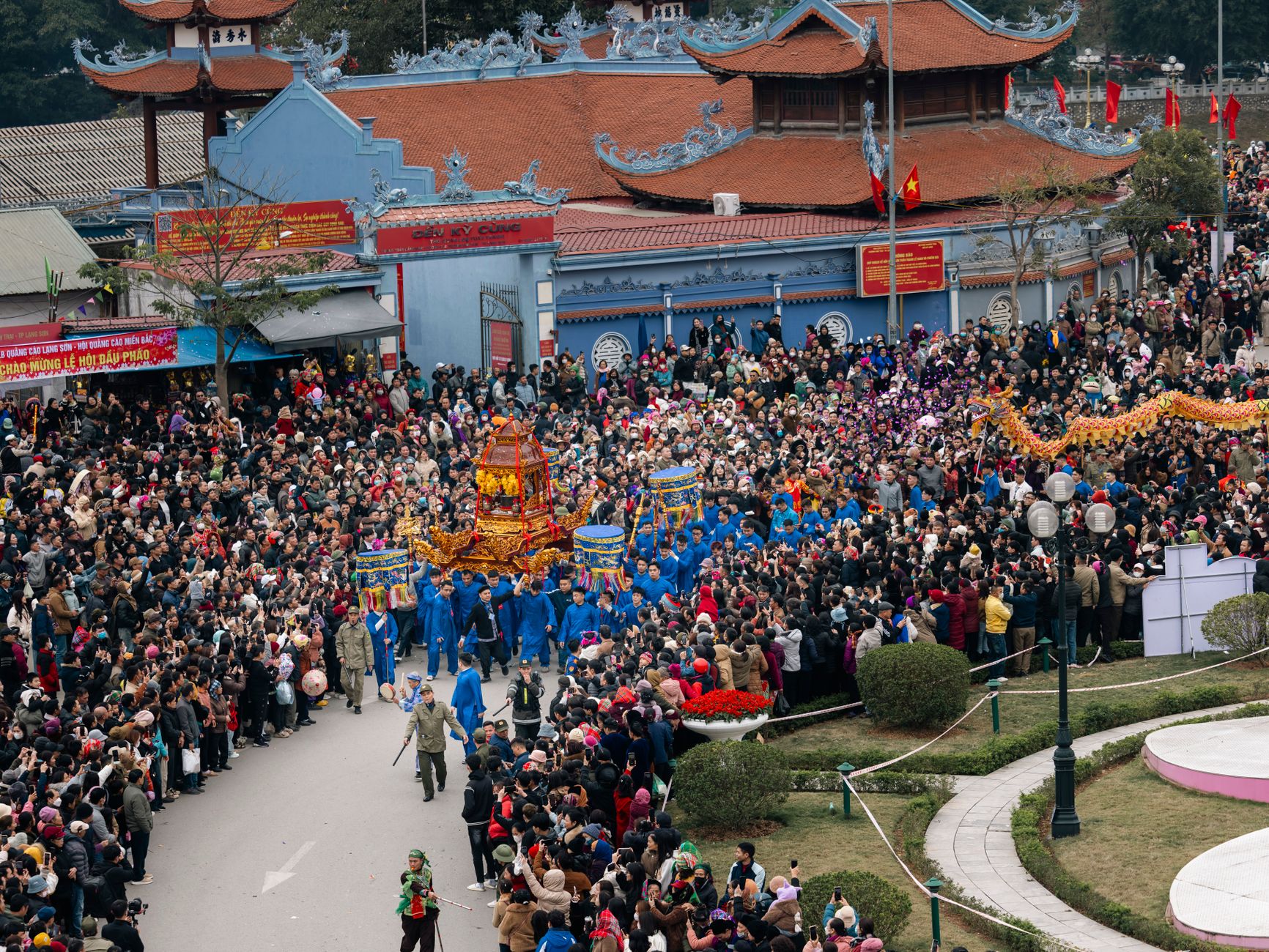
The festival that bears its name is the longest and largest religious pilgrimage in northern Vietnam. For three months, the Yen Stream carries boats loaded with pilgrims, monks, and tourists toward the sacred caves. The atmosphere sits somewhere between a temple fair and a county fair, with incense smoke, sticky rice cakes, and the constant creak of wooden oars.
This guide covers what happens during the festival, when to go, how to get there, and what the crowds and boat rides are really like.
What happens during the festival
The Perfume Pagoda Festival opens on the 6th day of the first lunar month, which falls in February or early March. It runs until the end of the third lunar month, usually closing in late April. The busiest period is the first two weeks, when Vietnamese pilgrims flood in before returning to work after Tet.
The pilgrimage follows a fixed route. Visitors board wooden boats at Ben Duc wharf and travel up the Yen Stream for about 30 minutes. The boat ride is the defining experience of the festival. Boats are rowed by local women using their feet, a technique that has been passed down for generations. The valley opens up with rice fields on one side and sheer limestone cliffs on the other. During festival season, the stream becomes a river of colorful boats, each packed with pilgrims in their finest clothes.
The boat drops passengers at Thien Tru Pagoda, also called the Heavenly Kitchen Pagoda. This is the main temple complex, with several halls, bell towers, and a large courtyard. Most pilgrims stop here to pray, light incense, and buy offerings before continuing up the mountain.
From Thien Tru, a cable car runs up the mountain to Huong Tich Cave, the most sacred site in the complex. The cable car costs 180,000 VND ($7.50) round trip. A walking path also climbs the mountain, taking about 45 minutes. Most visitors take the cable car up and walk down, or vice versa.
Huong Tich Cave is the heart of the pilgrimage. Inside, stalactites hang from the ceiling like frozen waterfalls, and a bronze bell cast in the 18th century sits near the entrance. Pilgrims crowd into the cave to touch the sacred rocks, light incense, and make offerings. The cave is said to have been discovered by a Buddhist nun in the 15th century, who named it "the cave of the fragrant traces."
Beyond the main sites, smaller pagodas dot the valley. Tuyet Son Pagoda, Cam Tuyen Pagoda, and Vong Tinh Pagoda each have their own small following. Dedicated pilgrims visit all of them over the course of a full day. Most day-trippers focus on Thien Tru and Huong Tich.
Pro tip: The festival is not a single-day event. The entire valley operates as a pilgrimage site for three months. Even outside the main festival dates, the boats run daily and the temples stay open.
When to go: navigating the crowds
The festival calendar follows the lunar calendar, so dates shift each year. In 2026, the festival opens on February 23 and runs through late April. The exact closing date depends on the lunar calendar, but the third lunar month typically ends in late April.
The first two weeks after opening are the most crowded. Vietnamese pilgrims come in family groups, often wearing matching ao dai, the traditional long dress. On weekends, the site can see 30,000 to 50,000 visitors per day. Weekdays are quieter, though still busy compared to the rest of the year.
The sweet spot is mid-March to mid-April. The initial rush of Tet pilgrims has faded, the weather is warming up, and the rice fields along the Yen Stream are at their greenest. Late April gets hot and humid, and the festival winds down as the third lunar month ends.
For travelers who want to avoid crowds altogether, the Perfume Pagoda is open year-round. Outside festival season, the site is nearly empty. The boats still run, the cable car still operates, and the caves remain open. The difference is night and day. A visit in October or November offers the same landscape without the queues.
Pro tip: If visiting during the festival, arrive at Ben Duc wharf before 8:00 AM. The boat queue builds quickly, and by 10:00 AM, wait times can stretch past an hour.
How to get to the Perfume Pagoda
The Perfume Pagoda sits in Huong Son commune, My Duc district, about 60 kilometers southwest of Hanoi. The drive takes 1.5 to 2 hours depending on traffic.
By private car or taxi: The most comfortable option. A private car with driver costs around 1,500,000 VND ($63) for the day, including waiting time. Grab and local taxi companies in Hanoi can arrange this. The driver drops passengers at Ben Duc wharf, where the boat ride begins.
By bus: Public buses run from My Dinh bus station in Hanoi to Ben Duc wharf. Bus number 2118 departs regularly and costs about 50,000 VND ($2). The journey takes 2 to 2.5 hours. From the bus stop, it is a short walk to the wharf. This option works best for budget travelers comfortable with local transport.
By organized tour: Many Hanoi tour operators offer day trips to the Perfume Pagoda. These typically include hotel pickup, transport, boat ride, cable car, and a guide. Prices range from 800,000 to 1,500,000 VND ($33 to $63) per person. Tours handle the logistics but limit flexibility. For independent travelers, the private car option offers more freedom at a similar price for small groups.
Getting around the site: The boat ride from Ben Duc to Thien Tru is the only way to reach the main temples. The boats are shared, seating 8 to 12 people. During the festival, boats fill quickly, and solo travelers may need to wait for a group to form. The boat fare is included in the site entrance ticket, which costs 90,000 VND ($3.75) per person during the festival.
From Thien Tru, the cable car runs to Huong Tich Cave. The round trip costs 180,000 VND ($7.50). Walking paths connect the main sites, and a small electric shuttle runs between Thien Tru and the cable car station for 20,000 VND ($0.85).
Pro tip: The boat ride is not optional. Even travelers with private cars must park at Ben Duc and take the boat. There is no road access to the temples.
What to expect from the boat ride
The boat ride is the most memorable part of the Perfume Pagoda experience. The Yen Stream is narrow, and during festival season, it becomes a conveyor belt of wooden boats. Each boat is rowed by one or two local women, often wearing conical hats and colorful shirts. They row with their feet, pushing a long oar back and forth while sitting on a wooden bench.
The ride takes about 30 minutes each way. The scenery is stunning: limestone karsts rise vertically from the water, and rice paddies stretch toward the mountains. Small shrines and bamboo groves line the banks. Vendors in small boats pull alongside to sell snacks, drinks, and incense.
The boats are basic. Wooden benches, no life jackets, and a canopy that provides partial shade. During peak festival days, the stream gets congested. Boats bump into each other, and rowers shout warnings in Vietnamese. It is chaotic but good-natured.
The return ride is downhill, so to speak. The current carries the boats back to Ben Duc, and the rowers rest their oars. This is a good time to buy a coconut or a bag of roasted peanuts from the floating vendors.
Pro tip: Sit on the left side of the boat going upstream. The best views of the karst mountains are on that side. The right side faces the rice fields, which are prettier in the late afternoon light.
The temples and caves
The Perfume Pagoda complex has three main stops, each worth a visit.
Thien Tru Pagoda: The first stop after the boat ride. This is the main temple complex, with a large courtyard, several halls, and a three-story bell tower. The architecture dates to the 18th century, though much of it has been rebuilt. Pilgrims light incense here and pray before continuing up the mountain. The pagoda is also a good place to buy offerings: fruit, flowers, and paper votive objects.
Huong Tich Cave: The main event. The cave sits halfway up the mountain, reachable by cable car or a 45-minute walk. The entrance is through a stone archway, and inside, the cave opens into a vast chamber filled with stalactites and stalagmites. Some of the rock formations have names, like "the golden tree" and "the silver tree." A large bronze bell hangs near the altar, and pilgrims ring it for good luck.
The cave gets crowded during the festival. On peak days, the queue to enter can stretch 30 minutes. The walk down from the cave is steep but manageable, with stone steps and handrails. The cable car is the easier option, especially for families with young children or older travelers.
Tuyet Son Pagoda: A smaller pagoda tucked into the mountainside, about 15 minutes on foot from Thien Tru. It is quieter than the main sites and offers good views of the valley. Worth a visit for those with extra time.
Pro tip: The walk from Thien Tru to Huong Tich Cave is steep and takes about 45 minutes. It is a proper climb, not a stroll. Bring water and wear sturdy shoes.
Practical tips for visiting
What to wear: The Perfume Pagoda is a religious site. Shoulders and knees should be covered, especially inside the temples and caves. Loose cotton clothing works well. Comfortable walking shoes are essential if planning to hike between sites. Read more about temple etiquette in Vietnam before visiting.
What to bring: Cash is essential. Vendors at the site do not accept cards. Small denominations are useful for offerings and snacks. Sunscreen and a hat are recommended, as the boat ride offers limited shade. Bring a rain jacket during the spring months, as showers are common.
Food and drink: Several restaurants and food stalls operate near Thien Tru Pagoda. The food is basic: pho, rice dishes, and grilled meats. Prices are higher than in Hanoi, reflecting the remote location. Snacks like banh gio, a pyramid-shaped rice dumpling, are sold along the boat route. The local specialty is a sticky rice cake wrapped in bamboo leaves, sold by vendors at the wharf.
Time needed: A full day is the minimum. The drive from Hanoi takes 1.5 to 2 hours each way, the boat ride takes 30 minutes each way, and the main sites require 3 to 4 hours. Plan to leave Hanoi by 7:00 AM and return by 6:00 PM.
Costs: A day trip from Hanoi costs roughly 700,000 to 1,000,000 VND ($29 to $42) per person for the entrance ticket, boat ride, cable car, and private transport. Budget travelers using public buses can cut this to 300,000 VND ($12.50) per person.
| Expense | Cost (VND) | Cost (USD) |
|---|---|---|
| Entrance ticket (festival season) | 90,000 | $3.75 |
| Boat ride (included in ticket) | 0 | $0 |
| Cable car round trip | 180,000 | $7.50 |
| Private car from Hanoi (per car) | 1,500,000 | $63 |
| Public bus from Hanoi | 50,000 | $2 |
| Lunch at the site | 100,000-200,000 | $4-$8 |
Is the Perfume Pagoda worth visiting?
The Perfume Pagoda is one of the most atmospheric religious sites in northern Vietnam. The combination of boat ride, mountain setting, and cave temples is unlike anything else in the region. The festival adds a layer of color and energy, but also crowds.
For travelers who enjoy cultural immersion and don't mind shared boats and queues, the festival period offers a genuine look at Vietnamese religious life. For those who prefer solitude, the site is equally rewarding outside festival season, when the valley is quiet and the temples feel almost private.
The Perfume Pagoda works well as a day trip from Hanoi, and pairs naturally with other destinations in the north. Travelers heading south can combine it with the Hanoi to Hue route, or extend into a longer northern Vietnam itinerary. The festival's spring timing also aligns with Tet Nguyen Dan, making it a natural addition to a Tet-season trip.
The site is less accessible than other Hanoi day trips. The boat ride and the mountain climb require time and effort. But the journey is part of the experience. The slow approach by boat, the incense smoke drifting through the cave, the sound of pilgrims chanting, these are the moments that stay with visitors long after the boat returns to Ben Duc.
Frequently asked questions
Q: How long is the boat ride to the Perfume Pagoda? The boat ride from Ben Duc wharf to Thien Tru Pagoda takes about 30 minutes each way. The boats travel along the Yen Stream through a valley of limestone karsts and rice fields.
Q: Can you visit the Perfume Pagoda outside festival season? Yes. The site is open year-round. Outside the festival, from May to January, the crowds disappear, the boat queue is minimal, and the temples are nearly empty. The weather is also drier from October to December.
Q: How much does a day trip to the Perfume Pagoda cost? A private car from Hanoi costs about 1,500,000 VND ($63) per car. The entrance ticket is 90,000 VND ($3.75), and the cable car is 180,000 VND ($7.50). Budget travelers using public buses can spend under 300,000 VND ($12.50) per person.
Q: Is the Perfume Pagoda suitable for children and older travelers? The boat ride and cable car are accessible. The walk from Thien Tru to the cable car station is flat and short. The hike to Huong Tich Cave is steep and not recommended for those with mobility issues. The cable car solves most accessibility problems.
Q: What should you wear to the Perfume Pagoda? Covered shoulders and knees are required inside the temples and caves. Loose, breathable clothing works best. Comfortable shoes are essential if walking between sites. Read the full temple etiquette guide for more details.
Q: How crowded does the Perfume Pagoda get during the festival? On peak weekends, the site can see 30,000 to 50,000 visitors per day. The boat queue at Ben Duc can stretch over an hour by mid-morning. Weekdays in March are significantly quieter than February weekends.
Q: Can you visit the Perfume Pagoda and other Hanoi attractions in one day? A full day is needed for the Perfume Pagoda alone. The round trip from Hanoi takes 3 to 4 hours, and the site requires 3 to 4 hours. Combining it with other attractions in Hanoi is not realistic. Plan it as a standalone day trip.