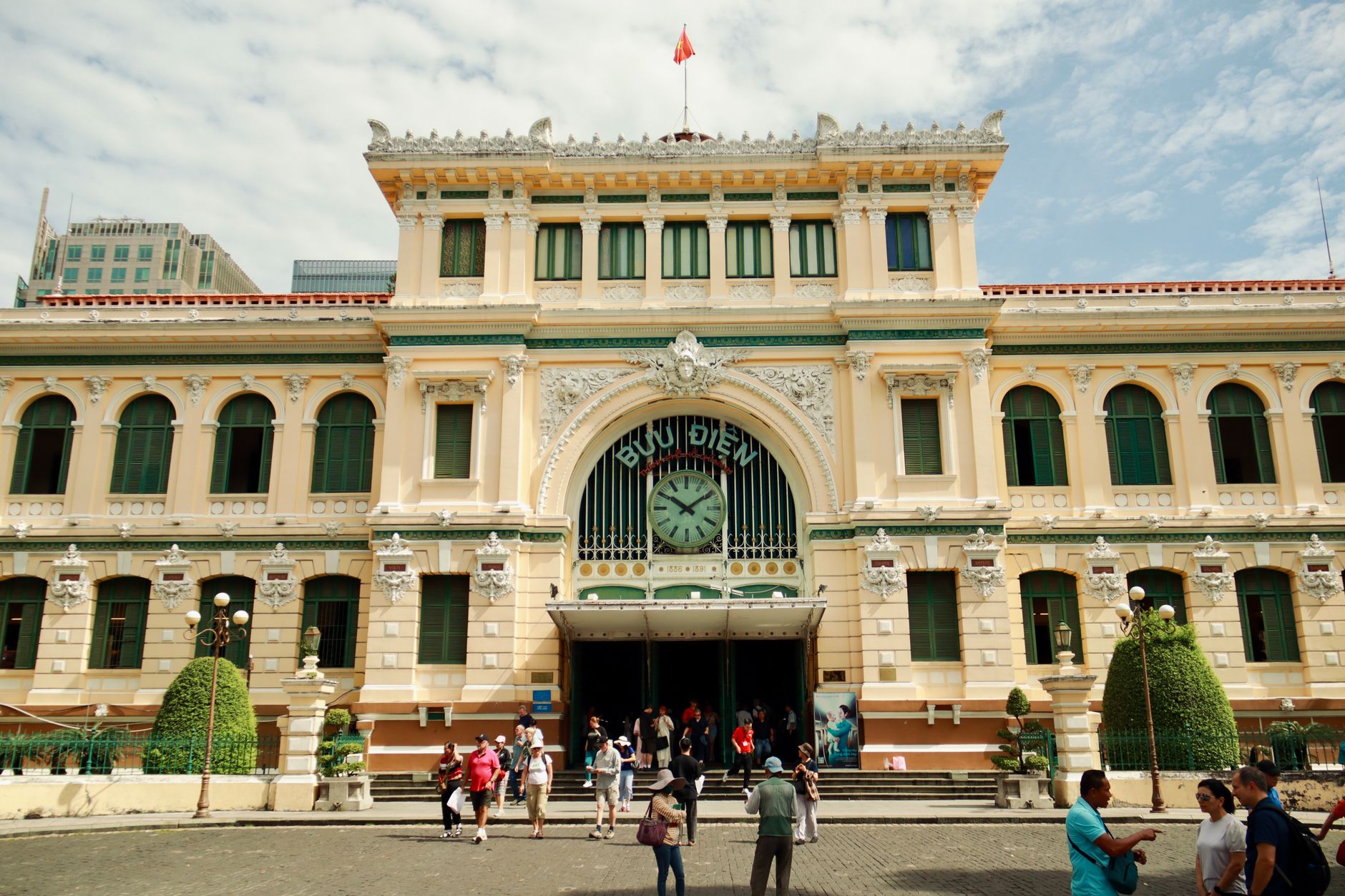
This guide covers what the Central Post Office is, why it exists, what to look at once you are inside, and how to visit without spending your morning queuing behind tour groups. It also tells you honestly who will love it and who should skip it.
What the Central Post Office actually is
The full name is Bưu điện Trung tâm Sài Gòn, and it still functions as a post office. You can buy stamps, send a parcel to Europe, change money at the counters on the right, and use the public phone booths that have stood in the same spot for decades. It is not a museum with a ticket desk. It is a government building that happens to be beautiful, and that combination is exactly why it feels different from the heritage sites you pay to enter.
The building sits on Cong xa Paris, a small square in District 1, directly behind Notre-Dame Cathedral Basilica of Saigon. The two buildings face each other across a garden, which is why almost every photograph of one includes the other.
The story: 1886 to today
Construction started in 1886 and finished in 1891, during the French colonial administration of Cochinchina. The design is usually credited to Alfred Foulhoux, though a persistent local legend attributes it to Gustave Eiffel. There is no documentary evidence for the Eiffel claim, and the Eiffel company's records do not list the building. The legend survives because Eiffel's name sells, and because the ironwork inside looks like something his workshop could have produced.
The building was never just a post office in the colonial period. It handled telegraph traffic, which in the 1890s was the fastest communication link between Indochina and France. Messages moved by cable, not by ship, and the Saigon office was a node in a network that stretched from Marseille to Singapore to Hong Kong.
After 1975 the building continued operating as the city's main postal hub. It was restored in the 1990s and again more recently, with the roof and the interior paintwork brought back to something close to the original scheme. The arched windows, the clock above the main entrance, and the rows of wooden counters are all part of the current layout.
The Eiffel myth is repeated by guides and taxi drivers alike. If someone tells you Eiffel designed it, you can smile and change the subject.
What you see, in visiting order
The facade and the square
Start outside. The building is roughly 60 metres long, with a central section topped by a clock and three arched entrances. The facade uses a mix of Renaissance and classical elements, with decorative reliefs showing faces and floral motifs. Look at the round medallions above the arches: they carry portraits and symbols connected to the early postal and telegraph service.
The square in front is where most people take their first photo. Morning light hits the facade from the left, which is why photographs taken before 9am look warmer than those taken at midday.
The main hall
Walk through the central arch and you are in the great hall. The ceiling is the reason people stop walking. It is a barrel vault of steel ribs and glass panels, supported by two rows of iron columns painted in the same pale green as the original ironwork. The span is wide enough to make the room feel like a train station, and the acoustics carry every conversation.
On the walls, two large painted maps face each other. One shows the telegraph network of southern Vietnam and Cambodia as it existed in the late nineteenth century. The other shows Saigon and its surrounding provinces. The maps were restored in the 2010s and the lettering is legible if you stand close.
The counters and the far end
The wooden counters run along both sides of the hall. The right side handles parcels and money exchange, the left side handles stamps and letters. At the far end, past the counters, there is a small souvenir section selling postcards, stamps and Vietnam-themed stationery. Prices here are higher than at street level, but the postcards are decent quality.
The public phone booths sit in a row on the left side of the hall. They are wooden, glass-fronted, and still in working order, though almost nobody uses them. They are the most photographed object in the building after the ceiling.
If you want to send a postcard, buy the stamp at the counter, write the card at one of the standing desks, and post it in the box near the exit. Delivery to Europe or North America typically takes two to four weeks.
The courtyard behind
Most visitors never walk past the main hall. Behind the building there is a small courtyard with service entrances and a few shade trees. It is not scenic, but it is quiet, and it gives you a sense of how the building functions as a workplace rather than a monument.
How the Central Post Office compares to nearby landmarks
Saigon has several colonial-era buildings within walking distance, and it helps to know what each one offers before you plan your day.
| Landmark | Distance from the post office | Entry fee | Time needed | Best for |
|---|---|---|---|---|
| Central Post Office | 0 m | Free | 20 to 40 minutes | Architecture, postcards, quick visit |
| Notre-Dame Cathedral | 100 m | Free (exterior only during restoration) | 15 to 30 minutes | Photography, colonial history |
| Book Street (Duong Sach) | 250 m | Free | 20 to 45 minutes | Coffee, browsing, shade |
| Independence Palace | 700 m | 65,000 VND (about 2.60 USD / 2.40 EUR) | 1.5 to 2 hours | Modern Vietnamese history |
| War Remnants Museum | 1.2 km | 40,000 VND (about 1.60 USD / 1.50 EUR) | 2 to 3 hours | Vietnam War history |
The post office is the smallest stop on that list. It works best as a 30-minute addition to a morning that already includes the cathedral and Book Street, not as a destination on its own.
Who will love it, and who should skip it
Architecture and photography enthusiasts will get the most out of the building. The steel vault is genuinely impressive, and the light changes through the day in a way that rewards a second visit. People who enjoy sending postcards will find the experience charming and inexpensive.
Travellers who want deep historical interpretation should look elsewhere. There is no exhibition, no audio guide, and very little signage explaining what you are looking at. If you arrive expecting a museum, you will be disappointed within ten minutes. The building is also hot in the middle of the day, because the glass roof traps heat, and the crowds between 10am and 3pm can make the hall feel like a transit lounge.
Honest verdict: the Central Post Office is worth 30 minutes if you are already in District 1. It is not worth a special trip across the city, and it is not a substitute for the War Remnants Museum or the Independence Palace if you want substance.
Practical information
Opening hours: approximately 7am to 7pm daily, including weekends and most public holidays. Hours were checked in January 2026 and can shift slightly around Tet and national holidays. If you are visiting during Tet, check locally, because many public buildings close for several days.
Entrance fee: free. There is no ticket desk and no mandatory donation.
Address: 2 Cong xa Paris, Ben Nghe ward, District 1, Ho Chi Minh City.
Dress code: none enforced, but this is a working government building. Beachwear and bare torsos are inappropriate. Cover shoulders if you plan to enter the cathedral next door, which does have a dress code.
Photography: allowed and expected. Tripods are tolerated outside peak hours but may attract attention from staff. Drone use over the square is restricted and requires a permit under Vietnamese aviation rules.
Closures: the building can close sections of the hall for maintenance without notice. The main entrance is occasionally blocked for official events.
Getting there from the city centre
The post office sits in the middle of District 1, so most visitors walk. From the Ben Thanh Market area it is a 15 to 20 minute walk up Le Loi and Dong Khoi. From the Nguyen Hue walking street it is about 10 minutes.
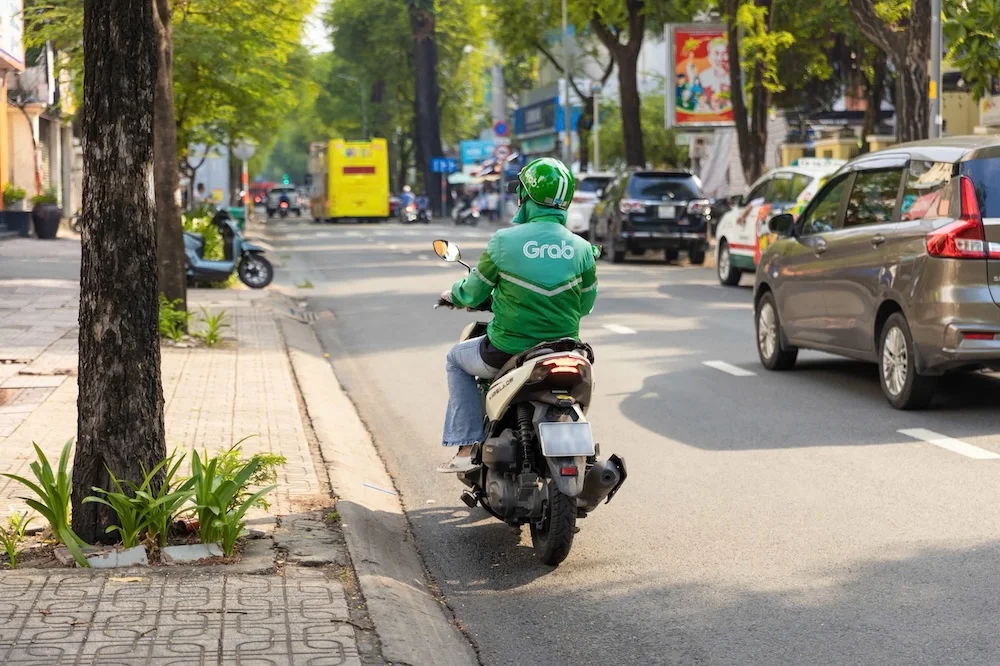
By Grab car or taxi, expect 30,000 to 60,000 VND (about 1.20 to 2.40 USD) from most District 1 hotels, more in heavy rain. By Grab bike, 15,000 to 30,000 VND. Public buses stop along Dong Khoi and Le Duan, but for most travellers the walk is faster than figuring out the routes.
Saigon Metro Line 1 has improved access to this part of District 1. The Opera House station is roughly a 10 minute walk from the post office, which makes the metro a reasonable option if you are coming from Ben Thanh or Ba Son.
Traffic on Cong xa Paris is heavy and the crossing has no useful signal timing. Cross slowly and predictably. If you are not confident, walk via the Book Street side, where there is more space.
How long to allow
Twenty minutes for the building itself. Forty minutes if you send a postcard and take photographs. Half a day if you combine it with the cathedral, Book Street, and the War Remnants Museum.
Best time to visit
Early morning, between 7am and 8:30am, is the quietest window. The light is soft, the hall is cool, and the tour buses have not arrived. Late afternoon, after 5pm, is the second-best option, though the light inside is dimmer.
Avoid midday in the dry season, roughly December to April, when the glass roof turns the hall into an oven. The rainy season from May to November brings short heavy downpours, usually in the afternoon, which can actually clear the square for a few minutes.
For broader context on when to plan a Saigon trip, see Ho Chi Minh City: when to visit around heat and rain.
What to combine nearby
Within a 15 minute walk: Notre-Dame Cathedral, Book Street, the Opera House, the Rex Hotel rooftop, and the Independence Palace. Within a short Grab ride: the War Remnants Museum, the Ben Thanh Market, and the Saigon nightlife around Bui Vien.
If you are planning a wider Saigon itinerary, Ho Chi Minh City things to do: beyond Ben Thanh and the war sites covers the neighbourhoods further out.
Insider tips most visitors miss
Look up before you look at anything else. The vault is the point of the building, and most people photograph the floor level.
The two painted maps on the side walls are original in design and restored in detail. They are worth two minutes each.
The phone booths on the left side still work. If you want a genuinely odd souvenir, make a call.
The postcards sold inside are more expensive than those on Book Street, but the stamps are the same price. Buy the card outside and the stamp inside.
Staff at the counters generally speak enough English to handle a simple transaction. Have your destination country written down if your pronunciation of it is unclear.
Air conditioning is limited. Bring water in the hot months. There are no public toilets inside the building, but cafes on Book Street have them if you buy something.
FAQ
Q: Is the Central Post Office free to enter? Yes. There is no entrance fee, and no ticket is required. You can walk in, look around, and leave without paying anything. Money exchange and postal services cost extra.
Q: What are the opening hours in 2026? The building is generally open from about 7am to 7pm daily. Hours were checked in January 2026. Expect reduced hours or full closure for several days around Tet, and occasional short closures for maintenance.
Q: Did Gustave Eiffel design the Central Post Office? No. The building is usually attributed to Alfred Foulhoux. The Eiffel connection is a popular myth with no documentary support. The ironwork resembles Eiffel's style, which is likely where the story started.
Q: How do I get there from District 1? Walk if you are near Dong Khoi, Nguyen Hue or Ben Thanh. It is 10 to 20 minutes on foot. Grab car or taxi costs roughly 30,000 to 60,000 VND (about 1.20 to 2.40 USD) from most central hotels.
Q: Can I send a postcard or parcel from inside? Yes. Stamps, postcards and parcel services are available at the counters. International delivery typically takes two to four weeks to Europe or North America. Bring cash in small notes.
Q: Is it worth visiting if I only have one day in Saigon? It is worth 20 to 30 minutes if you are already seeing the cathedral and Book Street. If your one day is packed, prioritise the War Remnants Museum and the Independence Palace instead, and treat the post office as a quick photo stop.
Q: What should I wear? There is no formal dress code, but this is a working government building. Avoid beachwear and bare shoulders. If you plan to enter Notre-Dame Cathedral next door, cover your shoulders and knees, following the same etiquette as at Tran Quoc Pagoda in Hanoi or any active religious site in Vietnam.
Q: When is the quietest time to visit? Before 8:30am. The tour groups typically arrive between 9am and 11am, and the hall stays busy until late afternoon. Late evening is quieter but the interior light is poor for photographs.
Your questions and tips
A question, an update, an experience to share? Our team reads every message before it is published.
No comments yet. Ask the first question or share a tip!