Why Can Tho Matters
The problem is that most visitors experience them through packaged tours that turn a living tradition into a photo op. Boats full of tourists arrive at 9 AM, snap pictures of fruit boats, buy a coconut, and leave. By then, the real market has been winding down for two hours.
This guide is about doing it differently. It covers how to reach both Cai Rang and Phong Dien independently, what to look for, and how to avoid the traps that turn an incredible experience into a forgettable one.
For context on how Can Tho fits into a longer trip, see the Mekong Delta Without a Tour: A 2025 Independent Travel Guide.
Cai Rang: The Big One, Done Right
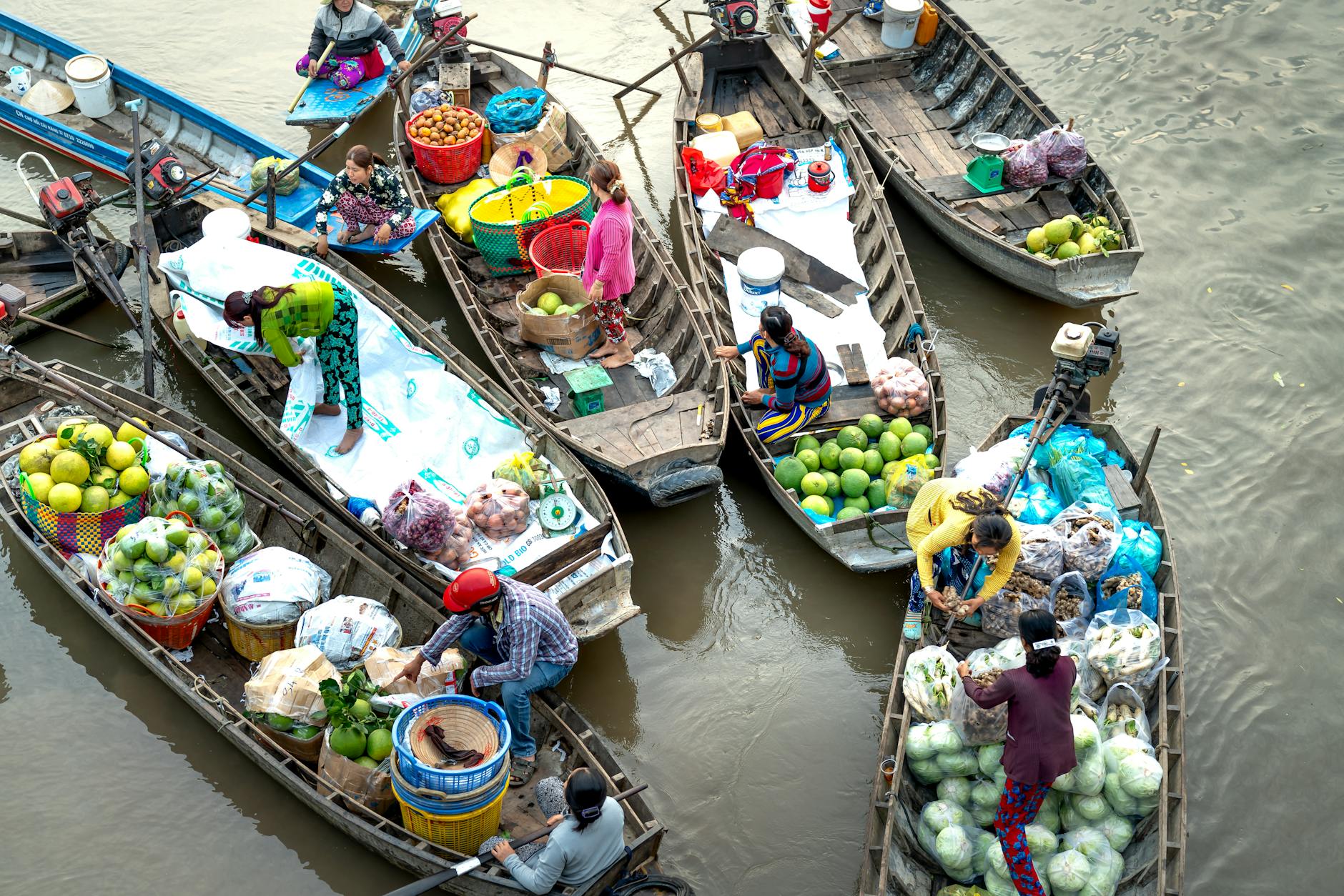
Cai Rang is the largest floating market in the delta. It sits on the Cai Rang River, about 6 km from central Can Tho. On a good day, you will see 100 to 200 boats trading everything from pineapples to watermelons to pumpkins.
The timing is everything
The market peaks between 5:30 AM and 7:30 AM. By 8 AM, the serious trading is over. By 9 AM, most boats are heading home or have become stationary souvenir shops for late-arriving tourists.
Pro tip: Set your alarm for 4:30 AM. A 5:30 AM arrival means you see the market in its full, chaotic glory. The light is also better for photos.
How to get there independently
Skip the hotel tour. Here is how to do it yourself:
- Walk to Ninh Kieu Wharf before 5 AM.
- Negotiate a private boat. Expect to pay 400,000-600,000 VND ($16-24) for a 2-3 hour trip.
- Tell the driver you want to go to Cai Rang market, not the tourist route.
- Ask to stop at a noodle boat for breakfast.
The noodle boats are a highlight. Small canoes pull up alongside your boat with steaming bowls of bun rieu or hu tieu. A bowl costs 20,000-30,000 VND ($0.80-1.20). The soup is hot, the broth is rich, and the setting is unforgettable.
What to look for
Cai Rang operates on a simple visual system. Each boat hangs a sample of what it sells from a long pole at the front. A bunch of green onions means that boat sells scallions. A single pineapple means fruit. A pumpkin means vegetables.
Watch the smaller boats weaving between the larger ones. These are the local shoppers, buying a kilo of this or a bunch of that for their own kitchens. They are not tourists. They are the reason the market exists.
What to avoid
Some boats now sell the same souvenir junk you find in every Vietnamese market. Plastic toys. Keychains. Cheap sunglasses. These boats are easy to spot. They have bright signs in English and Vietnamese. Skip them.
Also avoid the "fruit tasting" boats that charge 50,000 VND ($2) for a plate of overripe dragon fruit and unripe mango. The fruit at the actual market is better and cheaper.
Phong Dien: The Quiet Alternative
Phong Dien is smaller, quieter, and more authentic than Cai Rang. It sits about 17 km southwest of Can Tho, further into the delta's canal network. Fewer tour boats make it here. The market is mostly locals trading with locals.
Why choose Phong Dien
The boats here are smaller. The goods are more varied. You will see vendors selling homemade rice paper, fresh herbs, live fish, and handmade brooms. The atmosphere is relaxed. Vendors have time to chat. Children wave from the banks.
Phong Dien starts earlier than Cai Rang and ends earlier too. Peak activity is 4:30 AM to 6:30 AM. By 7 AM, the market is mostly done.
Pro tip: Combine both markets in one morning. Start at Phong Dien at 5 AM, then head to Cai Rang by 6:30 AM. The boat ride between them takes about 30 minutes.
How to get to Phong Dien
The same private boat from Ninh Kieu Wharf can take you to Phong Dien. The trip takes longer, about 45 minutes each way. Expect to pay 600,000-800,000 VND ($24-32) for a half-day trip covering both markets.
Alternatively, rent a motorbike and drive. The road to Phong Dien follows the canal. It is flat, scenic, and easy to navigate. For motorbike rental tips, see Renting a Motorbike in Vietnam: The Legal Truth Nobody Tells Tourists.
What makes Phong Dien special
The floating houses. Unlike Cai Rang, where most vendors live onshore, many Phong Dien vendors live on their boats year-round. You will see laundry hanging from lines. Children doing homework on deck. Dogs sleeping in the shade of fruit piles.
This is not a show. It is home.
Comparison Table: Cai Rang vs. Phong Dien
| Feature | Cai Rang | Phong Dien |
|---|---|---|
| Size | 100-200 boats | 40-60 boats |
| Peak time | 5:30-7:30 AM | 4:30-6:30 AM |
| Tourist density | High after 8 AM | Low all day |
| Boat tour cost (private) | 400,000-600,000 VND | 600,000-800,000 VND (incl. Cai Rang) |
| Souvenir pressure | Moderate to high | Very low |
| Local atmosphere | Trading hub | Community market |
| Breakfast options | Many noodle boats | Fewer, more local |
| Best for | First-time visitors | Repeat visitors or photographers |
The Tourist Traps to Avoid
The floating market tour industry in Can Tho has developed some reliable patterns. Here are the most common ones.
The "coconut candy" stop
Almost every packaged tour includes a stop at a "coconut candy workshop" or "rice paper making village." These are not real workshops. They are showrooms designed to sell overpriced candy to tourists. The candy is fine. The price is not. You can buy the same coconut candy at any Can Tho market for half the price.
The "homestay" that is actually a hotel
Many tours advertise a "floating market homestay" where you sleep on the water. Some of these are genuine. Many are just hotels on stilts with a "homestay" label and a higher price tag. For real options, see Mekong Delta: Sleep on a Fishing Boat or a Floating Palace.
The "fruit garden" that charges for everything
Fruit gardens in the Mekong Delta are real. But some tour operators take you to gardens that charge 100,000 VND ($4) for a plate of fruit that costs 20,000 VND ($0.80) at the market. Ask your boat driver to take you to a local garden, not a tourist one.
The early morning pickup scam
Some hotels and tour agencies advertise "sunrise market tours" that leave at 5:30 AM but actually pick you up at 4:30 AM and drive around collecting other guests for an hour. By the time you reach the market, the best part is over. Confirm the exact departure time and ask for a private tour if possible.
Practical Logistics for Can Tho
Getting there
From Ho Chi Minh City, buses leave from Mien Tay Bus Station every 30-60 minutes. The trip takes 3.5 to 4 hours. Fares range from 120,000 to 200,000 VND ($5-8). Futra Bus Lines and Phuong Trang are reliable operators.
For a comparison of transport options across Vietnam, see Domestic Flights in Vietnam: Vietjet vs Bamboo vs Vietnam Airlines Honestly Compared.
Getting around
Can Tho is walkable in the center. For the floating markets, you need a boat or a motorbike. Taxis and Grab are available but expensive for the distance to Phong Dien. For information on ride-hailing, see Does Grab work in Cat Ba Island? A complete guide to getting around (2026).
Where to stay
Ninh Kieu Wharf is the best base. It puts you close to the boat departure points and the night market. Hotels here range from 300,000 VND ($12) for a basic guesthouse to 1,500,000 VND ($60) for a mid-range hotel with a river view.
For budget travelers, the area around Hung Vuong Street has dorm beds from 100,000 VND ($4) per night.
What to eat in Can Tho
The floating markets are about breakfast. But Can Tho has excellent food year-round.
- Banh xeo (crispy pancakes) at Banh Xeo Bay Van on Nguyen Trai Street. 30,000 VND ($1.20).
- Hu tieu My Tho (pork and shrimp noodle soup) at any stall on Hai Ba Trung Street. 25,000-40,000 VND ($1-1.60).
- Lau ca kieu (sour fish hotpot) at Ninh Kieu Wharf restaurants. 150,000-250,000 VND ($6-10) per person.
For more on eating safely, see Vietnamese Street Food Safety: How to Eat Everywhere Without Getting Sick.
When to Visit
The best time for the floating markets is the dry season, from November to April. Mornings are clear. The water is calm. The fruit is abundant.
The rainy season, from May to October, is quieter. Fewer tourists. Lower prices. But expect rain most mornings. The markets still operate. They just do it under tarps and umbrellas.
For a broader view of timing, see The Best and Worst Months to Visit Vietnam: A Region-by-Region Guide.
Beyond the Markets: What Else Can Tho Offers
The floating markets are the main draw. But Can Tho has other things worth your time.
Bang Lang Stork Garden
A sanctuary for storks and herons, about 10 km from the city center. Thousands of birds nest here. Best visited at sunset when they return to roost. Entry is 30,000 VND ($1.20).
Can Tho Museum
A well-curated museum covering the history and culture of the Mekong Delta. Free entry. Located on Hoa Binh Street. Allow one hour.
Ong Pagoda
A Cantonese-style pagoda built in the late 19th century. Intricate carvings. Incense-heavy atmosphere. Located on Hai Ba Trung Street. Free entry.
Night market on Ninh Kieu Wharf
Open from 6 PM to 11 PM. Grilled seafood, sugarcane juice, and souvenir stalls. The food is decent. The prices are slightly higher than elsewhere. Worth a stroll.
FAQ
Q: Is it possible to visit the floating markets without a tour? Yes. Private boats are available at Ninh Kieu Wharf from 4:30 AM. Negotiate the price and route directly with the boat driver. For a full guide on independent travel in the delta, see Mekong Delta Without a Tour: A 2025 Independent Travel Guide.
Q: What time should I arrive at Cai Rang market? Arrive by 5:30 AM for the best experience. The market is most active between 5:30 AM and 7:30 AM. After 8 AM, most trading boats have left.
Q: How much does a private boat tour cost? A private boat to Cai Rang costs 400,000-600,000 VND ($16-24) for 2-3 hours. A trip covering both Cai Rang and Phong Dien costs 600,000-800,000 VND ($24-32) for 4-5 hours.
Q: Can I buy fruit at the floating markets? Yes. Vendors sell fresh fruit by the kilo. Prices are lower than in the city. Bring small bills. Most vendors do not have change for large notes.
Q: Is Can Tho safe for solo travelers? Yes. Can Tho is one of the safest cities in Vietnam. Violent crime is rare. Petty theft happens but is uncommon. For general safety tips, see Is Vietnam Safe in 2026? An Honest Country-Wide Risk Assessment.
Q: Do I need to speak Vietnamese to navigate the markets? No. Boat drivers and vendors are used to tourists. Basic phrases help but are not required. Pointing and smiling works. For more on communication, see Nod, Smile, and Swipe: How to Survive Vietnam Without Speaking Vietnamese.
Q: What should I bring to the floating markets? Sunscreen, a hat, insect repellent, cash in small denominations, and a camera. The sun is strong even at 6 AM. Mosquitoes are present near the banks. For health precautions, see Mosquitoes, Dengue and Malaria in Vietnam: The Realistic Risk Map for Travelers.