Yên Tử at a glance
Yên Tử is not a single temple. It is a mountain, a forest and a chain of pagodas and shrines spread across roughly 6 km of trail, all tied to one man: Trần Nhân Tông, the king who defeated the Mongols and then became a monk here. Vietnamese Buddhists treat the mountain as a place of pilgrimage, and the spring festival draws hundreds of thousands of visitors.
| Item | Detail |
|---|---|
| Summit height | 1,068 m (Chùa Đồng, the Bronze Pagoda) |
| Trail length | About 6 km from Giải Oan stream to the summit |
| Time needed | Half a day with the cable car, a full day on foot |
| Distance from Hanoi | About 120 to 140 km, 2 to 2.5 hours |
| Distance from Ha Long | About 50 km, roughly 1 hour |
| UNESCO status | Inscribed July 2025 as part of a wider complex |
| Province | Quảng Ninh (east side), Bắc Ninh (west side, after the 2025 merger) |
The UNESCO listing explained
In July 2025, at the 47th session of the World Heritage Committee, the "Yên Tử - Vĩnh Nghiêm - Côn Sơn, Kiếp Bạc Complex of Monuments and Landscapes" was inscribed as a cultural site. The listing spans three provinces and several separate pagoda clusters, not just the mountain itself. Some guides still describe Yên Tử as "nominated" or "on the tentative list". That is out of date.
A note on place names
Vietnam carried out a major administrative reform in July 2025. District-level units were abolished, and Bắc Giang province merged into Bắc Ninh. The western slope of Yên Tử, formerly in Bắc Giang, now falls under Bắc Ninh province. Booking sites and map apps may still show "Uông Bí" as the address, and some still list the old district names. The mountain has not moved. Only the paperwork has.
On spelling: Yên Tử is correct. "Yen Tu" without diacritics is the common English form. "An Tu" appears in some machine translations and is wrong.
A short history: the king who became a monk
Trần Nhân Tông was born in 1258. He repelled the Yuan invasions of 1285 and 1288, then abdicated in favour of his son Trần Anh Tông. Published sources disagree on the exact year of the abdication, with 1293 and 1294 both cited, and on when he settled at Yên Tử, often given as 1299. He died in 1308 at Ngọa Vân, and his relics were placed in the Huệ Quang Tower on the mountain.
What Trúc Lâm Zen is
Trúc Lâm is a Vietnamese Zen lineage that blends meditation with lay and civic life. It does not demand withdrawal from the world. The school names three patriarchs: Trần Nhân Tông, Pháp Loa and Huyền Quang. This is why Yên Tử matters to Vietnamese Buddhists in a way that a scenic mountain alone would not.
Decline and rebuilding
The complex declined under later courts dominated by Confucian officials. Large rebuilding campaigns began in the early 2000s and continue. This matters for what a visitor actually sees, and it is covered honestly in a later section.
East or west Yên Tử: choosing your side
Most guides only know the Quảng Ninh side. The mountain has two approaches, and the choice shapes the whole day.
| Side | Province (post-2025) | Access from | Main sites | Crowd level | Best for |
|---|---|---|---|---|---|
| East Yên Tử | Quảng Ninh | Ha Long (1 hour), Hanoi (2 to 2.5 hours) | Giải Oan, Hoa Yên, Huệ Quang Tower, Một Mái, Chùa Đồng | Heavy, extreme at festival | First-timers, history, Ha Long combinations |
| West Yên Tử | Bắc Ninh | Hanoi via the Bắc Giang direction | Chùa Hạ, Chùa Trung, Chùa Thượng, its own cable car | Lighter outside festival | Crowd avoidance, photography, quiet walks |
Both sides converge near the summit ridge.
East Yên Tử (Quảng Ninh)
This is the historic pilgrimage route and holds the most heritage stops. It is also the busiest and the easiest to reach from Ha Long.
West Yên Tử
The western complex is newer, with mostly recent construction, a calmer atmosphere and its own cable car.
Which side suits whom
Choose the east for a first visit with an interest in history, or when combining with Ha Long. Choose the west for crowd avoidance and photography, especially during the festival months.
How to get there
| Starting point | Mode | Duration | Approx. cost | Pros | Cons |
|---|---|---|---|---|---|
| Hanoi | Private car, day return | 2 to 2.5 hours each way | 1,800,000 to 2,500,000 VND ($70 to $95) | Door to door, flexible timing | Most expensive |
| Hanoi | Bus to Uông Bí plus taxi | 2.5 to 3.5 hours | 100,000 to 150,000 VND ($4 to $6) plus taxi | Cheapest | Transfers, timetable limits |
| Ha Long | Taxi or private car | About 1 hour | Metered or app fare for about 50 km | Short, easy | Return fare can be steep |
| Hai Phong | Car or taxi | About 1 hour (50 to 60 km) | Metered or app fare | Convenient | Fewer public options |
From Hanoi
The drive takes about 2 to 2.5 hours via the Hanoi–Hai Phong expressway or National Road 18. Traffic near Uông Bí can add time on weekends. The public option is an intercity bus from Gia Lâm or Mỹ Đình to Uông Bí, then a taxi or ride-hail app for the final 14 km or so to the base.
From Ha Long
About 50 km and roughly 1 hour. Some guides cite old taxi fares that no longer reflect current prices, so confirm the quote before getting in.
From Hai Phong
About 50 to 60 km and roughly 1 hour.
By motorbike
National Road 18 carries heavy truck traffic, and this is not a relaxing ride. You need a valid licence and insurance, and an International Driving Permit under the 1968 convention if your home licence is not Vietnamese. Parking near the base attracts touts who wave riders into private lots. Agree the fee first.
Getting back
Evening ride-hail availability near the mountain can be thin, especially on weekdays. Arrange the return in advance or keep a local taxi number.
Tickets, cable car and real costs
Prices below are the 2026 fares. Under a Quảng Ninh provincial resolution, the site entrance is free from 2026 to the end of 2028; the cable car is paid separately.
| Item | Adult price | Child price | Notes |
|---|---|---|---|
| Site entrance | Free | Free | Free from 2026 to the end of 2028 |
| Cable car segment 1 (Giải Oan to Hoa Yên) | 200,000 VND ($7.70) one way, 280,000 VND ($11) return | Free under 1.2 m | Free for visitors over 70 |
| Cable car segment 2 (Một Mái to upper station) | 200,000 VND ($7.70) one way, 280,000 VND ($11) return | Free under 1.2 m | Free for visitors over 70 |
| Both segments | 350,000 VND ($13.50) return, 280,000 VND ($11) down only | Free under 1.2 m | The usual choice |
| Parking | Free in 2026 | n/a | Private lots charge separately |
The 350,000 VND return fare covers both cable car segments, not one. Buy at the ticket window at the base or on the operator's official page.
Entrance and shuttle
The site entrance is free from 2026 to the end of 2028. The electric shuttle runs from the parking area to the Giải Oan cable car station and saves a dull road walk.
Cable car segments
Segment 1 runs from Giải Oan to Hoa Yên. From Hoa Yên, the walk past Huệ Quang Tower to Một Mái takes about 20 to 30 minutes uphill. Segment 2 runs from Một Mái up toward the An Kỳ Sinh statue.
What the cable car does not do
It does not reach the summit. From the upper station, expect a steep climb of roughly 45 to 75 minutes on uneven stone and rock to Chùa Đồng. This is the most common surprise for visitors who assumed the cable car delivers them to the top.
If you have limited mobility or knee problems, plan to stop at the upper cable car station and enjoy the views there. The final climb is genuinely rough.
Opening hours and suspensions
The cable car runs from 7:00 to 18:00, and from 5:00 to 20:00 during the festival season (1st to 3rd lunar month). It can be suspended in high winds, thunderstorms or typhoon warnings. Check the forecast the night before and have a backup plan.
Cash and payment
Bring cash for stalls, offerings and parking. ATMs are in Uông Bí town, not on the mountain.
The route, stop by stop
| Stop | Approx. elevation | Access | Time to next stop | Original or rebuilt |
|---|---|---|---|---|
| Trúc Lâm Zen Monastery (Chùa Lân) | Base | Walk | 10 to 15 min | Modern |
| Giải Oan stream and pagoda | Low | Walk or shuttle | 5 to 10 min | Rebuilt |
| Hoa Yên Pagoda | Mid | Cable car segment 1 or walk | 20 to 30 min | Rebuilt 2002 |
| Huệ Quang Tower | Mid-high | Walk | 15 to 20 min | Oldest surviving fabric |
| Một Mái Pagoda | High | Walk or cable car segment 2 | 10 min | Rebuilt, cave setting |
| An Kỳ Sinh statue | High | Cable car segment 2 or walk | 45 to 75 min | Weathered stone |
| Chùa Đồng (Bronze Pagoda) | 1,068 m | Walk only | n/a | Cast 2007 |
Trúc Lâm Yên Tử Zen Monastery (Chùa Lân) and the Trần Nhân Tông cultural centre
These sit at the foot of the mountain and are often skipped by day trippers. They are an active practice centre, not a museum piece.
Giải Oan stream and pagoda
The name means "release from injustice". The legend tells of royal concubines who drowned themselves when the king refused to return to court. The stream marks the start of the historic climb.
Hoa Yên Pagoda
This is the spiritual heart of the complex, rebuilt in 2002. Ancient frangipani and pine trees stand in the courtyard, along with a 1.2 m bronze statue of Trần Nhân Tông and surviving stone lions and stele.
Huệ Quang Tower and the stupa garden
The tower holds the king's relics and has been restored many times. Its carved base shows lotus, cloud and dragon motifs. About 97 smaller stupas of monks surround it. This is the oldest surviving fabric on the route.
Một Mái Pagoda
The "half-roof" shrine is set into a cave. Look for the small white marble statues from the late Lê to early Nguyễn period and the spring believed to have healing properties.
An Kỳ Sinh statue and Vân Tiêu Pagoda
The weathered stone statue is linked to the legend of the immortal An Kỳ Sinh. These are the last stops before the final climb.
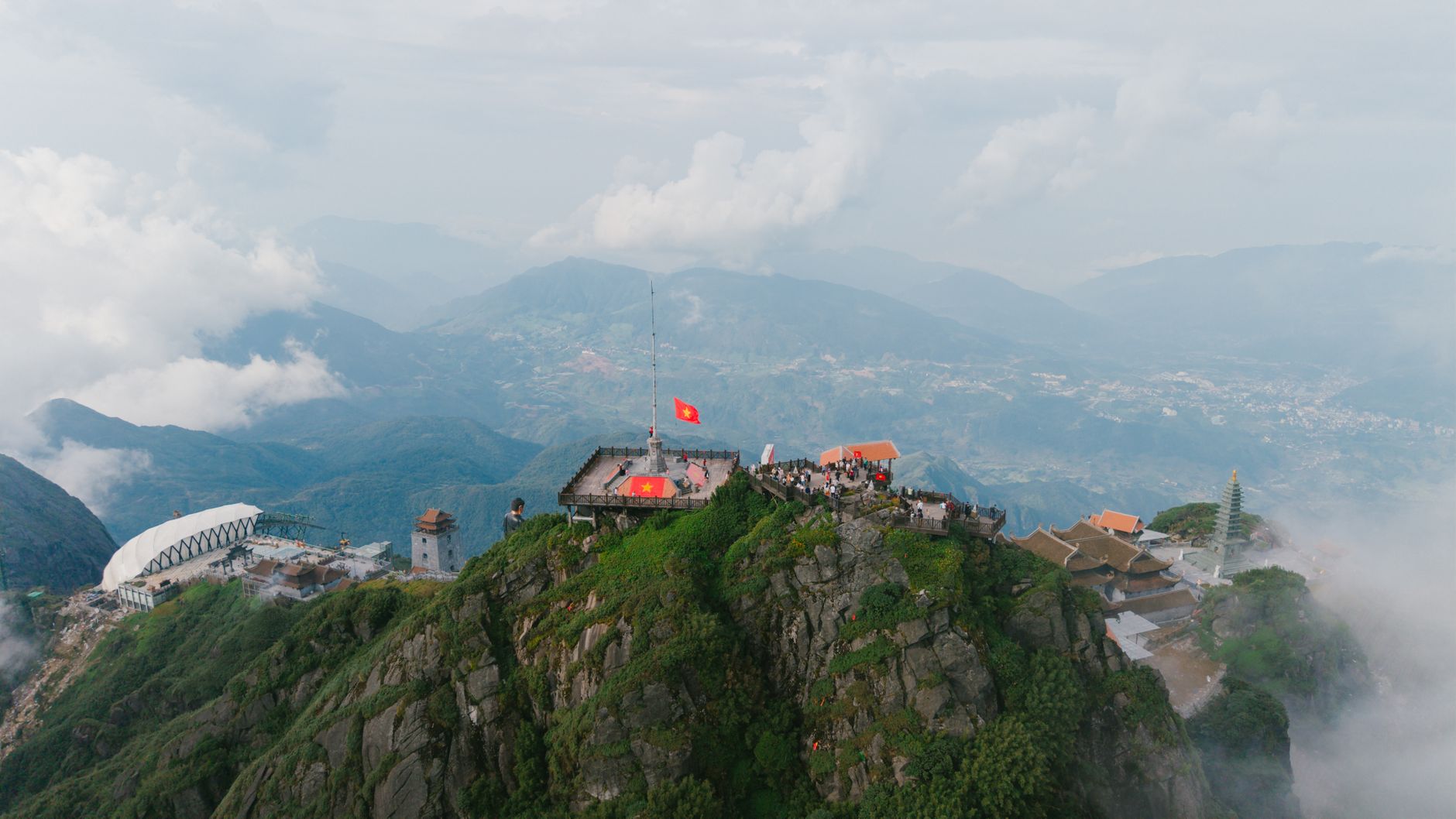
Chùa Đồng, the Bronze Pagoda on the summit
It was cast in 2007 and weighs about 70 tonnes according to published figures. It replaced a much smaller older bronze shrine. In Trần Nhân Tông's time there was only a rock outcrop used for meditation. On clear days the views reach toward Ha Long. Fog often hides everything, so treat the view as a bonus, not a guarantee.
Climbing on foot: what the hike is really like
| Option | Total time | Difficulty | Cost | Best for |
|---|---|---|---|---|
| Both cable car segments | 4 to 5 hours | Moderate (final climb still steep) | Highest | Families, limited time, older visitors |
| Cable car up, walk down | 6 to 7 hours | Hard on knees | Medium | Fit walkers who want the descent scenery |
| Walk up, cable car down | 6 to 7 hours | Hard on lungs | Medium | Strong walkers, pilgrim experience |
| Full hike both ways | 8 to 10 hours | Very hard | Lowest | Serious hikers, pre-dawn starters |
Distance, elevation and time
The route is about 6 km with roughly 900 to 1,000 m of elevation gain over several thousand stone steps. Allow about 4 to 6 hours up and 3 to 4 hours down for an average fit walker.
The partial-hike option
Taking the cable car up and walking down is popular, but the descent is hard on the knees. The reverse, walking up and riding down, suits strong walkers who want the pilgrim experience without the pounding descent.
Starting early like pilgrims
Many Vietnamese climbers start before dawn. Reaching the summit is thought to bring luck for the year, and elderly climbers doing the full route are common. Join them if you can.
What to bring
Shoes with grip, not sandals. A rain shell. A warm layer for the summit. Water. A headlamp for pre-dawn starts. Walking poles for the descent.
When to go: seasons and the Yên Tử festival
| Months | Weather at summit | Crowds | Highlights | Risks |
|---|---|---|---|---|
| October to November | Drier, clearer | Light | Best views, comfortable walking | Occasional late storms |
| December to February | Cold, damp, single-digit °C possible | Moderate | Fog atmosphere, mai vàng blossom around Tết | Slippery stones, poor visibility |
| March to April | Mild | Heavy early, tapering | Festival atmosphere | Queues, pickpockets |
| May to September | Hot, humid, stormy | Busy with domestic visitors | Green forest | Typhoon risk, cable car suspensions |
Season by season
October to November is often the best window, with drier air, clearer views and few crowds. Late October is a good time to go now. December to February is cold and damp, the summit can drop to single-digit temperatures, fog is common and stones are slippery. Late January to February brings yellow apricot blossom (mai vàng Yên Tử) around Tết. March to April is milder, with crowds tapering after the festival peak. May to September is hot, humid and stormy, with typhoon risk in Quảng Ninh and frequent cable car suspensions on bad days.
The Yên Tử spring festival
The festival traditionally opens on the 10th day of the 1st lunar month and runs about three months, to the end of the 3rd lunar month. Tết falls on 6 February 2027, so the opening is expected around 15 February 2027, with the festival running until about early May 2027. Peak days are the opening weekend and the first lunar month.
Festival reality check
Expect queues of several hours for the cable car, packed steps, pickpocketing risk, higher taxi prices and fully booked local rooms. Go on a weekday, start before 6:00, or choose West Yên Tử.
Other dates
The commemoration of Trần Nhân Tông's passing into nirvana falls on the 1st to 3rd day of the 11th lunar month. The next one falls on 9 to 11 December 2026. Ceremonies draw monks and pilgrims, which makes it a meaningful but busier time.
Etiquette, dress and pilgrim culture
Yên Tử is an active religious site, not a theme park.
Dress code
Cover shoulders and knees inside pagodas. Remove hats and, where indicated, shoes before entering halls.
Behaviour in pagodas
Keep voices low. Do not climb on statues or stupas. Ask before photographing monks or people praying, and do not point feet toward altars.
Offerings and incense
Offerings and incense are customary but optional for non-Buddhists. Incense and offering sellers can be pushy on some stretches. A polite refusal is fine.
Trail courtesy
Pilgrims greet each other with "Nam mô A Di Đà Phật", and returning the greeting is appreciated. Keep to one side on narrow steps and carry your rubbish out.
Safety, health and honest drawbacks
Physical risks
Wet stones are slippery, the steps near the summit are steep and uneven, and the descent strains knees. Winter brings cold and fog, summer brings heat exhaustion. People with heart or mobility conditions should rely on the cable car and still treat the final climb with caution.
Weather and the cable car
Check forecasts. Typhoons and thunderstorms can shut the cable car and make the trail unsafe. Since Typhoon Yagi in September 2024 damaged forests across Quảng Ninh, confirm whether any trail sections are closed or rerouted.
Accessibility
The site is not wheelchair accessible beyond the base area. Even with the cable car, visitors need to manage hundreds of steps.
Scams and annoyances
Parking touts, inflated taxi quotes on festival days and unofficial "guides" are common. Use metered or app-based taxis.
Authenticity and commercialisation
Most buildings are recent reconstructions. Hoa Yên was rebuilt in 2002, and the summit pagoda is a 2007 casting. Stalls and loudspeakers line some sections. The spiritual atmosphere comes from the pilgrims and the forest, not from ancient architecture. Huệ Quang Tower and some stone relics are the main older elements. Visitors expecting centuries-old temples may be disappointed. Visitors who come for the walk, the history and the pilgrim energy usually are not.
Where to stay and eat
Staying near the mountain
The high-end option is Legacy Yên Tử MGallery, a Bill Bensley-designed resort inspired by Trần-era architecture. Mid-range hotels and homestays cluster in Yên Đức village and near the base. Budget hotels are in Uông Bí town, about 15 km away. Staying overnight allows a pre-dawn start, which beats crowds and catches clearer morning views.
Food
Vegetarian (chay) food is common on and around the mountain and suits the religious context. Basic stalls along the route charge more than in town. In Uông Bí, look for local Quảng Ninh specialities such as squid cakes (chả mực).
Combining Yên Tử with the heritage trail and Ha Long
The rest of the UNESCO complex
Vĩnh Nghiêm Pagoda, whose Buddhist woodblocks are on UNESCO's Memory of the World Asia-Pacific register, sits in the former Bắc Giang area. Côn Sơn and Kiếp Bạc, near Chí Linh, are now in Hải Phòng city after the 2025 merger. Ngọa Vân, where Trần Nhân Tông died, and the Trần sites around Đông Triều complete the picture.
Sample itineraries
A day trip from Hanoi works with an early start and a private car. Hanoi to Yên Tử to Ha Long fits comfortably in two days. A three-day "Trúc Lâm heritage trail" can cover Yên Tử, Ngọa Vân, Côn Sơn, Kiếp Bạc and Vĩnh Nghiêm.
FAQ
Q: How long does it take to climb Yên Tử Mountain? A: On foot, allow about 4 to 6 hours up and 3 to 4 hours down for roughly 6 km and close to 1,000 m of gain. With both cable car segments, the visit takes about 4 to 5 hours, including the walk between stations and the 45 to 75 minute final climb to the summit.
Q: Does the cable car go to the top of Yên Tử? A: No. The second segment stops near the An Kỳ Sinh statue, and the Bronze Pagoda is still a steep climb of several hundred steps and rocks away. Plan for it physically and allow enough time.
Q: How much does the Yên Tử cable car cost? A: In 2026, one segment costs 200,000 VND ($7.70) one way or 280,000 VND ($11) return, and a return ticket on both segments costs 350,000 VND ($13.50). Children under 1.2 m and visitors over 70 ride free. The site entrance is free until the end of 2028.
Q: When is the Yên Tử festival? A: It opens on the 10th day of the 1st lunar month and lasts about three months. The next opening is expected around 15 February 2027, and the festival runs until about early May 2027. The first weeks are extremely crowded, so choose weekdays or early starts.
Q: Is Yên Tử worth visiting if I am not Buddhist? A: Yes, for the forest walk, the pilgrim atmosphere and its place in Vietnamese history. Be aware that most buildings are rebuilt. Visitors expecting ancient architecture or guaranteed views may be disappointed.
Q: Can Yên Tử be done as a day trip from Hanoi? A: Yes, with about 4 to 5 hours of total driving. A private car or an early bus to Uông Bí plus a taxi works. An overnight stay makes a pre-dawn start possible and avoids rushing the descent.
Q: What should I wear to Yên Tử? A: Wear grippy walking shoes and clothes that cover the shoulders and knees for the pagodas. Bring a rain layer and a warm layer, because the summit is noticeably colder and often foggy, especially from December to February.
Q: Is Yên Tử a UNESCO World Heritage Site? A: Yes. Since July 2025 it has been part of the "Yên Tử - Vĩnh Nghiêm - Côn Sơn, Kiếp Bạc Complex of Monuments and Landscapes", which spans Quảng Ninh, Bắc Ninh (former Bắc Giang) and Hải Phòng (former Hải Dương).
Your questions and tips
A question, an update, an experience to share? Our team reads every message before it is published.
No comments yet. Ask the first question or share a tip!