This guide covers 20 essential Vietnamese fruits. You will learn their local names, when to find them, how to eat them, and what they should cost. Whether you are wandering through a Bac Ha Market in the northern mountains or bargaining at a Can Tho Floating Market in the Mekong Delta, this guide will help you eat like a local.
The seasons of Vietnamese fruit
Vietnam does not have four seasons in the Western sense. The north has a distinct winter and summer. The south has wet and dry seasons. Fruit follows these patterns.
The dry season in the south runs from November to April. This is when the Mekong Delta produces its best mangoes, durians, and dragon fruit. The rainy season from May to October brings rambutan, mangosteen, and longan.
The north has a shorter growing season. Lychee and longan peak in June and July. Plums and peaches appear in the cooler months of the highlands.
For a full breakdown of timing, read What is the best month to travel to Vietnam? A detailed 12-month reference guide for beginners.
The 20 fruits you must try
1. Durian (sầu riêng)
The king of fruits divides travelers. Some love its custard-like texture. Others cannot handle the smell. Durian is banned from hotels, airplanes, and buses across Vietnam.
Taste: Sweet, creamy, with hints of almond and vanilla. The smell is strong and polarizing.
How to eat: Crack open the spiky shell. Eat the yellow flesh pods directly. Avoid the large seeds.
Season: May to August. Peak in June.
Price: 40,000 to 80,000 VND per kilo ($1.60 to $3.20) in the Mekong Delta. Up to 120,000 VND ($4.80) in Hanoi.
Region: Mekong Delta provinces like Tien Giang and Ben Tre.
Pro tip: Buy durian already opened. Vendors will split it for you and wrap the flesh in newspaper. Eat it the same day.
2. Dragon fruit (thanh long)
This is the fruit you see in every supermarket abroad. In Vietnam, it tastes better. The white-fleshed variety is common. The red-fleshed variety is sweeter.
Taste: Mildly sweet, similar to kiwi but less tart. The red variety tastes like a cross between watermelon and pear.
How to eat: Cut in half lengthwise. Scoop out the flesh with a spoon. Or peel and slice.
Season: Year-round. Peak from May to October.
Price: 10,000 to 25,000 VND per kilo ($0.40 to $1.00).
Region: Binh Thuan province grows the most. But you find it everywhere.
3. Mangosteen (măng cụt)
The queen of fruits. Small purple spheres with a white, segmented interior. This is the fruit that makes travelers fall in love with Southeast Asia.
Taste: Sweet and tangy, like a cross between peach, strawberry, and citrus. Refreshing and delicate.
How to eat: Press the top until the shell cracks. Pull apart. Eat the white segments. Spit out the seeds.
Season: May to August.
Price: 30,000 to 60,000 VND per kilo ($1.20 to $2.40).
Region: Mekong Delta and southern highlands.
4. Rambutan (chôm chôm)
Hairy red balls that look like sea urchins. The name means "hair" in Malay. Inside is a translucent white fruit similar to lychee.
Taste: Sweet and juicy, like a mild grape with floral notes.
How to eat: Twist the fruit open with both hands. Squeeze the flesh into your mouth. Discard the seed.
Season: May to October.
Price: 15,000 to 30,000 VND per kilo ($0.60 to $1.20).
Region: Mekong Delta.
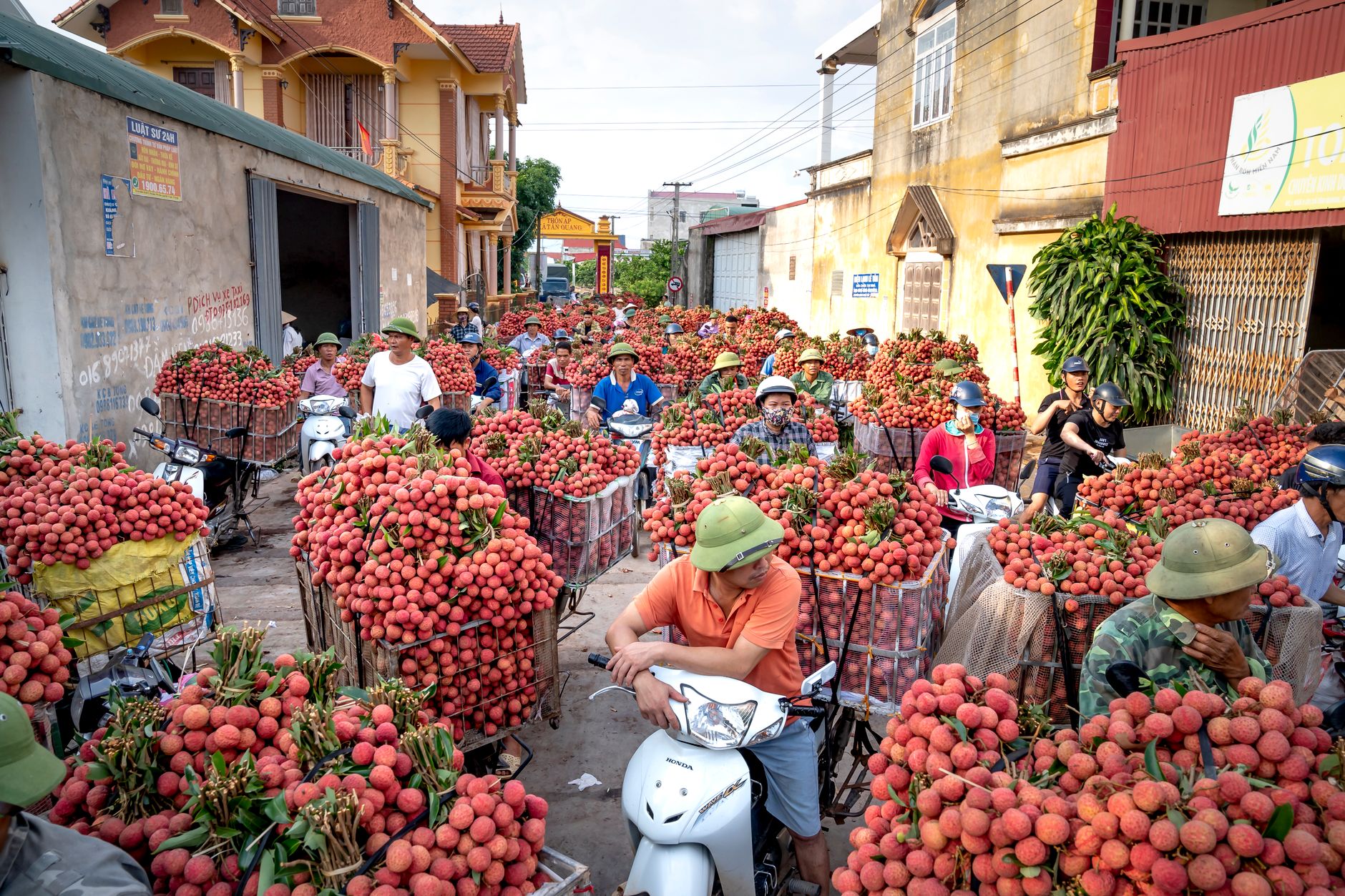
5. Lychee (vải thiều)
Northern Vietnam's most famous fruit. The small red fruits with bumpy skin are a summer obsession. Thanh Ha district in Hai Duong province produces the best.
Taste: Extremely sweet, floral, with a rose-like aroma.
How to eat: Pinch the skin to crack it. Peel off. Eat the white flesh. Spit out the large seed.
Season: May to July. Peak in June.
Price: 20,000 to 50,000 VND per kilo ($0.80 to $2.00) during peak season.
Region: Hai Duong, Bac Giang, and Lang Son provinces in the north.
6. Longan (nhãn)
Small brown fruits that hang in clusters. The flesh is translucent and surrounds a single black seed that looks like an eyeball (hence the name "dragon eye").
Taste: Sweet, honey-like, with a musky undertone.
How to eat: Squeeze the fruit until the flesh pops out. Remove the seed. Or peel and eat.
Season: June to September.
Price: 20,000 to 40,000 VND per kilo ($0.80 to $1.60).
Region: Mekong Delta and northern provinces like Hung Yen.
7. Jackfruit (mít)
The largest tree fruit in the world. A single jackfruit can weigh 40 kilos. The yellow flesh pods are eaten fresh or used in desserts.
Taste: Sweet, tropical, like a mix of banana, pineapple, and mango. The ripe fruit is sticky. The young fruit is used in savory dishes.
How to eat: Buy pre-cut pods from vendors. The fruit is too sticky to handle easily. Avoid the latex sap.
Season: Year-round. Peak from May to August.
Price: 15,000 to 30,000 VND per kilo ($0.60 to $1.20) for whole fruit. 30,000 to 50,000 VND for pre-cut pods.
Region: Mekong Delta and southeastern provinces.
8. Mango (xoài)
Vietnam grows dozens of mango varieties. The green mango (xoài xanh) is eaten with salt and chili. The ripe mango (xoài chín) is eaten as dessert.
Taste: Green mango is sour and crunchy. Ripe mango is sweet, creamy, and aromatic. Cat Chu mango from the Mekong Delta is considered the best.
How to eat: Green mango is peeled, sliced, and dipped in salt, sugar, and chili. Ripe mango is peeled and sliced.
Season: March to June for the best varieties.
Price: 15,000 to 40,000 VND per kilo ($0.60 to $1.60).
Region: Mekong Delta (Cao Lanh, Dong Thap) and southern provinces.
9. Pomelo (bưởi)
A large citrus fruit that looks like a giant grapefruit. The flesh is less bitter and more fragrant than grapefruit.
Taste: Sweet, mild, with a floral aroma. Some varieties are slightly tart.
How to eat: Cut off the top. Score the skin in sections. Peel off the thick pith. Separate the segments and remove the membrane.
Season: August to December.
Price: 20,000 to 50,000 VND per fruit ($0.80 to $2.00).
Region: Ben Tre and Vinh Long in the Mekong Delta. Da Xanh variety is famous.
10. Sapodilla (hồng xiêm or sapôchê)
A brown, egg-shaped fruit with rough skin. Inside is sweet, grainy flesh that tastes like brown sugar and pear.
Taste: Extremely sweet, like caramelized brown sugar. The texture is gritty, like a pear that has been candied.
How to eat: Cut in half. Scoop out the flesh with a spoon. Avoid the black seeds.
Season: September to December.
Price: 20,000 to 40,000 VND per kilo ($0.80 to $1.60).
Region: Mekong Delta and southeastern provinces.
11. Star apple (vú sữa)
A round purple or green fruit. The name means "mother's milk" in Vietnamese because of the milky white flesh.
Taste: Sweet, mild, with a milky texture. Some compare it to a pear soaked in condensed milk.
How to eat: Roll the fruit between your palms to soften it. Cut a hole in the top. Squeeze the flesh into your mouth.
Season: September to December.
Price: 25,000 to 50,000 VND per kilo ($1.00 to $2.00).
Region: Mekong Delta, especially Ben Tre and Tien Giang.
12. Custard apple (mãng cầu or na)
A green, scaly fruit that looks like an oversized pine cone. The flesh is creamy white with black seeds.
Taste: Sweet, creamy, like custard mixed with banana. Some varieties have a hint of pineapple.
How to eat: Break the fruit open with your hands. Eat the flesh directly. Spit out the seeds.
Season: June to November.
Price: 20,000 to 40,000 VND per kilo ($0.80 to $1.60).
Region: Southern provinces and highlands.
13. Soursop (mãng cầu xiêm)
A green, spiky fruit that looks like a large avocado with soft spines. The flesh is white and fibrous.
Taste: Sweet and sour, like a mix of strawberry and pineapple with a creamy texture.
How to eat: Cut in half. Scoop out the flesh. Blend into smoothies or eat fresh. Avoid the seeds.
Season: Year-round. Peak from June to September.
Price: 25,000 to 50,000 VND per kilo ($1.00 to $2.00).
Region: Mekong Delta and southeastern provinces.
14. Passion fruit (chanh dây or lạc tiên)
A purple or yellow wrinkled fruit. The inside is filled with seeds surrounded by aromatic juice.
Taste: Intensely tart and fragrant. The aroma is floral and tropical.
How to eat: Cut in half. Scoop out the seeds and juice. Eat directly or mix with yogurt and sugar.
Season: Year-round. Peak from November to March.
Price: 30,000 to 60,000 VND per kilo ($1.20 to $2.40).
Region: Central highlands (Da Lat) and Mekong Delta.
15. Guava (ổi)
A green, round or pear-shaped fruit with white or pink flesh. The skin is edible.
Taste: Sweet and floral. The flesh is crunchy, similar to a pear. The pink variety is sweeter.
How to eat: Wash thoroughly. Eat like an apple, skin and all. Or slice and dip in salt and chili.
Season: Year-round.
Price: 10,000 to 20,000 VND per kilo ($0.40 to $0.80).
Region: Grown everywhere.
16. Rose apple (mận or roi)
A bell-shaped fruit with thin, waxy skin. The flesh is white, crisp, and hollow in the center.
Taste: Mildly sweet, refreshing, with a rose-like aroma. The texture is similar to a crisp apple.
How to eat: Wash and eat whole. The entire fruit is edible.
Season: May to August.
Price: 15,000 to 30,000 VND per kilo ($0.60 to $1.20).
Region: Mekong Delta and northern provinces.
17. Coconut (dừa)
Not technically a fruit in the culinary sense, but essential to Vietnamese cuisine. Young coconuts are sold everywhere as drinks.
Taste: The water is sweet and refreshing. The young flesh is soft and jelly-like.
How to eat: Vendors chop the top off with a machete. Drink the water through a straw. Scoop out the flesh with a spoon.
Season: Year-round.
Price: 10,000 to 20,000 VND per coconut ($0.40 to $0.80).
Region: Mekong Delta (Ben Tre is the coconut capital) and coastal areas.
18. Sugar apple (na dai or mãng cầu dai)
Similar to custard apple but with firmer flesh. The segments are more distinct and easier to separate.
Taste: Sweet, creamy, with a hint of vanilla. Less watery than custard apple.
How to eat: Break apart with hands. Eat the segments. Spit out seeds.
Season: June to November.
Price: 25,000 to 45,000 VND per kilo ($1.00 to $1.80).
Region: Southern provinces.
19. Water apple (mận hồng đào or điều)
A small, bell-shaped fruit with pink or green skin. The flesh is white and spongy.
Taste: Mildly sweet, watery, with a light floral note. Very refreshing on hot days.
How to eat: Wash and eat whole. The skin is thin and edible.
Season: May to August.
Price: 20,000 to 35,000 VND per kilo ($0.80 to $1.40).
Region: Mekong Delta.
20. Persimmon (hồng)
Two types exist in Vietnam. The crunchy persimmon (hồng giòn) is eaten like an apple. The soft persimmon (hồng chín) is squishy and very sweet.
Taste: Crunchy variety is mild, slightly sweet, and crisp. Soft variety is intensely sweet, like honey.
How to eat: Crunchy persimmon is peeled and sliced. Soft persimmon is eaten with a spoon.
Season: September to December.
Price: 20,000 to 40,000 VND per kilo ($0.80 to $1.60).
Region: Da Lat and the central highlands.
How to buy fruit in Vietnam
Vietnamese markets are chaotic but rewarding. Here is how to navigate them.
Weighing: Fruits are sold by the kilogram (kilo). Always ask "Bao nhiêu một ký?" (How much per kilo?).
Bargaining: Prices at markets are negotiable. Supermarkets have fixed prices. For a guide on negotiating, read Bargaining in Vietnam: Complete Guide to Negotiating Like a Local in 2026.
Ripeness: Vendors will sell you unripe fruit if you do not specify. Say "Chín" (ripe) or "Ăn ngay" (eat now).
Cutting: Most vendors will peel and cut fruit for free. Just ask "Làm ơn gọt giúp" (Please peel for me).
Warning: Never buy pre-cut fruit from street vendors who leave it exposed to sun and flies. Ask them to cut it fresh.
Regional fruit specialties
Different regions grow different fruits. Here is what to look for where.
Northern Vietnam (Hanoi, Sapa, Ha Giang)
The north has cooler winters and distinct seasons. Lychee from Hai Duong is the star. Longan from Hung Yen is excellent. Plums from Sapa and peaches from the highlands appear in summer.
Visit a Bac Ha Market on Sunday morning to see H'Mong farmers selling mountain fruits. The market is one of the best places to try local varieties you will not find in the south.
Central Vietnam (Hue, Da Nang, Hoi An)
Central Vietnam produces excellent dragon fruit, mangoes, and jackfruit. The region is also famous for its seafood, but the fruit selection is more limited than the south.
Southern Vietnam (Ho Chi Minh City, Mekong Delta)
The Mekong Delta is Vietnam's fruit basket. Seventy percent of the country's fruit comes from this region. Can Tho, Ben Tre, and Tien Giang are the key provinces.
The Can Tho Floating Market is the best place to see fruit trading in action. Boats loaded with durian, mango, and pomelo arrive at dawn.
Central Highlands (Da Lat)
Da Lat's cool climate produces temperate fruits that are rare elsewhere in Vietnam. Persimmons, strawberries, avocados, and passion fruit grow here. The Da Lat market is famous for its fresh produce.
Fruit comparison table
| Fruit | Season | Price per kilo (VND) | Sweetness | Ease of eating |
|---|---|---|---|---|
| Durian | May-Aug | 40,000-120,000 | Very sweet | Moderate |
| Dragon fruit | Year-round | 10,000-25,000 | Mild | Easy |
| Mangosteen | May-Aug | 30,000-60,000 | Sweet-tart | Easy |
| Rambutan | May-Oct | 15,000-30,000 | Sweet | Easy |
| Lychee | May-Jul | 20,000-50,000 | Very sweet | Easy |
| Longan | Jun-Sep | 20,000-40,000 | Sweet | Easy |
| Jackfruit | Year-round | 15,000-50,000 | Very sweet | Moderate |
| Mango | Mar-Jun | 15,000-40,000 | Sweet | Easy |
| Pomelo | Aug-Dec | 20,000-50,000 | Mild | Moderate |
| Sapodilla | Sep-Dec | 20,000-40,000 | Very sweet | Easy |
| Star apple | Sep-Dec | 25,000-50,000 | Sweet | Moderate |
| Custard apple | Jun-Nov | 20,000-40,000 | Sweet | Easy |
| Soursop | Year-round | 25,000-50,000 | Sweet-tart | Moderate |
| Passion fruit | Year-round | 30,000-60,000 | Tart | Easy |
| Guava | Year-round | 10,000-20,000 | Sweet | Easy |
| Rose apple | May-Aug | 15,000-30,000 | Mild | Easy |
| Coconut | Year-round | 10,000-20,000 | Sweet | Easy |
| Sugar apple | Jun-Nov | 25,000-45,000 | Sweet | Easy |
| Water apple | May-Aug | 20,000-35,000 | Mild | Easy |
| Persimmon | Sep-Dec | 20,000-40,000 | Sweet | Easy |
Fruit etiquette and safety
Vietnamese fruit culture has some unwritten rules.
Do not touch fruit with dirty hands. Vendors will not appreciate you squeezing their produce. Point to what you want.
Do not eat fruit that looks cut or damaged. Flies carry bacteria. Stick to whole fruit that vendors cut fresh for you.
Wash fruit before eating. Even if the vendor peeled it. Street vendors use tap water that may not be safe. For more on food safety, read What to eat in Vietnam to not get sick: A practical guide for travelers.
Do not eat durian in public transport. It is banned on buses, trains, and planes. Hotels also forbid it. Eat it outdoors or in designated areas.
Do not bargain aggressively for a few thousand dong. Fruit vendors make thin margins. A fair price is better than a hard bargain.
Where to find the best fruit
Markets: Local markets have the best selection and prices. The Can Tho Night Market is excellent for evening fruit shopping.
Supermarkets: Co.opmart, Lotte Mart, and AEON have fixed prices and clean fruit. Selection is less exciting but quality is consistent.
Street vendors: Fruit stalls on motorbikes roam every city. They sell seasonal fruits at low prices. Just check for ripeness.
Fruit gardens: The Mekong Delta has many fruit gardens that offer all-you-can-eat tours. Ben Tre and Tien Giang have the best options.
FAQ
Q: Can I bring fruit out of Vietnam? Most countries restrict fresh fruit imports. Eat it in Vietnam. Do not try to bring it home. Customs will confiscate it.
Q: Is it safe to eat fruit from street vendors? Yes, if the fruit is cut fresh in front of you. Avoid pre-cut fruit that sits in the sun. Wash whole fruit with bottled water before eating.
Q: What is the most expensive fruit in Vietnam? Durian is the most expensive during peak season. Premium varieties can cost 120,000 VND per kilo or more.
Q: What fruit should I avoid as a first-timer? Durian is the most challenging. Jackfruit is easier but very sticky. Start with dragon fruit, mango, and rambutan.
Q: When is the best time to visit Vietnam for fruit? May to August is peak season for most tropical fruits. Lychee, mangosteen, rambutan, and durian all ripen during these months.
Q: Can I find organic fruit in Vietnam? Organic certification is rare. Most small farms use minimal pesticides. Wash all fruit thoroughly. Da Lat has the most reliable organic options.
Q: What is the weirdest fruit in Vietnam? Durian wins for smell. Star apple wins for texture. Custard apple wins for appearance. All are worth trying at least once.