What lẩu is, and how it differs from Chinese, Thai or Japanese hot pot
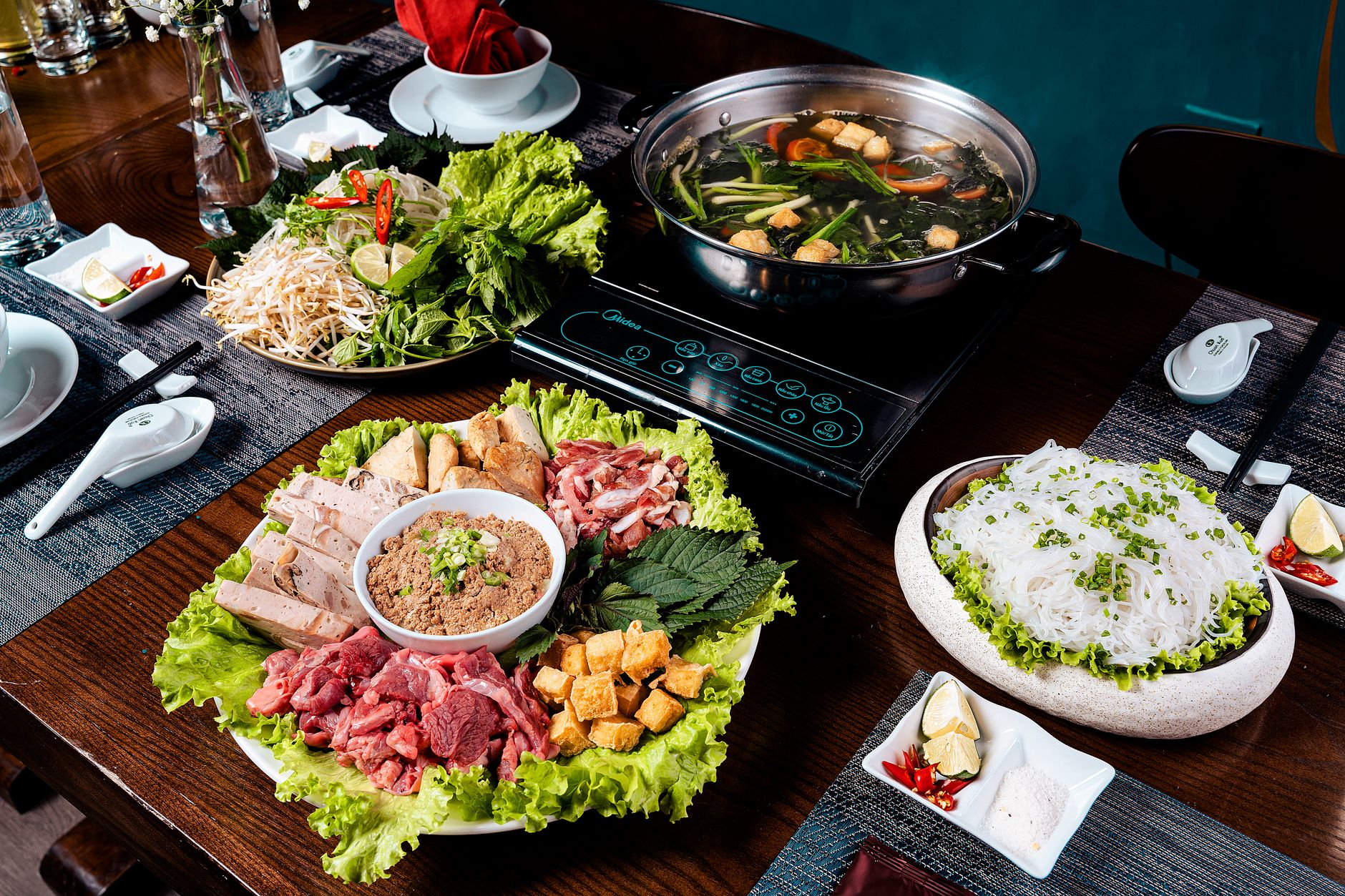
Lẩu is a pot of seasoned broth brought to the boil at the table, surrounded by plates of raw ingredients that diners cook themselves. The word is commonly traced to the Chinese term for a brazier or stove. Hot pot itself is Chinese in origin. Michelin's account places lẩu on Saigon restaurant tables by the 1960s and in everyday Hanoi life by the early 2000s, though Northern families were cooking in charcoal copper pots (lẩu đồng) well before that.
What makes it Vietnamese is the broth and the trimming. Vietnamese broths are lighter and often sour, built on tamarind, sour leaves or fermented fish rather than chili oil. The share of fresh greens and edible flowers is enormous. Each type comes with its own dipping sauce, and noodles go into the broth at the end, when it has taken on everything cooked in it.
The contrasts are worth knowing. Sichuan hot pot is oil-heavy and numbing. Shabu-shabu is clear and usually cooked in individual pots. Lẩu thái is a Vietnamese reading of tom yum, sweeter and milder than the Thai original.
The key point for ordering: in Vietnam, lẩu means a type of broth with a matching set of ingredients, not a build-your-own buffet. Buffet formats exist, but mostly at chains.
How a hot pot meal works: what arrives at the table
The setup
At a street quán, the pot sits on a mini butane stove (bếp ga mini) in the middle of a low table. Chains use induction hobs. In the North you may occasionally see a charcoal copper pot.
Chains often offer a two-compartment "yin-yang" pot (lẩu uyên ương or lẩu hai ngăn), which lets a group split a spicy and a mild broth.
What comes on the plates
The broth arrives already seasoned, and staff bring it to the boil. Then come the plates: a base set of raw proteins (thin-sliced beef, seafood, chicken pieces or fish), a large plate of greens that changes with the type of pot, and noodles. Expect bún (rice vermicelli), mì tôm (instant noodles, very common), mì trứng (egg noodles) or miến (glass noodles).
The rhythm of the meal
- Greens and harder items go in first, since they need time.
- Thin-sliced meat is dipped for 10 to 30 seconds.
- Seafood cooks in 2 to 3 minutes.
- Noodles go in last, when the broth is at its richest.
Staff top up the broth on request, usually free. Say "thêm nước lẩu". Skim the foam off the surface if it builds up.
Dipping sauces
Each type has its own sauce, and the table usually carries the building blocks: salt, black pepper, lime, chili, fish sauce, sometimes MSG. A small dish of salt, chili and lime is often assembled by the diner rather than served. The regional types below each name their sauce.
Pro tip: taste the broth before you add anything. It is already seasoned, and the dipping sauce is where you adjust heat and salt.
The main regional types of lẩu
Hot pot in Vietnam follows geography: sea, forest, river. Coastal towns lean on seafood, the mountains on goat and chicken, the Delta on fish and flowers.
Lẩu thái (Thai-style sour and spicy)
The default student and office party pot, sold everywhere. The broth is built on lemongrass, galangal, kaffir lime, chili satế and tomato. Shrimp, squid, clams, beef, mushrooms and mì tôm are the usual plates. It is the spiciest common type and the cheapest entry point. Ask for "ít cay" if you want it milder.
Lẩu mắm (Mekong Delta fermented fish)
Found in Cần Thơ, Sóc Trăng and Bạc Liêu, and at many Saigon venues. The broth is made from mắm cá linh or mắm cá sặc, fermented fish paste. Pork belly, shrimp, squid, catfish or snakehead go in, along with eggplant and ten or more greens and flowers: bông điên điển, bông súng, kèo nèo, rau đắng, bông so đũa.
This is the strongest-smelling pot of all. It is wonderful and it is not for everyone. The flood season (mùa nước nổi), roughly August to November, is when cá linh and bông điên điển peak.
Lẩu dê (goat hot pot)
Very popular in Saigon, where dedicated goat restaurants serve it as part of a multi-dish meal alongside grilled goat and dê tái chanh. The broth is herbal, often with Chinese medicinal herbs (thuốc bắc). Goat meat, tofu skin (tàu hũ ky) and taro are the main plates. The signature sauce is chao, fermented tofu. The dish is popularly linked to male vigour, which is why you will see it marketed heavily to groups of men.
Lẩu gà lá é (chicken with lá é, Da Lat)
Originally from Phú Yên and made famous in Da Lat. Free-range chicken (gà ta) is simmered with lá é, a peppery minty herb, plus bamboo shoots and mushrooms. The sauce is salt, green chili and lime. You order by half or whole chicken (nửa con or nguyên con). Details on where to eat it are in the Da Lat section below.
Lẩu riêu cua (field crab hot pot, the North)
The archetypal Hanoi cold-weather pot. Pounded freshwater field crab (cua đồng) makes the broth, with tomato. Beef shank (bắp bò), cartilage ribs (sườn sụn), fried tofu, fish cake, banana flower, water spinach, perilla and bún complete the set. Anyone with a crustacean allergy should avoid it entirely.
Lẩu cá kèo (Mekong goby)
A sour broth made with lá giang leaves, with small goby fish. Traditionally the fish are dropped into the pot alive at the table. If that is not for you, ask for the fish to be prepared in the kitchen before it reaches you.
Lẩu nấm (mushroom hot pot)
A mushroom-based broth with anything from ten to twenty varieties, many grown in Lâm Đồng. The Ashima chain is the best-known version, and vegetarian restaurants (quán chay) serve lẩu chay. Mushroom broth is not automatically vegetarian, since it may be built on chicken stock.
Other pots you will see on menus
- lẩu bò: beef
- lẩu hải sản: seafood, best in coastal cities
- lẩu cá đuối: stingray, a Vũng Tàu speciality
- lẩu lươn: eel, Central Vietnam, especially Nghệ An
- lẩu ếch: frog, popular in Hanoi
- lẩu ngan: Muscovy duck, a Northern winter fixture
- lẩu đuôi bò: oxtail
- lẩu cá lăng: catfish, North
Regional lẩu at a glance
| Type | Region | Broth base | Dipping sauce | Spice | Smell | Best season | Street price for 2–4 |
|---|---|---|---|---|---|---|---|
| Lẩu thái | Nationwide | Lemongrass, galangal, chili satế | Chili, lime, fish sauce | High | Moderate | Year-round | 150,000–300,000 VND ($6–12) |
| Lẩu mắm | Mekong Delta, Saigon | Fermented fish (mắm) | Chili, lime, fish sauce | Medium | Very strong | Aug–Nov flood season | 200,000–400,000 VND ($8–15) |
| Lẩu dê | Saigon, South | Herbal, thuốc bắc | Chao (fermented tofu) | Low | Moderate | Cooler months | 250,000–450,000 VND ($10–17) |
| Lẩu gà lá é | Phú Yên, Da Lat | Chicken, lá é herb | Salt, green chili, lime | Low | Mild | Year-round in Da Lat | 250,000–400,000 VND ($10–15) |
| Lẩu riêu cua | Hanoi, North | Field crab, tomato | Fish sauce, lime, chili | Low | Moderate | Nov–Feb | 200,000–350,000 VND ($8–13) |
| Lẩu cá kèo | Mekong Delta | Sour, lá giang leaves | Fish sauce, chili | Medium | Moderate | Year-round | 180,000–350,000 VND ($7–13) |
| Lẩu nấm | Nationwide | Mushroom | Soy, chili, lime | Low | Mild | Year-round | 200,000–400,000 VND ($8–15) |
Prices are for the pot before extras such as beer or additional plates.
Why lẩu is the winter dish of the North
Hanoi's winter, November to February, brings average highs of 17 to 20°C, damp drizzle (mưa phùn) and northeast monsoon cold snaps that can drop below 10°C. Homes are largely unheated and many restaurants open straight onto the street. A boiling pot on the table is not a novelty there, it is central heating.
From about 17:00, quán spill onto the pavements. December and January add year-end company parties (tiệc tất niên), so Friday and Saturday nights fill early. Book ahead or arrive by 18:00.
Tết is the complication. The next Lunar New Year falls on 6 February 2027. Many family-run quán close from a few days before until around the sixth day of the lunar year, roughly 4 to 11 February 2027. Chains in shopping malls usually stay open.
The South eats lẩu all year, especially on rainy-season evenings from May to November. Da Lat's cool nights, often 14 to 16°C, make it a hot pot town in every month. Vegetarian days on the 1st and 15th of each lunar month boost demand for lẩu nấm and lẩu chay.
| Period | Where | What is in season |
|---|---|---|
| November–February | Hanoi and the North | Lẩu riêu cua, lẩu ếch, lẩu ngan, lẩu cá lăng |
| December–January | Nationwide | Year-end parties, book ahead |
| May–November | Saigon and the South | Rainy-evening lẩu thái, seafood pots |
| August–November | Mekong Delta | Lẩu mắm with cá linh and bông điên điển |
| Around Tết (early February 2027) | Nationwide | Many family quán closed, chains open |
How to order lẩu for 2 to 6 people
How menus are structured
Street quán sell by pot size: nồi nhỏ, nồi vừa, nồi lớn. The base pot includes broth, a set of protein and greens. Some places price per person (suất or phần). Extra plates of meat, seafood, greens and noodles are ordered separately. Chains sell à la carte or as buffet sets per person.
Scenarios by group size
- Two people: one small pot, one extra protein plate, noodles included.
- Three to four people: one medium or large pot, two extra plates, extra greens.
- Five to six people: one large pot plus extras, or two different pots, or a yin-yang pot at a chain.
- Solo travellers: many quán will not serve one person. Chains with individual pots or conveyor belts are the practical option, and some quán will sell a small pot at the full two-person price.
How much to order
| Group | Pot size | Extra plates | Noodles | Estimated street bill | Estimated chain bill |
|---|---|---|---|---|---|
| 1 | Small (often refused) | 0–1 | Included | 150,000–250,000 VND ($6–10) | 250,000–450,000 VND ($10–17) |
| 2 | Small | 1 | Included | 200,000–350,000 VND ($8–13) | 500,000–900,000 VND ($19–35) |
| 3–4 | Medium or large | 2 | 1–2 portions | 350,000–600,000 VND ($13–23) | 800,000–1,800,000 VND ($31–69) |
| 5–6 | Large, or two pots | 3–4 | 2–3 portions | 600,000–1,000,000 VND ($23–38) | 1,300,000–2,700,000 VND ($50–104) |
Chain figures assume per-person pricing at 250,000–450,000 VND.
Customising
You can ask for less spice, more broth, different noodles, vegetables only, or no organ meat. Most of this is routine and costs nothing.
Phrases to use
"Cho tôi nồi nhỏ" (a small pot, please). "Ít cay" (a little spicy). "Không cay" (not spicy). "Thêm nước lẩu" (more broth). "Thêm rau" (more greens). "Cho xin muôi" (a ladle, please). "Tính tiền" (the bill, please).
What lẩu costs in Vietnam
Prices below are as of October 2026, converted at roughly 26,000 VND to the dollar and rounded.
- Street quán, small pot for two: 150,000–250,000 VND ($6–10).
- Street quán, medium or large pot for three to four: 250,000–450,000 VND ($10–17).
- Extra meat or seafood plate: 50,000–120,000 VND ($2–5).
- Extra greens: 20,000–30,000 VND ($1).
- Mì tôm or bún: 5,000–15,000 VND (under $1).
- Beer: 15,000–30,000 VND ($1).
- Iced tea: 3,000–5,000 VND.
- Wet towels (khăn lạnh): 2,000–5,000 VND each, usually charged.
Buffet chains such as Kichi-Kichi and Lẩu Phan run about 200,000–450,000 VND ($8–17) per person, with weekday lunch cheaper. Mid-range chains including Manwah, Ashima and Haidilao land at 250,000–600,000 VND ($10–23) per person. Michelin-listed and upscale venues start around 400,000 VND ($15) and climb past 800,000 VND ($31).
| Venue type | Format | Price per person | Payment | VAT and service | Best for |
|---|---|---|---|---|---|
| Street quán | Pot by size | 100,000–200,000 VND ($4–8) | Cash, bank QR | Rarely added | Authentic regional types, atmosphere |
| Buffet chain | All-you-can-eat | 200,000–450,000 VND ($8–17) | Card, cash | VAT sometimes added | Groups, big appetites |
| Mid-range chain | À la carte or set | 250,000–600,000 VND ($10–23) | Card, cash | VAT 8–10%, sometimes 5% service | Solo diners, families, English menus |
| Upscale or Michelin | À la carte | 400,000–800,000+ VND ($15–31+) | Card | VAT and service usually added | Special occasions |
Warning: seafood priced "per kg" or "thời giá" (market price) must be confirmed before it goes in the pot. Ask for the weight and the total.
Chains may add VAT of 8 to 10% and sometimes a 5% service charge. Street quán rarely do either. Pay cash or by bank QR at quán, by card at chains. Tipping is not expected.
Where to eat lẩu in Hanoi
For a sit-down Northern-style pot, Hanoi Garden at 36 Hàng Mành holds a Michelin Selected listing. For street quán, look at the residential streets around the Old Quarter edges, including the Trúc Bạch and Ngũ Xã area, where hot pot places set up pavement tables from late afternoon. The Hanoi specialities to seek out are lẩu riêu cua, lẩu ếch, lẩu ngan and lẩu cá lăng.
Chains cluster in malls: Ashima for mushroom pots, plus Manwah, Kichi-Kichi and Haidilao in Vincom and Aeon centres.
To pick a street quán, look for high table turnover, local families rather than only tourists, and a printed price list on the wall.
Pro tip: addresses in Hanoi use the post-July 2025 ward names, since the district level was abolished and wards merged. Check the current ward before you set off.
Where to eat lẩu in Saigon (Ho Chi Minh City)
Nhà Tú at 129/4 Võ Văn Tần holds a Michelin Bib Gourmand and is known for milk oyster and beef belly hot pot. Confirm the updated ward name before visiting.
Beyond that, Saigon rewards wandering. Dedicated goat restaurants (lẩu dê) are everywhere and usually serve a full goat menu. Mekong-style kitchens turn out lẩu mắm and lẩu cá kèo, and hot pot clusters exist in residential districts such as Phạm Văn Hai in Tân Bình. Lẩu thái is sold in every student neighbourhood.
Saigon is the easiest place to try lẩu mắm without travelling to the Delta. For the original, head to Cần Thơ.
Where to eat lẩu in Da Lat
Da Lat's cool climate makes it a year-round hot pot town, and lẩu gà lá é is the dish to order. Two names come up repeatedly: lẩu gà lá é Tao Ngộ on Ba Tháng Tư street and lẩu bò Ba Toa for beef hot pot. For a wider picture of what to eat in the city, see Da Lat's food scene.
Weekend crowds from Saigon mean queues on Friday and Saturday evenings. Arrive around 17:30. Night market stalls serve small pots, but check prices before sitting down.
Street-side quán vs. chains: which to choose
| Criteria | Street quán | Chain |
|---|---|---|
| Authenticity | High, regional types | Leans Chinese and Taiwanese |
| Price | Low | Medium to high |
| English menu | Rare | Usually |
| Solo-friendly | Rarely | Yes |
| Vegetarian | Ask, uncertain | Clearly labelled |
| Comfort | Plastic stools, smoking nearby | Air conditioning, non-smoking |
| Payment | Cash or QR | Card accepted |
Street quán are best for regional types, low prices and atmosphere. Chains are best for solo diners, first-timers, families with children, vegetarians and anyone who wants air conditioning and card payment. Buffet chains offer good value, but meat quality varies at the cheapest tiers.
Hot pot etiquette and table customs
The eldest or the host usually orders and serves first. Guests wait to be invited to start. Use the communal ladle or serving chopsticks, and ask "cho xin muôi" if there is none. Never stick chopsticks upright in a bowl, as this evokes funeral offerings. Serving others, especially elders, is a polite gesture.
The toast is "một, hai, ba, dzô!" and clinking repeatedly through the meal is normal. Declining alcohol politely is acceptable.
The bill is often paid by one person as a treat (khao) or split. Ask "tính tiền" to get it, and check for items you did not order, including towels and peanuts. It is fine to lower the flame yourself, but ask staff to change the gas canister.
Health, safety and what to avoid
Fire and burns. Mini butane stoves have caused explosions reported in Vietnamese media. Make sure the pot does not overhang the canister compartment, keep the stove away from other heat, and let staff swap canisters. Keep children away from boiling pots on low plastic tables.
Food safety. Cook meat and seafood fully, especially freshwater fish and shellfish. Avoid rượu tiết, raw blood mixed with rice wine, sometimes offered at goat restaurants, because raw blood carries infection risks. Raw greens are a minor risk for sensitive stomachs.
Allergies and diets. Crab paste, shrimp and fermented fish are common hidden allergens. Vegetarians should ask "nước lẩu chay không?" (is the broth vegetarian?).
Ethical and legal issues. Dog (thịt chó) and cat (thịt mèo) hot pots still exist, mainly in the North. Avoid any "thú rừng" (wild animal) hot pot: many involve protected species, are illegal, and carry zoonotic risk. Cá kèo is traditionally cooked alive.
Drink-driving. Vietnam enforces zero alcohol tolerance for all drivers, with heavy fines under the penalty decree in force since 2025. After a beer-heavy hot pot, take a ride-hailing car or bike rather than a rented scooter.
Bills. Confirm prices for seafood sold by weight, and avoid quán in tourist zones with no printed prices.
The smell. Clothes absorb broth and charcoal smoke, especially at lẩu mắm venues. Some chains provide aprons and bag covers. Avoid wearing a jacket you need the next day.
FAQ
Q: Is hot pot Chinese or Vietnamese? A: Hot pot originated in China, and the Vietnamese word lẩu is commonly traced to Chinese. Vietnam localised it with sour, herb-heavy broths, fermented fish bases and region-specific dipping sauces. Lẩu mắm, lẩu riêu cua and lẩu gà lá é have no real Chinese equivalent.
Q: How do you say "hot" and "spicy" in Vietnamese at a hot pot restaurant? A: "Nóng" means hot in temperature and "cay" means spicy, so confusing them leads to surprises. Useful phrases are "không cay" (not spicy), "ít cay" (a little spicy) and "cay nhiều" (very spicy).
Q: Will my clothes smell after eating hot pot? A: Often, yes, especially after lẩu mắm or at venues with charcoal grills alongside. Outdoor sidewalk tables disperse the smell better than closed rooms, and some chains provide aprons and bag covers. Avoid wearing a jacket you need the next day.
Q: How long should meat cook in the hot pot? A: Thin-sliced beef needs 10 to 30 seconds, shrimp and squid 2 to 3 minutes, and fish fillets 2 to 4 minutes. Chicken pieces in lẩu gà are usually simmered by staff, but check that they are cooked through. Freshwater fish and shellfish should always be fully cooked.
Q: Can I eat hot pot alone in Vietnam? A: Many street quán only serve pots for two or more. Solo diners do better at chains with individual pots or conveyor belts. Some quán will sell a small pot to one person at the full two-person price.
Q: Is there vegetarian hot pot in Vietnam? A: Yes. Lẩu nấm and lẩu chay at vegetarian restaurants are widely available, especially on the 1st and 15th of the lunar month. A mushroom broth at a regular restaurant may use chicken stock, so ask "nước lẩu chay không?".
Q: How much should I budget for a hot pot dinner? A: At a street quán, expect about 100,000–150,000 VND ($4–6) per person with a beer when sharing a pot for three or four. Buffet chains cost roughly 200,000–450,000 VND ($8–17) per person, and upscale venues 400,000 VND ($15) and up.
Q: Is it safe to eat hot pot at street stalls? A: Generally yes, because everything is boiled at the table. The main risks are undercooked seafood, raw blood drinks at goat restaurants, and the butane stove itself. Choose busy places with fast turnover and let staff handle gas canisters.

Your questions and tips
A question, an update, an experience to share? Our team reads every message before it is published.
No comments yet. Ask the first question or share a tip!