The short answer: no, you don't have to tip
Vietnamese restaurants do not expect tips. Service charges are rarely included in bills. Tipping is a bonus, not an obligation. This baseline matters because many travelers arrive with habits from countries where tipping pays a portion of staff wages. Vietnam works differently.
Restaurant staff earn a living wage by local standards. The price on the menu covers the cost of your meal and the service. When you finish eating and pay exactly what the bill says, you have done nothing wrong. No one will chase you out the door. No one will passive-aggressively point at a tip jar.
Pro tip: The only time tipping becomes expected is when a service charge is already printed on your bill. Check before adding anything extra.
Why tipping culture is different in Vietnam
Vietnamese hospitality is rooted in genuine service, not tip-motivated performance. The cultural expectation is simple: the restaurant provides good food and attentive service because that is their job, not because they want a bonus.
The economic reality supports this. A bowl of pho at a local shop costs 40,000-60,000 VND ($1.60-$2.40). The owner sets that price knowing exactly what they need to cover costs and pay staff. Tipping is not factored into anyone's budget.
Government officials and locals rarely tip. This is not rudeness. It is a cultural norm that has existed for generations. Younger, wealthier Vietnamese in cities like Ho Chi Minh City and Hanoi have started leaving small tips at upscale restaurants, but this remains uncommon. Understanding this context helps travelers make informed decisions rather than blindly following Western habits.
Warning: Over-tipping can create awkwardness. Staff may feel obligated to refuse, or worse, they may come to expect extra money from all foreign customers. Keep tips modest.
When you might want to tip anyway
Tipping is never required, but specific scenarios make it appropriate. These include:
Exceptional service. The waiter remembered your dietary restrictions, explained every dish, and checked on you without hovering. A tip acknowledges genuine effort.
Large groups. Tables of six or more create extra work. A tip of 5-10% is a fair recognition.
Expensive meals. When your bill exceeds 1,000,000 VND ($40), leaving a small percentage feels natural to many travelers.
Demanding or messy situations. You spilled something. You made special requests. You occupied a table for three hours with one bowl of soup. A tip smooths these situations.
Pro tip: If you feel inclined to tip, do it discreetly. Hand cash directly to the server with both hands, or leave it on the table as you leave. Say "cam on" (thank you) with a smile.
How much to tip at different types of restaurants
The amount depends on the restaurant type. Here is a breakdown with specific numbers.
Street food stalls and bia hoi
No tip expected. Rounding up small change (2,000-5,000 VND, about $0.08-$0.20) is appreciated but unnecessary. These are family operations where the person cooking is often the owner. They set their prices. They do not expect extra.
Local pho shops and family-run restaurants
No tip expected. Leaving 5,000-10,000 VND ($0.20-$0.40) on the table is a kind gesture for good service. This amount is small enough to be gracious without creating awkwardness.
Mid-range restaurants
No tip expected. Leaving 20,000-50,000 VND ($0.80-$2.00) or 5-10% for exceptional service is welcomed. These restaurants often employ younger staff who may be more familiar with international tipping norms.
High-end and fine dining restaurants
No tip expected, but 10% is becoming more common in tourist-oriented fine dining. Always check the bill for a service charge first. Some upscale restaurants add 5-10%. When a service charge is already included, additional tipping is not necessary.
| Restaurant type | Tip expected? | Recommended amount (VND) | Recommended amount (USD) | Notes |
|---|---|---|---|---|
| Street food stalls | No | 0-5,000 | $0-$0.20 | Rounding up is fine |
| Local pho shops | No | 5,000-10,000 | $0.20-$0.40 | Kind gesture, not required |
| Mid-range restaurants | No | 20,000-50,000 | $0.80-$2.00 | 5-10% for exceptional service |
| High-end restaurants | No | 10% of bill | 10% of bill | Check for service charge first |
How to check if service charge is already included
Many travelers accidentally double-tip because they do not notice an included service charge. Here is how to read a Vietnamese restaurant bill.
Look for the phrase "phu phi dich vu." This translates to "service charge." It usually appears near the bottom of the receipt, just above the total. Some restaurants list it as "phi phuc vu" or simply "service charge" in English.
The standard service charge in Vietnam is 5%. Some high-end restaurants charge 10%. A few add both a service charge and VAT (value-added tax, listed as "thue VAT" or "VAT"). When these appear, you have already paid for service.
Pro tip: If you see a service charge and still want to leave something extra, give the server a small cash tip directly. Do not add it to the credit card payment.
How to leave a tip in Vietnam
Cash is preferred. Credit card tips often do not reach staff. Many restaurants have policies where credit card gratuities go to the business, not the server. Handing cash directly ensures the right person receives it.
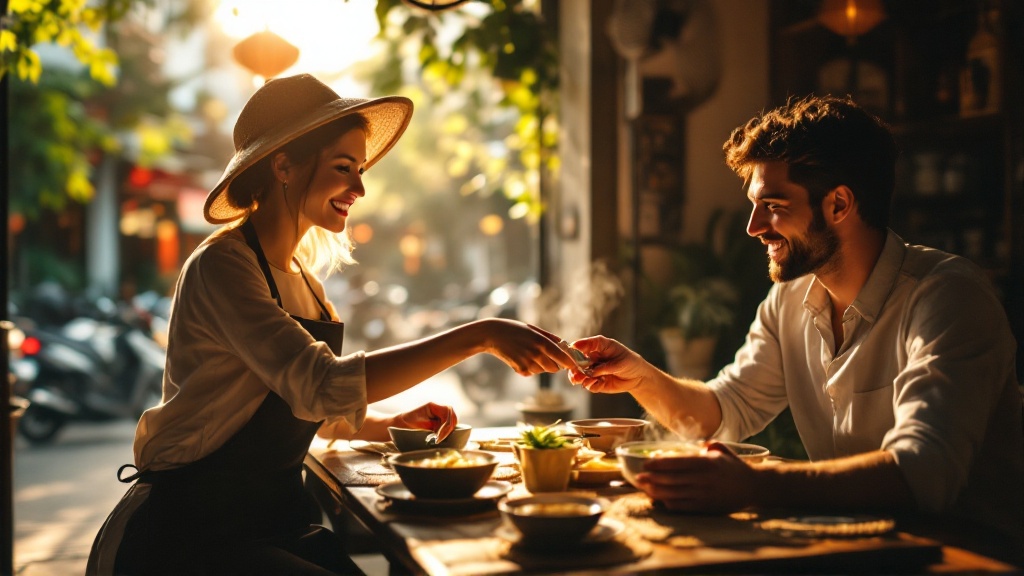
The correct way to hand over money matters. Use both hands when passing cash directly to staff. This is a sign of respect in Vietnamese culture. Alternatively, place the cash on the table rather than handing it over. Avoid tossing money on the counter or using one hand.
Say "cam on" (thank you) with a smile. That is enough. Do not make a big show of tipping. Discretion is appreciated.
Warning: Do not tip in foreign currency. US dollars, euros, or other foreign money is inconvenient for local staff to exchange. Always tip in Vietnamese dong.
Tipping in other common situations
Travelers encounter tipping situations beyond restaurants. Here is what to expect.
Hotel staff
Bellboys: 10,000-20,000 VND ($0.40-$0.80) per bag. Housekeeping: 20,000-50,000 VND ($0.80-$2.00) per day. No tip expected for front desk staff. Leave housekeeping tips in an envelope or on the pillow with a note.
Tour guides and drivers
Group tours: 50,000-100,000 VND ($2-$4) per person per day for guides, half that for drivers. Private tours: 100,000-200,000 VND ($4-$8) per day. These are the most common tipping situations in Vietnam because guides work long hours and often go above expectations.
Spa and salon services
No tip expected. 10% for exceptional service is appreciated. High-end spas in tourist areas may add a service charge. Check the bill.
Public bathroom attendants
Small change: 2,000-5,000 VND ($0.08-$0.20). They will ask. This is not optional. Attendants hand you a tissue or paper towel and expect a small payment. Keep coins handy for this.
| Situation | Tip expected? | Recommended amount (VND) | Recommended amount (USD) |
|---|---|---|---|
| Hotel bellboy | No | 10,000-20,000 per bag | $0.40-$0.80 |
| Hotel housekeeping | No | 20,000-50,000 per day | $0.80-$2.00 |
| Tour guide (group) | No | 50,000-100,000 per day | $2-$4 |
| Tour driver (group) | No | 25,000-50,000 per day | $1-$2 |
| Spa service | No | 10% for exceptional service | 10% |
| Bathroom attendant | Yes | 2,000-5,000 | $0.08-$0.20 |
Common tipping mistakes travelers make
Western tourists commit several predictable errors. Here is what to avoid.
Over-tipping. Leaving 20% or more creates awkwardness. Staff may feel uncomfortable accepting large sums. It also sets unhealthy expectations for future tourists. Keep tips modest.
Tipping in foreign currency. US dollars and euros are not useful to local staff. Exchange rates are poor. Always tip in Vietnamese dong.
Tipping with credit cards. Credit card tips often go to the restaurant, not the server. Cash is the only reliable method.
Leaving tips on tables at street stalls. At street food stalls, the table is shared. Your tip may be taken by the next customer or swept away. Hand cash directly to the cook or owner.
Assuming all restaurants add service charge. Most do not. Check the bill before deciding whether to tip.
Tipping before the meal. Some travelers leave money upfront thinking it ensures good service. In Vietnam, this can confuse staff. Tip after the meal.
Pro tip: Carry a mix of small bills. 10,000 VND, 20,000 VND, and 50,000 VND notes cover most tipping situations.
What locals do: Vietnamese tipping habits
Most Vietnamese locals never tip at restaurants. This is not stinginess. It is cultural normality. When a Vietnamese person receives excellent service at a high-end restaurant, they might leave 20,000-50,000 VND ($0.80-$2.00). That is considered generous.
Younger Vietnamese in their 20s and 30s who work in international companies or have traveled abroad are more likely to tip. But even then, tips rarely exceed 10%. The idea of tipping as a percentage of the bill is foreign to most locals.
At weddings and special events, tipping is more common. Guests might leave 50,000-100,000 VND ($2-$4) for the serving staff. But this is a special occasion gesture, not a daily practice.
How tipping changed after COVID and tourism recovery
The pandemic shifted some norms. When international tourism collapsed in 2020-2021, many restaurants in tourist areas struggled. Some added service charges to compensate for lost revenue. Others trained staff to expect tips from foreign customers.
As tourism recovered through 2022-2025, these changes partially stuck. Restaurants in Ho Chi Minh City's District 1, Hanoi's Old Quarter, and Hoi An's Ancient Town are more likely to have service charges than they were in 2019. Staff in these areas may subtly expect tips from foreign customers.
But the core rule remains: tipping is not required. The changes are subtle, not structural. A 2026 traveler should still feel no pressure to tip.
Pro tip: If a restaurant adds a service charge and the service was poor, you can ask for it to be removed. This is rare but possible.
Regional differences: does tipping vary across Vietnam?
Tipping norms shift slightly depending on where you are.
Hanoi. Conservative tipping culture. Locals rarely tip. Tourist restaurants in the Old Quarter may expect small tips.
Ho Chi Minh City. Slightly more open to tipping. International influence is stronger. High-end restaurants in District 1 and District 2 are accustomed to tips.
Da Nang and Hoi An. Tourist-heavy destinations with higher tipping expectations. Many restaurants serve almost exclusively foreign customers. Service charges are more common here.
Rural areas and small towns. No tipping culture whatsoever. Staff may be confused or embarrassed by tips. A smile and verbal thanks are the best reward.
Mai Chau, Cao Bang, Ha Giang. Homestays and family restaurants in these areas do not expect tips. If you stay at a homestay, leaving a small gift or 50,000-100,000 VND for the family is a kind gesture but never required.
| City/Region | Restaurant tipping norm | Tourist area adjustment | Notes |
|---|---|---|---|
| Hanoi | No tip expected | Small tips in Old Quarter | Conservative culture |
| Ho Chi Minh City | No tip expected | 5-10% at high-end spots | More international influence |
| Da Nang | No tip expected | 5-10% common in tourist areas | Heavy foreign tourist traffic |
| Hoi An | No tip expected | 5-10% expected by some staff | Very tourist-dependent |
| Rural areas | No tip expected | None | Staff may refuse tips |
Final verdict: should you tip or not?
Tips are never required in Vietnam. They are appreciated for exceptional service. The best approach is simple.
Carry small bills in Vietnamese dong. Tip in cash when service genuinely exceeds expectations. Never feel pressured. If you are unsure, do not tip. You will not offend anyone.
Here is a decision framework for any situation:
Ask yourself three questions:
- Was the service exceptional?
- Is this a high-end restaurant?
- Do I have small bills in VND?
If you answered yes to all three, leave 5-10%. If you answered yes to one or two, leave a small amount (10,000-50,000 VND) or nothing. If you answered no to all, pay the bill and leave. That is perfectly fine.
Pro tip: The best tip you can give in Vietnam is genuine appreciation. A smile, a "cam on," and respectful behavior matter more than money.
FAQ
Q: Do you tip at Vietnamese restaurants? A: No, tipping is not expected at Vietnamese restaurants. Vietnamese hospitality is genuine and not tip-dependent. However, leaving a small cash tip for exceptional service is appreciated, especially at higher-end establishments.
Q: Is it offensive to tip in Vietnam? A: No, it is not offensive to tip. Offering extra money for good service is seen as a generous gesture. The key is to tip modestly. Over-tipping can create awkwardness or set uncomfortable expectations.
Q: Do Vietnamese locals tip at restaurants? A: Most Vietnamese locals do not tip at restaurants. Some younger, wealthier Vietnamese in cities like Ho Chi Minh City and Hanoi may leave a small tip at upscale restaurants, but this remains uncommon.
Q: How much should I tip at a restaurant in Vietnam? A: For street food and local restaurants, no tip is needed. For mid-range restaurants, 20,000-50,000 VND ($0.80-$2.00) or 5-10% is generous. For fine dining, 10% is becoming more common. Always check if a service charge is already included.
Q: Is service charge included in Vietnamese restaurants? A: Some mid-range and high-end restaurants add a service charge of 5-10%. Look for "phu phi dich vu" on the bill. When a service charge is included, additional tipping is not necessary.
Q: Should I tip in US dollars or Vietnamese dong? A: Always tip in Vietnamese dong (VND). Foreign currency is inconvenient for local staff to exchange and may not be accepted. Carry small bills for tipping.
Q: Do I tip at street food stalls in Vietnam? A: No, tipping at street food stalls is not expected. Staff at these stalls earn a living wage by local standards. Rounding up a small amount (2,000-5,000 VND) is a kind gesture but completely optional.
Q: What is the correct way to hand a tip in Vietnam? A: Place cash on the table or use both hands when handing it directly to staff. Avoid tossing money on the counter or using one hand. A simple "cam on" (thank you) with a smile is polite.