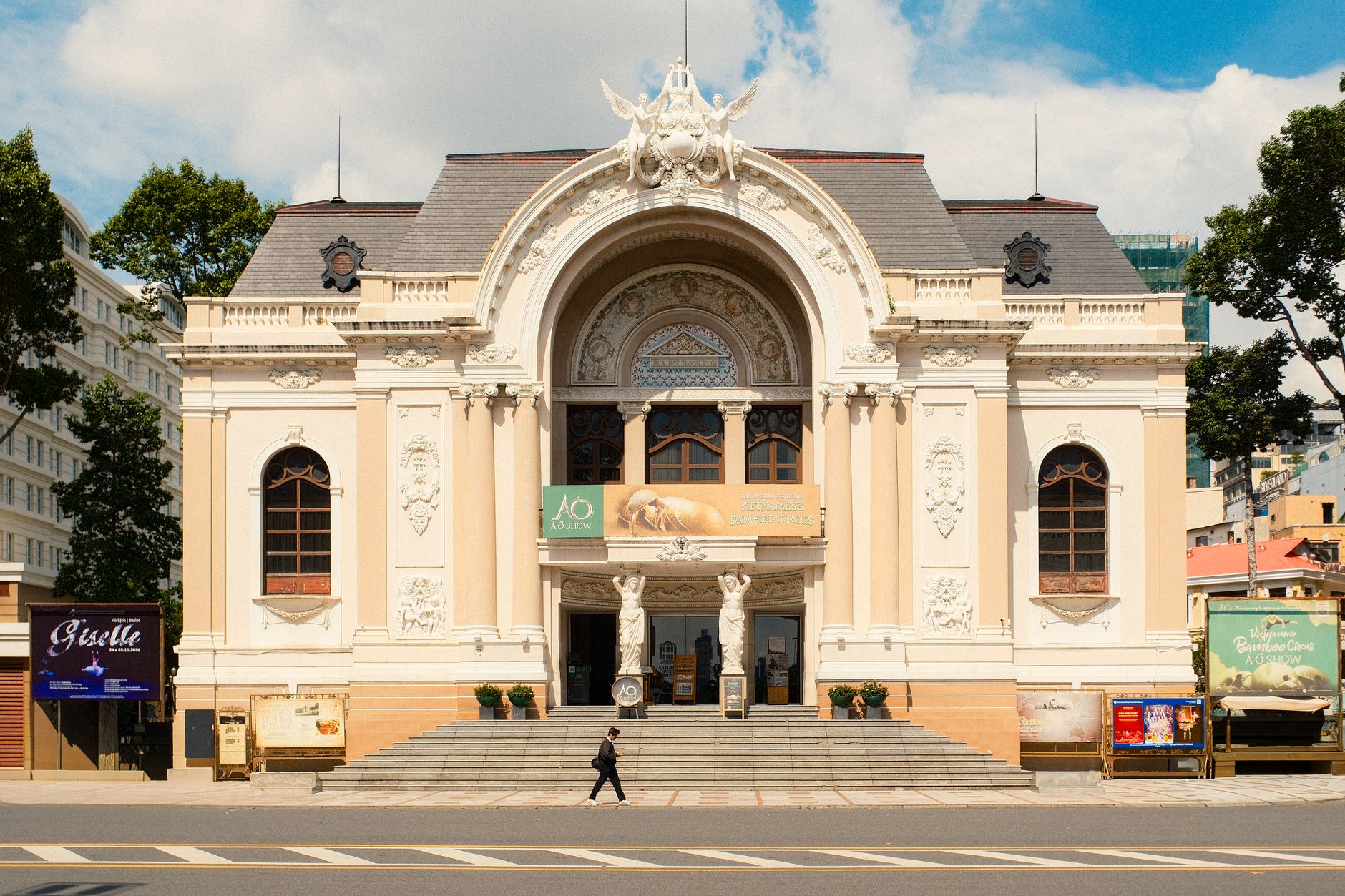
This guide covers what the building is, what you actually see inside and outside, and how to get in. It also answers the question most guides dodge: is a ticket worth it?
Saigon Opera House at a glance
A quick-facts block for skimmers, stated as of October 2026.
| Item | Detail | Status |
|---|---|---|
| Official Vietnamese name | Nhà hát Thành phố Hồ Chí Minh | Confirmed |
| English and French names | Municipal Theatre; Théâtre municipal de Saïgon | Confirmed |
| Address | 7 Công trường Lam Sơn, Phường Sài Gòn | Confirmed |
| Heritage status | National Relic since 2012 | Confirmed |
| Capacity | About 500 seats | Last known |
| Interior access | Performance ticket or organised visit only | Confirmed |
| Exterior access | Free, 24 hours a day | Confirmed |
| Box office | Beside the building, 9:00 to 16:30 | Last known |
The address needs a note. Since the July 2025 administrative reform, District 1 and Ben Nghe ward were merged into Saigon Ward, so official paperwork now reads Phường Sài Gòn rather than Bến Nghé, Quận 1. Locals, taxi drivers and Grab still say "Quận 1", and you should too when giving directions.
Lonely Planet lists the box office number as +84 28 3823 7419. Confirm it still answers before relying on it.
A history in five acts
Sources disagree on the Saigon Opera House's dates, and the disagreements are worth understanding rather than glossing over. Here is the story with the contradictions left visible.
Before the building: theatre in a wooden hall, 1863 to 1898
After the French conquest of Cochinchina, touring troupes performed in a wooden hall near the old Place de l'Horloge, roughly where Nguyen Du meets Dong Khoi today. A temporary theatre later stood on the site of the present Caravelle Hotel.
Saigon's colonial elite wanted a permanent stage. The gap between ambition and building was three decades long.
1898 to 1900: building a Paris-style theatre in the tropics
Construction started in 1898. Many sources quote 1897, which most likely refers to the approval and design phase rather than the first stone. The building was inaugurated on 1 January 1900.
The attribution is genuinely muddled. Eugène Ferret is the name most often cited as designer. Félix Olivier appears in many sources. Ernest Guichard is cited as supervisor. All three probably had a hand in it, and no single document settles the question cleanly.
Materials and decorative elements were shipped from France. The facade is often compared to the Petit Palais, which opened in Paris the same year. The frequently repeated claim of 1,800 seats at opening is rarely sourced, so treat it as reported rather than established. The building today seats about 500.
Decline, war and refugees, 1918 to 1954
Subsidies for touring troupes fell between the wars, and the theatre's programme thinned. In 1943, some facade ornaments and statues were removed in a "modernisation" drive. In 1944, the building was damaged in Allied air raids; the extent is not well documented in accessible sources.
After the 1954 Geneva Accords, the building served as a temporary shelter for French civilians evacuated from the North. A theatre built for operetta became a refugee processing centre.
The parliament years and the square of The Quiet American, 1955 to 1975
The building became the Lower House of the Republic of Vietnam's National Assembly. Sources say 1955 or 1956, so both dates circulate.
Lam Son Square, then called Place Garnier, was the stage for a car bombing in January 1952. Graham Greene fictionalised it in The Quiet American, and his narrator watches the square from the Continental terrace next door. The Caravelle opposite hosted foreign press bureaus during the American war. This layer is entirely missing from most visitor guides, and it is the reason the building matters beyond its architecture.
1975 to today: back to the stage
In 1975 the building was briefly used by the revolutionary government's assembly. It returned to theatre use in 1976.
The 1998 restoration, timed for Saigon's 300th anniversary (the city dates its founding to 1698), reinstated facade sculptures and reliefs. Exterior lighting was added in the 2000s; sources mention funding from the city of Lyon, but that detail should be verified before repeating. Seating was replaced in 2007, and National Relic status came in 2012.
From around 2015 to 2024, Metro Line 1 construction fenced off the square in front, with public debate about vibration risks to the heritage building. Line 1 opened on 22 December 2024, and the square has its open view back.
| Year | Event | Note on source agreement |
|---|---|---|
| 1863 | First wooden theatre near Place de l'Horloge | Broad agreement |
| 1897 | Approval and design phase | Often quoted as construction start |
| 1898 | Construction begins | Most reliable start date |
| 1900 | Inauguration, 1 January | Confirmed |
| 1943 | Facade ornaments removed | Some sources |
| 1944 | Air raid damage | Extent unverified |
| 1954 | Shelter for French evacuees | Some sources |
| 1955 or 1956 | Becomes Lower House | Both dates cited |
| 1976 | Returns to theatre use | Confirmed |
| 1998 | Restoration for 300th anniversary | Confirmed |
| 2012 | National Relic status | Confirmed |
| 2024 | Metro Line 1 opens | Confirmed |
Reading the facade, spot by spot
Walk the building in the order a visitor sees it, and stand where the view works.
Diagonal approach from Le Loi. The best first view, showing the full side elevation and roofline. Come at this angle rather than head-on.
Front steps. The building sits on a raised platform about 2 m above street level, and the double doors were designed to keep out street noise. Stand at the base of the steps and look up.
Central arched portal. The main entrance, with sculpted elements above it. This is where ticket checks happen on show nights.
Upper facade. The restored statues, cartouches and garland reliefs reinstated in 1998. Look for the figures flanking the central bay.
Ironwork and lanterns. Easy to miss. Look at the balustrade and the lamp standards.
Night lighting. Comes on after dusk, roughly 18:00. Confirm the current timing on the day.
Pro tip: the park strip and metro exit in front of the theatre give the cleanest frontal shot. The Caravelle side of Lam Son Square gives the diagonal. The Continental corner on Dong Khoi gives the street-context shot with colonial facades. For an elevated angle, the rooftop bars of the Caravelle and Rex work, but you need to buy a drink.
Inside, room by room
The interior is only accessible with a ticket or a confirmed organised visit. Here is what a ticket buys you architecturally, described in visiting order.
Under the portico. Ticket check, then through the doors.
Foyer. Granite flooring, and the first sense of scale. It is smaller than the facade suggests.
Main staircase. Statues and balustrade. This is the photograph most ticket-holders take.
First-floor foyer and balcony area. Welcome drinks are served here for some AO Show tiers.
The auditorium. Horseshoe or oval in shape, with stalls plus upper levels. The upper rows are shallow, about four rows deep, so sightlines are good but legroom is not.
Ceiling paintings and chandeliers. The decorative centrepiece.
Be honest about what this is. The interior is intimate and less lavish than the facade promises. It is not Palais Garnier scale. On a show night you will not see backstage or the empty hall in daylight.
What's on: shows, concerts and free events
AO Show, the resident show
Produced by Lune Production, the AO Show is the near-nightly headline act. The name À Ố evokes village and town, from làng phố. The content is bamboo, basket boats, acrobatics and live traditional instruments.
It runs about 60 minutes with no intermission and no language barrier. The usual start time is 18:00, with extra or alternative slots on some dates. The schedule changes week to week, so check before booking.
Other Lune Production titles
Teh Dar, with Central Highlands themes, and The Mist (Sương Sớm), about southern rice-farming life, have rotated through the venue. Teh Dar was reported to have moved to the Lune Center in Hoi An in 2026, so it may not be playing in Saigon. Confirm before buying.
HBSO and the classical programme
The Ho Chi Minh City Ballet Symphony Orchestra and Opera stages ballet, symphonic concerts and occasional opera. Actual opera is rare. Anyone expecting an opera night must check the calendar carefully. HBSO tickets are generally cheaper than AO Show tickets and sold per event.
Free events on the steps and the square
Occasional free outdoor performances and festival stages use the steps. National holiday programming appears around 30 April and 2 September. Frequency varies, so treat free events as a bonus rather than a plan.
Tickets and opening hours
All figures here are as of October 2026, with last-known flags where unverified.
Box office. Last published hours are 9:00 to 16:30 daily. One source gives shorter weekend hours, so confirm on the day.
AO Show prices. The last published values, from March 2026, are below.
| Tier | Location in house | Price VND | Approx USD | Approx EUR | Includes | Watch-out |
|---|---|---|---|---|---|---|
| aah | Standard stalls | 800,000 | 31 | 27 | Seat | Rear stalls sightlines |
| ooh | Mid-house | 1,250,000 | 48 | 42 | Seat, often welcome drink | Confirm drink inclusion |
| wow | Premium, front centre | 1,750,000 | 67 | 58 | Best seat, welcome drink | Priciest tier |
Conversions use roughly 26,000 VND per USD and 30,000 VND per EUR. Prices change, so check the producer's site or the box office before going.
Booking channels, compared generically.
- The official producer website: reliable, full price, refund terms stated.
- The box office: same price, card payment accepted, but risk of no seat on the night.
- Online resellers: refund terms vary, and markups happen.
- Hotel concierges: reported 15 to 20 percent markup.
Door rules. Doors close about 10 minutes before curtain, and latecomers are seated in a late-entry area. Arrive early.
Daytime visits. The Viator snippet suggests a 16:00 to 22:30 tour slot programme every 30 minutes, but this could not be confirmed on official channels as of October 2026. Treat standalone heritage tours as not confirmed. Ask at the box office for same-week options.
How long to allow
| Option | Cost | Time needed | What you see | Best for |
|---|---|---|---|---|
| Exterior only | Free | 15 to 30 min | Facade, steps, square | Photographers, walkers |
| AO Show | From 800,000 VND | About 2 hours | Foyer, staircase, auditorium, performance | First-time visitors, families |
| HBSO concert | Varies, usually lower | About 2 hours | Interior plus classical programme | Music lovers |
| Organised tour (if confirmed) | Unknown | Unknown | Interior in daylight | Architecture visitors |
How to get there
Metro Line 1. Opera House station (Ga Nhà hát Thành phố) is under the square, one stop from Ben Thanh. The last known fare is about 7,000 VND (0.27 USD) per ride, with a day pass around 40,000 VND (1.50 USD). One source names Gate 5 as the exit facing the park in front of the theatre, so verify on the station signage. Operating hours are roughly 5:00 to 22:00. The station interior is worth a look in its own right.
On foot. From Ben Thanh Market, about 1.1 km along Le Loi, 15 minutes. From Bui Vien, about 1.8 km, 25 minutes. From Notre Dame Cathedral, about 700 m down Dong Khoi, 10 minutes.
Grab or Xanh SM. Bike and car fares vary by origin. A bike from District 1 is usually under 30,000 VND (1.15 USD); a car from District 3 or the airport costs more. Watch for surge pricing between 17:00 and 19:00, exactly when AO Show audiences arrive.
Metered taxi. Flag-fall and per-km rates vary by company. Use app-booked or major-company cabs, and agree the meter is running before you move.
Bus. Airport bus 109 reaches the Ben Thanh and 23 September Park area, then walk or take one metro stop. City routes stop near Vincom Đồng Khởi and the Park Hyatt.
Parking. There is no dedicated parking at the theatre.
Rules, etiquette and real risks
Dress. Smart casual works for the AO Show, and beachwear does not. HBSO evenings run smarter. Bring a layer, because the air conditioning is cold.
Photography. No photos or video during performances. Exterior photography is free. Drones require permits.
Children. The AO Show suits children from about age 5, last known policy.
Accessibility. Be realistic: the front steps and historic staircases are a barrier. Confirm lift or ramp options with the box office before booking.
Warning: drive-by phone and bag snatching happens on Le Loi and Dong Khoi. Keep phones away from the kerb, and hold bags on the building side.
Scams. The shoe-shine scam and the coconut-vendor scam both operate around the square: a friendly service or a "gift" followed by an inflated demand. Overpriced cyclo rides and unofficial ticket touts are also common. Buy tickets at the box office or the official producer site.
Traffic. Crossing at Le Loi and Dong Khoi requires patience. Walk steadily and predictably.
Weather. Heat is constant. In October and November, late-afternoon downpours and occasional street flooding can hit right before the 18:00 show.
Best time to visit and insider tips
Season. December to April is dry. May to November brings rain, often between 15:00 and 18:00, which can collide with the show.
Light and crowds. Golden hour runs roughly 17:00 to 17:45, and the lights come on after dusk, so one visit gives two sets of photographs. Weekday mornings are the emptiest for facade shots.
What most visitors miss. Pre-wedding photo shoots on the steps are a fixture; be courteous and do not walk through their frame. The view down Dong Khoi, the old rue Catinat, is the city's best colonial streetscape. The Continental's facade sits right beside the theatre and rarely gets a second look.
Crowd dates ahead. Christmas Eve 2026 and the 31 December 2026 countdown on Nguyen Hue bring road closures around the square. Tet falls on 6 February 2027, and shows may pause or change around it. Reunification Day on 30 April 2027 brings celebrations and crowds.
How it compares with nearby and national rivals
| City | Opened | Seats | Style reference | Public tours | Verdict |
|---|---|---|---|---|---|
| Ho Chi Minh City | 1900 | About 500 | Petit Palais | Not confirmed | Most compact, hardest to enter casually |
| Hanoi | 1911 | Larger | Palais Garnier | Has run regular guided tours; verify current status | Grandest, most accessible |
| Haiphong | 1912 | Smaller | French colonial | Limited | Least visited |
The Saigon Central Post Office nearby offers free interior access, which makes it a better architecture visit if you will not buy a ticket. Notre Dame Cathedral is under long-term restoration, so confirm the access situation before walking over.
The conclusion is simple. The Saigon building is the most compact and the most lived-in of the three opera houses, but the hardest to enter casually.
Who will love it, who may be disappointed, and the verdict
Will love it. Architecture photographers. First-time visitors who want one polished evening. Families, since the AO Show has no language barrier. History readers drawn by the parliament years and the Greene connection.
May be disappointed. Anyone expecting opera. Budget travellers, since the AO Show costs more than many day tours. Visitors wanting a museum-style walk-through. Anyone expecting a grand, gilded interior on the Palais Garnier scale.
The verdict. The exterior is a free must on any District 1 walk. A ticket is worth it if you want an evening performance and the atmosphere of a working theatre. A ticket bought purely to see the interior is harder to justify.
Combine it within walking distance
Build a loop rather than a list.
On the square, 0 to 100 m. Hotel Continental, Caravelle Hotel, Park Hyatt.
Nearby, 250 to 400 m. Nguyen Hue walking street and the Ho Chi Minh statue in front of the City Hall, about 300 m, with the Hôtel de Ville interior closed to the public. Rex Hotel, about 250 m. Bach Dang wharf, about 400 m.
Up Dong Khoi. The Central Post Office, Notre Dame Cathedral and Nguyen Van Binh book street.
By metro or short ride. Ben Thanh Market, then the War Remnants Museum or Independence Palace, about 1 km.
| Place | Distance | Walk time | Entry fee | Combine when |
|---|---|---|---|---|
| Continental Hotel | 50 m | 1 min | Free | Any time |
| Nguyen Hue walking street | 300 m | 4 min | Free | Late afternoon |
| Rex Hotel rooftop | 250 m | 3 min | Drink purchase | Sunset |
| Central Post Office | 700 m | 10 min | Free | Morning |
| Ben Thanh Market | 1.1 km | 15 min | Free | Morning |
Pro tip: a three-hour late-afternoon loop works well. Start at Ben Thanh around 15:00, walk Le Loi to the square, photograph the facade at golden hour, then take in the 18:00 AO Show.
FAQ
Q: Can you visit the Saigon Opera House without a ticket? The exterior, steps and square are free at any hour. The interior requires a performance ticket or a confirmed organised visit. Standalone daytime tours could not be confirmed as of October 2026, so ask at the box office, last known hours 9:00 to 16:30, for same-week options.
Q: How much are AO Show tickets? The last published prices, from March 2026, were 800,000, 1,250,000 and 1,750,000 VND (about 31, 48 and 67 USD) for the aah, ooh and wow tiers. Prices change, so check the producer's site or the box office before going.
Q: Is Miss Saigon based on an opera? Yes. The 1989 musical reworks Puccini's Madama Butterfly, moving the story to Saigon in 1975. It is not performed at the Saigon Opera House, and its "Saigon" is a Broadway creation rather than a portrait of this building.
Q: Do Vietnamese people still call Saigon "Saigon"? Yes, widely, in everyday speech, business names and songs, while the official city name remains Ho Chi Minh City. Since July 2025 the central ward containing the Opera House is officially named Saigon Ward, so the name is administrative again at ward level.
Q: What shows are scheduled at the Saigon Opera House? The AO Show is the near-nightly resident show, usually at 18:00. HBSO ballet and symphonic concerts, and occasional opera, rotate through the calendar. Schedules are published week to week. Expect disruptions around 31 December 2026 and Tet on 6 February 2027.
Q: What is the richest city in Vietnam? Ho Chi Minh City has the largest economy in Vietnam, and its 2025 merger with Binh Duong and Ba Ria-Vung Tau made it larger still. The Opera House area is the city's historic commercial core, between Dong Khoi and Nguyen Hue.
Q: Is there a dress code? There is no strict code for the AO Show, and smart casual is fine. HBSO evenings lean smarter. Bring a layer, because the air conditioning is strong.
Q: How do you get there by metro? Take Line 1 to Opera House station, one stop from Ben Thanh. The last known fare is about 7,000 VND (0.27 USD) per ride. Verify the exit gate on the station signage.