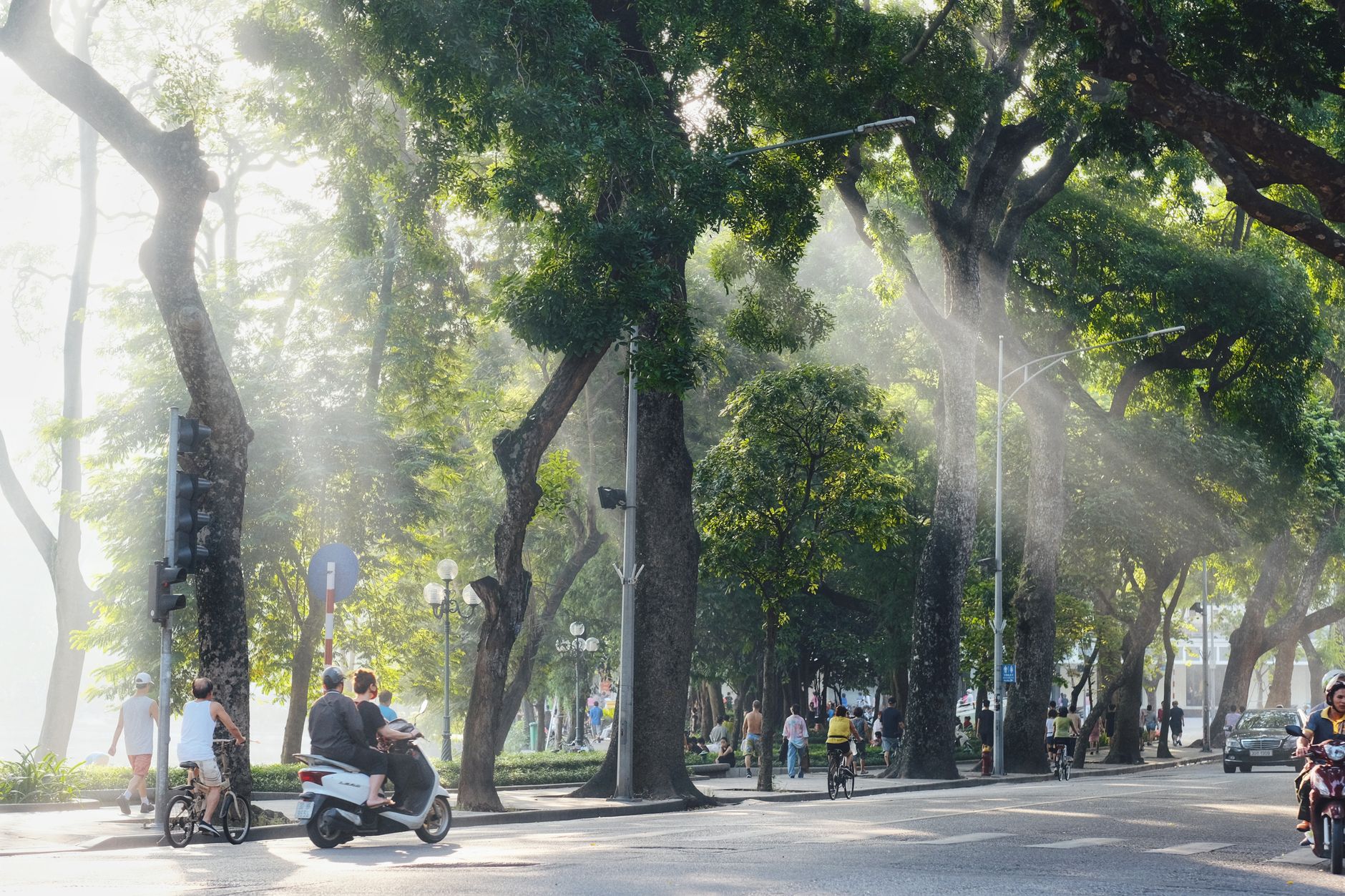
The story of the street
Dong Khoi began life in the 1860s as Rue Catinat, the first paved commercial street of French Cochinchina. For roughly eighty years it was the spine of colonial Saigon: the opera house at one end, the cathedral at the other, and between them the cafés, tailors, pharmacies and hotels where journalists, planters and spies did their business. Graham Greene drank here while gathering material for The Quiet American. The Hotel Continental, still standing at number 132, was the press headquarters during the war.
In 1955 the South Vietnamese government renamed it Tu Do, meaning freedom. That name lasted twenty years. In 1975, weeks after the fall of Saigon, the new authorities renamed it Dong Khoi, meaning "simultaneous uprising", a reference to the 1960 uprising against the Diem government. So the street has carried three names in a century and a half, and each one tells you who was in charge.
The colonial shopfronts were largely demolished in the 1990s and replaced with glass towers and luxury boutiques. What survives is a handful of buildings, the street's proportions, and the tree canopy. That is enough. Dong Khoi today is not a museum piece. It is a working commercial street with a very long memory, and the mix of Vincom Center air-conditioning and shuttered shophouses is precisely what makes it interesting.
Walking the street, spot by spot
The natural route runs from the river inland, uphill to the cathedral. Allow two to three hours on foot, more if you stop for coffee.
Start at the Saigon River end. Bach Dang Wharf is a five-minute walk from the bottom of Dong Khoi. The riverfront here is a landscaped promenade, busy at dawn with exercisers and at dusk with couples. Look back up the street from here: this is the classic view of the boulevard rising toward the cathedral, and the only place you can see the whole thing at once.
The Opera House. Saigon's Municipal Theatre, built in 1898, sits on the corner of Dong Khoi and Le Loi. The facade is a scaled-down copy of the Petit Palais in Paris, all columns and caryatids. It reopened as a performance venue in the late 1990s and hosts ballet, symphony and traditional music. You cannot wander in without a ticket, but the forecourt is one of the best photo spots in the city, especially at night when the facade is lit.
Hotel Continental. Number 132, on the left as you walk uphill. Opened in 1880, it is the oldest hotel in Vietnam still operating. The ground-floor terrace, now a café, is where the foreign press corps worked during the war. Rooms are dated and overpriced for what they are, but the terrace is worth one overpriced coffee for the sense of place.
The boutiques and the towers. Between Le Loi and Mac Thi Buoi the street turns retail. Dong Khoi is Saigon's luxury strip: Louis Vuitton, Chanel, Rolex. If that is not your interest, look up instead. The upper floors of several buildings still have shuttered colonial windows and faded paint, and a few side alleys, particularly around Mac Thi Buoi and Ngo Duc Ke, hide small galleries and tailor shops.
Notre-Dame Cathedral and the Central Post Office. At the top of the street, Dong Khoi meets the cathedral square. The red-brick cathedral, completed in 1880, is the anchor of the whole district. For opening hours, mass times and the current state of its long-running restoration, see the complete guide to Saigon's red-brick landmark. One block east, the Central Post Office is free to enter and still functions as a post office.
Pro tip: walk the street uphill, from the river to the cathedral, in the late afternoon. You get shade from the buildings on your right, the light on the cathedral facade is best around 5pm, and you finish at the two free landmarks just as the tour buses leave.
What sets Dong Khoi apart
Saigon has no shortage of streets worth walking. Nguyen Hue walking street runs parallel, one block southwest, and is car-free, wider and more obviously designed for strolling. Ben Thanh Market is louder, cheaper and more chaotic. Bui Vien is for late nights.
Dong Khoi is the only one of these that carries the full arc of the city's modern history in a single walk, and the only one where you can see colonial, republican and contemporary Saigon layered on top of each other. It is also the only one with a genuine architectural destination at each end. That combination is why it appears on every itinerary, and why it still rewards a slow visit even for people who have been to Saigon before.
Who will love it, and who will not
Dong Khoi suits travellers interested in architecture, history and city life, and anyone who wants a walk that combines all three without needing a guide. It is excellent for a first afternoon in Saigon, when you are jet-lagged and want orientation rather than a museum.
It is less good for bargain hunters, families with small children in the middle of the day, and anyone hoping for a market atmosphere. The street is expensive by Vietnamese standards, the traffic on the crossings is relentless, and there is very little shade between 11am and 3pm. If your idea of a good time in Saigon is a plastic stool and a bowl of noodles for 40,000 VND (US$1.60), Dong Khoi will feel like a shopping mall with a history plaque.
Practical information
Getting there. From the backpacker area around Pham Ngu Lao, a Grab car to the cathedral end costs roughly 40,000 to 70,000 VND (US$1.60 to US$2.80) and takes 10 to 20 minutes depending on traffic. A Grab bike is half that. Metered taxis from Mai Linh or Vinasun charge similar fares; see the guide to taxis in Vietnam for how to spot a rigged meter. From Tan Son Nhat airport, expect 150,000 to 250,000 VND (US$6 to US$10) by Grab car; the full breakdown is in the airport to District 1 transport guide. Saigon Metro Line 1 has a station at Ben Thanh, a 10-minute walk from the bottom of Dong Khoi.
Costs. Walking the street is free. There is no entrance fee and no gate. The Opera House is free to look at, ticketed for performances, typically 300,000 to 800,000 VND (US$12 to US$32). Coffee on the Hotel Continental terrace runs 90,000 to 150,000 VND (US$3.60 to US$6). A mid-range dinner on or near the street is 300,000 to 700,000 VND (US$12 to US$28) per person.
Opening hours. The street never closes. Shops generally open 9am to 10pm. The cathedral and post office keep separate hours, roughly 8am to 11am and 2pm to 4pm on weekdays for the post office, with the cathedral open around mass times only during restoration. Always check before making a special trip.
Dress and etiquette. No dress code on the street. If you enter the cathedral or the post office, cover shoulders and knees. Photography is fine everywhere outdoors; be discreet inside the cathedral during mass and do not use flash. Do not photograph police or military installations.
| Landmark | Cost | Time needed | Best hour |
|---|---|---|---|
| Bach Dang Wharf | Free | 20 min | Sunrise or sunset |
| Saigon Opera House | Free outside | 15 min | After dark |
| Hotel Continental terrace | Coffee from 90,000 VND | 45 min | Mid-morning |
| Central Post Office | Free | 30 min | 8am to 10am |
| Notre-Dame Cathedral | Free outside | 20 min | Late afternoon |
How long to allow. Two hours for a brisk walk with photos. Half a day if you add coffee, the post office and the cathedral square. The street pairs naturally with a morning at the Independence Palace, which is a five-minute walk from the cathedral end.
When to go and how to avoid the crowds
Saigon is hot year-round, but the dry season from December to April is the most comfortable stretch for walking. May to November brings afternoon downpours, usually short and heavy. If you are planning around the monsoon, the rainy season guide explains how to structure days. For a wider view of the city's climate, see when to visit Ho Chi Minh City.
The street is busiest between 9am and 11am, when tour groups work through the cathedral and post office, and again from 5pm when locals come out to shop. The quietest windows are 6am to 8am, when the street belongs to delivery drivers and people doing tai chi by the river, and after 9pm, when the shops close and the facades light up.
Warning: crossing Dong Khoi is not like crossing at home. Traffic does not stop for pedestrians. Walk at a steady, predictable pace and let the motorbikes flow around you. The full technique is explained in the street crossing guide.
What most visitors miss
Almost everyone walks Dong Khoi and never turns off it. Three detours are worth the five minutes each.
The Saigon Central Mosque on Dong Du, one block east of the cathedral, is a small, quiet Indian-Muslim mosque built in the 1930s and still in use. Non-Muslim visitors can look from the entrance outside prayer times.
Lam Son Square, in front of the Opera House, hosts free outdoor performances and events, particularly around Tet and the Reunification Day holiday on 30 April. Check local listings during your dates.
The upper-floor cafés in the older buildings on the cathedral end of the street. Several have rooftop or balcony seating looking straight down the boulevard. They cost more than street level and are worth it once, at dusk.
The verdict
Dong Khoi is worth two hours of anyone's first visit to Ho Chi Minh City, and worth a repeat walk on any return. It is not a hidden gem and it does not pretend to be. It is the most historically dense street in the country, it is free, it is central, and it connects three of the city's best landmarks in a single kilometre. Go early or go late, skip the boutiques, look up at the buildings, and finish at the cathedral.
FAQ
Q: Is Dong Khoi Street free to visit? Yes. There is no entrance fee and no gate. You only pay for what you buy, whether that is coffee, shopping or a performance at the Opera House.
Q: How long does it take to walk Dong Khoi Street? The street itself is about 1 km and takes 15 minutes at a normal pace. Allow two hours to see the landmarks properly, or half a day with stops.
Q: What is the best time of day to visit Dong Khoi? Early morning, 6am to 8am, for cool air and empty pavements, or after 8pm for lit facades and fewer tour groups. Avoid 9am to 11am.
Q: How do I get to Dong Khoi Street from the airport? Take a Grab car from Tan Son Nhat, roughly 150,000 to 250,000 VND (US$6 to US$10), or bus 109 to District 1 and walk. Journey time is 30 to 50 minutes depending on traffic.
Q: Is Dong Khoi the same as Nguyen Hue walking street? No. They run parallel, one block apart. Nguyen Hue is pedestrianised and wide; Dong Khoi carries traffic and has the historic buildings.
Q: What should I wear on Dong Khoi Street? Anything comfortable. If you plan to enter the cathedral or the post office, cover shoulders and knees as a courtesy.
Q: Can I visit Dong Khoi during Tet? Yes, but expect many shops and restaurants to close for three to five days around Lunar New Year. The street itself stays open and is decorated. See the Tet travel guide for what closes and when.